
According to official Canadian statistics, 1.03 trillion Canadian dollars worth of goods were traded with the United States last year. This figure marks the lowest level since 2021, the year of the post-Covid rebound, after trade had collapsed by 13.4% in 2020.
Trade volume is rising this year, but the increase hides a pace that is much weaker than that observed with the rest of the world.
- Compared with Ottawa’s other trading partners, Canadian trade with the United States is relatively stagnant.
- Indeed, it rose by 6.2% over the January-to-August period, adding 43 billion Canadian dollars versus a year ago, but growth with the rest of the world reached 19.7%.
- Trade with the European Union also jumped 14.4% over the same period.
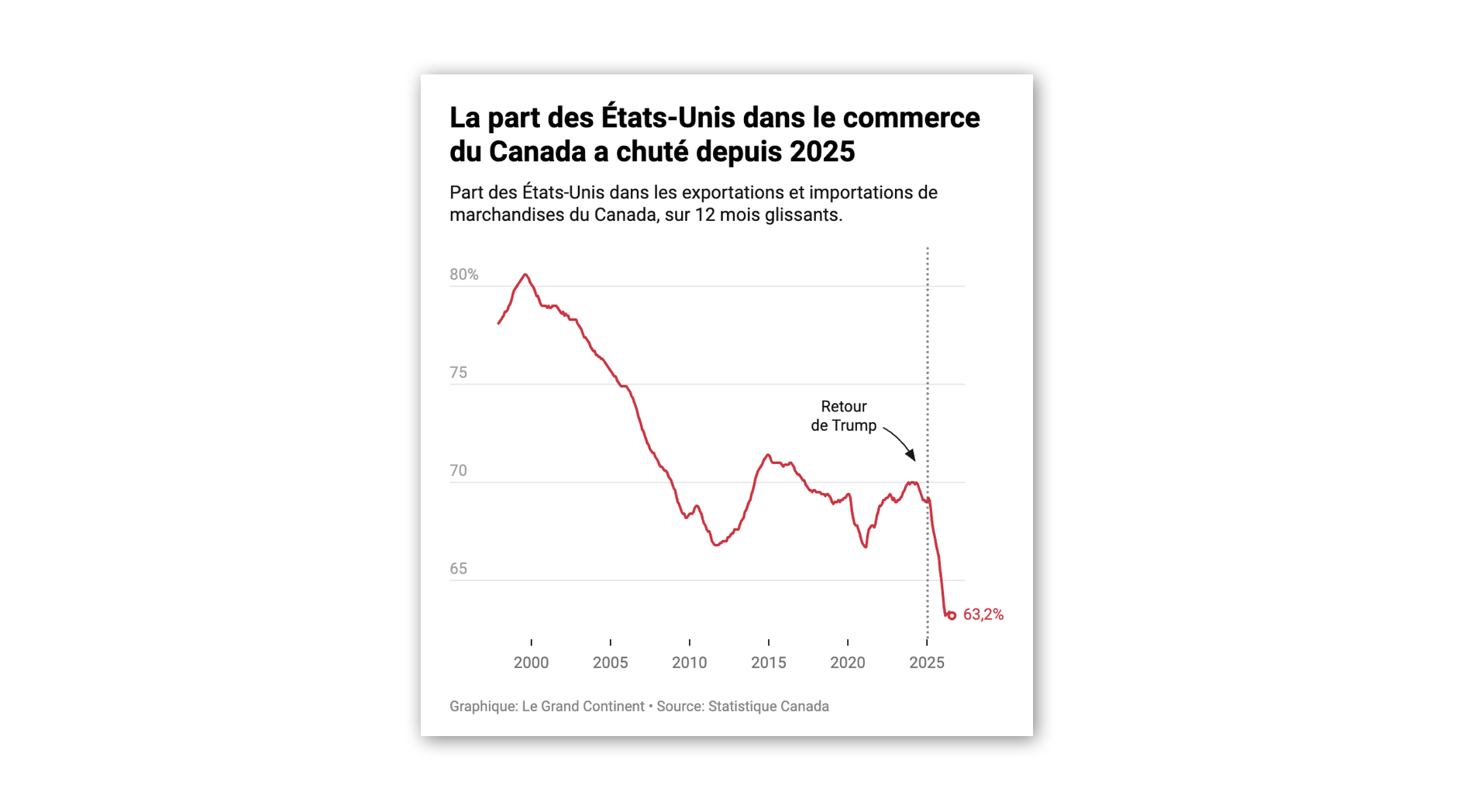
Directly as a consequence of the aggressive trade policy of the Trump administration, which repeatedly threatened to annex Canada and imposed hefty tariffs on goods from the country, the United States’ share in Canada’s foreign trade has fallen since 2025.
The United States now accounts for only 63% of Canada’s combined exports and imports over the past twelve months, versus 69% in 2024.
- This decline is not merely cyclical: by the end of September, Canada’s Transport Minister, Steven MacKinnon, explained that the government was guided by “the imperative to diversify [its] markets abroad, to diversify by moving away from the United States.”
- The government of Mark Carney has thus unveiled a sweeping bill designed to develop its trade with Europe and Asia, notably through the removal of administrative formalities to speed up the construction of new transport infrastructures, such as “national trade corridors” toward Pacific ports and the St. Lawrence Seaway.
This development could notably be advanced through a strengthening of exchanges with the Union.
- According to a draft joint declaration for the EU–Canada summit opening today, Thursday, October 29, in Montreal, Ottawa and Brussels plan to strengthen ties between Canadian and European ports to support the diversification of trade
- The document notably mentions corridors for critical raw materials and energy, the launch of dialogues on transport and the Arctic, as well as a feasibility study on Canadian LNG exports to Europe.
The “decoupling” of Canada from the American economy also involves a substantial rise in exports to China: +52% in the first eight months of the year compared with the same period in 2024. Mark Carney has thus already covered nearly half the way toward the 2025 target of doubling exports to non-U.S. markets over the next decade.