

Our definition of nature does not correspond to that of the Greeks and the Romans. Of “ beef month ” has “ Forest lady “, The ancients did not think of separating men from their animal or vegetable environment.
There “ nature Is one of those concepts that we handle without questioning the vision of the world he proceeds. The word seems obvious, simple, immutable, natural. However, like any concept, it is the fruit of a story, a language, a culture that patiently built it.
In 2005, the anthropologist – now a professor at the Collège de France – Philippe Descola published Beyond nature and culturean ethno-anthropological and philosophical reflection nourished by his experience with Amazon’s Achuars. He concluded that the western and modern dimension of our notion of nature and what it implies there: a radical cut between man and what characterizes him (culture, society, art) and mineral, plant and animal kingdoms.
Founded in a great whole, this nature is therefore thought of as radically other, whether it is to protect itself, dominate it or preserve it. Historians, anthropologists and environmental philosophers – concepts useful for taking the necessary distance with that of “ nature – – since then, to question the origins, the contours, the foundations and the limits.
Stars and plants
It is in this vein that the work directed by Maria Cecilia d’Ercole, Silvia d’Inino and Florence Ghercharoc and co-written by nineteen other researchers from the Anhima Center (Anthropology and History of the Ancient Worlds). Mainly specialists in Greek and Roman civilizations, they question the concept at its source, at a time when it has not yet taken its current meaning: Antiquity. They thus participate in the development of environmental history, only a few decades old, and even younger when applied to ancient history.
This collective work is not intended to be a synthesis of past research or upcoming research program. It is rather an overview – Kaleidoscope way – what environmental history can produce reflections on the relationships of ancients to what we call nature, and on the questions they thus refer us. Despite the direct etymological link, the modern definition of nature does not correspond to what the Romans called Natura and the Greeks phusis (φύσις).
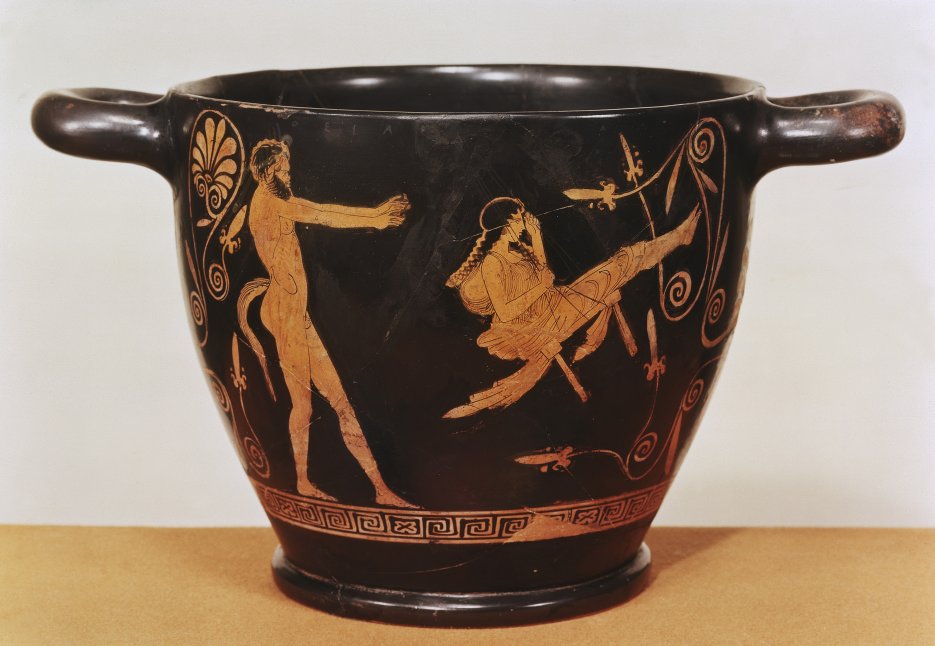
Skyphos Attic with red figures attributed to the painting of Pénélope, 440-430 BC
This last term appears for the first time in theOdysseywhen Hermès gives Ulysses a plant that protects him from Corcé spells and from which he reveals the phusisprotective properties. There “ nature Ancients are initially that of things and, above all, that of plants: their inherent ability to grow and deploy their characteristics.
Then took place a shift in meaning. At Vie century BC, Empedocles, Parmenides and Heraclitus, the pre -Socratic philosophers who are interested in the origins of the world and its functioning (we would say to its “ physical ) Apply this term to the stars and elements of which they study growth and properties. Their contemporaries Thales, Pythagoras and Anaximandre add the idea of a global system in which are born, grow and decrease these elements. In his treaty Nature (Peri phlusos), Anaximandre explains that certain elements have formed from others. Aristotle will only take the process of systematization of nature, by seeing it as a tangle of multiple causalities: any natural phenomenon can be explained by the properties inherent in the elements that compose it.
Society, Politics and Religion
But Greeks and Romans do not push the reasoning to the point of cutting themselves from this nature that has become domain. At Ve A century BC, the first Greek doctors spin the vegetable metaphor by applying it to the human body and, first of all, to its growth in the maternal belly. Worried about the effects of the climate on the human body, they also believe in its action on customs and even on political institutions. The historian Thucydides, who tells the war of the Peloponnese, sketches the idea of a “ human nature »Conditioning the behaviors he describes. Nature and humans are gradually put in place, but according to a distinction which is more of continuity than dichotomy.
There “ nature Ancients are not more opposed to what we consider today as its opposites: society, politics, culture, institutions, etc. For Cicero and the Stoics, justice did not first proceed from the law written by men to order society. She was an ideal “ natural », Innate and prior to civilization, to which human law had to comply, but which it sometimes exceeded, for example by legalizing slavery. Ancient lawyers like Marcien (IIIe century of our era) deduced by this same natural right that, for everyone, to exploit nature. Even the epicurean Lucrèce, author of the treaty Nature (Natura rerum), did not oppose its reflections on nature to those on society. THE “ things “(rerum) in which he was interested was an etymologically of these same realities in which philosophers, historians and mythographers were interested. Human sciences and natural sciences seemed inseparable.
On the religious level, the Christianization of the Empire initiates another dichotomy than ours, as illustrated by one of the controversies between Christians and polytheists. In 384, the bishop of Milan, Ambroise, replied the symmaque polytheist, who accused the abandonment of traditional cults of having caused droughts and famines. The Christian affirmed that nature had certainly been created by God, but that he had ceased to intervene and that the imperfections of the world were only the consequence of original sin. Nature separated from God, but not from man.
THE “ beef month »»
This idea of continuity between man and nature was also expressed in speeches and arts of antiquity. The olive tree, an emblematic tree of Athens, was symbolically merged with the city and its inhabitants. Having become their emblem on the coins of the city or on the shields of his defenders, he inspired the myth of the hero Erichthonios, himself born from the earth in the image of a tree, and ancestor of all the Athenians. The Greeks of Béotie held a similar speech around the beef, pivot of their agriculture and omnipresent on their shields, in the names they gave to their children and even in their calendar and its “ beef month ».
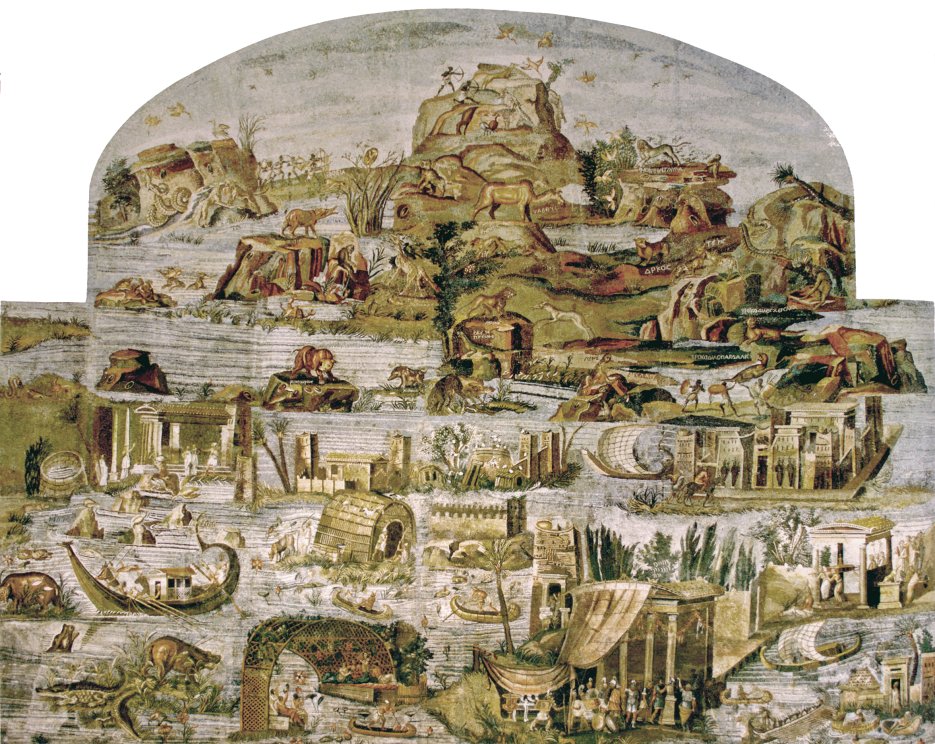
Roman mosaic of Pavement, 1er century BCE, nymphusiast of the Préneste sanctuary, Italy
In the artistic field, separating man from nature seems almost impossible, as in the scenes painted by the Romans in the beginnings of our era, and whose dozens of examples have been preserved by the eruption of Vesuvius. Shepherds, animals, heroes, gods, ruins, trees and mountains mingle in these ideal and timeless representations. On the Greek vases, plant patterns are not content to delimit the paint spaces: they mean a space in a simplified manner (a tree for the forest) and place the action in nature.
The ovid poet, according to whom the luxury of his time was not so bad thing, did not oppose art and nature, but considered that the first came to exalt the second by sublimating his fruits, whether it is a prepared dish or a primed woman. Even the Greek children, who played with pebbles, nuts or bones (and sometimes had fun singing the rites of adults by sacrificing apples), cheerfully crossed our categories.
The interactions of the ancients with nature
The daily interactions of the ancients with nature constituted another form of discourse, implicit, but just as revealing. The environment of ancient societies obliged them to constant adaptation, like the coasts of the Latium, swampmakers, inhospitables and which imposed adaptations: seasonal transhumance, planting of vines on the slopes, raising of roads, drainage work, etc. The Atlantic Ocean and its tides were the object of an evolution of discourse and practices. General Roman Scipio-Emilian greeted the boost given by Neptune to his fleet, when Julius Caesar, a century later, delayed his assault to benefit from a more favorable tide.
The ancients also sought to adapt their environment, from the attempted piercing of the future Corinth Canal until the transformation of the Syracuse peninsula into island. Failures, divine reprobations and all Greek distrust of the “ excess “(hubris) which men were thus guilty of it changed anything.
The consumption of animal meat and its two corollaries that were hunting and breeding forced Greeks and Roman to question the relationship of man to animal. Despite some discordant voices denouncing (already) animal suffering and the moral risk inherent in violence, philosophers like Plato, Xenophon or the Pollux rhetorician theorized a primordial war between wild beasts and first men. Unable to defend themselves alone, the latter went superior to the animals by their social, political and civic organization, therefore based on the law of the victors to dispose of (animals) defeated and inferiorized, but integrated into the history of human wars.
Towards reconciliation ?
The nature of the ancients is therefore not so different from ours in terms of perimeter. On the other hand, it is in terms of her relationships with man. To our modern separation, the ancients preferred a protean continuity, but omnipresent. Even the few chronological or geographical side steps proposed by the work confirm.
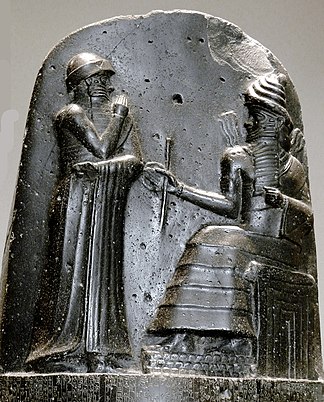
Summit bas-relief of the Hammurabi code, black basalt stele, C. 1750 BC
In the Ṛgvedafounding text of Hinduism, “ Forest lady Is not only the antithesis of the village and the civilized world. It is also the generous and fragrant land that welcomes the ascetic and allows its initiation. In ancient Mesopotamia, where the city, the cultivated countryside and the desert was distinguished, the solar god Šamaš, God of politics, fertilizer of the soils and master of the burning desert, traversed and linked these three spaces. And when in the 1930s Christian Zevros founded the review Notebookshe claimed that the Greek art of yesterday as today owed its remarkable beauty and its unity to Greek nature, as beautiful as it can be immune.
Western societies today rediscover their links with a nature of which they have thought of being able to abstract, by technology and by the very definition of this concept. The popularization of the term “ environment », Less dichotomous, testifies to this. Despite the chronological, cultural and technological distance that separates us, the example of ancient societies can contribute to this rediscovery. Perhaps even to this reconciliation, between man and what the ancients have never thought as fundamentally separated from him.