
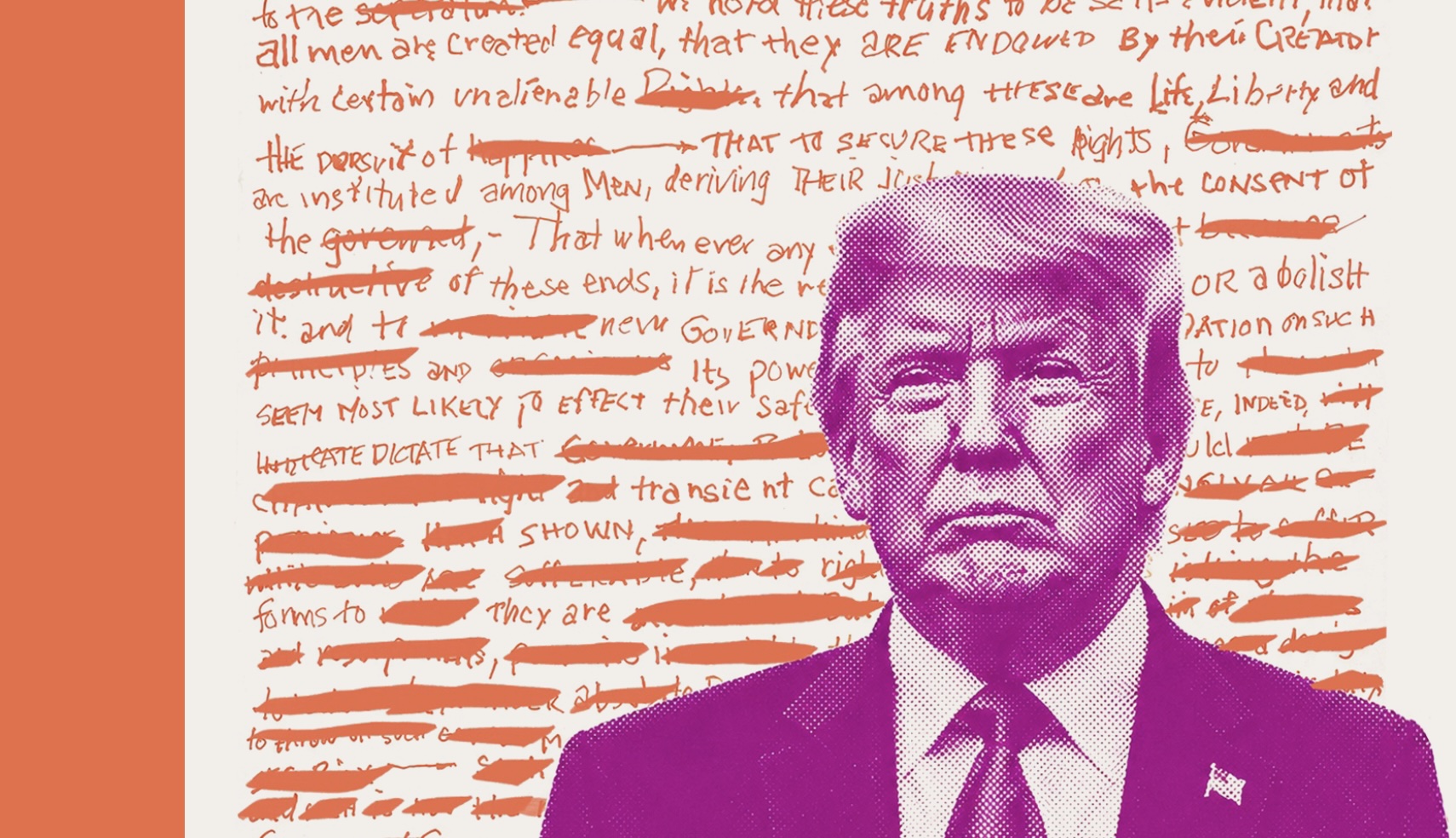
From the start of his third presidential campaign in December 2022, just after announcing his candidacy, Donald Trump made freedom of expression an existential fight for the country. In a video published on YouTube and shared on his campaign site, he declared: “If we don’t have free speech, then we just don’t have a free country.” He immediately added his intention to “destroy the left’s censorship apparatus.” In 2023 and 2024, this emphasis on free speech continued, strengthening with every new lawsuit announced against him, and was echoed across the entire MAGA media landscape and, in particular, by his leading influencers, several of whom are today members of the administration or accredited with press services covering the various agencies.
Upon returning to the White House, the push to “restore freedom of expression” by “protecting the First Amendment” became the subject of an executive order whose premises were false, as it accused the Biden administration of carrying out broad censorship. Since then, the notion of “freedom of expression” has been weaponized by the Trump II administration to pursue the president’s political “enemies,” especially officials from the previous administration who had worked on countering foreign-origin disinformation, as well as several figures linked to his legal indictments.
On an international scale, this notion has been used as a pretext to attack European regulations targeting tech companies, as well as the laws of several countries, particularly regarding hate speech. It has also been brandished as a coercive instrument against Europe, especially during trade negotiations.
The publication on December 5, 2025 of the Trump administration’s National Security Strategy made the instrumentalization of freedom of expression against Europe even more explicit: safeguarding American citizens’ “freedom of expression” is defined as a “fundamental principle” to guide U.S. foreign policy, and the document assigns to the Union the practice of this so-called censorship. The inclusion of these notions and their repetition in the main American strategic document marks a profound break that gives strategic dimension to the cultural battle and confirms the centrality of the notion of freedom of expression in the transatlantic relationship.
Yet the meaning and scope of “freedom of expression” and the First Amendment have undergone significant evolutions in American history. The definition of the reach and limits of this freedom, as well as press freedom, has varied with changing majorities and Supreme Court decisions. More importantly, the conservative camp has recently made it a political battleground in connection with Trump’s return to power in January 2025. In his first year in office, the notion appears to have been redefined under the influence of the assassination of influencer Charlie Kirk.
Freedom of expression is thus doubly in question: redefined within the United States, it becomes also a tool for projecting the American model internationally, directed first and foremost against Europe. This dual movement makes a historical review of this notion in the United States essential.
The Long History of Freedom of Expression in the United States
The American Constitution and Freedom of Expression
The concept of freedom of expression inscribed in the American Constitution draws its roots from English legal tradition, the foundations of political liberalism according to John Locke (Second Treatise of Government), and the Enlightenment philosophy. John Milton’s pamphlets, notably Areopagitica (1644), argued for freedom of the press against censorship, contending that the free exchange of ideas laid the groundwork for truth and knowledge. This philosophy nourished the debates of the American Founding Fathers at the end of the eighteenth century.
The freedom of expression is thus doubly in question: redefined within the United States, it becomes also a tool for projecting the American model internationally, directed first and foremost against Europe.
Maya Kandel
Thus, during the Constitutional debates (1787–1789), some state representatives voiced reservations about the absence of explicit guarantees for individual rights. The purpose of the amendments to the Constitution (the Bill of Rights) is to safeguard individual rights against the powers of the three branches defined by the Constitution. The ratification of the Bill of Rights in 1791, and in particular the First Amendment, was a response to these concerns: “Congress shall make no law… abridging the freedom of speech, or of the press…” This formulation does not specify the contours of freedom of expression, leaving the interpretation to the judiciary.
In the political context of the time, marked by the federalist–anti-federalist divide, there was no absolute definition of this freedom. The Alien and Sedition Acts of 1798, enacted under President John Adams (1797–1801), criminalized criticism of the federal government. These laws were seriously challenged, notably by Thomas Jefferson and James Madison, and contributed to Adams’s defeat in 1800.
For much of the 19th century, federal protection of freedom of expression remained limited. The First Amendment protected against laws of Congress, leaving states to restrict speech and press according to their own legislation.
The issue of slavery produced the most severe breach of freedom of expression in the 19th century. The “gag rule,” adopted as a simple resolution by the House of Representatives in 1836, instituted an automatic procedure to exclude abolition petitions from consideration. This measure, renewed several times until its repeal in 1844, reflected Southern lawmakers’ intent to neutralize public debate on slavery at a moment when the abolitionist movement was gaining influence in Northern states. By suspending parliamentary discussion on such a pivotal topic, Congress effectively accepted a form of institutional censorship in conflict with the First Amendment.
In These Truths, Jill Lepore portrays this episode as a manifestation of the constitutional paradox of American democracy: a nation founded on the ideal of equality, yet compelled to restrict public speech in order to sustain slavery. John Quincy Adams, the son of the former president and a former president himself (1825–1829), by then serving as Representative for Massachusetts, denounces the rule as an infringement of the First Amendment and leads a campaign for its repeal. His success in 1844, with the repeal of the “gag rule” by a new House resolution, represents both a victory for abolitionists and a reaffirmation of the citizen’s right to hold the government to account, a cornerstone of American constitutionalism.
After the Civil War, the 14th Amendment, in 1868, introduced the due process clause, which enables federal courts to apply certain protections of the Bill of Rights to the states. In the Gitlow v. New York case, in 1925, the Supreme Court first recognized that freedom of expression is encompassed by the 14th Amendment and must apply to the states, even though the Court had previously convicted Gitlow for publishing a socialist manifesto calling for the government’s overthrow.
The First Amendment in the Face of the Twentieth Century Upheavals
World War I brought back the tension between liberty and national security. The Espionage and Sedition Acts of 1917 and 1918 criminalized criticism of the government and the armed forces.
In 1917, Woodrow Wilson, seeking public support for entering the war, established an official propaganda office, the Committee on Public Information (CPI), headed by journalist George Creel. The CPI employed hundreds of officials and thousands of volunteers to disseminate pro-war messages through the press, radio, and cinema. John Dewey denounced this forced intellectual mobilization as a “conscription of thought,” a government attempt to block critical judgment in the name of state imperatives during war.
This “conscription of thought” had profound consequences for the definition of freedom of expression. In a climate of wartime unity, Congress passed in 1918 the Sedition Act, intended to suppress any government criticism or anti-war sentiment, constituting the most severe constraint on political freedom since the 1798 Alien and Sedition Acts. Repression was unprecedented: more than two thousand citizens were prosecuted for sedition and about half were convicted, while all appeals to the Supreme Court failed. Victims included pacifists, feminists, and especially socialists. For example, 96 members of the Industrial Workers of the World (IWW), including its leader Bill Haywood, were sentenced to twenty years in prison, while socialist leader Eugene Debs received ten years for defending freedom of conscience. This episode is known as the first “Red Scare.”
In Schenck v. United States (1919), Justice Oliver Wendell Holmes articulated the famous metaphor of “shouting fire in a crowded theatre,” introducing the test of the “clear and present danger” as a restriction on certain speech. This jurisprudence sought to balance protection of speech with national security imperatives. Holmes also wrote that any democratic society must rest on the free exchange of ideas: “The best test of truth is the tendency of a given idea to get itself accepted in the competition of the market of ideas.”
This metaphor expressed the conviction that truth emerges naturally from public debate and deliberation, not from the imposition of an opinion by authority. It drew on the liberal philosophy of John Stuart Mill, who argued that the confrontation of opinions is the condition of intellectual and moral progress. Defending freedom of expression, in this view, is defending democracy itself, since democracy can only thrive where ideas circulate freely.
Although a minority at the time, Holmes and his colleagues opened a new path in American jurisprudence. Their ideas were taken up and developed by thinkers such as Walter Lippmann or Alexander Meiklejohn, the latter defining himself as the first “absolutist” of freedom of expression.
The 1960s, marked by the civil rights movement, saw the emergence of landmark decisions strengthening political speech and especially press freedom. New York Times Co. v. Sullivan (1964) redefined defamation by requiring proof of “actual malice”—knowing falsehood or reckless disregard for the truth—for a public figure to pursue defamation, thereby strengthening press protection and the right to criticize. This definition, and the necessity to prove “actual malice” gave the press stronger protection than that enjoyed in France at the same time.
This innovative reading of the First Amendment gradually transformed freedom of expression into a tool for advancing rights, with the support of the Supreme Court under Chief Justice Earl Warren (1953–1969).
Under his presidency, the Supreme Court established a “deep national commitment to the principle that debate on public questions must be unrestrained, robust, and open,” in the famous formulation of New York Times Co. v. Sullivan (1964). The Court protected a New York Daily against a defamation suit brought by an Alabama official, in the context of the civil rights struggle. By recognizing the primacy of public criticism over protecting the reputations of authorities, the Court gave the First Amendment its central meaning: a guarantee of free discussion, essential to democracy.
David Enrich notes that this decision remains a cornerstone of press freedom today, though it faces growing threats from certain conservative groups and, since 2016, from President Donald Trump. At the forefront of the offensive is the Claremont Institute since the 1980s. At the time, it was already collaborating with Clarence Thomas, the future Supreme Court justice, supplying clerks and ideas to lead the fight.
This innovative reading of the First Amendment gradually transforms freedom of expression into a tool for the conquest of rights.
Maya Kandel
In 1971, another ruling, New York Times v. United States, further strengthens freedom of expression on the occasion of the publication of confidential documents relating to the Vietnam War. Leaked by a whistleblower, the “Pentagon Papers” revealed a host of sensitive information about American involvement. The Nixon administration protested, but the Supreme Court held that the government could not prevent their disclosure unless it would “surely cause direct, immediate, and irreparable harm to our nation or its people.” In 1976, the Court even opened up the First Amendment to commercial speech in the case Virginia State Pharmacy Board v. Virginia Citizens Consumer Council, ruling that a state could not limit pharmacists’ right to advertise prescription drug prices. A year later, in 1977, the Supreme Court underscored this absolute primacy of freedom of expression by requiring Illinois to hear a case brought by the American Nazi Party (the National Socialist Party), a small extremist group banned from marching in Skokie, a Chicago suburb with many Holocaust survivors. The Illinois Supreme Court held that “the use of the swastika is a symbolic form of freedom of expression protected by the First Amendment.”
An Army of Progressives Co-opted by the Ultra-Conservatives
The conservative reaction to Warren’s Court did not take long. It organized around several actors and institutions: think tanks like the Claremont Institute, whose originalism has been a central battle since its 1979 founding, the Heritage Foundation (founded in 1973), the Federalist Society (1982), as well as federal judges appointed by Republican administrations and influential figures and legal minds such as Edwin Meese or Robert Bork. In 1971, Bork argued that constitutional protection should apply only to explicitly political discourse, excluding literary, scientific, or obscene expressions.
Gradually, the conservative camp recognized the strategic value of the First Amendment for its own purposes. A 2018 University of Michigan study of Supreme Court decisions shows a steady decline in cases in which a progressive viewpoint is advanced. Beginning in the mid-2000s, conservatives could rely on a majority of justices chosen by the Federalist Society. Under Chief Justice John Roberts, in office since 2005, conservative wins on free speech outnumber progressive wins by a wide margin (69% to 21%).
The decision Citizens United v. Federal Election Commission (2010) is emblematic of this shift. In Citizens United, the Court held that restrictions on corporate or political-communication spending in campaigns infringe the First Amendment, thus expanding freedom of expression to collective and private entities. This ruling profoundly transformed the American political landscape.
Gradually, the conservative camp understands the interest it can draw from its own use of the First Amendment.
Maya Kandel
It is the first major blow to the free-market of ideas, as money poured into Super PACs, individual political action committees (like Elon Musk in 2024), or corporations, gives the biggest spenders an overwhelming weight in elections. The immediate consequence of Citizens United is the de facto abolition of any limits on political campaign spending, despite existing campaign-finance laws in the United States. The conditions imposed on Super PACs to avoid statutory financing restrictions rest on hypocrisy: the main condition is that there must be no institutionalized coordination between donors and the campaign team. Here again the Elon Musk example during the 2024 campaign illustrates the hollowness of that condition.
The second blow to the liberal interpretation of freedom of expression comes from Trump, who resurrects from his first campaign the long-standing attacks on the Sullivan decision carried by the conservative ecosystem, notably the Claremont Institute.
Freedom of Expression under the Second Trump Administration
From the conservative counter-revolution that began in the 1970s, groups sought to triumph with a different concept of freedom of expression. From Citizens United to assaults on New York Times v. Sullivan, Warren’s Court heritage was gradually undermined. There is thus no timeless “American free speech.” The Trump II administration now seeks to redefine its contours to serve political goals, first domestically, against his opponents and the media, but also internationally, against Europe and European regulations.
The Free Speech in MAGA Circles, from Trump’s First Term to His Third Campaign
The instrumentalization of freedom of expression by Trump and the MAGA bloc is first framed within a media strategy that radically transformed the American information landscape within a few years.
From his earliest media appearances in the 1970s, Donald Trump built a symbiotic relationship with the press, inseparable from his career as a promoter and then reality-TV star, and finally a politician. A true media virtuoso, Trump understood early that provocation, exaggerations about his wealth, and the focus on his personal life, including his romantic life, could captivate journalists and the public if staged effectively, a skill he mastered thanks to a personality with no inner censor. Whether in print media or on television, he courted the press while courting provocation and sensationalism. As he himself summed up, “I use the media as the media uses me – to attract attention.”
During his first presidential campaign in 2015, Trump exploited this logic and enjoyed immense media exposure: traditional media, cable channels, echoed and amplified his provocations and sensationalism in unison. It represented a form of mutual dependency: Trump boasted about the free publicity he received, while the media saw their audiences soar.
But the 2020 defeat, the assault on the Capitol, and the ensuing deplatforming reshaped the American media landscape and Trump’s relationship with the media. He built his third campaign on the double lie of a 2020 election stolen by Biden and the January 6, 2021 assault as a legitimate patriotic manifestation. More importantly, an alternative media ecosystem formed and consolidated, with video platforms and conservative-dominated social networks. Elon Musk’s 2022 acquisition of Twitter further consolidated this ultra-conservative ecosystem.
Trump no longer needs traditional media to reach his audience. Through social networks, podcasts, pro-MAGA channels and influencers, and his own Truth Social network, he now operates in a media bubble fully captured by his cause and shaped to his will. Traditional media have become enemies: he attacks them, sues them, threatens their credibility and, ultimately, their business model. He simultaneously supports the new media that are loyal to him. His objective has thus shifted from simply capturing attention to dominating the information space with his own narrative, amplified by friendly media, and destroying traditional media and any journalism that remains.
The White House itself now functions as a media engine, producing content, memes, and narratives, orchestrated with a speed and strategy comparable to a corporate media operation.
This new model develops in a context of fragility of traditional media and declining public trust, making the press particularly vulnerable to political pressure. This disaffection is exploited by Trump to impose an alternative reality, solidified by an ultra-conservative media ecosystem dominated by MAGA, a massive spread of false information and conspiracy narratives, and a manipulation of government data to shape information at will. The boundary between official communication, propaganda, and entertainment has become blurred. In this context, the traditional press becomes a secondary actor in the new media ecosystem.
The MAGA Players in Free Speech
The principal actor is Donald Trump himself. From his third declaration of candidacy in November 2022, right after the midterms, Trump placed freedom of expression at the heart of his campaign, turning it into a mobilization tool and a means of reconquering the White House. In a discourse published on YouTube in December 2022, he asserted: “If we don’t have freedom of expression, we don’t have a free country” and announced his intention to “dismantle the left’s censorship apparatus.”
Freedom of expression, thus redefined and weaponized, becomes the stake of an existential fight justifying direct intervention by the future government to “dismantle the censorship cartel” and sanction those involved in what he calls the “undemocratic suppression of constitutionally protected speech.” The statement reveals the depth of his trauma at having been suspended from the major social networks after the Capitol assault in January 2021. It is echoed by other ultra-conservative voices aligned with Trump, some of whom had also been suspended from social networks in 2021–2022 (sometimes also for Covid-19 misinformation, within the Biden administration’s requests to major platforms).
In 2021–2022, the Biden administration did indeed demand several major platforms, notably Facebook, Twitter, and YouTube, to tighten moderation of Covid-19 and vaccine misinformation, invoking public health protection. Those moves drew accusations of government censorship, and several lawsuits followed. In 2024, the Supreme Court limited injunctions against the administration, finding that the plaintiffs had not proven direct harm. Justices Thomas, Alito, and Gorsuch, in their dissent, argued that the Court was “unjustifiably” failing to condemn the Biden administration’s First Amendment intrusions.
Thus, by December 2022, Trump makes freedom of expression a central argument for his return to power. He accuses the Biden administration and major platforms of censorship, presents all lawsuits against him as attacks on democracy, and thus enlarges his grand narrative of political victimhood. In this framing, “left-wing censorship” refers as much to health-public concerns of the Biden administration—aimed at protecting citizens from misinformation, notably about vaccines—as to the prosecutions against Trump, which aim to uphold the rule of law in the country.
The redefined freedom of expression thus becomes a mobilization tool for his MAGA base, a lever to challenge the Biden administration and the judiciary, and a framework to legitimate future control over information.
This instrumentalization is reflected in measures taken as early as Trump’s January 2025 inauguration. His decree on freedom of expression claims to protect the First Amendment; in reality, it amounts to a rewriting of recent history to buttress the Trump administration’s narrative and to weaponize the Department of Justice against his opponents and all those who had worked on cases involving him.
At the same time, media concentration continued to accelerate, with the takeover of local outlets by a few large groups (Nexstar, Sinclair, Disney, and Paramount), sometimes close to Trump and the MAGA movement.
2025 marks another turning point. To better grasp it, note that the Claremont Institute has long treated freedom of expression as a central pillar of American democracy, arguing that the First Amendment must protect speech against any government interference—even when it shocks or offends moral sensibilities—refusing to subordinate individual freedom to the public interest. The emphasis is on the autonomy of expression and mistrust of state regulation, constituting an absolutist view of freedom of expression.
This stance changed with the assassination of MAGA influencer Charlie Kirk in September 2025. The Claremont Institute suddenly conceded that, “when it comes to morally or politically unacceptable speech, expression may be sanctioned, including by institutional or professional measures.” This introduces a double standard: freedom of expression is no longer an absolute principle but a tool to be wielded “according to morality and social propriety.” From then on, any individual could be sanctioned for speech deemed offensive.
This selective instrumentalization turns freedom of expression into a tool for social and ideological control, far from the American tradition and the spirit of the Constitution and the Bill of Rights. It illustrates that for Claremont, freedom of expression has always been a weapon in the political struggle against its opponents.
This selective instrumentalization transforms freedom of expression into a tool of social and ideological control, far from the American tradition, and the spirit of the Constitution and the Bill of Rights.
Maya Kandel
The Heritage Foundation’s 2025 Project, published in April 2023, further illustrates this selective instrumentalization of freedom of expression. In the chapter on the Federal Communications Commission (FCC), an independent agency created by Congress in 1934 to regulate telecommunications and the content of radio, television, and Internet programs, Brendan Carr, appointed by Trump to head the agency, explicitly mobilizes freedom of expression and the First Amendment to justify his views on regulating media and digital platforms. He portrays large tech companies as actors who suppress conservative opinions. He argues for FCC intervention to protect a plurality of opinions and to prevent private actors from ideologically restricting political speech.
Of course, this argument predates Trump’s 2024 primary victory and the tech industry’s alignment. His victory in November 2024 would alter the relationship with platforms, with the sector’s general loyalty, notably from Meta. Just before Trump II’s inauguration, Mark Zuckerberg announced the removal of moderation and alignment with Musk’s practices on X. Carr subsequently tempered his enthusiasm for free speech, even endorsing limits and adopting the Trumpian view against “the left censorship cartel.”
Since the assassination of Charlie Kirk in September 2025, Carr has shown himself favorable to restrictions on the First Amendment, targeting media and Trump’s critics (e.g., Jimmy Kimmel of ABC). He also seems relatively indifferent to ongoing local-media acquisitions in the United States, which the FCC could block or approve. The evolution could signal a new breach of the “free market of ideas,” as consolidation could place 80% of U.S. local television under a single media group in a Nexstar–Tegna merger. The FCC had already approved the Paramount–Skydance merger, which includes CBS. In both cases, these evolutions consolidate media and cultural concentration favorable to the American right, entrenched in Trumpism’s cultural wars from the outset.
During the 2023–2024 U.S. presidential campaign, several MAGA figures made freedom of expression or “censorship” a central theme of their rhetoric. These uses range from criticizing platforms and media to implicitly or explicitly promising institutional retaliation, to building mobilizing identity discourse. Among the major actors are Trump himself, his vice president J.D. Vance, Stephen Miller, Kash Patel, Dan Bongino, Tucker Carlson, Charlie Kirk, Jack Posobiec, Laura Loomer, and, of course, Elon Musk.
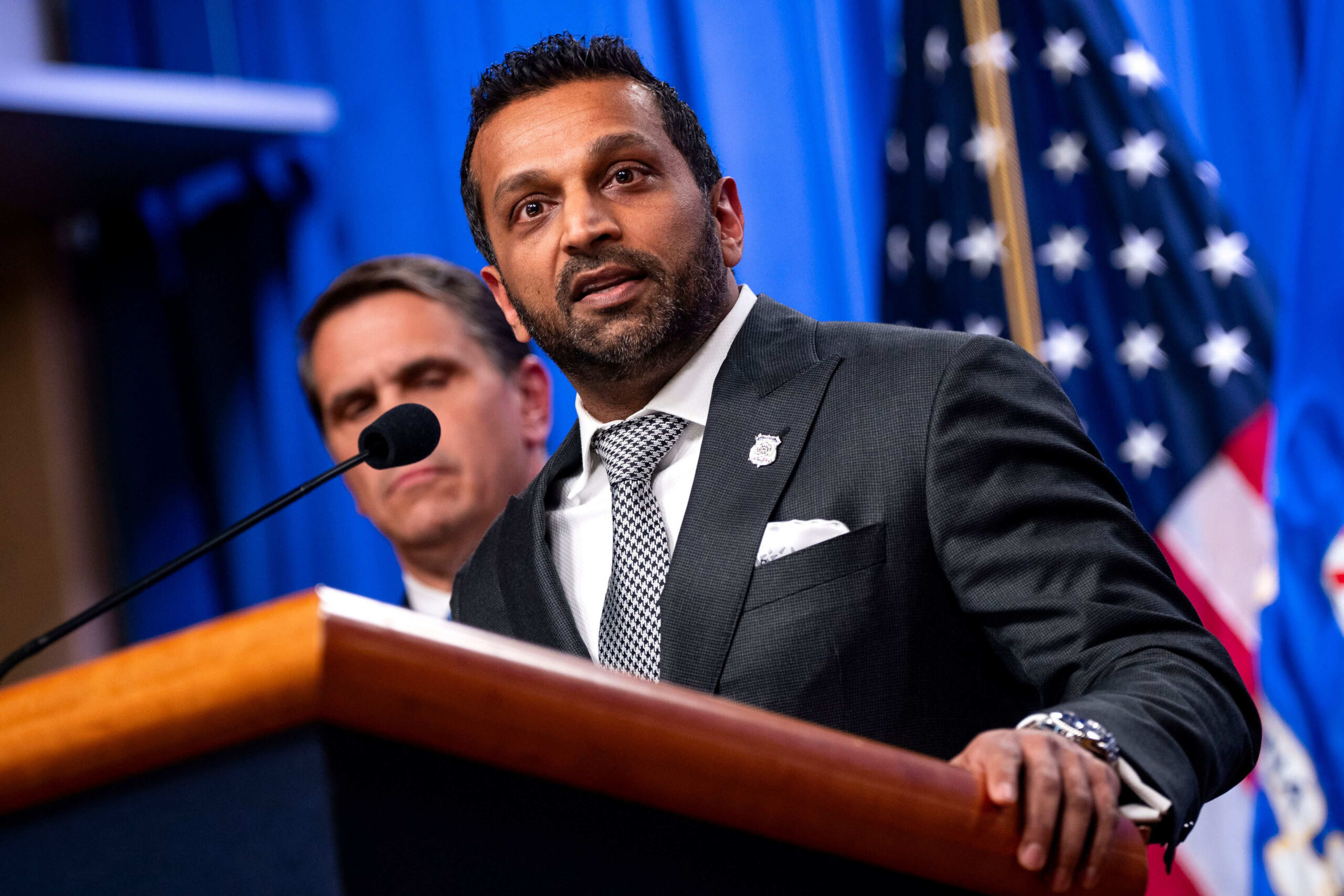
Kash Patel, now the FBI Director, stated on December 6, 2023 that, in a second Trump administration, the government would prosecute “the conspirators,” not only within the government but also in the media.
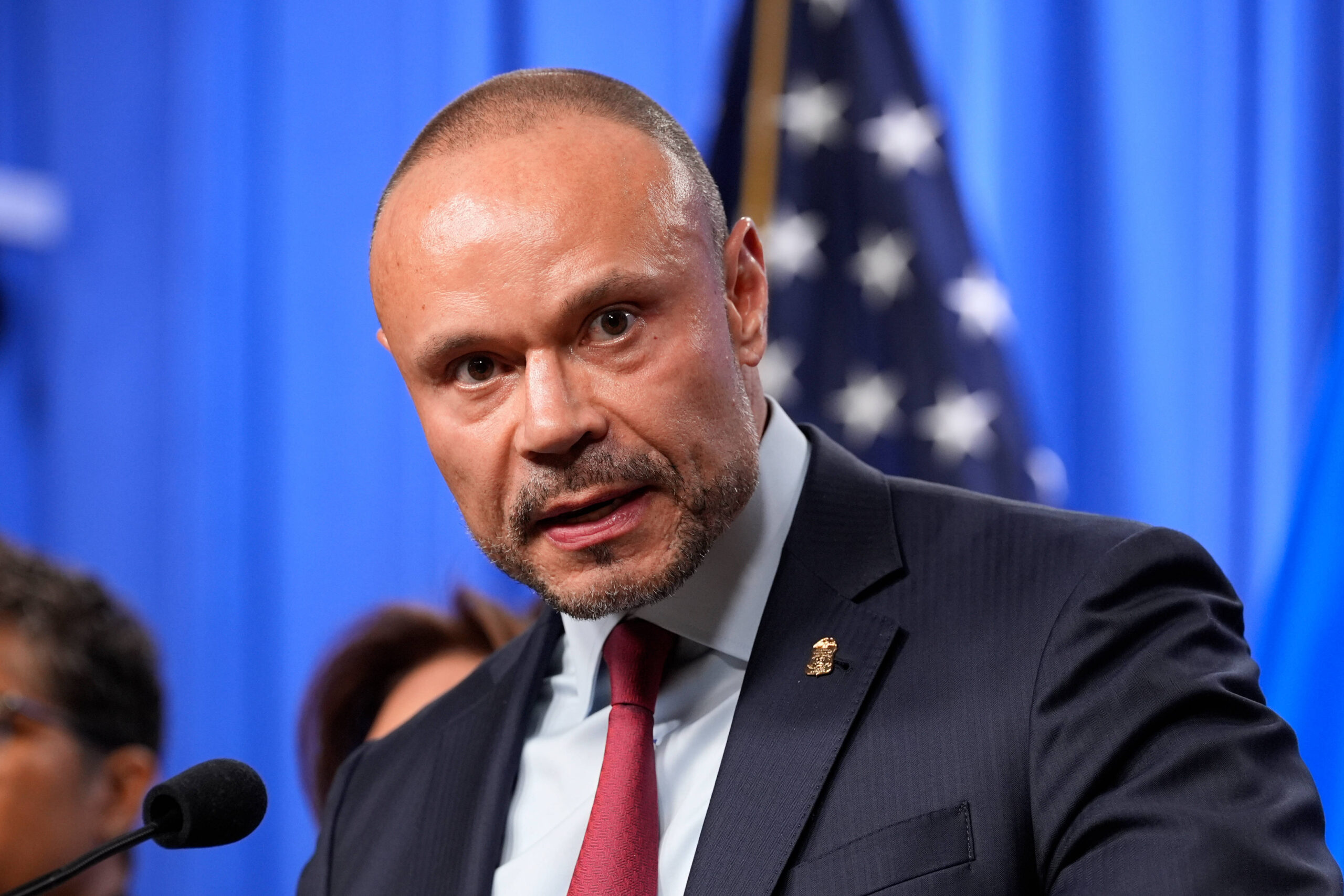
Dan Bongino, a former deputy to Patel at the FBI, has since Trump’s first term been one of the leading disseminators of conspiracy theories, as well as a MAGA influencer with a large following on Facebook and YouTube, and later on Fox News, before being “deplatformed” after spreading misinformation about Covid.
The influencer and founder of Turning Point USA, Charlie Kirk, had repeatedly voiced support for a broad view of the First Amendment: “Hate speech has no legal existence in the United States. There are awful, vulgar, and hateful speeches. They are ALL protected by the First Amendment,” reflecting an absolutist stance that had guided conservatives up to 2024. It is ironic that Kirk’s assassination would lead to statements and measures that radically challenge this view even within the same conservative circle, as seen among several Republican politicians, such as Senator Ted Cruz.
Laura Loomer, a Trump-aligned influencer, long presented herself as a victim of deplatforming and Democratic “censorship.” Her role became more pronounced since Trump’s return to the White House, with some influencers placed at the heart of political processes. Loomer helped shape the composition of the National Security Council and, in 2025, became a leading advocate of a new McCarthyism of the mind in the United States, even before Kirk’s assassination.
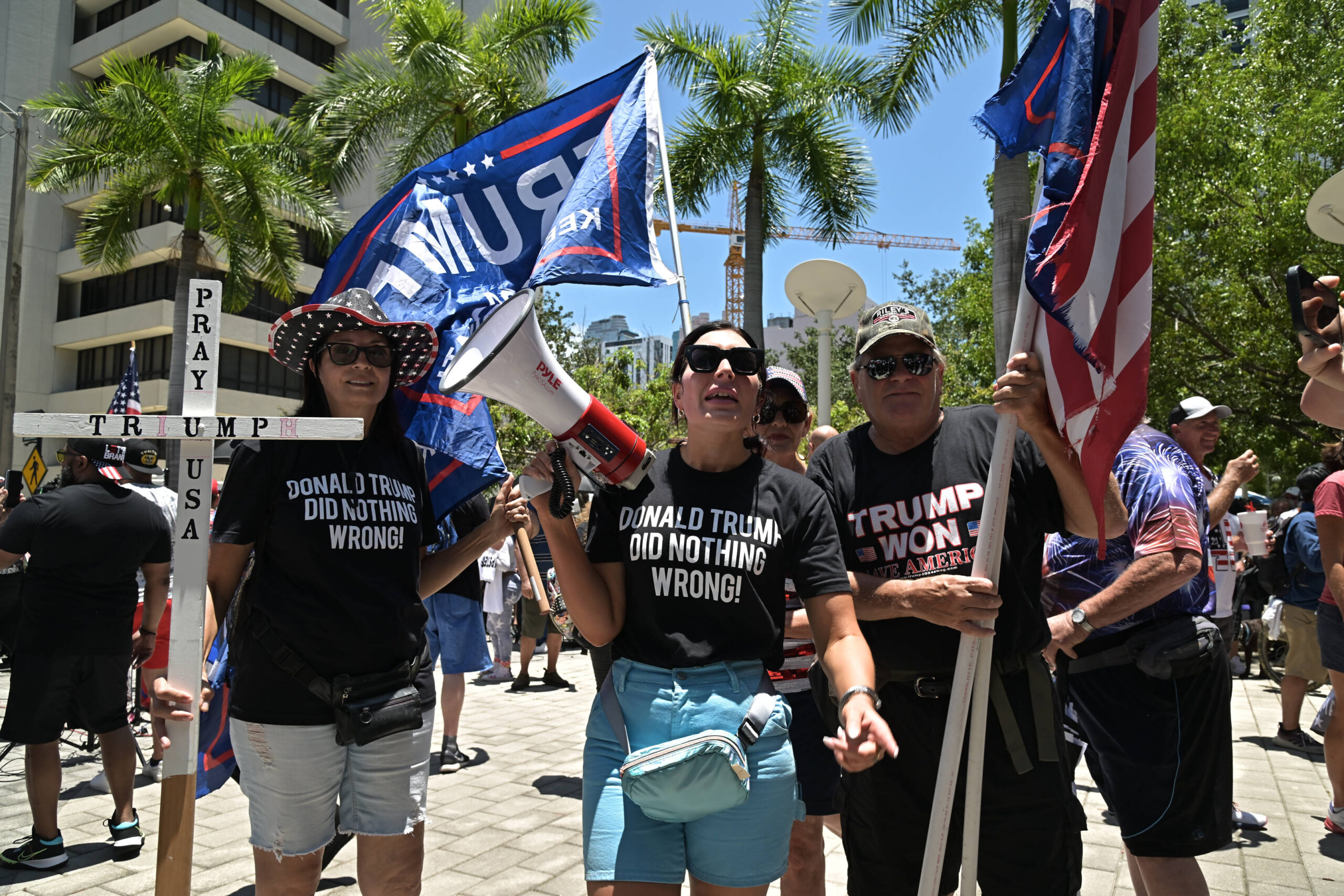
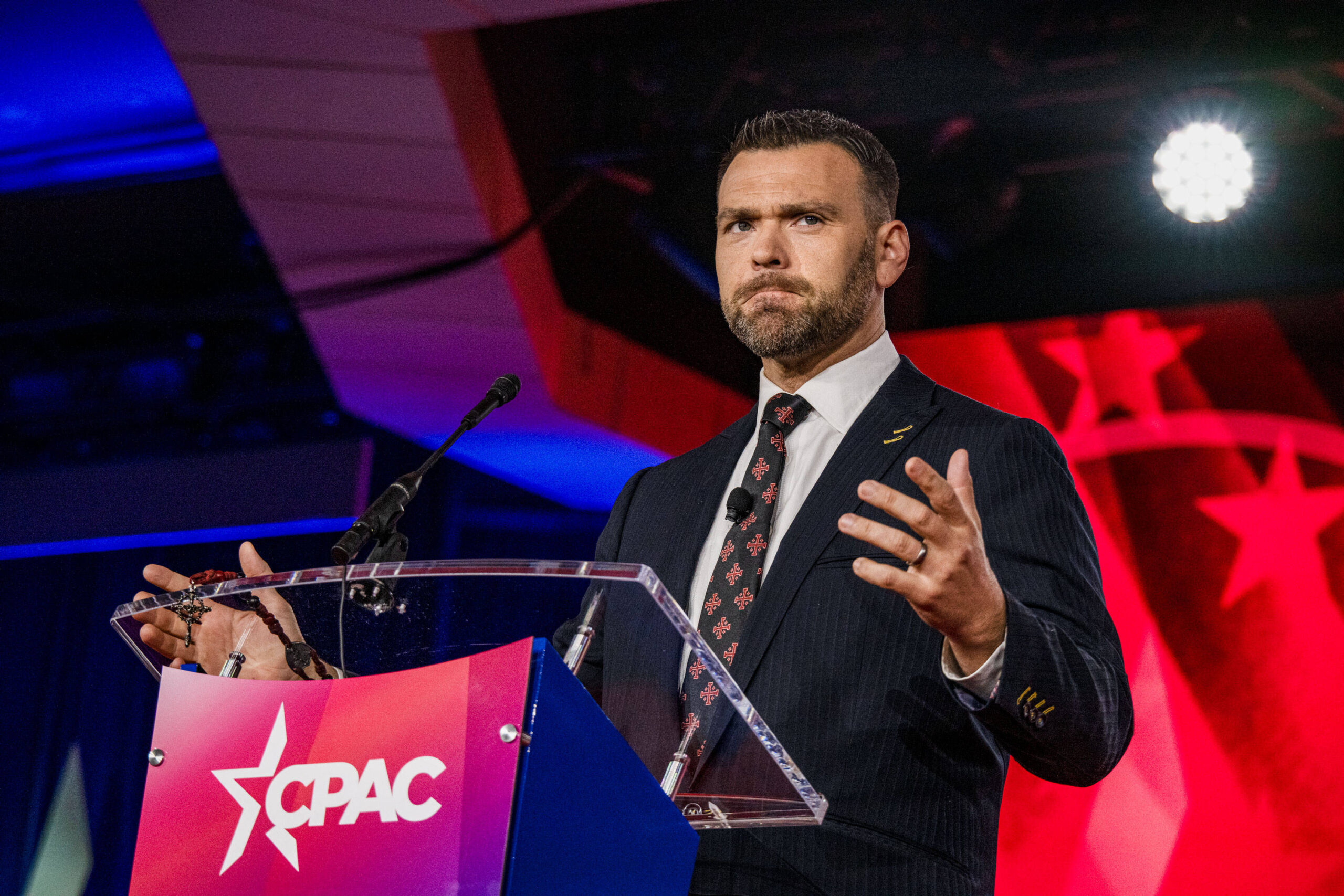
Jack Posobiec, another far-right influencer also integrated into Trump’s second-term political process, has repeatedly condemned moderation attempts on platforms as “barely veiled attempts to control free speech.”
Just like Laura Loomer, Jack Posobiec is now a member of the press pool of journalists accredited to the Pentagon, after many reporters left due to new rules imposed by Pete Hegseth on media covering the department.
Elon Musk also presents himself as an “absolutist of free speech” to justify the end of moderation on X and the restoration of banned accounts. At the same time, he has removed journalist accounts that displeased him or complied with platform-suspension requests from illiberal leaders.
Stephen Miller, Trump’s chief adviser since 2016, continues to speak of institutional censorship (by Democrats) and denounce biases in the mainstream media. He now drives the new McCarthyism orchestrated from the White House against left-leaning organizations or those close to the Democrats.
Tucker Carlson, whose Fox News program was the most-watched in Trump’s first term, was a pioneer in weaponizing freedom of expression and accusing the Democrats and the mainstream media of censorship. In his December 6, 2021 broadcast, he accused the Biden administration of wanting to “criminalize political critique.” Since leaving Fox News in 2023 and launching his own show, he has repeatedly presented free speech as a “birthright” of Americans, or even a “God-given” right.
After Charlie Kirk’s assassination, Carlson said he was concerned about efforts to ban hate speech, referencing statements by former Attorney General Pam Bondi, emphasizing the distinction between rhetoric that calls for violence and violence itself.
His invitation of the white supremacist neo-Nazi Nick Fuentes in late October 2025 sparked a wave of indignation even among Republicans and within Trumpism and the MAGA fold, provoking the Heritage Foundation’s criticism. It was ultimately endorsed by Trump himself (“Tucker does what he wants, he invites who he wants”). Carlson’s supporters argue that they do not engage in “cancel culture”—an accusation they often attribute to the left. A similar logic appears in Candace Owens’s turn to antisemitism, an influence who is less close to Trump today than during his first term, when she was even invited to the White House.

One could also mention Robert F. Kennedy Jr., who made a name for himself by spreading misinformation about vaccines and lamenting media censorship. He is today the Secretary of Health and has erected the obscurantism that found its way into official policy.
Finally, Vice President J.D. Vance was behind accusations of censorship and violations of freedom of expression against European institutions and several European countries, particularly the United Kingdom.
“Free Speech” vs. Europe
Since the Trump administration took office in 2025, American foreign policy and major Republican initiatives have systematically organized around challenging European digital regulations and turning the so‑called MAGA-defined freedom of expression into a diplomatic, political, and rhetorical weapon. This strategy unfolds through mobilization of the State Department and the production of reports and congressional hearings, which supply talking points and public confrontations subsequently relayed by the MAGA media ecosystem.
Thus, in the early months, American diplomats in Europe were instructed to coordinate a lobbying campaign against the Digital Services Act (DSA) by highlighting “American freedom of expression” and denouncing “excess censorship” by European governments or institutions.
The first to deploy this international rhetoric was Vice President J.D. Vance in February 2025. His speech at the Munich Security Conference effectively launched MAGA’s campaign against European regulations. He provided the “intellectual framework” by accusing Europe of democratic drift under the cover of fighting hate and misinformation, linking regulatory and moderation policies to an attack on the political right and on conservative culture, thereby challenging the legitimacy of the European model. This framework reappears in the strategy of national security published on December 5, 2025.
Immediately, these talking points were echoed by the European politicians he championed in his Munich speech, presenting themselves as victims of censorship, notably far-right parties in Britain and Germany. This rhetoric of inward threats more troubling than adversaries like China or Russia replicates exactly the language Trump used during the 2024 campaign.
Meanwhile, envoys from the State Department were instructed to denounce the DSA and platform moderation from the angle of freedom of expression understood in its American absolutist sense. This ideological subjugation of Europe unfolded as explicit blackmail in the text published late May 2025 by Samuel Samson, which weighed the transatlantic security relationship.
Samson, like Vance in Munich, uses very few supporting examples for their charge of censorship in Europe, and they constantly invoke the same example of a former veteran “punished for quietly praying” outside a UK abortion clinic, a case that lets them claim that England “forbids freedom of expression.”
The recurrence of this isolated example seems at odds with the idea of widespread censorship in European democracies. Yet a simple search shows that the man in question, Adam Smith Connor, was fined for disobeying a police officer after almost two hours of discussion, who did not ban him from praying but asked him to step back to avoid remaining in the 200-meter “safety zone” around the clinic, in line with British law that creates a safety perimeter around abortion clinics to protect women from verbal or physical abuse. The man was defended by the Alliance Defending Freedom International (ADF), a US Christian extremist group active in Europe against the rights of sexual minorities and often tied to Hungarian complaints against the European Court of Human Rights, including in religious matters.
In an investigation published by Tech Policy Press on October 7, 2025, it emerged that the White House, specifically the vice president’s office, had asked in the early weeks of the Trump administration the State Department’s Democracy, Rights and Labor Bureau to find examples of infringements on freedom of expression in Europe. According to a former bureau member, “that was our only task for weeks,” without results.
The DSA policy work was placed under the direct supervision of Samson and Darren Beattie, undersecretary of state for public diplomacy. Beattie had worked in the previous Trump administration before being dismissed after revelations of his white supremacist past.
This offensive went hand in hand with the closure of Atlantic-to-Pacific programs countering information manipulation, the shutdown of the successor to the State Department’s Global Engagement Center (GEC), and the reorganization of the Bureau of Democracy, Human Rights and Labor around defending the “threatened” rights of Americans abroad.
In the State Department’s annual human rights report, Europe was a particular target, with France cited as a country where “credible information shows grave restrictions on freedom of expression, including the enforcement or threatened enforcement of penal or civil laws aimed at limiting freedom of expression; as well as crimes, acts of violence, or threats of violence motivated by anti-Semitism.” The DoS indicated that the next annual report would propose “a much clearer framework of what matters to the Trump administration.”
Finally, the Rubio directive, published in August 2025, instructed the relevant teams to identify any instance of “restriction of freedom of expression” that has an impact on American citizens or businesses, with promises of targeted retaliatory measures (visa restrictions, trade sanctions).
Congressional Republicans’ Offensive
The House Judiciary Committee, chaired by Republican Jim Jordan, released on July 25, 2025 its report on the threat of foreign censorship from the European Union, titled: “The Foreign Censorship Threat: How the European Union’s Digital Services Act Compels Global Censorship and Infringes on American Free Speech,” with a hearing scheduled for September 3, 2025, in Washington.
The report characterizes the DSA as “a global digital censorship law.” It argues that the regulation does not stop at Europe but effectively imposes its standards worldwide, since major platforms often apply a single moderation policy, thereby limiting the free speech of Americans (citizens as well as businesses). It is recalled that the aim of the DSA is to protect European citizens and the European public debate.
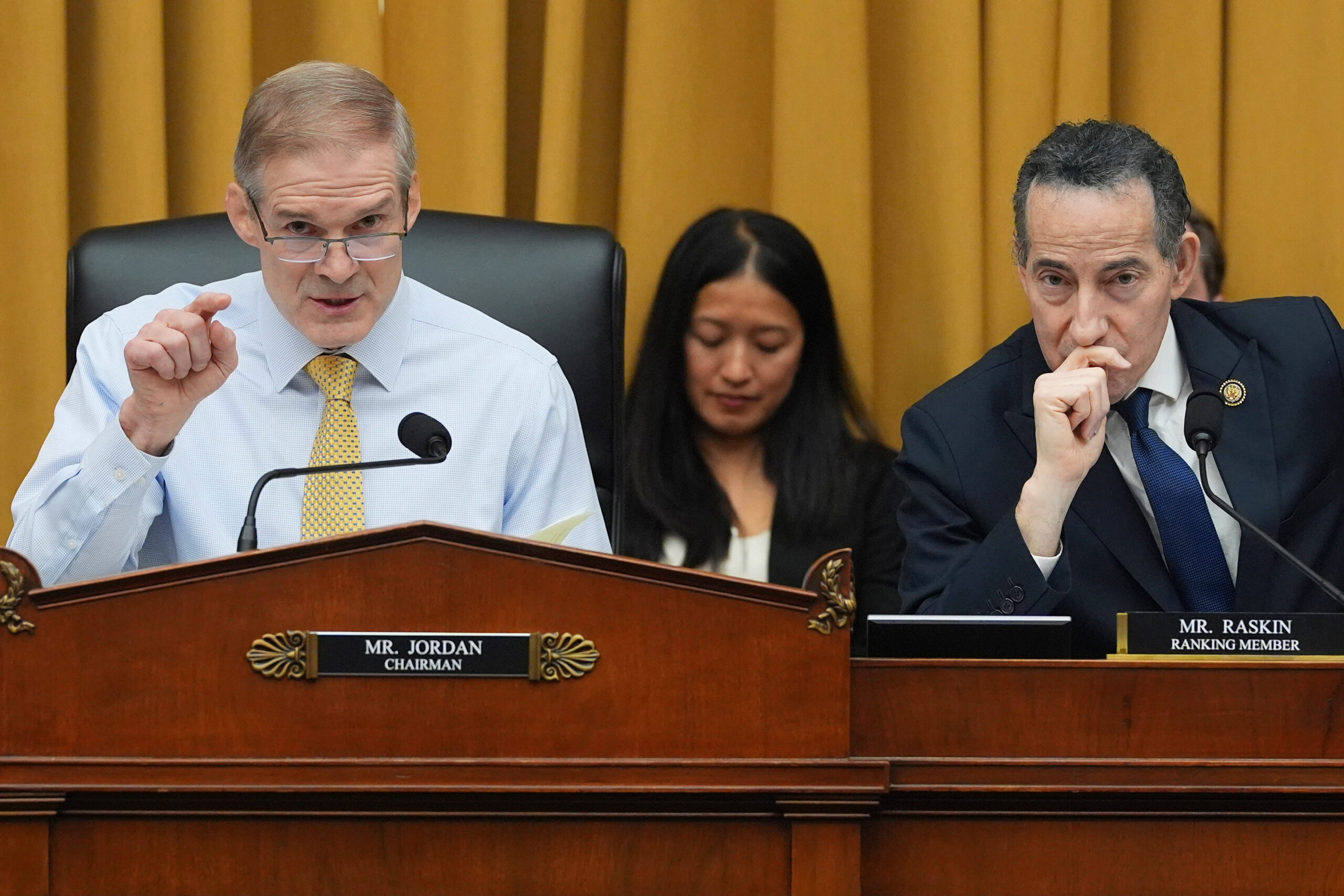
The report describes cases where European Commissioners, notably Thierry Breton, pressured American companies to remove certain content, a point reminded by Jordan at the opening of the hearing. It notes that fines or the possibility of suspending a platform in Europe create a strong incentive to over-moderate.
The central argument of the report is that even if the DSA purports to target illegal or harmful content in Europe, its application pushes platforms to censor lawful content in the United States, violating the First Amendment. Among concrete examples cited in the report, one concerns France, about the Annecy child-murder case carried out by a Syrian asylum seeker. The report provides only part of the anecdote to contour reality to fit the argument (the racist message was also accompanied by an obscene image involving a child). As in the hearing, most European cases concern Great Britain. All cases are presented as evidence that the DSA serves to muzzle political positions, while they are consistently presented in a partial manner, lacking context.
The report concludes that Congress should consider legislative measures to prevent the importation of foreign norms that would restrict freedom of expression in the United States – a paradox since the irresponsibility of platforms, which are not treated as publishers, flows from Section 230 of the 1996 Communications Decency Act, a gift to Silicon Valley during Bill Clinton’s 1996 re-election campaign. The report ends by mentioning the proposal of the No Censors on our Shores Act, which would allow denial of entry into the United States, or expulsion if necessary, to any foreign national whose conduct would amount to a First Amendment violation if it had taken place in the United States or against a U.S. citizen.
Donald Trump also propagates this rhetoric and these themes via his Truth Social network and in official statements, such as threats of tariffs against any country that imposes digital taxes or norms penalizing American companies. These developments explain why weaponizing freedom of expression, particularly against Europe, is now official in the National Security Strategy.
The New American Public Diplomacy: Sarah Rogers, Messenger of Trump’s Civilizational Crusade in Europe
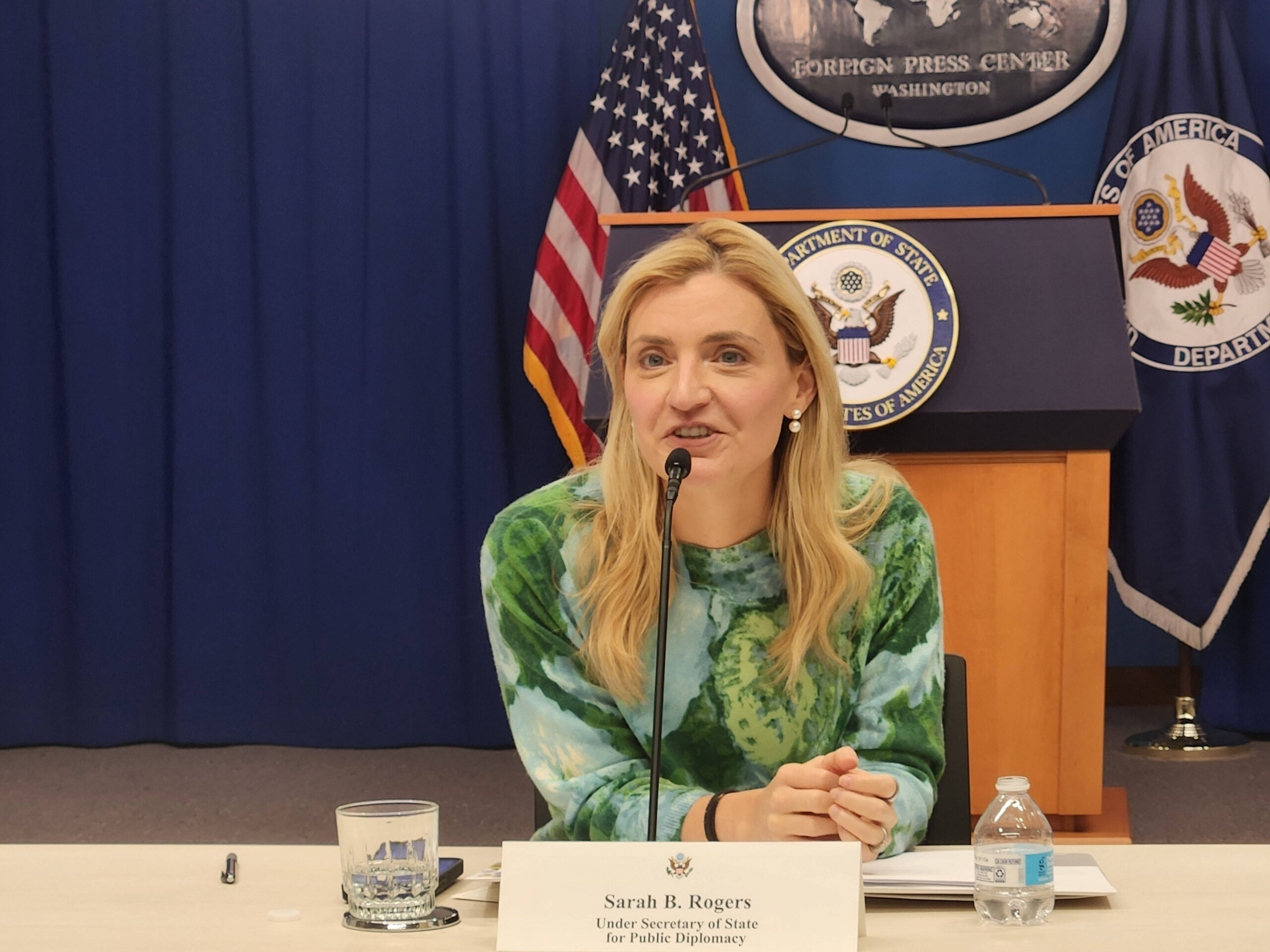
Thus, the public diplomacy apparatus of the State Department has been redirected toward defending a “threatened” freedom of expression of conservatives in Europe, according to the strategy’s redefinition. It has been entrusted to Sarah Rogers, Undersecretary of State for Public Diplomacy. A trained lawyer, she had lobbied for the National Rifle Association (NRA) and worked with Charlie Kirk, two factors that weighed heavily in her appointment.
Since her appointment in October 2025, Rogers has co-authored an op-ed with a Viktor Orban adviser, met a cadre from Nigel Farage’s party, and hosted a member of the AfD in Washington. Her record is deliberately provocative: in January 2026 she posted on her official X account about “hordes of barbaric rapists” imported by Germany; before a London libertarian institute, she presented a series of false statements, for example about IQ disparities between “racial groups.”
This diplomacy extends beyond statements; it now has public funding. Rogers announced in early 2026 a $500,000 grant to “promote digital freedom,” particularly to subsidize think tanks aligned with Trump’s priorities. The State Department is also developing the freedom.gov portal designed to allow Europeans to access content deemed illegal by their governments (hate speech, terrorist propaganda). Finally, Rogers was appointed in May to lead the agency overseeing Voice of America.
And Now?
The weapon of “free speech” used today against Europe must be viewed in historical perspective and especially in the context of Trump’s most recent campaign. Before it is wielded against the EU and seized upon by European far-right parties eager to win at the polls, it had been employed by Trump and his allies to rewrite history, notably the January 6 Capitol assault and the prosecutions against Trump. It has also been used, upon his return to the White House, to dismantle agencies fighting foreign interference that had highlighted collaboration between MAGA influencers and actors of Russian origin seeking to destabilize American democracy.
The fallout of Charlie Kirk’s assassination in Europe revealed the degree of mimicry among far-right groups with Trumpism, and their speed in borrowing heroes and rhetorical elements. MAGA in Europe, like Trump and his allies in the United States during the 2023–2024 campaign against Democrats, intend to make freedom of expression a weapon to delegitimize political opponents and win upcoming elections.
Starting from the premise that this battle is an American-language import, it is useful to return to the etymology of certain expressions now present in European public debate.
When Secretary of State Marco Rubio announced the dismantling of agencies tasked with countering foreign interference, particularly Russian, Chinese, and Iranian, and the reorganization of the State Department’s Democracy, Rights and Labor Bureau, led by Samuel Samson and focused on cases of censorship in Europe, he accompanied the official statement with the publication of an essay in The Federalist, titled “To Protect Freedom of Expression, We Must Dismantle the Censorship Industrial Complex.”
A linguistic investigation into the origin of this well-chosen phrasing shows that it was primarily aimed at attacking Trump’s political opponents in the United States, notably the Biden administration, and the entire set of decisions and institutions created by the Democrats to counter foreign interference in the electoral process.
The term “censorship industrial complex” indeed echoes a phrase popularized by the MAGA journalist Michael Shellenberger during his March 2023 congressional hearing on the Twitter Files—an alleged censorship affair that revealed more about moderation difficulties than about censorship itself. Trump, in his December 2022 statement, spoke of a “cartel” or “regime” of censorship; Shellenberger supplied a more nuanced formulation that nods to Eisenhower’s “military-industrial complex.”
This March 2023 hearing, organized by Jim Jordan shortly after the Republicans gained a majority in the House, aimed to denounce “the weaponization of the government by the Democrats.” In reality, it was a staged event to attack the Biden administration’s initiatives to counter foreign interference, as well as the measures taken during the pandemic to curb misinformation about vaccines. It was also a challenge to the work done by the prior Congress (2021–2022), which had a Democratic majority, on Trump’s role in the January 6 Capitol assault.
During the hearing, and in a publication on X shortly after, Shellenberger cited reports from the Foundation for Freedom Online, an obscure MAGA-funded institution created by Mike Benz, another MAGA “journalist,” which issues numerous reports on censorship in Europe. His foundation, though its funding is opaque, has the resources to produce lengthy reports and stands at the forefront of the current U.S. offensive against Europe. Its latest report, published in December 2025, is titled “EU Rolls Out ‘Democracy Shield’ Initiative to Enforce Censorship Laws.”
This etymological inquiry reveals the MAGA media ecosystem’s discipline, but, above all, the ultimate aim: a political struggle in service of Trump and against his political opponents.
As often, Trump’s accusations against his Democratic opponents precisely illustrate what he himself was doing, according to a recurring and proven mirror strategy.
Maya Kandel
The first victims, before Europe, were researchers who work on interference and information manipulation, then the institutions responsible for this work, and finally the American public.
It is important to recall: Trump and his allies have won this struggle, first in the United States against the Biden administration, then at the polls. They now use the same weapons against Europe and its laws. In this coordinated effort launched in the wake of the Capitol assault, all the major figures of Trumpism appear: Stephen Miller and his organization America First Legal, one of whose financiers was Elon Musk as early as 2022; Eric Schmitt, then Missouri’s Attorney General and now among the White House’s closest allies; Mike Benz, now in charge of the Foundation for Freedom Online, dedicated to attacking European laws; Vince Haley, a longtime Trump adviser responsible for domestic policy at the White House.
In January 2021, Haley stated that it would be necessary to “win the narrative of Trump’s history, which would be crucial for victory in 2024,” according to private messages released by the January 6 congressional inquiry. As is often the case, Trump’s charges against his Democratic opponents precisely illustrate what he himself was doing, according to a recurring, proven mirror strategy. Thus, in a 2024 campaign email, he wrote that Biden was “setting up the most sophisticated censorship-and-information-control apparatus in the world to silence free speech in America.”
That is precisely what the Trump administration seeks to do, even more aggressively since Charlie Kirk’s assassination, by enlisting the FCC, by being the first to invoke violence in his Truth Social statements (he recently called for Democratic officials to be “hanged”), while seeking to muzzle his opponents, and by enlisting the Department of Justice to prosecute them.
It is important to recall this context: the Trump administration’s fight has little to do with the fundamental principles of the American Constitution or the defense of a First Amendment whose meaning has shown great historical variation, and is today the object of overt political instrumentalization. This context is all the more important when these rhetorical devices are imported to be used in European democracies with different histories and rules on freedom of speech and the press. This is to avoid a similar degradation of public debate and heightened vulnerability to hostile information operations from other foreign actors.
What are the returning effects of such an offensive? Within the United States, counterpowers, and especially the judiciary, are beginning to question the McCarthyite crusade that followed Charlie Kirk’s assassination. The wave of retaliation against Americans who criticized Charlie Kirk after his assassination (hundreds fired or sued) is now yielding costly legal defeats. For instance, in Tennessee, a retired police officer who was arrested and jailed for sharing a meme at a vigil in Kirk’s memory received more than $800,000 in compensation from the county sheriff. In total, more than two million dollars in compensation have been paid in similar cases, and other lawsuits are still pending.
Outside the United States, the Trumpian crusade now confronts the president’s growing unpopularity, his constant attacks on Europeans, and even more so after the Iran conflict. The economic consequences of the conflict, added to the president’s recurring musings about Greenland and the unpredictability of business, have eroded Trump’s credibility even among his supporters. Several European far-right movements, previously showcase figures of the Trumpism, now distance themselves from this president, and almost all European parties worry about their dependence on American digital technologies.
This distancing from the man Trump does not disarm the method. The rhetorical devices crafted across the Atlantic—the so‑called censorship of political voices, even though they are present in national and European parliaments; the invocation of freedom of expression to defend racist or inciting statements—have been internalized by European public debate, where they now circulate autonomously.