
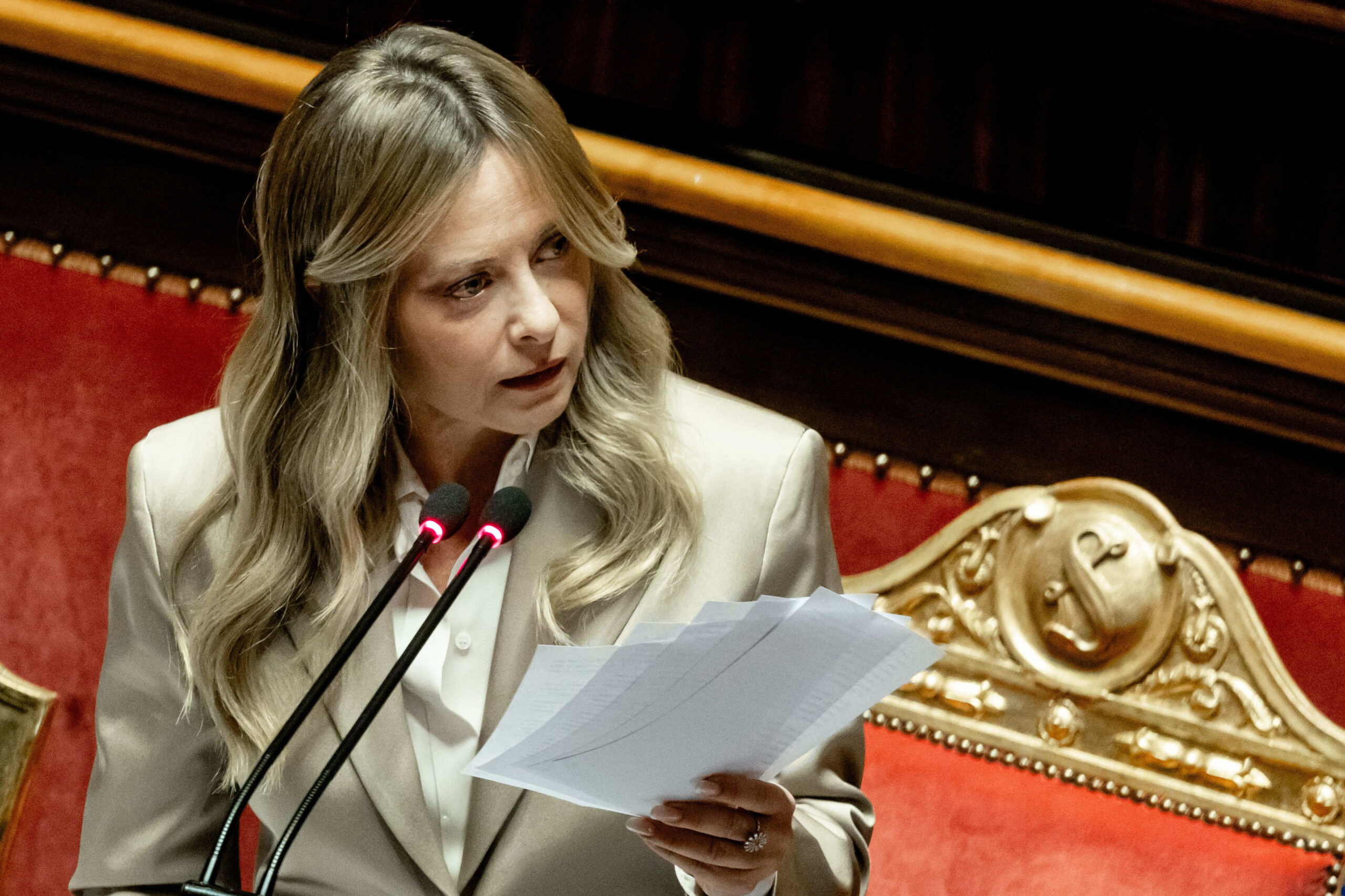
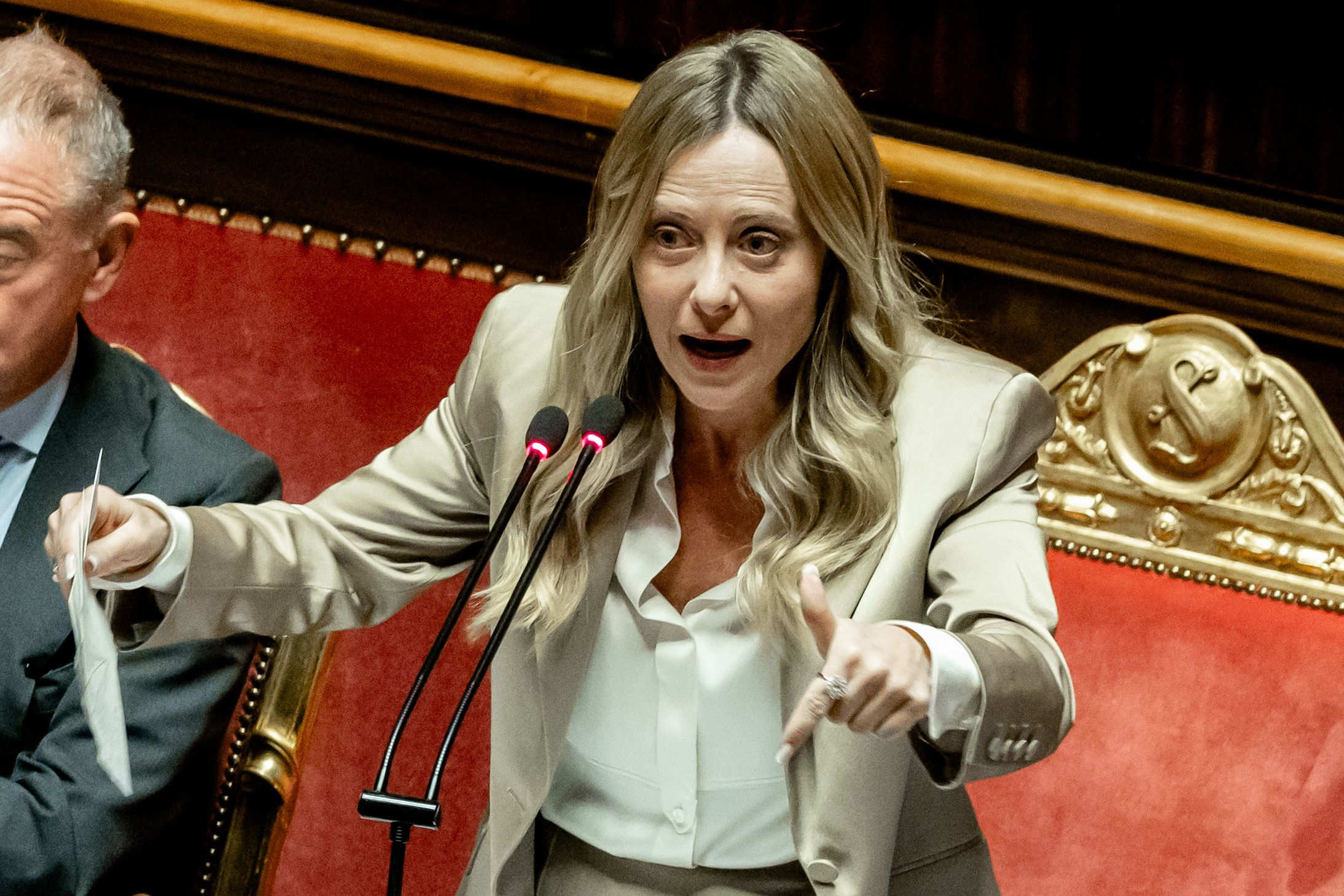
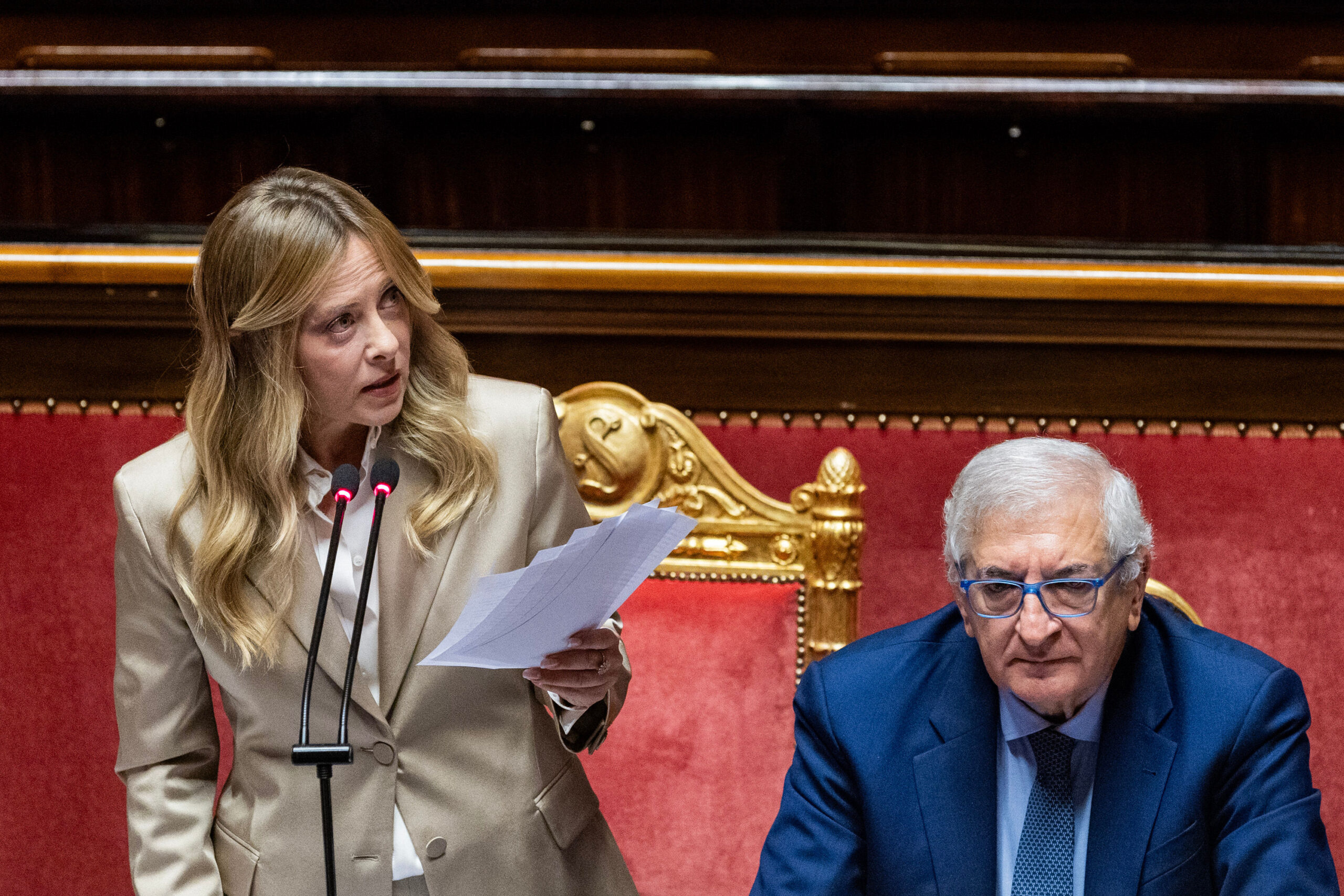
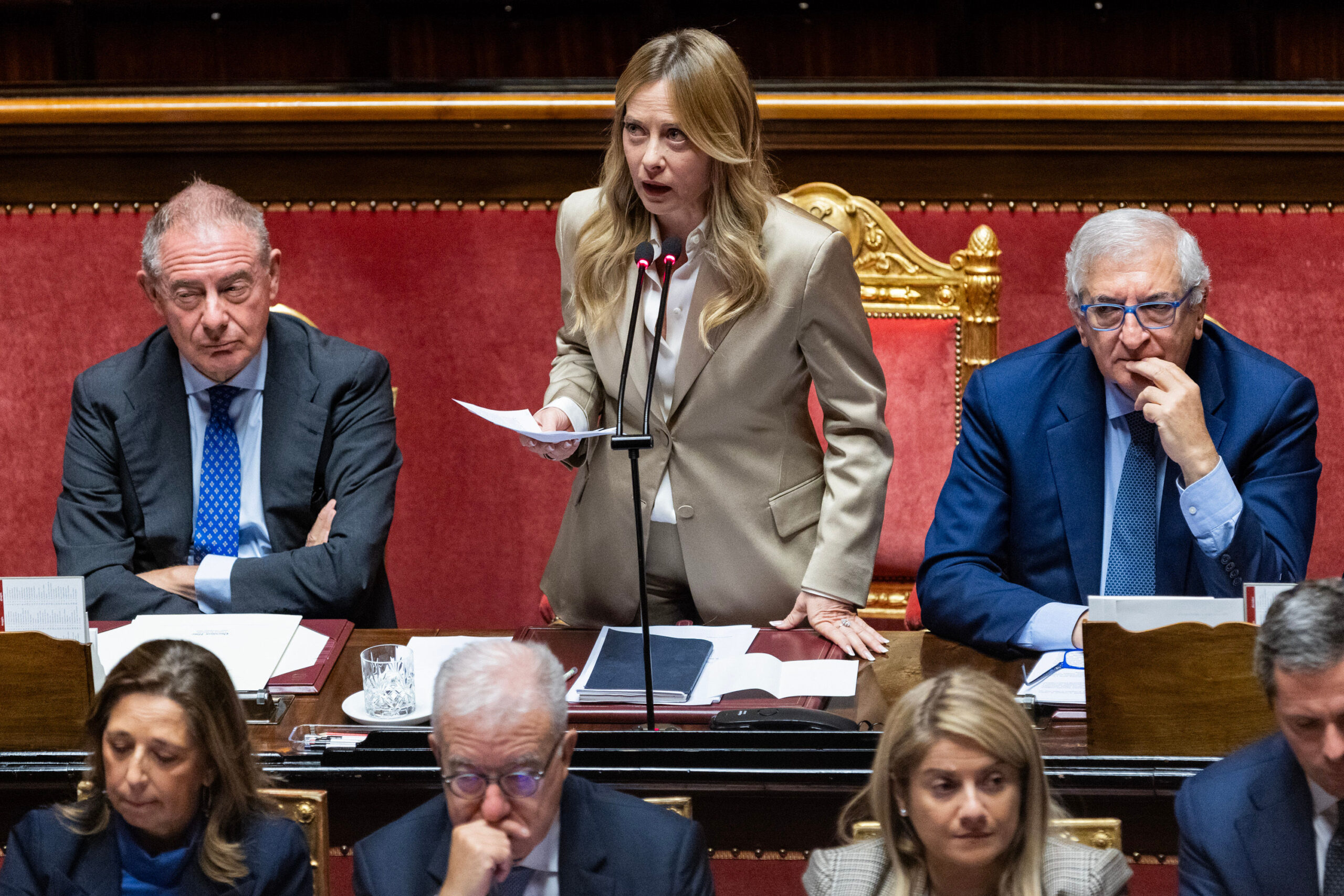
Yesterday, October 14, on the eve of the European Council, Giorgia Meloni presented to the Senate, then to the Chamber of Deputies, the major priorities of her government’s European policy: competitiveness and energy costs, reform of the carbon market, the EU budget for the 2028-2034 period, and migration.
The decisive part of her speech lay elsewhere.
For the first time before Parliament, the President of the Council clearly distanced herself from Washington, calling the agreement by which Donald Trump lifts certain sanctions on Russian diesel “very risky.” She challenged the justification put forward by the White House, arguing that the surge in fuel prices is primarily due to the war in Iran, and not the Ukrainian conflict.
She then argued for Europe to speak with a single voice in negotiations: “I’ll be honest: the question of who sits at which table matters little to me. What matters is under whose name we sit there, and for what we say. […] A Europe that is divided gives itself an infantile image, and that is the only real gift we could make to Moscow. And gifts to Moscow, these days, we have given enough.”
This stance contrasts with the position expressed almost simultaneously in Brussels by Marine Le Pen. On the sidelines of a meeting with her allies from the European Patriots group in the presence of Viktor Orban and Matteo Salvini, the RN candidate announced that if she is elected next spring, France will stop its financial aid to Ukraine, due to budgetary constraints.
To understand Meloni’s positioning, one must return to the national context. The rise of the ultra-right General Roberto Vannacci’s party, which surged from about 4% to nearly 8% of the vote in just a few months, has triggered the first real political instability of the governing coalition since October 2022.
Giorgia Meloni finds herself for the first time confronted with an opposition that overtakes her from the right. And her government’s support for Ukraine has become the symbol of renouncing her sovereignist origins and aligning with Brussels and NATO. General Vannacci even presents the cessation of weapons and money for Kyiv as a condition for any alliance.
Support for Ukraine is also a fault line within the coalition being formed, which would unite centrist forces with the left populism—the “campo largo”—and which pits more conciliatory forces toward Moscow against others far more hostile to the Kremlin.
In the chamber, the president of the Five Star Movement group, Riccardo Ricciardi, also stated that the notion of a “just peace” does not exist in human history, and called for halting weapons deliveries to Kyiv and European rearmament. A formulation almost identical to the one Vannacci has repeated for months. On March 5, in front of foreign reporters in Rome, he responded to a correspondent from the Russian news agency RIA: “Just peace has never existed; in the history of humankind, I have never seen the peace of the victor.”
In her replies to the Chamber, the Prime Minister leveraged this convergence by placing the far-right party among the left-wing opposition parties: “I will primarily respond to the arguments of the opposition parties, so I will focus on the campo larghissimo, let’s put it that way.” She also mocked the divisions of the centre-left, which had tabled several separate resolutions on Ukraine: “Before trying to get Putin and Trump to agree, try to get the different left leaders to agree on a single resolution.”
Monsieur le Président, chers collègues,
The choices that Europe is called upon to make to preserve its ability to remain competitive, secure, and a leading actor on the world stage are becoming more numerous and more complex.
The war in Ukraine continues, striking an increasing number of civilian targets. Instability in the Middle East has repercussions that extend far beyond the region’s borders. Global economic competition is intensifying. Geopolitical tensions affect the security of our supply chains, the price of fuel, the cost of living, and the ability of our businesses to stay competitive. Not to forget hybrid threats, migratory pressures, growing instability, and the need to strengthen European security and defense.
These are, of course, different dossiers. But they share a common thread: they remind us how what happens beyond our borders increasingly influences our daily lives and challenges our nation’s ability to defend its prosperity and security.
That is why, in recent years, the government has chosen to be present and active on the international stage, with consistency and by following a clear line. Because national interest is defended by shaping the choices that concern us, not merely by suffering their consequences.
This is especially true in Europe. And it is in this spirit that Italy has also worked toward the upcoming European Council, and that it will address the main topics on the agenda.
The first topic I want to dwell on is competitiveness.
The European Council will assess the implementation of the “One Europe, One Market” agenda and the progress made in deepening the single market, simplifying rules, reducing administrative burdens, and speeding up planning and permitting procedures.
These are goals Italy has long pressed for, but the question weighing most on competitiveness today is not these: it is energy costs.
We have said it many times: we cannot ask European companies to compete with global giants while allowing them to bear energy costs that are consistently far higher than those of their rivals. We cannot pursue the ecological transition at the expense of our industrial base. Decarbonization cannot be synonymous with deindustrialization, especially in today’s geopolitical context.
The tensions on key trade routes and supply chains have repercussions on energy security and fuel prices. Transport and insurance costs rise and eventually show up on bills, in the household basket, and in business accounts.
Facing such a scenario, no one can respond effectively alone. The response must be coordinated and rapid.
That is why we worked to achieve an agreement within the G7, which provided for bringing a substantial amount of fuel to the market, notably to prevent the risk of a blockage of American exports, which would have had heavy consequences for our economies.
But alongside this, we must also have the courage to look at what we can do, in Europe. Beginning with the most obvious step: preventing rules designed in a context completely different from today’s reality from ending up worsening the effects of the crises we are going through.
Because our companies are now facing increasingly aggressive global competition, and every extra cost that Europe imposes on itself is an advantage it offers to its competitors. And the time we have to right the course is not unlimited.
That is the point on which Italy has concentrated its efforts.
Last week, we launched a new dialogue with the most committed heads of state and government on competitiveness, around three priorities: energy, simplification, and international trade. It is precisely as a result of this coordination that, with the German Chancellor and the Belgian Prime Minister, I sent Brussels three simple proposals aimed at facilitating and unlocking investments: priority pathways for strategic projects, a real brake on excessive bureaucracy, and a drastic reduction of reporting obligations, especially for small and medium-sized enterprises.
At the same time, with the Czech Republic, we presented several targeted proposals, including temporary measures, to reduce energy costs.
I will try to explain it simply. In Europe, a company that pollutes must buy a quota for every tonne of CO₂ it emits: that is the ETS system. But these quotas are bought on the market, and it is the market itself that sets the price – with dynamics that, if you’ll allow me, have little to do with environmental protection. When the price of ETS quotas rises, production costs rise as well. Whether for steelworks, paper mills, cement plants, or ceramic factories. And this cost, in the end, is passed on to what we buy.
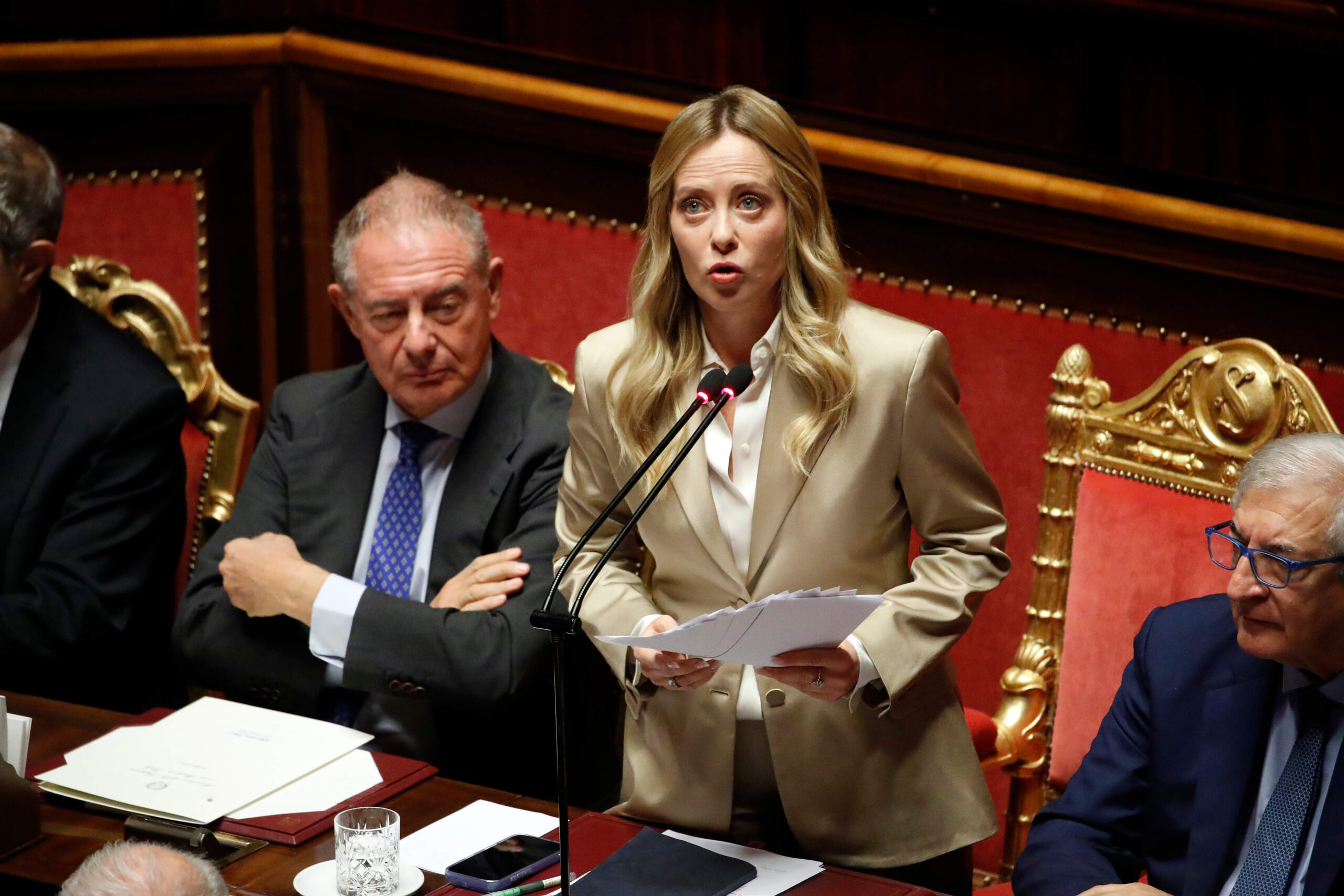
That is why we have put on paper some concrete proposals to fix the ETS system, so that the price of CO₂ reflects the real economy and not financial logics. And we have asked to postpone again the ETS2, which, from 2028, would place new costs on households and businesses.
There is then a second problem, which weighs directly on bills: the price of electricity is determined by the marginal price. This means that, in practice, it is the last plant called to produce, the one with the highest price – which is very often a gas-fired plant under the ETS – that sets the entire price. Thus, the CO₂ cost paid by this plant is passed on to the price of all electricity, including that produced from renewable sources.
It is a problem that, as you will understand, concerns particularly Italy, because, as you know well, our energy mix still includes a substantial share of gas. A vulnerability that goes back a long way and on which we are working, notably by developing renewable energies as no government had done before us, and by reopening the path to next-generation nuclear power, in order to build a safer system less dependent on foreign sources.
But these investments take time, and we need solutions now. That is why I consider it very important to be able to propose a concrete perspective that would bring short-term benefits.
At the March European Council, we managed to include in the conclusions the possibility of adopting national, temporary, targeted measures to mitigate the various components of electricity production costs. On this basis, the Commission committed to working with us on the “Bollette” decree. Technical discussions have been intense and constructive and are leading us toward a solution compatible with European rules, allowing us to implement our measure while reducing the weight of gas costs on the overall price of electricity.
That is the result that concerns us and for which we are working: not another line in the summit conclusions, but a lower bill for a family, a reduction in the cost for a business.
There are also advances regarding the European methane regulation. The new requirements for importers could further restrict available supply and exert new pressures on prices. That is why we asked for a temporary suspension of certain obligations. When we raised this issue in recent months, the proposal seemed very difficult to move forward. Yet today the European Commission announced its intention to postpone the regulation by one year. And we consider this excellent news.
These two examples illustrate a principle we have been insisting on from the start: if a rule, tested by facts, leads to consequences that were not anticipated, or worsens a crisis, that rule must be corrected.
For we are not here to defend rules against reality. We are here to defend citizens against bad rules. And that is possible.
Thanks to Italy, this has happened several times. It happened, for example, with the national safeguard clause, when Italy was the first to request that the flexibility provided for defense and security could also be used to address the energy crisis. Although few believed it, this proposal became a solution available to all Member States.
That is what we hope to see happen also with the new reflections we have launched in the field of budget rules. As you know, I wrote to President von der Leyen asking for two things. First: that the energy shock and inflationary impact be duly taken into account in calculating expenditures allowed under European rules. Second: that Member States be able to use at least part of the additional VAT revenue generated by price increases to fund temporary and targeted measures in favor of businesses and households. Because it would be hard to explain to citizens that, to face this shock, we cannot even use the extra revenue it generates.
These are common-sense proposals. Of course, we know it will not be easy to reach a consensus, but that will not stop us from forcefully raising this issue.
There is finally the question of critical raw materials. Lithium, cobalt, graphite and rare earths are indispensable to the energy and digital transition, and to defense. Yet, today Europe imports almost all of them, often from a single country. If we do not tackle this knot, we risk moving from dependence on one supplier to dependence on another.
That is also why Italy has offered to host in Porto Marghera one of the first European sites for strategic storage of these materials, an initiative that could become a European pilot project.
The guiding thread connecting all these initiatives is simple: Europe must place production capacity back at the heart of its choices.
The European Council will open with an exchange with President Zelensky. We will of course address the Ukraine question. In the meantime, Russia has launched its new autumn campaign against Ukraine. Unable to progress on the front, Moscow has begun to strike civilian populations more forcefully: power plants, residential buildings, hospitals, even the buses that transport people to work, as in the horrific massacre of Kramatorsk.
This is a strategy by which Russia seeks to break the Ukrainian people through terror, cold, and darkness, simply because it has not managed to defeat them on the battlefield. The facts, moreover, contradict the Kremlin’s propaganda and that of those who spread it here in Italy. Since the beginning of the year, Moscow has gained very little ground, and in September alone it lost much of what it had gained in recent months.
This stalemate did not fall from the sky. It is the result of the courage of the Ukrainians and the support of the West, including Italy. And I continue to think that this stalemate is the only effective way we have to bring Russia to a serious negotiating table.
I know the debate on this subject is lively, including in this Assembly, and even within the various political groups. I respect it and understand it, because no one in this Assembly wants war. We all want peace. The difference lies in how we think to achieve it.
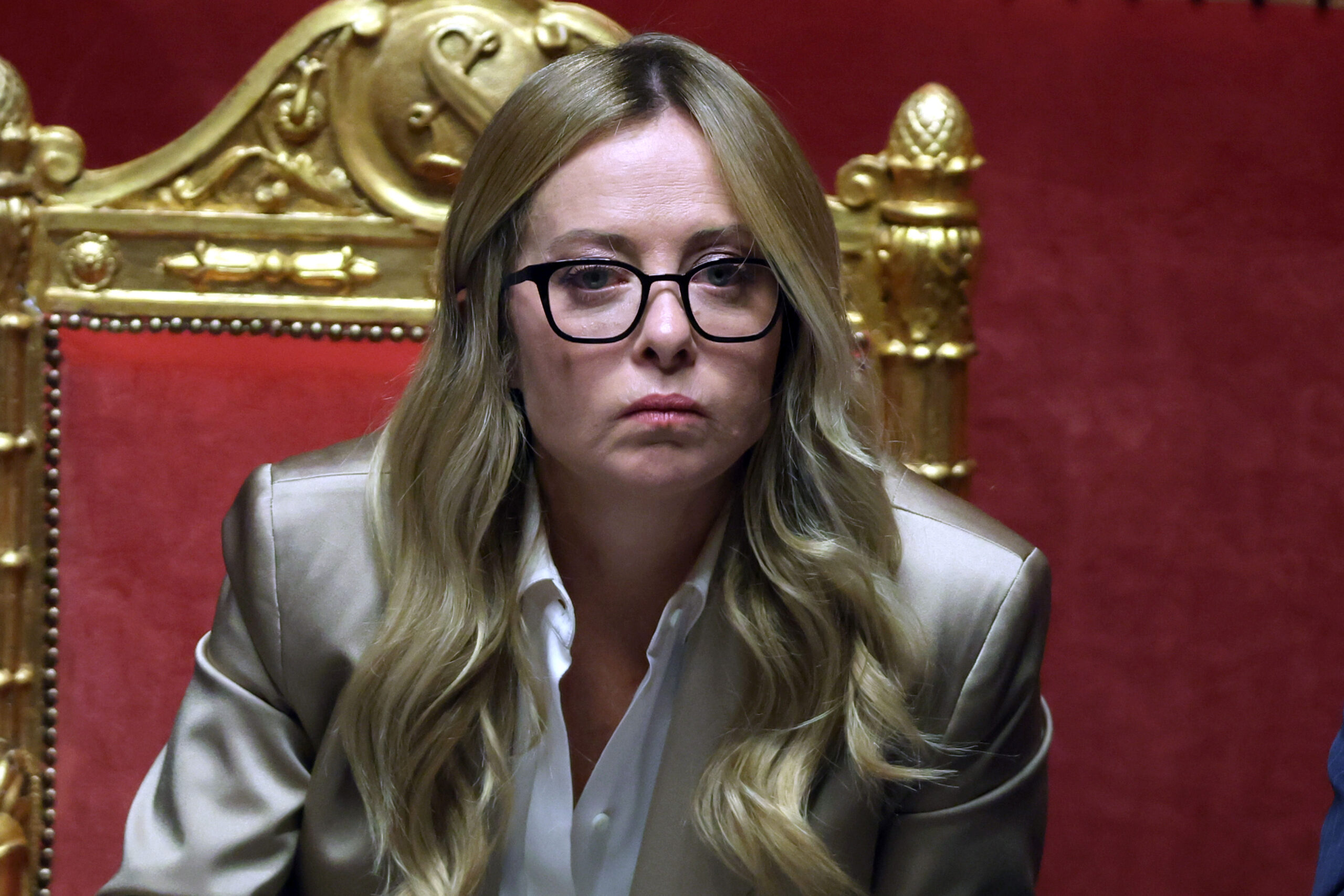
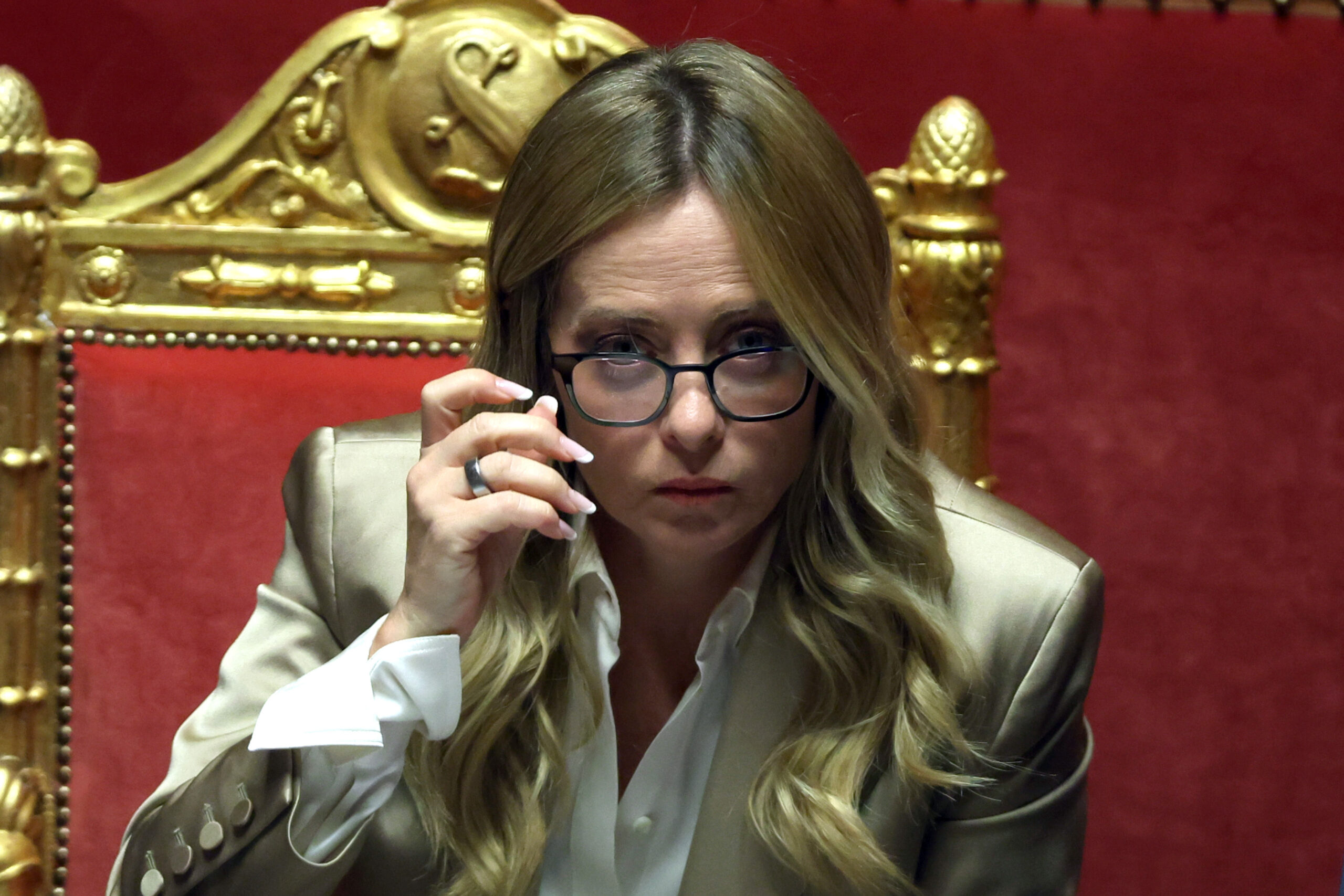
In my view, support for Ukraine is not an alternative to peace: it is what makes it possible. For if the aggressor can count on his opponent’s capitulation, why would he need to negotiate? But capitulation is not peace, it is conquest. If Ukraine stopped defending itself tomorrow, as many wish or propose, we would not have peace. We would be discussing the occupation of a European nation and the return of Soviet-style imperialism that Europe experienced for half a century. Personally, I do not regret those years; I do not regret the Russian tanks that crushed the uprisings in Prague and Budapest, and I do not regret the Berlin Wall. And no one will convince me that the capitulation of those who defend their freedom can be called peace. The peace we want, and we strive to build, even at the cost of some lack of consensus, is a just peace, because only a just peace can endure, only a just peace guarantees Europe’s security and our interests.
The government’s position, therefore, remains unchanged. Support for Kyiv, with particular attention to the civilian population, pressure on Moscow, and euro-Atlantic unity remain the pillars of our action.
In this context, we must also take into account the agreement on Russian diesel announced last Friday by the President of the United States, Donald Trump. It is a choice I consider very risky.
It is clear that we all understand, and share, the need to contain energy prices that weigh on households and businesses, including in Italy. But we must be aware that the spike in fuel prices is mainly due to the war in Iran, and not the conflict in Ukraine. The outcome of this choice is therefore uncertain, while the risks are evident. A legitimization for Moscow while its bombs continue to fall on Ukrainian cities, new revenues to finance the war, an implicit weakening of sanctions leverage: these are elements we cannot ignore, and which contradict what the Western states, including the United States, have done so far to push Putin to the negotiating table.
It is a different matter to support a ceasefire between the parties with regard to the power plants, which Italy clearly supports. We thank President Zelenskiy for immediately stating Ukraine’s full willingness in this regard. We now expect Russia to do the same and to halt attacks on Ukrainian power plants and energy infrastructure.
Moreover, in such a complex period, where so many variables escape our control, there is at least one thing we can control: ensuring that Europe does not stand idly by. Because the conditions for a peace that concerns our continent, and thus our security, cannot be defined without us.
That is why I continue to ask that the Twenty-Six designate a figure of authority, equipped with a mandate from all, and capable of giving Europe a voice at the negotiating table. And if no consensus emerges on a name, we are also prepared to consider other solutions.
If, for example, France, Germany and the United Kingdom, in the famous E3 format, believe they can act alone, better than all of us combined—and that has been their choice so far—then let them do so at least in the name of all of us and with an official mandate given by all.
Because I will be honest: the question of who sits at which table seems secondary to me. What matters is under whose name we sit at the table, and what we say there. What matters is that Europe is not in disarray, that it does not expose itself to those who want to fuel divisions and that it speaks with a single voice. For a Europe divided on the issue of formats, it presents itself as childish, and that is the only real gift we could give Moscow. And in these past days, we have already given Moscow enough gifts.
Next, dear colleagues, what is happening in Ukraine does not stay in Ukraine. The European Council will discuss in more detail the escalation of Russia’s hybrid attacks. And this is entirely justified, because the hybrid threat has now become the nth “new norm” of this troubled era.
The fact is that hybrid warfare does not declare itself and has no front. It is drones that violate the airspace of our partners, fly over airports and bases of several European countries. It is submarine cables damaged in the Baltic Sea; it is cyberattacks against hospitals, ports and public administrations; it is sabotage of railway networks.
These are disinformation campaigns designed to divide our public opinion, to discredit political leaders regarded as enemies and to influence elections, including through real forms of cognitive manipulation. And the instrumentalization of migrants, pushed to the borders as weapons of pressure.
Such a context requires a coordinated response, and Italy will put forward Brussels with a few clear priorities. Protect our critical infrastructures: I am thinking here of energy networks, submarine cables, ports, airports and the maritime domain, where Italy has exceptional expertise; support Italian industry so that it makes a decisive contribution to anti-drone and anti-missile systems; reaffirm that the security of the Union’s borders is indivisible, which means that while helping to back the eastern flank, we cannot accept that we lose sight of the southern flank.
Because defending ourselves today does not mean only having battle tanks. Defending ourselves means a hospital that continues to treat even under a cyberattack; a power plant that does not shut down; an airport that does not stop because of a drone. Defending ourselves does not mean protecting an abstract idea of power. It means protecting the daily life of our citizens.
And this brings me to the question of resources. As I have already said, security and energy are two sides of the same coin. Without security, energy costs more. And without energy, there may be nothing left to defend.
That is why we requested, and obtained, that the safeguard clause could be used not only for defense spending but also for the measures necessary to address the energy crisis.
As a result, on the maximum margin of 1.5% of GDP provided by the clause, Italy decided to use 1.2%: 0.6% for measures to combat rising energy prices, i.e., about 14 billion euros allocated to vulnerable households and energy-intensive businesses, and 0.6% for defense and security. We therefore chose, given the context, not to use the full margin allotted for defense.
But I remind that the greatest flexibility in defense and security essentially means additional resources beyond what is allowed by European parameters. It is therefore not money taken from health or education. If we do not spend it on defense, we could not spend it on something else.
Those who claim that higher security means fewer hospitals, resources diverted from essential services by a warlike government, are lying knowingly. Moreover, those same people who are accusing us from the opposition had approved, when they were in government – during the pandemic – an increase in military expenditure of 15 billion euros. And at that time, there was not even a war in Ukraine.
But I want to say to those who listen to us, echoing an argument from Minister Crosetto, whom I thank. For every 100 euros that the State spends on Defense, about 60 go to paying the salaries of those who defend our security, i.e., nearly 280,000 men and women in uniform. About 10 euros go to the daily operation of the structures.
Roughly 30 euros are allocated to investments in an industrial sector employing more than 300,000 people, often highly skilled, in thousands of small and medium-sized enterprises spread across Italy. Those who speak about waste should also explain to these families that their work is not useless. And when we buy, what do we buy? Primarily means of defense. Air defense, anti-drone systems, cybersecurity, protection of infrastructures. We buy shields.
Finally, I would like to remind you that security is also a prerequisite for prosperity. No one will invest in a country that cannot protect its networks, its ports, its data. No company exports if trade routes are not secure. Moreover, investing in security is safeguarding the savings, jobs, and innovation of the next twenty years. A country that does not invest in its own security does not save. It defers the bill. And history teaches us that this bill, in the end, always turns out to be much more costly.
Among the topics on the agenda of the Council is of course the Middle East, perhaps the dossier that most clearly illustrates how much international balances now have a direct impact on the daily life of our nations.
One week ago, while I was in Split with the leaders of the MED9 countries, we commemorated the third anniversary of the dramatic attack of October 7, 2023. A barbaric attack that plunged the entire region into chaos. I think it is important to recall this even today, because any legitimate critical approach to the actions of the Israeli government in the three years that followed cannot and must not forget what was the most horrific pogrom since the Shoah, planned and executed by Hamas.
Especially at a moment when the shadow of anti-Semitism seems to re-emerge in many countries. The security of the State of Israel cannot therefore be called into question. And I continue to think that there is a need to maintain an open channel of dialogue with Israel. That said, we are concerned by the persistence of Israeli presence in the south of Lebanon, in Syria and in Gaza. And in the West Bank, we are witnessing intolerable pressure on the Palestinian population.
As we have written jointly with France, Germany, the United Kingdom and other partners, Israeli settlements in the West Bank are illegal. And we strongly oppose those who support annexation and forced displacement of the Palestinian population.
In the face of this situation, I think Europe must reclaim the role it deserves. And the opportunity to do so will inevitably present itself with the formation of the new Israeli government, whoever wins the elections. It will be the moment to demand gestures capable of reversing the negative spiral that has persisted for too long, and to eventually reopen a political path toward peace.
That will take time, we know. But we also know that if, in the coming months, we witness an endless expansion of settlements in the West Bank, the collapse of the Palestinian Authority, or a resumption of violence in Gaza or in the West Bank itself, the two-state solution will become impossible. And that is a consequence we cannot afford.
So I will propose working, in Europe, on some precise demands, capable of creating the conditions for a return to political dialogue. Among these, the transfer to the Palestinian Authority of the tax revenues that Israel withholds today and the freezing of the E1 settlement, on which we have already spoken with our major European partners.
In Gaza, the situation remains dramatic. More aid is needed, and it must arrive quickly. And there must be a political initiative to verify whether Hamas is truly willing to lay down its arms. This would be the turning point we need, and it would open the path to reconstruction, in the interest—above all—of the civilian population.
We continue, moreover, to believe in a true peace between Israel and Lebanon, and to work toward it. As you know, Italy has hosted several cycles of negotiations and we are ready to do so again. I am convinced that the Lebanese leaders are sincerely ready to conclude a just and lasting peace with Israel. And we are prepared to support it, notably through a Franco-Italian initiative for the post-FINUL, to equip the Lebanese Armed Forces with the capacities to assert Lebanon’s sovereignty over its entire territory.
At the European Council, we will also discuss the situation in Iran and in the Gulf. Beginning with freedom of navigation through the Hormuz and Bab el-Mandeb straits, which represents a vital interest for Europe.
Restrictions and attacks in these two straits have had a direct effect on the lives of our citizens, starting with the price of energy.
The government has undertaken to limit these effects and will continue to do so with all the means at its disposal, but a lasting solution necessarily requires the restoration of full freedom of navigation: no tolls and no discriminatory restrictions.
That is why I think Europe must lead from the front, starting with the strengthening of the Aspides operation in the Red Sea, which Italy currently leads and which relies largely on the contribution of a very small number of countries. We need more ships, and we need them now.
We must then deepen our partnership with the Gulf countries. Europe and the Gulf are two regions connected by increasingly close interests, which require rules and stability to prosper. Italy has made available to the region’s countries that requested it the means to defend themselves against unjust attacks by Iran and its allies.
Attacks that, in recent days, have seen a new escalation of the Houthis against Saudi energy infrastructure, which we firmly condemn. But, in the coming phase, the priority should be different: no longer depend on a single transit point. This means building new links between Europe, the Gulf and Asia, starting with the IMEC corridor; better protect ports, submarine cables and energy infrastructures; diversify routes and suppliers. Again, Italy, with its companies, plays its part. But Europe must now do the same.
A further central chapter of the upcoming European Council will be the negotiation of the multiannual financial framework. A complex and important issue, because the Union’s budget is not a mere accounting exercise. It is the instrument through which we concretely decide what our future priorities will be and what resources we are prepared to put at the disposal of these priorities.
In recent months, we have already achieved several concrete results compared to the Commission’s initial proposal. Member States will play a more decisive role in managing the new instruments; in other words, decisions on the use of resources will not be taken solely in Brussels. The Common Agricultural Policy and the Common Fisheries Policy will keep their identity and guarantees, because farmers and fishers cannot become merely another line item in a universal fund. On the rule of law, we have obtained clearer and more objective rules, to prevent it from being used for political purposes. The new European Fund for Competitiveness will offer greater guarantees to small and medium-sized enterprises, which form the backbone of our economy. And governments will have more say in defining the priorities of the Union’s external action.
These are important results, but negotiations are far from finished. On the contrary, we are now entering the most delicate phase, the negotiations on the actual budget amount and on the necessary sources of funding.
First, there is a question of method that I also want to reaffirm here. The Irish presidency and the European institutions have set the objective of reaching an agreement by the end of the year.
We are not opposed in principle to this objective, but it must be clear that the date cannot take precedence over substance. We will not sign an agreement that would be advantageous only to meet a deadline. We will sign an agreement only when it is fair for Italy.
And concretely, what does that mean? It mainly means drafting a budget that provides clear and concrete answers. It means adequately funding the new priorities that we all consider strategic, without sacrificing policies that constitute one of the foundations of the European project.
I state very clearly: Italy will not accept a budget that reduces the Common Agricultural Policy, fisheries and cohesion. Agriculture and fishing concern our food security, an essential component of European strategic autonomy.
Cohesion concerns the ability of the single market to function without leaving entire territories behind, which would weaken overall growth.
There is therefore, in my view, no contradiction between traditional policies and new priorities. On the contrary: there is no security without food security, and there is no real competitiveness without equal dignity among territories.
In recent days, the Irish presidency has presented a new negotiation proposal, which provides for a budget of around 1.622 trillion euros for 2028-2034, at constant prices. This is a reduction of 108 billion euros compared with the June proposal and more than 140 billion compared with the Commission’s initial proposal.
Despite such significant cuts, the overall resources of the national and regional plans, which include the CAP and cohesion, have been preserved. This is a very important result and far from guaranteed in advance, to which, I am happy to say, the joint letter from the 17 Member States the “Friends of Cohesion” contributed decisively, another initiative launched by Italy, this time in cooperation with Romania.
And it is precisely to continue working in this direction that, with Romania, we will host, on the margins of the next European Council, a new meeting of the group. It will be the occasion to take stock of the negotiations and reaffirm a common position before the decisive phase.
Then remains the fundamental question of how to finance the priorities that Europe has set. In this regard, I think the starting question is not what the budget should be, but what Europe considers indispensable for the years to come. First we define the objectives, then we find a way to fund them. And not the other way around.
Furthermore, regarding the new own resources proposed by the Commission, we have several reservations, but we are prepared to work according to a clear criterion: to lighten, as far as possible, the burden on national budgets, without imposing new taxes on European citizens and businesses.
We believe that it is possible and necessary to also consider a more gradual repayment of the debt incurred under Next Generation EU, so that these repayments do not weigh on other European policies precisely when it is necessary to invest more.
And in general, I think that, to finance strategic priorities for all of us, no instrument should be excluded a priori.
There are then some questions on which, for Italy, the compromise will necessarily need to be improved.
The first concerns our overall position. The Irish presidency’s proposal essentially keeps the resource allocation criteria unchanged, which continue to penalize our country. We cannot accept that Italy pays more into the European budget while receiving less in return. It is a mere question of fairness.
The second concerns the “rebates,” those reductions in contributions enjoyed by certain Member States, on which the new proposal offers no progress. I struggle to explain why precisely those who call for “modernizing” the budget, i.e., reducing it, claim to preserve privileges that arose at an earlier stage of European integration.
If modernization is to happen, it must apply to all. And I would add that one cannot claim that sacrifices are European and privileges national.
The third question, which may seem technical, says a lot about how Europe operates. It concerns the principle that European funds cannot finance activities that significantly harm the environment. A fair principle. But the Commission’s initial drafts of implementing rules threaten to automatically exclude entire sectors, which is precisely what governments had sought to avoid.
We cannot ask a steelmaker to invest billions in the transition, to pay CO₂ quotas, and then tell it that, precisely because it is a steelmaker, it cannot access European funds intended for decarbonization. We cannot also say we want to strengthen energy security and then automatically exclude the infrastructures necessary to guarantee this process.
And I also want to say that government decisions are not drafts that bureaucrats can fix at will. The drift whereby heads of state and government make decisions that bureaucratic rules systematically dismantle is unacceptable and must be corrected.
Our overall assessment of the package will also depend on how these knots are untied. But on this point, as I said, we will have the opportunity to return to it.
The European Council will also hold a strategic debate on the enlargement process and on the Union’s internal reforms. A topic that Italy has always attached great importance to. Only a united Europe, supported by solid political consensus, can reach the critical mass necessary to stay competitive, influential, and secure.
Starting with the Western Balkans. Of course, each journey has its own characteristics, its own timetable, and its own conditions. But the political prospect is the same: to solidify the European anchoring of nations that are part of our history.
We support an enlargement founded on merit and mutual accountability. It is up to candidate countries to carry out the necessary reforms and gradually align with European rules. However, it is up to the Union to recognize, without delay, these results accompanied by tangible progress. That is why, in the short term, our priority is to firmly back the advancement of the process in Montenegro and Albania. Because their success would have a reach that goes far beyond their borders and ours. It would show the entire region that the accession process is real, that reforms are rewarded, and that when a candidate country does its part, the Union is capable of doing its own part.
Finally, the European Council will hold a strategic debate on managing migratory flows.
I have repeatedly emphasized, in this Assembly, how much the European approach to this issue has evolved in recent years.
At first, many believed it was impossible for topics such as preventing departures, rather than managing arrivals, strengthening the external dimension, establishing partnerships with origin and transit countries, making returns more effective, and developing innovative solutions, to become part of the European debate. But that is what happened. And this change in approach, to which Italy contributed decisively, is producing tangible results.
It is not the government that says it. It is Frontex’s data that show it. In two years, irregular crossings of the Union’s external borders have fallen by more than half.
And this year, the decline continues: minus 35% in the first eight months compared with last year. In the central Mediterranean, i.e., on the route that concerns Italy, arrivals have fallen by more than half.
The problem is not solved, we know that. But these numbers show one simple thing: the alternative to the “open borders” policy has always existed. It has always existed. For years, people simply chose not to implement it.
We intend to continue on the path we have embarked upon, without letting our guard down. Especially since the Ceuta events in late July clearly showed how quickly border pressures can arise at Europe’s external frontiers.
In light of these facts, as you know, Italy decided to reintroduce temporary checks at internal air and sea borders with Spain, on security grounds. And allow me to say that I find the ensuing debates rather surreal, notably from some opposition parties, who clearly seem more concerned with defending the Spanish government’s position than Italy’s security and borders.
I remind you that the Schengen code expressly provides for the temporary reintroduction of border controls for reasons of public order or security. It is indeed a regularly used instrument: since 2006, Member States have resorted to it nearly five hundred times, and in more than thirty cases, the controls directly concerned Italy. France, for instance, has maintained controls at its border with us for more than ten years.
It is therefore hard to support — dear colleagues — that Italy does not have the right to use an instrument that has been used against it dozens of times. I remind my colleagues that Italy has the same duties and the same rights as the other Member States, but it also has the same rights. We do not accept that defending borders should be a right for others and a fault when it concerns Italy.
Ceuta taught us another lesson: border crises do not always arise spontaneously. Sometimes they are orchestrated. People-smugglers organize them, social media amplifies them, misinformation fuels them.
Those who use desperate people as a means of pressure at our borders do not simply force a border. They attack Europe, and Europe must equip itself with the necessary tools to respond.
Still in the wake of Ceuta, on August 1, Italy, together with Denmark, took the initiative of a letter signed by 22 heads of state and government out of 27, in which we called for greater protection of outer borders, tougher action against smuggling networks, more returns, and a better ability to anticipate and respond to similar situations.
And we asked that the factors attracting migration be seriously addressed, including large-scale regularizations. Of course, each Member State retains its competences and makes its own decisions. But we live in an integrated space, with free movement and common borders. And what a State decides at home does not necessarily stay there: it can have repercussions on other Member States and jeopardize the proper functioning of the Schengen area.
If the message is that an irregular entry can later turn into a legal stay, the risk is to encourage new departures, strengthen the migrants’ smuggling business model, and negate part of the efforts we are making to reduce irregular arrivals. And we cannot allow that.
Then there are returns. For years in Europe, an expulsion decision was often just a piece of paper. Today we have more effective tools, notably thanks to the new European rules, and the results are visible. This year, returns have reached their highest level ever recorded for the same period, and they continue to rise. I would like to thank Minister Piantedosi and all those who work daily to achieve this result. Because the message must be clear: those who enter Italy illegally cannot count on remaining there.
And then there is the work along the migratory route. Thanks to collaboration with the International Organization for Migration as well as with Algeria, Libya and Tunisia, around 65,000 migrants have voluntarily returned to their country of origin over the past two years, even before attempting to cross the Mediterranean. That is 65,000 people who did not entrust their lives to smugglers.
But for this model to work even better, closer cooperation from third countries is essential. And when such cooperation falters, Europe must use every lever at its disposal: diplomacy, cooperation, trade, visas. Because those who want to be our partners cannot treat returns as a standalone chapter.
There is still more ambition on the external front and better coordination with national initiatives, starting with the Plan Matteo for Africa, born from the conviction that Europe–Africa relations must be based on equal partnerships, investments and shared growth.
The same goes for innovative solutions. Italy has opened the way with its centers in Albania, and today, “return centers” in third countries are provided for by European regulations, and many Member States want to engage in this path. It is now time to move to implementation. The Union must support those who want to launch pilot projects, providing them with resources, expertise, and means, fully respecting European and international law. And these resources must also find their place in the next EU budget.
We will discuss this on the sidelines of the European Council, notably at the traditional working lunch dedicated to innovative migration solutions, which we have, as always, organized jointly with Denmark and the Netherlands.
In conclusion, dear colleagues, beyond the individual dossiers, the European Council that awaits us carries a clear political significance.
We live in a world where security, prosperity, and many of the balances we have considered as given for years are not guaranteed. And Europe must decide how it intends to respond. It can continue to set rules as if nothing had changed. Or it can face reality and equip itself with the tools necessary to defend its economy, its security, and its freedom.
And it is for the latter that we are working. An Europe capable of reconciling transition and industry, traditional policies and new priorities, cooperation with its partners and defense of its borders. A pragmatic Europe that does not fear correcting its choices when reality changes. A Europe that focuses its strengths on the major challenges that no nation can meet alone, and that knows when to step back where nations do better alone. A Europe strong on major issues, and discreet on everything else.
For years, we were told that, to count in Europe, Italy had to renounce defending its interests. We proved the opposite. For a strong Europe needs strong nations. And one can work toward a stronger and more credible Europe without ceasing, not even for a moment, to defend Italy with pride.
And it is with this pride that, once again, I will go to Brussels. With the same determination as millions of Italians who daily work, produce, innovate, and sustain this nation. Because it is to them that we owe a Europe that protects them, rather than placing obstacles in their way. And I want to tell them that, wherever their future is decided, Italy will be there to make its voice heard.
Thank you.