
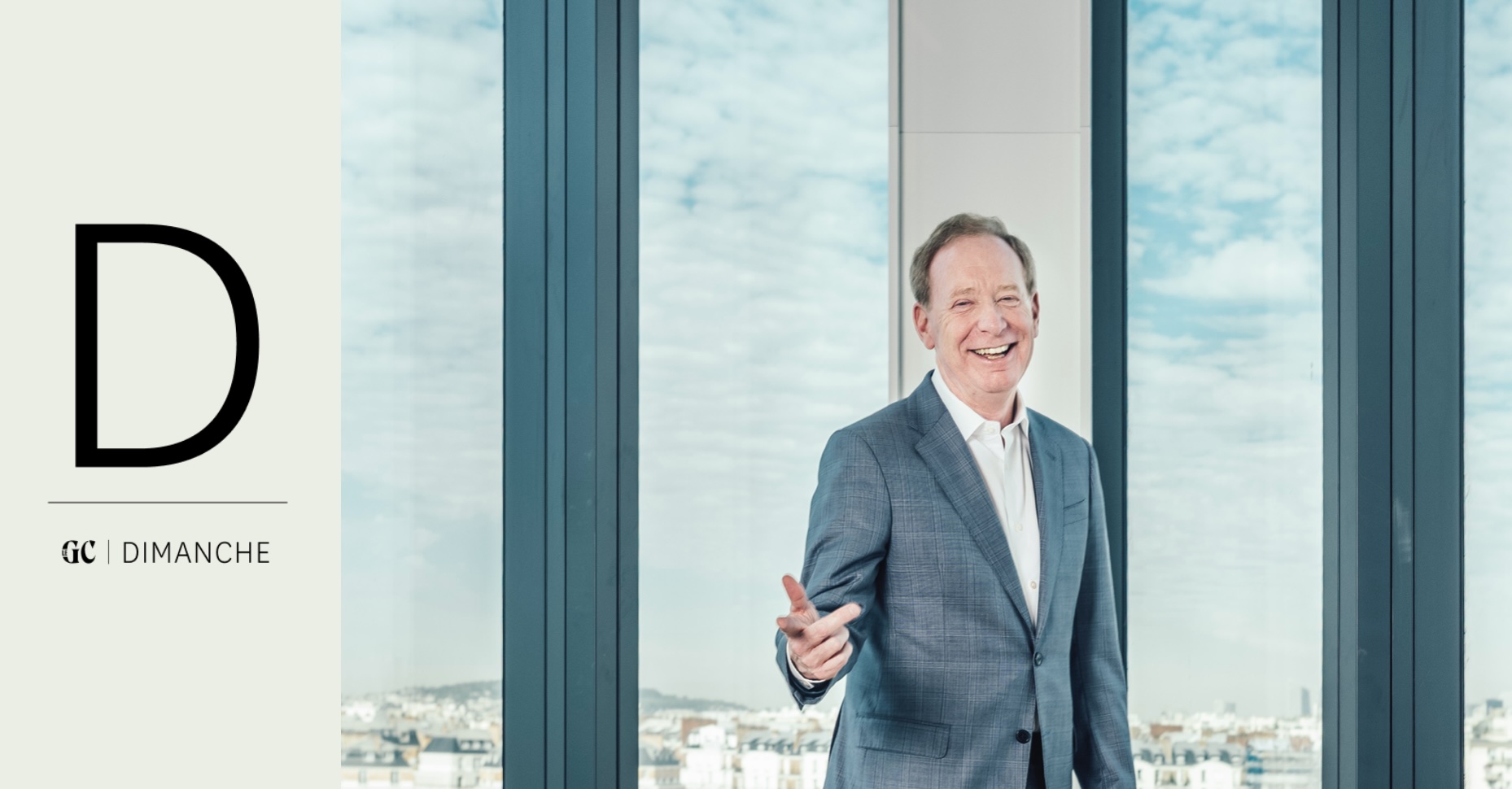
The coffee is served in a paper cup. We are on some floor of a glass-walled building overlooking the ring road, and the man sipping it in small sips is one of the most powerful leaders in the global economy.
Perhaps Brad Smith’s first riddle. President of Microsoft, a U.S. lawyer with an impeccable pedigree, a senior administrator of the company. “Thirty-three years in the house,” he insists, out of the fifty-one years the giant founded by Bill Gates in 1975 has.
Affable, courteous, almost soothing, with a broad smile and a crisply pressed shirt, he operates on the fault line of the contemporary, where the enormous concentration of technological power in the hands of a few often quirky men melts law and is about to implode Western institutions.
Brad Smith is one of the figures in this gigantomachy with apocalyptic overtones. But it doesn’t seem to trouble him at all.
From Chartres to Redmond
There would be plenty to worry about. The explosion of artificial intelligence unsettles the foundations of the world’s economic giants. Microsoft included. Windows was, for a large part of humanity, the window onto the digital world; that role is increasingly, day by day, being taken by Claude or ChatGPT.
Brad Smith isn’t naïve: “The traditional heart of Microsoft is classic software. And the very nature of software development is changing.”
He pauses, becomes a historian, almost an anthropologist, and offers an observation that strikes us: “Until recently, software was handmade. When you think about it, the most advanced technology there is was produced by human fingers typing on a keyboard.”
The engineers who built the virtual cathedrals of our time, even as they strive to disrupt everything, used to share at least this with the builders of Chartres: they worked with their hands.
Perhaps that is the real rupture. The era drawing to a close, as code makes code and machines venture into a spiral of recursive improvement, will have been digital in the literal sense of digitus (the finger in Latin), typed letter by letter by millions of phalanges.
But if AI marks the end of the digital age, what does it begin?
When software devoured the world
What this start portends can be measured by the fate of Microsoft’s most emblematic products. Who will still need Excel in the era of conversational agents? His answer is a deft high‑level dodge: “I think we’ll still look at numbers in a table a lot. But what will have more value tomorrow, getting Excel to perform tasks, or knowing how to ask the right questions to get the best answers? I’d say the latter.”
To gauge the reach of this reversal, one must go back to a 2011 essay in the Wall Street Journal, famous in Silicon Valley but still little known in Europe. Its author, Marc Andreessen, cofounder of Netscape and now one of tech’s most powerful investors, is today among the main backers of the new Trumpism. The title set the program: Software Is Eating the World, software devours the world.
Following the 2008 crisis, Wall Street regarded the tech sector as a bubble. Andreessen argued the opposite. In his view, the revolution was just beginning and would extend far beyond the realm of computing. Evidence was already piling up. That same year, Borders bookstore chain went bankrupt, while Amazon, an online retailer, became the world’s largest bookstore. The previous year, Blockbuster had sunk in the face of Netflix. Music would belong to iTunes and Spotify, and advertising to Google. According to him, all sectors would follow: banking, automotive, health, agriculture, up to defense. The rest of the decade vindicated him beyond his wildest dreams. The world’s first taxi service, Uber, owns not a single car, and the first host, Airbnb, does not own a single room.
In the disruption
The acid of software dissolved the traditional economy to recompose it around itself. And since software replicates itself to infinity at near-zero cost, value had to concentrate in the hands of a handful of companies, a handful of cities, and a few thousand well-tempered fingers. This prophecy was fulfilled beyond measure. Ten years after the article’s publication, by the end of 2021, software occupied almost the entire top tier of market capitalizations. Between Apple and Google, Microsoft reigned.
Then AI arrived.
Since the summer of 2025, the world’s most valuable company is Nvidia, the leading designer of the chips without which the AI race would be impossible. As the Silicon Valley adage goes: “In a gold rush, it’s the shovel sellers who get rich.” And if AI devours code, value shifts again. From software, which can duplicate itself at zero cost, to a new, costly industry: chips, land, electricity.
That is Brad Smith’s job: to transform Microsoft into an industrial company that would not have seemed so distant to the great names of the 19th‑century Industrial Revolution. “There is a part of Microsoft that is entirely industrial. We have become one of the world’s largest players in construction, in operating infrastructure, in energy and in liquid cooling.”
It may seem paradoxical, but what Microsoft does in the face of AI is to look less and less like a software publisher and more and more like Vinci or EDF. “They are two very different companies under one roof, and we must figure out how to bring them together,” he tells us.
This transformation has few parallels in history. Early 2025, Smith himself announced an investment of more than $80 billion in data centers. Since then, the pace has only accelerated. Nearly $145 billion for the year ending June 2026, more than $40 billion in just the last quarter, and a target of about $190 billion for the calendar year.

The tobacco-logic king company invests each quarter more than the Manhattan Project as a whole and now devotes to its undertakings an amount equivalent to the GDP of an average power. All the more so when you add the $13 billion invested in OpenAI since 2019, later converted into about a 27% stake in its restructured creation, which in turn committed to purchasing $250 billion worth of computing services. The creature funds the creator who funds the creature.
Microsoft or the Church
In 1994, Umberto Eco had an intuition that at the time seemed like a joke. Almost no one imagined back then that computing would become a theological affair.
He lamented that too little attention was paid to “the new underground war of religion that was transforming modernity.” According to him, the world split between Apple users and Microsoft users, and in this schism he recognized the traces of a centuries-old bloody quarrel: for “the Macintosh is Catholic” and Microsoft is Protestant.
Thirty years later, the Protestant giant is in the throes of conversion. Smith tells us with good humor: “We were the first business leaders to meet Pope Leo after his election.”
He is enthusiastic about the contents of the encyclical Magnifica humanitas, whose fourth chapter he knows almost by heart. He unfolds before us its thread: truth, without which there is no democracy, and which disinformation threatens; education and critical thinking; the dignity of work, in the vein of Rerum Novarum, Leo XIII’s 1891 encyclical, which invited employers and workers to come together and reminded how work gives life meaning. And this paragraph that strikes him, where the pope links protecting children with a very provocative question: will AI engender a new form of slavery? The pope starts with what one might easily imagine—the fate of workers in the supply chains of our devices—and goes further. If the work of men were to serve only to train an ever smarter machine, that would be servitude of a new kind. The tech sector, says Brad Smith, should listen to this message, “instead of trying to give birth to a new species, something that would surpass us, almost a deity.”
Does he go as far as to think we should teach theology to language models so that, if they do harm, they can at least recognize it and ideally confess it? “That’s probably not where I’d start!” He does not dismiss those who think so, but AI remains for him a tool in the service of people. He says he greatly appreciated the pope’s two words about magnificent humanity, which remind us what AI must preserve, protect and promote.

We press him on revelations about exchanges between Anthropic and religious authorities. His answer is clear: “I feel that is headed in the wrong direction.” Asking theologians to conceive AI as a new creature is not something he supports. Like the Church, Brad Smith refuses to attribute consciousness to machines and aims to place humans at the center.
He states it plainly. Universities and churches exist to preserve a human civilization, “and not a civilization populated with all sorts of new species.” He notes with pride that Microsoft is the only one of the major tech companies to claim this universality and the expression “empowering people.”
A Normal Pope
In the religious-war Eco predicted, Redmond has here explicitly chosen its side.
Microsoft does not come to the Vatican as a novice. As early as February 2019, Smith was received by Pope Francis. He told him that the tech world needed “a human voice like that of the Church,” and he added, “we appreciate yours.” The following year, he signed at the Holy See The Rome Call for an Ethics of Artificial Intelligence, alongside IBM and the Pontifical Academy for Life.
The honeymoon did not begin with Pope Leo XIV. But it is with him that it takes on an added dimension.
As the conversation progresses, a likeness becomes more evident between these two Midwestern Americans, born on the shores of Lake Michigan, only four years and about 150 kilometers apart, one in Milwaukee in 1959, now at the head of the Church of software, the other in Chicago in 1955, at the head of the Church as a whole.
They embody another way of being American, which stands out in today’s context. They are a pope and a president who, at heart, seek to be normal.
Brad Smith, in that sense, resembles the image Microsoft has now, a paradoxical giant because it seems determined to be normal. He has neither the sultry edge of Meta, nor the pop vibe of Google, nor the messianic tilt of the new AI labs. He is the model student. He talks about compliance without blushing, calls for regulation, engages in polite dialogue with Europeans, and pays attention to law. Like good students, Microsoft can be dull, and so can its products. Copilot is less revolutionary than Claude or ChatGPT, but many companies use it because it inspires more confidence in data security. It’s not fun, but it works.
The opposite of the apocalypse
While many of his peers speak of war, the end, or disruption, Brad Smith advocates for the paradoxical charm of normality.
That struck us from the start, when he welcomed us by speaking of his readings, and first of De l’esprit des lois, which he has just reread. More than Tocqueville, he turns to Montesquieu at the moment, in his view the greatest gift France has given the United States: the theorist of the separation of powers and checks and balances. “AI has become extremely powerful. It’s time to ask ourselves which powers to oppose it with,” he tells us, almost combatively.
One must say that the backlash that is brewing in the United States has few precedents. Americans are turning against AI. In May 2026, Gallup measured that 71% of Americans oppose the construction of a data center near them, about half of them strongly. That’s higher than opposition to a nearby nuclear plant, which tops at 53%. Today this movement is accelerating. According to the Annenberg Public Policy Center, opposition has gained twelve points in four months, and majorities of both Democrats and Republicans share it. There are now hundreds of local anti-data-center groups in almost every state. New York and Texas have suspended permitting for large projects, and about fifteen states have considered a moratorium. Donald Trump himself railed against it, saying on Truth Social that communities that refuse these facilities are choosing to stay “backward and poor.” Microsoft has even abandoned a project in Wisconsin in the face of local mobilization, and since then it has pledged not to rely on non-disclosure agreements for its data-center projects.
Facing the AI populism vibe shift, Smith rejects any prophecy. “No one has a crystal ball. One of the common errors in our sector is to multiply predictions, often false, rarely questioned.” He adds: “We must be a industry that lives under the law.”
We may grimace, but he anticipates our remark, saying: “We don’t always like every law, but we live under the law.”
For sure
Europe remains, for which his interest seems sincere. First, because it is a much more important market for Microsoft than for young AI labs. Second, because contemporary Europe seems fairly close to what Microsoft wants to defend, a well-regulated competition, predictable rules.
One hears the French president’s discourse, and it is not a coincidence. He tells us, “Among all heads of state in office, I have met no one more thoughtful about what AI means for a society, and about the questions it forces us to ask.”
He also recounts, amused, European officials who told him their worry about not having their own Facebook, and a few days later their relief that they do not have one.

Between acceleration and stagnation, isn’t there a third way? His advice comes in a few words. We should not forget what we already have. “It is very natural to focus on what we lack, but the essential is to remember what Europe possesses. An extraordinary range of specialized industries. Pharmaceuticals, chemicals, automotive, and I could go on for a long time.” The priority is therefore to build the future without sacrificing what has made the continent successful: protect privacy, keep data in Europe, and above all one thing: “Europe cannot afford a future where the know-how and experience of its companies would be captured to train an AI model.” This know-how must remain distributed among many companies that continue to profit from it; that is the condition for good jobs.
As for dependence, he rejects both absolutes. “It would be unrealistic and imprudent for a country to decide to use only technologies designed on its own soil; it would cut itself off from best practices and the most advanced technologies. But it would be just as imprudent to use only technologies from elsewhere. That is where national champions come in, such as Mistral, or a company like Cohere, now British, German and Canadian.”
He assigns to Microsoft an unexpected role in this arrangement. “Our role and our responsibility, as U.S.-headquartered companies, is not to merely be competitors, but to help build this balance. Our partnership with Mistral aims to help it develop sovereign solutions, by giving it access to computing power and by using its own as well.”
This Is Not the End
Can we take Microsoft at its word? The company that today praises checks and balances was, at the turn of the century, the very symbol of abuse of dominant position. Smith knows this better than anyone. Becoming chief legal officer in 2002, he spent a decade settling antitrust conflicts with governments around the world, after the 2001 agreement that ended four years of battles with Washington.
If the head of Microsoft is calling today to reframe AI within the law, it is the result of a political and legal process. Montesquieu would probably agree; do not ask the powerful to be virtuous, give them laws and judges, and virtue will follow.
The midterm elections are approaching, a broad and structured call for regulation is forming, political struggles are beginning. Another American jurist recently told us that AI models worth billions are today less regulated than a tuna sandwich.
Arriving in the tower, we joked about whether we were more impressed to interview the president of Microsoft or a king of Spain. It is, of course, a sign of the times.
But there is another sign of the times. In their interviews, Brad Smith and Juan Carlos have both, convincingly, praised Europe and democracy.
That should mean something.