
The enemy that points at us, the new paper volume from Le Grand Continent, is now available at Gallimard and in all good bookstores. Click here to discover it — receive it directly and support an independent editorial team by subscribing to the magazine
It seems that the major conflicts of the 2020s share a common thread: they always end up playing out at sea. From the blockage of Ukrainian grain exports in the Black Sea to the closing of the Strait of Hormuz following the conflict with Iran, to the Houthis’ attacks on shipping through the Bab el-Mandeb, maritime routes have become major strategic theaters. Has modern warfare become a war of maritime flows?
Indeed, all recent conflicts spill over into the sea. Today, our maritime spaces have become arenas of confrontation, in which the principle of friction is regularly exercised, whether between states or non-state actors, such as the Houthis. The ability to destabilize maritime and commercial flows has become a strategic asset. It is the global economy as a whole that is gravely disrupted as a result, with dramatic consequences. This capacity to perturb flows is an attribute of power in modern warfare.
One of the first impacts of the war in Ukraine was the cessation of grain transport and, for countries dependent on cereals, notably in Africa, this turned into genuine food crises.
The cascading consequences of the October 7, 2023 attack in Israel, and the Houthis’ involvement in Middle East conflicts, made the crossing of the Bab-el-Mandeb Strait unusually dangerous, to the point that a European security operation had to be created, ASPIDES: 60% of traffic had been suspended and was naturally rerouted towards the Cape of Good Hope, off southern Africa.
In the case of the war with Iran, in spring 2026, the shock had immediate consequences on energy supply from the Arab-Persian Gulf and thus – in the end – on fuel prices. This situation requires strategic and political solutions. For one cannot move millions of tonnes of oil by land, the volumes being far too large compared to existing infrastructures. The time and cost of building sufficiently robust pipelines, their dependence on alliances, are far too significant.
Moreover, the seas are not only conduits for these flows, visible on the surface of the ocean or invisible in the cables laid on the seabed: they are also stocks. They will be the subject of conflicts tomorrow.
What does that mean?
The questioning or coercion of freedom of navigation by certain actors is not the sole aspect of current conflicts. Harvest fish stocks, mineral resources lying in the seabed and of which some remain untapped, are increasingly the object of desires and predation, if not direct attacks. This is the case in the Gulf of Guinea, and more generally in the South Atlantic. Illegal fishing exerts pressure on these fish reserves, to the point that some African coastal economies are now in danger. It is the sovereign capacities of certain African countries to guarantee protein-rich food for their populations that are being challenged. There is not, at the moment, sufficiently effective regulation to counter these actions.
The capacity to destabilize maritime and commercial flows has become an attribute of power in modern warfare.
Admiral Vaujour
Rare earths are also highly coveted. One can expect that a conflict could break out over the exploration and exploitation of the seabed. The resources contained in polymetallic nodules are today indispensable to our globalized economy. Some countries, including France, advocate a moratorium on their exploitation, but other countries do not hesitate to seize these resources.
What about underwater infrastructures?
Whether it is energy cables, oil and gas pipelines laid underwater, or Internet cables, these infrastructures face pressure and attacks. They are major strategic assets. I should note that 30% of the world’s fleet of cable-laying ships is operated by French groups. In a moment of ultra-competition, this is a real asset.
Beyond underwater infrastructures, coastal infrastructures have also become more vulnerable. Indeed, with increasingly abrasive coastal zones, the cost of controlling the seas has risen sharply in the 21st century. On land, sensitive sites are targeted by long-range ballistic missiles and precise aerial drones. Mobile units at sea, in particular, are less exposed but must operate further from the coast, offshore, and require a high level of self-defense.
Is this the result of growing technological sophistication to monitor what happens at sea?
The sea is indeed becoming increasingly monitored. Today, surface units and aircraft carriers are visible from space thanks to constellations of satellites. The transparency of the kill zone, typical of the Ukrainian battlefield, is not yet the standard in littoral spaces, but we are approaching it. This is not the case for the underwater space, which remains very opaque. This new reality obliges us to work on the mobility of our units as well as their protection and to continually develop the agility with which we operate at sea.
concretely, through what could this mobility be achieved?
France is a global power by its geography. We are on all the oceans of the world, we must not forget it. We are a Pacific, Indian Ocean, and Western Atlantic coastal nation because we have a presence in Papeete, Nouméa, La Réunion, Mayotte, Guyana, the Caribbean. The sea is not a peripheral part of France but a strategic depth that must be truly exploited.
When we speak of mobility, we also mean mobility between theaters of operation: moving a carrier group from the Baltic/North of Europe theater to the Indian Ocean theater in a few weeks is an intense and complex maneuver that few navies know how to execute with the logistic fleet.
And finally it is about tactical mobility to adapt our modes of action to the new tempo of operations. The “tactical time” has shortened considerably.
Back to the Ukraine war. It is precisely through sea crises that we began to question the idea of security guaranteed by interdependence.
Indeed, Europe had welcomed globalization as a solution to the continent’s security and defense issues: economic interdependence, broadened to a global scale, appeared not only as a path to greater prosperity but also to long-term peace, both within the common market and at the global level.
Progressively, since February 24, 2022, at a pace varying by state and by continent, the collective illusion of security through interdependence has dissipated. Force has become a means of resolving conflicts. Russia, through its aggressive behavior and its invasion of Ukraine, has revived this European awareness of danger.
Admiral Pierre Vandier said in these pages that the enchanted interlude of globalization and peace is closing, giving way to a murmur of history in which we will have to raise our voice. This is precisely what we are living through.
Have we already tipped into the “wars suffered,” to borrow an expression from Thierry Burkhard, former Chief of the Defence Staff, as opposed to “wars chosen”?
That is also my observation. Indeed, we have lived through chosen wars, in the sense that the operations conducted by France and Europeans were operations we called “external” — interventions in crises more or less distant, but where we chose to engage, without obligation. Things have changed, in favor of wars endured: the conflicts we did not choose, for which we have an obligation to involve ourselves – without necessarily taking part, because they now have direct consequences on our economies and our countries.
Progressively, since February 24, 2022, the collective illusion of security through interdependence has dissipated. Force has become a mode of resolving conflicts.
Admiral Vaujour
The tragedy of interstate war is returning to our continent. It is a reality we could not imagine, and yet it is what will mark these four years of war in Ukraine: the awakening for Europeans to the dangers of the world. War is no longer an anomaly or a passing crisis: it is set to last, with little hope that things will ease in the coming years.
The current Chief of the Defence Staff, General Fabien Mandon, foresees a high-intensity conflict within three years. The National Strategic Review clearly defines the threat with a 2030 horizon. French intelligence services share the same diagnosis, in concert with their German, British, and Eastern European counterparts. What could this conflict consist of?
The main threat facing Europe today is Russian. Russia invaded Ukraine, a sovereign country. It notably multiplies aggressive behaviors at Europe’s borders. It continues to rearm without interruption, with an industrial production base that has greatly strengthened, and it projects into a long-term war economy. It is therefore our duty to anticipate and to reflect on the possibility of a direct clash with this particularly belligerent adversary.
As for timing, setting a dated horizon allows us to move much faster through the preparatory steps. This is not about fear, but about being pragmatic, boosting positive energy, planning to be ready to defend ourselves and our allies. One of my American counterparts had, in his office, a clock counting down to January 1, 2027 and showing it to all visitors, to clearly convey that his navy was preparing with determination for the next possible shock in the Indo-Pacific space. Imposing a timeframe has virtues, the first of which is collective awareness.
We do not have the right to watch what is unfolding without preparing and acting.
In an era of unabashed power dynamics, can we still count on international institutions to delay as much as possible this moment of impact?
For some states, military power has become a political lever like any other to weigh in world affairs. This military power is now indispensable in an era where unpredictability has become the norm and violence a habit. A few years ago, it would have been unthinkable for Israel to strike Iran or for Iran to launch hundreds of missiles at Israel. All of this began in February 2022 in Ukraine, and gained new momentum starting October 7, 2023, in the attack on Israel. This rise in the violence threshold has only intensified since.
Meanwhile, international institutions, such as the UN, are scarcely heard. This is the sign that these regulatory tools are, unfortunately, less audible, hence less credible. There was a time when the mere movement of the UN Secretary-General in war-torn countries would end hostilities and enable negotiations to open. We need powerful regulatory tools to make the rule of law prevail over force.
Is the French military apparatus capable of sustaining this high‑intensity conflict you foresee?
If we want to be respected and heard, we must assert our power. This is the foundation of our credibility. France has the means, which it has managed to preserve. Our defense industrial base allows us to complement this sovereignty in an unparalleled way in Europe. This is true for combat capabilities, as well as for the nuclear forces.
The efforts made over many decades to establish a reliable, permanent, and credible nuclear deterrent pay off. For the Navy, it is the oceanic component of submarine-launched ballistic missiles, but also the airborne component of the nuclear naval air force that operates from the aircraft carrier, in addition to the strategic air forces of the Armée de l’Air et de l’Espace. France’s voice on the international stage is fundamentally credible, particularly because of deterrence.
What operational exercises enable the Navy to prepare itself?
All our exercises aim to strengthen the resilience of the Navy, in conjunction with the other armed forces. We must be capable of testing our vulnerabilities over time, facing different kinds of threats. For example, over the past ten years, our naval bases have primarily prepared to counter terrorist threats. They now prepare for a “state” attack, with more lethal means. We are making rapid progress, notably through more realistic exercises: a way to honestly diagnose our weaknesses.
The NATO alliance is particularly interested in these exercises, which testify to the ability to adapt to the current state of the threat. This way of testing our operational capabilities relies on the principle of free play, meaning there are no rules other than those of war: teams play the role of our opponents, without limits, reproducing their combat methods, which allows us, by facing them, to examine our own level with lucidity. And to put in place everything so that our systems, our organization, and our know-how can be adapted very quickly to the level of the threat.
Besides the tactical aspect, we must also adapt to new forms of weaponry.
This is the problem of the massification of threats, which we could observe in Ukraine. The resilience of the Ukrainian army and all the armies now relies on the ability to cope with the massive proliferation of weapon systems that we call low cost. Previously, one favored a small number of high-tech weapons. Now, it is necessary to combine the two: drones and ballistic missiles, both in defensive and offensive terms. The Houthis launched ballistic missiles at French Navy ships after the twelve-day war. They possess not only these highly sophisticated and hard-to-source weapons but also low-cost aerial and surface drones. This broadens the spectrum of threats we face. Our objective is to reduce the cost per kill, i.e., to use the most suitable weapons in terms of effectiveness and cost against the different threats.
Therefore we must make our units more capable now, in the very short term, by adapting to the era of drones. In the long term, we must develop a strategic vision that takes into account a different scale, that of long programs and associated infrastructures, or the scale of human resources. Building a submarine for deterrence, like the Invincible submarine, is projecting ourselves to 2080. It is also about constructing infrastructures that will last at least 100 years and will host these technological jewels, with enough margin to allow future evolutions. This requires us to do foresight today. The Barracuda submarines, conceived over thirty years ago, are today delivering exceptional service: we did not err in their design, the quality of the host infrastructures, and the transfer of know-how between the two generations of submarines. We must continue to look far ahead and never stop investing.
What are today the strategic priorities of the Navy? You spoke of agility and resilience. What are the others?
The speed of adaptation is the priority. Merely having hyper-technology, a large number of ships, and well-trained crews is not enough. We must accelerate analyses and adapt much more quickly. If Ukraine resists, it does so because it manages to adapt to the Russian threat, i.e., to bypass it. The same goes for the Russians: their ships are far less often hit by the Ukrainian Navy than at the start of the war, even though nearly 30% of their fleet was neutralized in the Black Sea.
The speed of adaptation is the priority.
Admiral Vaujour
To achieve this, we must absolutely have units adaptable by design, i.e., tools that are not digitally closed and more modular. Until now, systems were produced according to an industrial model that could not be changed: it was up to the company to ensure maintenance and to perform regular updates. It becomes urgent to multiply open architectures to optimize the use of our equipment. We must involve our industrial partners in this new way of acting.
Has this principle of openness been applied to the “France libre” aircraft carrier?
Its model indeed rests on a platform that is both rigid (a hull) and perfectly modular, equipped with an open digital architecture that can evolve in real time. The digital artery of today may not be the same in fifteen years: we will keep it evolving continuously to adapt to new threats. France Libre will also host an hybrid air group, composed of drones and manned aircraft, whose modularity will allow it to perform the ordered missions.
This agility we have in capability terms, we must also have in our way of conducting operations, which we call modes of action: this is true in the fight against illicit trafficking, as in high-intensity missions.
How can this principle of openness, used in the digital domain, be applied to the Navy’s modes of action in a more general way?
Let us take the example of fighting the phantom fleet. Intercepting a cargo ship is not the hardest part. The real difficulty is ensuring continuity between military action at sea and judicial action on land. The commander of a ship in the French Navy has the power to observe a violation of international law at sea. It is a distinctly French asset that other nations, especially European ones, do not possess. This is the strength of our model: the maritime prefect is simultaneously the commander-in-chief of the air-sea forces in his area of responsibility, under the authority of the Chief of the Armed Forces, and the sea prefect under the authority of the Prime Minister; he thus has a direct link with the public prosecutor.
The tactical tempo has shortened considerably.
Admiral Vaujour
The Navy’s format is what we call “complete”: at the low end of the spectrum, there are patrol boats; at the high end, there are frigates and aircraft carriers. But the two spectrums are interconnected. The combat Navy benefits from all the know-how developed on these small ships that combat illicit trafficking of all kinds… These operations, sometimes of rare violence, serve as the bedrock of competencies for all sailors before they project onto combat ships. This coherence, this fluidity of relations between the different levels of the spectrum of action are indispensable.
Are these efforts toward greater adaptation still compatible with certain current standards, for example those of the European Commission?
This speed of adaptation goes hand in hand with another capability, alas rare in our contemporary societies: risk-taking. Inaction remains the worst solution. That is why I advocate taking more risks in the capacity acquisition process, in conjunction with the Direction Générale de l’Armement. What I want in terms of systems is the good enough, i.e., tools sufficiently capable to be operational now and to respond to the urgency of current operations. They can be industrialized more broadly at a later stage.
What about recruitment? Is the Navy looking to recruit more?
Recruitment is a separate and permanent challenge; it is particularly structuring for armed forces whose youth and dynamism are foundational. Our first challenge is retaining our sailors, who are drawn quite early to civilian life after acquiring highly sought-after skills with us. We are also facing the consequences of falling birth rates that affect modern societies. Age cohorts are shrinking drastically and a fierce competition will ensue among sectors to recruit people of high quality.

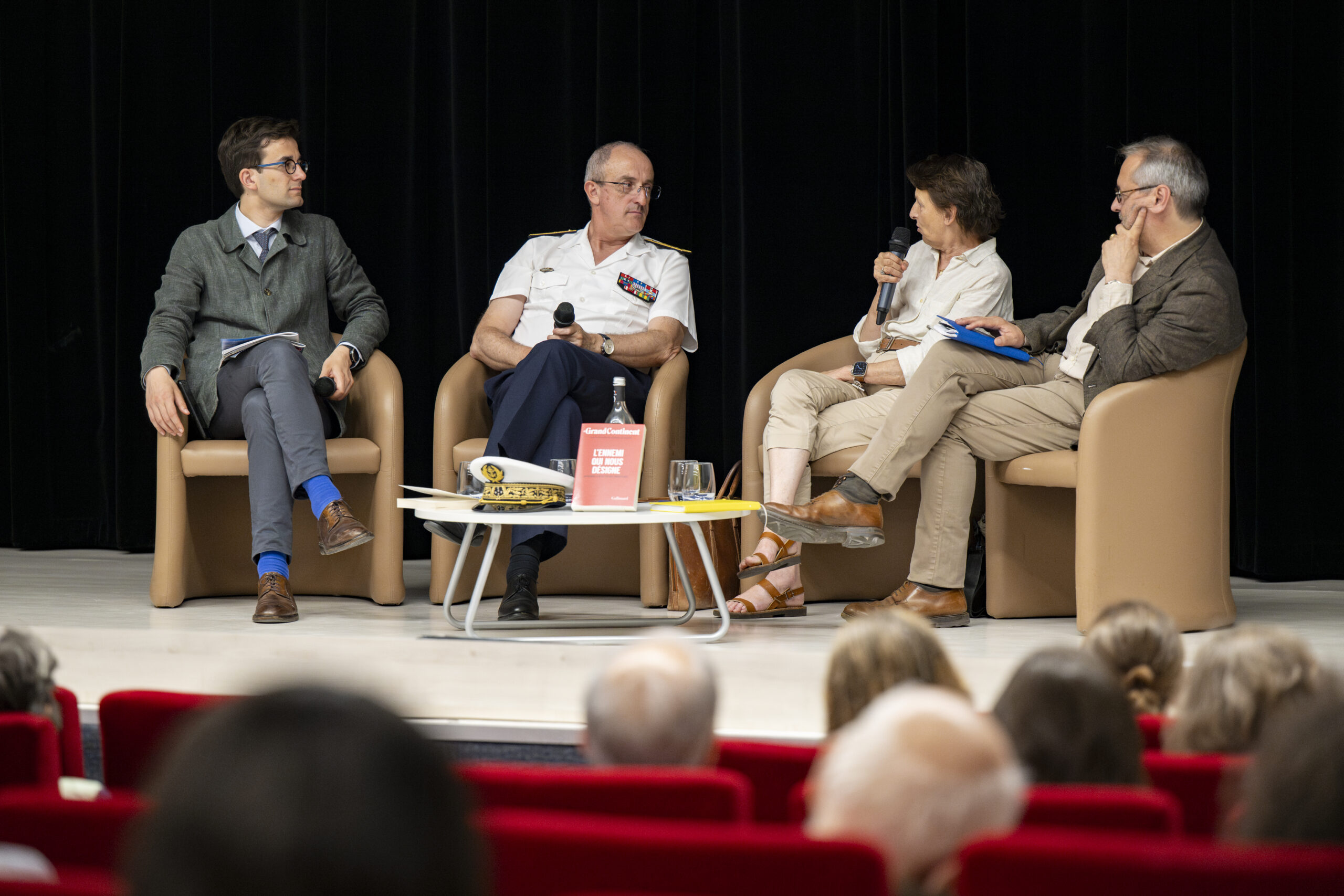
The Navy will be directly involved. This will likely involve diversifying our recruitment and training pathways. For officers, the sustainability of our recruitment, largely achieved through technical tracks, raises the question of broadening other academic pathways. It is likely that this constraint will become an opportunity: broadening the recruitment pools will enhance the resilience of our armed forces, but also that of society as a whole.
What do you mean?
Expeditionary operations carried out for around thirty years have sometimes obscured the fact that war is not only a military affair. The war in Ukraine shows that it touches the armed forces but also industry, infrastructures—logistics and energy in particular—, social cohesion, public opinion. This is explained by the diffuse and permanent nature of this multifaceted threat. In the cyber world, a Russian hacker can attack a country’s energy infrastructures thousands of kilometers away. Multiple segments of society are thus quickly involved in this total war.
Beyond our armed forces, this phenomenon can question the capacity we Europeans have to resist as nations. It is this issue of moral strength, acting as a bond between the population and its armed forces, that should concern us. Ukraine provides many lessons on this essential point.
Calling to strengthen our moral resilience, isn’t that a way of preparing minds for significant human losses?
We must realize what war implies for a country: in a war, human and material losses are very high and touch the entire population. France must prepare itself for another kind of war than the distant conflicts in which we were involved over the last thirty years. The war in Ukraine is a lesson for Europeans.
The central question for us lies in our ability to have an organization and the associated means ready to respond to a shock. The path of resilience and reinforcement is being taken, notably through the updating of the military programming law passed by Parliament. I also think France has had a powerful moral force, which must be awakened further.
Would this awakening not be more effective with external forces’ involvement? I mean our partners and allies.
The current context raises questions about partnerships. NATO, the alliance that binds us, is in the midst of transformation. The next Ankara summit will take stock of expenditure targets set at 5% of GDP by 2035, and Europe’s capacity to shoulder the burden that Americans now wish to transfer to them. The lesson to be drawn from American positions is that merely being part of an alliance does not automatically guarantee its effectiveness. What makes a partnership strong today is the reliability of the stated commitments and the operational credibility. France now possesses these two assets and, thanks to them, finds itself in a strong position to hope to form more partnerships around the world.
What about our ties with the United States?
The United States are fully aware of France’s operational capabilities. In certain domains and in certain parts of the world, we work with the American armed forces in a highly synchronized way. This is the case in the High North, to detect, track, and counter the actions of Russian submarines. We have in this domain a level of excellence recognized and appreciated.
The fact of simply being part of an alliance does not automatically guarantee its effectiveness. What makes the strength of a partnership today is the reliability of the commitments and the operational credibility.
Admiral Vaujour
Today, however, there are certain issues on which we are not aligned. That, my counterparts accept and respect. Why? Because we demonstrate our credibility on the ground by deploying our frigates, our submarines, our aircraft carrier, our air assets, and our oceanic deterrence. Trust is built over the long term with our partners.
Precisely, the President of the Republic announced working on forming a coalition to help unblock maritime traffic in the Strait of Hormuz. What is its current status and under what modalities could the French Navy conduct this expedition?
First, it is the French Navy’s role, alongside many partners notably European, to be ready to conduct mine-clearing operations in the Strait of Hormuz when conditions are right. No element confirms that the area has not been mined by Iranian forces. Shipping companies must be able to traverse the strait in a secure and sustainable manner; this is essential for our economies.
The sea is not a peripheral part of France, but a strategic depth
Admiral Vaujour
The deployment of the Charles de Gaulle aircraft carrier in the Indian Ocean demonstrated France’s determination to seek a common exit from the crisis and contributed to de-escalating violence.
Paradoxically, China, which has immense oil interests in the region, remained particularly discreet. What are our maritime relations with this country?
China has developed its maritime military apparatus in a spectacular way. Admiral Prazuck, one of my predecessors, used to say that the Chinese were building the equivalent of a French Navy every four years. Today, it is rather every two years. Their objective is to hold at least six aircraft carriers, i.e., two more than at present. They deploy daily in the South China Sea no fewer than around forty frigates and destroyers. This is a show of force.
How do you explain this record development?
China is trying to create a zone of influence, first up to the first island chain, then gradually extending their maneuver space to the second island chain. From Hainan Province, the Chinese intend to reach the deep waters to deploy their nuclear submarines there without constraint.
The aim of China is also to guarantee its supply, notably of rare earths, hence the construction of a genuine Maritime Silk Road toward the African continent.
Is Taiwan in their line of sight?
Taiwan is at the center of the balance of power. But that does not mean that the military option is the preferred one for China. It is very difficult to know or interpret their intentions, as we have very little exchanges with them. I occasionally dialogue with my Chinese counterparts at symposiums, for example the Western Pacific Naval Symposium that France will chair in November 2026. Every two years, all Pacific Ocean navies meet. China was the Secretary at the last edition and France took over in Tahiti. Admiral Hu Zhongming, my counterpart, will come to Papeete.
What is the French and European strategy in the Indo-Pacific, as China’s assertiveness is increasingly felt?
Our role is to carry a voice of sovereignty and responsibility, but also dialogue, partnership, and respect for international law. We strive for the interests of each country to be heard. France is very present as a coastal nation of the Indo-Pacific, our partners see it and trust us.