
To gear up for the new term, try le Grand Continent. The ideas and analyses you won’t find anywhere else—yet you’ll see them everywhere soon. Delivered to your inbox from 8 euros per month
Administered by France within New Caledonia, the islets Matthew (Umaenupne) and Hunter (Umaeneg-Leka ), located at the eastern tip of the vast exclusive economic zone (EEZ) of New Caledonia, covering about 1.3 million square kilometers, southeast of the Vanua archipelago, are claimed by Vanuatu. The second cycle of negotiations between Paris and Port-Vila held at the end of June 2026 did not manage to reconcile the positions of the two states concerning this long-standing dispute. The dispute now unfolds in a regional context that has been profoundly renewed and occurs as New Caledonia undergoes a period of strong political tensions. At the same time, Oceanian island states assert more strongly their diplomatic agency, in a context of heightened regional rivalries among China, Australia and the United States. France, for its part, seeks to consolidate its claimed role as a “balancing power” in the Indo-Pacific. In this context, Matthew and Hunter are not merely a territorial quarrel but a test of the credibility of France’s strategy in the South Pacific.
The New Caledonia at the heart of France’s strategy in the Pacific
The engagement in two successive negotiation cycles, in 2025 and then in 2026, does not reflect a shift in the legal positions of the two states, which remain unchanged. It rather signals a willingness to maintain bilateral dialogue on this old dispute, in a context where France seeks to bolster its regional legitimacy.
This diplomatic restart fits into a political sequence initiated during Emmanuel Macron’s visit to Vanuatu in July 2023, then extended by the visit of Prime Minister Jotham Napat to the Élysée in July 2025 and the bilateral exchanges that followed. Paris seeks to keep dialogue with Port-Vila and to show that the disputes inherited from the colonial era can be addressed through diplomacy.
Since Emmanuel Macron’s speech in Nouméa in May 2018, where the word “Indo-Pacific” is used eleven times, New Caledonia occupies a central place in the French strategy. The archipelago concentrates most of France’s military means in the Pacific through the Forces Armées de la Nouvelle-Calédonie (FANC). It serves as a strategic foothold thanks to the extent of its EEZ and indirectly secures Paris a seat within regional oceanic organizations.
Indeed, thanks to its external-relations capabilities that France shares with it, New Caledonia maintains direct links with states and regional organizations. Moreover, regional insertion through its overseas territorial bodies provides French presence with an Oceanian political anchor that goes beyond its military means and humanitarian operations.
Yet, the place of New Caledonia in France’s strategy is now being tested by the violence that erupted in 2024, the enduring polarization of the political debate around the question of independence, and the uncertainties surrounding the archipelago’s institutional future. Such a context nourishes questions about Paris’s ability to remain a force for regional stability and weakens the main support point of its presence in the Pacific.
If New Caledonia has a shared competence in external relations, the conduct of international negotiations and the delimitation of borders remain exclusively the state’s responsibility. The Kanak authorities therefore did not participate in the negotiations conducted with Vanuatu, even as the evolving political situation of the archipelago weighs on the regional perception of French presence.
Why does this dispute take on a new dimension today?
Vanuatu’s claim over Matthew and Hunter predates the Caledonian crisis. Today, the regional context’s evolution gives it a new geopolitical reach.
Indeed, the issue now goes beyond mere territorial sovereignty and fits into broader narratives related to decolonization, Melanesian solidarities, and France’s role in the Pacific.
The support of the Kanak and Socialist National Liberation Front (FLNKS) for the positions advocated by Vanuatu has notably been reaffirmed in the 2009 Keamu Declaration and even more recently. It extends the political solidarities developed within the Melanesian Lance Group (GFML), created to diplomatically back Kanaky’s independence in the 1980s facing France. Beginning in 2015, Indonesia became an associate member of the GFML, while the independence movement of the West Papuan people obtained only an “observer” status: the GFML now appears less directly mobilized on issues related to New Caledonia’s independence. Matthew and Hunter’s claim thus allows Vanuatu to remobilize Melanesian solidarities without directly entering the old regional register of support for Kanak independence claims.
Melanesian solidarity was reaffirmed by Christian Tein, president of the FLNKS, during his visit to Port-Vila in early May 2026. In an interview with the Daily Post on May 6, he stressed the depth of these links: “We are Melanesians and we understand each other […] we share the same cultural and traditional links, and we have the same blood running through our veins.” On that occasion, he recalled that his movement “has always maintained its position that Matthew and Hunter belong to the people of Vanuatu,” noting that settling the territorial dispute would be “easier” should New Caledonia become independent.
New Caledonia’s question does not determine this dispute, which has its own history and logic. The two issues tend, however, to be linked in the rhetoric of Vanuatu’s authorities, FLNKS, and several Melanesian political actors. The dispute remains, therefore, primarily territorial and legal, but it also becomes a vehicle for broader positions on France’s presence in the Pacific.
The discourse carried by the Vanuatu government illustrates this evolution particularly well. Before the Parliament of Vanuatu on May 19, 2026, Prime Minister Jotham Napat stated: “Our path to independence is not yet finished. It will be completed only when we have sovereignty over all our islands and seas.” The Vanuatu government links the Matthew and Hunter question to decolonization and the independence proclaimed in 1980. Port-Vila sees the 1976 administrative attachment of the islets to New Caledonia as a decision of the French colonial administration made on the eve of the independence of the condominium of the New Hebrides.
France defends a substantially different legal reading and contends that the 1976 administrative attachment stems from an earlier situation and uses, among other things, the 1965 Franco-British note exchange as an argument, notes that recognize the islets’ attachment to New Caledonia. French authorities also emphasize the continuity of their sovereignty manifestations to support the effectiveness of their administration. This position thus rests on a historical and legal argument that Paris considers established, even if it remains contested by Vanuatu.
In a response published by the Senate in February 2026, the Ministry of Europe and Foreign Affairs stated that “the French side has set out in detail the legal elements supporting French sovereignty ”, while noting that “no cession of territories or renunciation of our sovereignty has been discussed ”. France thus frames the negotiations within a process of amicable settlement of the dispute, without challenging its sovereignty over the islets.
The Matthew and Hunter issue provides a diplomatic lever for Vanuatu, which can carry its claim into regional and international forums and assert its capacity to act.
The firmness displayed by chief negotiator Johnny Koanapo illustrates this resolve. After the failure of the second round of negotiations in Paris on June 30, 2026, he rejected any prospect of joint management: “We are the ones who will authorize you to access the islands, not the other way around. It doesn’t work like that.” Facing the lack of progress in the bilateral framework, the Vanuatu government also mentioned the possibility of taking the case to the International Court of Justice, thus opening the door to a potential judicialization of the file, until now treated within a diplomatic framework.
The strategic importance of Matthew and Hunter lies less in their land area than in the maritime spaces their sovereignty opens access to. Together, these two volcanic islets account for less than two square kilometers of land. Sovereignty over these islets thus constitutes a factor in delineating an exclusive economic zone of about 350,000 square kilometers, nearly one-fifth of the maritime domain linked to New Caledonia. As has long been shown by studies on the geopolitics of maritime spaces, the strategic value of an oceanic territory is often inversely proportional to its area.
The diplomatic assertion of Oceanian island states changes regional balances
One must also read the disagreement over Matthew and Hunter in the light of a broader transformation of international relations in Oceania. For a long time considered mainly through the strategies of great powers, the region’s island states are now trying to be recognized as diplomatic actors capable of defending their own interests and priorities and of influencing regional dynamics on their own terms.
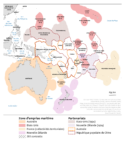
Like other Oceanian states, Vanuatu seeks to preserve its strategic autonomy in an environment marked by the intensification of strategic rivalries. For a small state—around 330,000 inhabitants, 184th global GDP, 161st in land area—possessing limited diplomatic and economic resources, broadening its network of partners is a means to preserve its room for maneuver against powers with far greater capabilities. Often analyzed through the concept of hedging, this strategy translates into the simultaneous development of security cooperation with Australia and economic or technical relations with China. The theoretical aim is to maintain freedom of action without permanently aligning with a single power.
It would, however, be an overstatement to view Vanuatu as a regional power capable of single-handedly shifting the Pacific’s balances. Its actions illustrate a broader trend, namely the growing willingness of Oceanian island states to defend their interests by mobilizing international law, regional organizations, and diversification of their partnerships. The agenda does not arise solely from competition among great powers but extends a longer-standing movement of political assertion by Oceanian states within regional institutions.
In this perspective, the case of Matthew and Hunter illustrates one of the transformations underway in Oceanian geopolitics.
A test for France’s Indo-Pacific strategy?
For France, the issue goes beyond merely safeguarding a strategic maritime space. It concerns the coherence of an Indo-Pacific strategy that rests on a double ambition: to shoulder the responsibilities attached to its claimed status as a resident power while being recognized as a legitimate regional partner. This equation is all the more delicate because any development regarding Matthew and Hunter could be interpreted as a precedent for other sovereignty disputes within French foreign policy. At the national level, the opening of negotiations has provoked strong reactions in the media and within parts of the political class: for some, it amounted to “selling out” national sovereignty. In the eyes of political leaders, progress on this file could also open Pandora’s box and undermine France’s position on other overseas territories, notably the Éparses Islands, Tromelin, or Mayotte. Conversely, a purely sovereignty-affirming approach could feed already critical perceptions in parts of the Oceanian world.
As is clear, this case far exceeds the fate of two uninhabited volcanic islets. It shows that in contemporary Pacific, the credibility of a regional power no longer rests solely on its military capabilities, the extent of its maritime domain, or the legal foundations of its sovereignty. It also depends on its ability to convince its partners that its presence contributes to space stability and aligns with the priorities they express.
For France, the challenge is to align its strategic interests with the issues that regional states place at the heart of their regional agendas, including climate security, protection of maritime spaces, and disaster response. This requirement appears all the more crucial in a relationship like the one between France and Vanuatu.
France is not, in fact, an external partner like any other for Vanuatu. The two countries maintain long-standing relations and concrete cooperation across several domains, notably in civil protection, disaster response, and maritime surveillance. The FRANZ framework, which brings together France, Australia, and New Zealand, stands as an example of operational cooperation in the Pacific. While it does not erase sovereignty disagreements over Matthew and Hunter, the density of ties between the two states—as Vanuatu remains part of the Francophone world in an Anglophone ocean—shows that the Franco-Vanuatuan relationship rests on common interests beyond a territorial dispute.
The sequence thus places France in a delicate position: to maintain its legal sovereignty over the islets while preserving a trusted relationship with Vanuatu and, more broadly, with Oceanian states. The evolution of the file could gradually redefine the conditions under which France exercises power in the Indo-Pacific.