
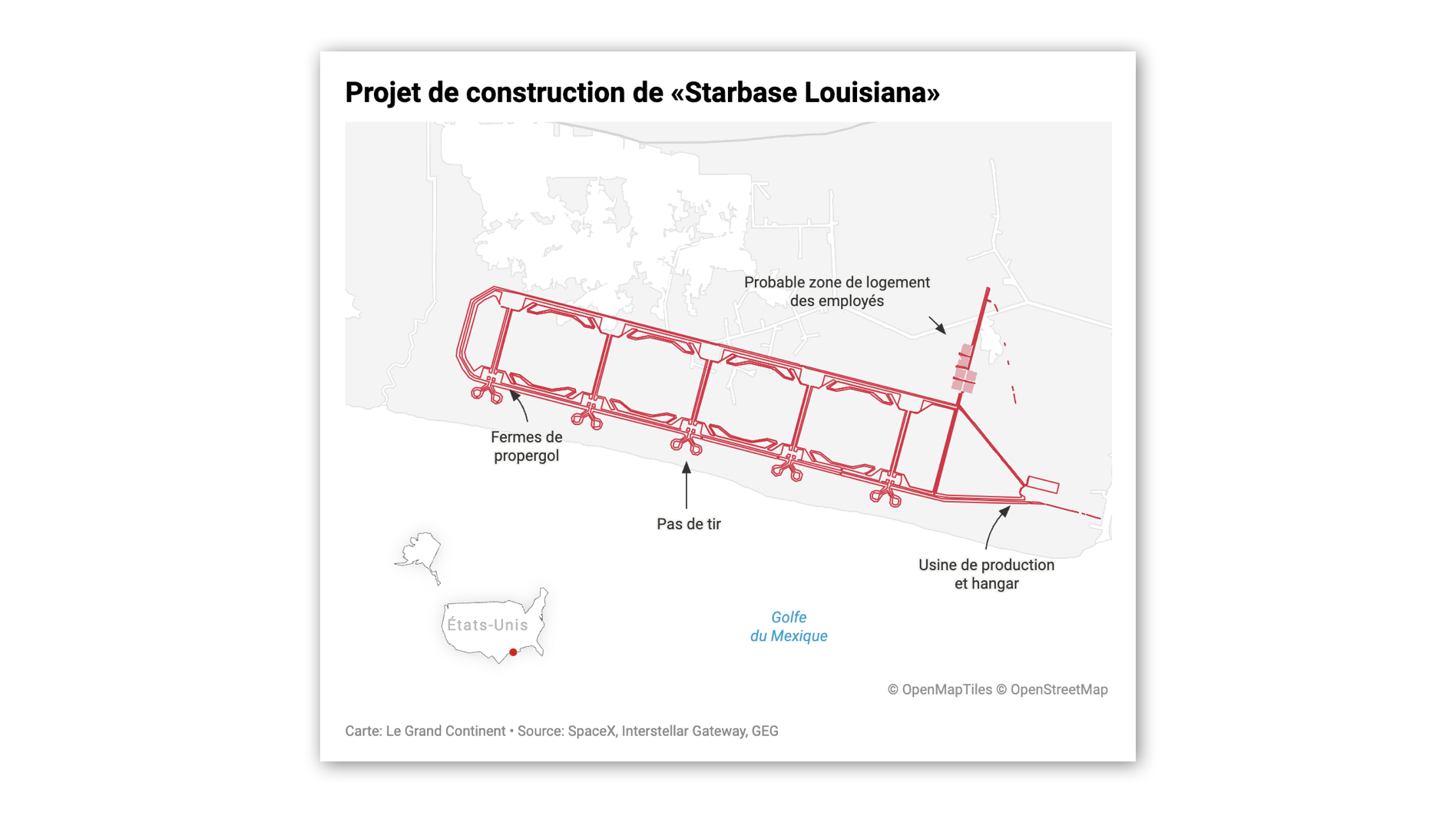
SpaceX, the space company led by Elon Musk, unveiled on August 25 a plan for a mega spaceport along the coastline of Louisiana. Construction could begin as early as 2027, with the first launch anticipated in 2029. In the long term, the facility would enable thousands of Starship flights per year.
- The spaceport would comprise 10 rocket launch sites, arranged in pairs separated by roughly 2.5 kilometers each, according to an estimate from Interstellar Gateway.
- “Starbase Louisiana” would also feature propellant farms, water retention basins, and housing for employees, and could, according to images released by the company, include sites for propellant liquefaction.
- A Starship rocket manufacturing center as well as an assembly and storage hangar could also be built on the site.
In total, the site would span more than 50,000 hectares – about 0.45% of the total area of the state of Louisiana.
- Despite its size, “Starbase Louisiana” would remain far smaller than several major spaceports, such as Baikonur in Kazakhstan, used by Russia, the Guiana Space Centre used for French and European space programs, or the Kennedy Space Center in Florida.
- However, the site could enable a launch cadence well above current levels: up to more than 30 flights per day, according to Elon Musk, compared with around one every two days on average last year for SpaceX (165 orbital flights).
SpaceX launched nearly twice as many orbital missions as China in 2025, and the company accounted for about 85% of all rockets launched by the United States.
- Once construction of the site is finished, SpaceX could be capable of launching up to 10,000 rockets per year starting in 2030.
- This target far exceeds the limit set by the Federal Aviation Administration (FAA), the U.S. federal agency responsible for civil aviation.
- In its latest National Space Transportation Policy, signed on August 20 by Trump, the U.S. government aims to permit 1,000 launches and atmospheric reentries by 2030, i.e., 10 times less than Musk’s target.
To accelerate the development of orbital and lunar missions, the Trump administration ordered federal agencies “to identify new launch sites” and to “speed up licensing procedures and environmental assessments.”
- In December, Trump had signed an executive order setting two main objectives: returning Americans to the Moon by 2028 as part of the Artemis program, and establishing the first elements of a permanent lunar base by 2030.
- This timeline aims to outpace China, which has set itself the goal of sending a crewed mission to the Moon by 2030.
- The 2028 deadline is especially significant for Trump, as it would mark the last year of his second— and, constitutionally, final—term.