
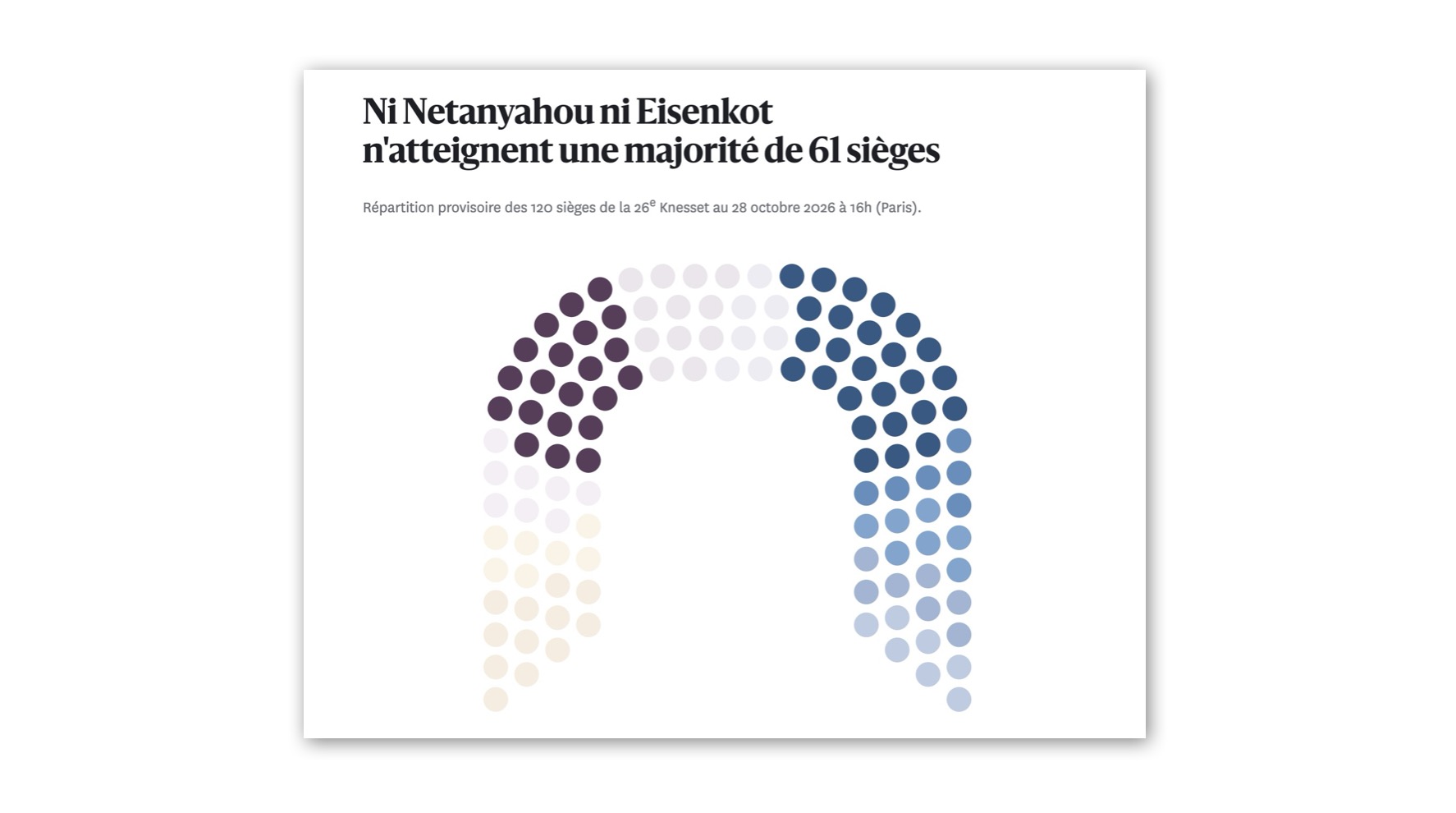
More than 85% of the ballots in Israel’s legislative elections held yesterday, Tuesday, October 27, had been tallied this Wednesday, October 28 at 5:00 PM (Paris time). Prime Minister Benjamin Netanyahu’s bloc is projected to win 53 seats in the Knesset (versus 64 in 2022), while his main opponent Gadi Eisenkot’s bloc is projected to secure 48 seats.
Results could continue to evolve through Thursday. The electoral commission has until November 4 to communicate the official results to President Herzog.
- The vote represents a tempered victory for Likud, Netanyahu’s party, which is expected to finish first with about 21% of the votes.
- Yashar!, Eisenkot’s party, is credited at this stage with around 16% of the votes, and the Unified List, which brings together three Arab-majority parties (Hadash, Balad and Ta’al), with just over 9%.
- It would be the best performance of the list since 2020, when it still included Ra’am. With Ra’am’s 7 seats, the Arab parties would total 19 seats.
Due to the lack of a clear majority for the two main blocs – 61 seats are needed to hold a majority in the Knesset – the Arab parties could be called upon to play a decisive role. However, several weeks could be needed to attempt to form a coalition, a period during which the situation in Israel and in the region could evolve, particularly with regard to Iran and the United States.
- Netanyahu attempted to rekindle the war with Tehran a week before the vote, dispatching dozens of aircraft to the Iranian border, in a maneuver that could have provoked an Iranian response.
- Donald Trump, to whom the Israeli prime minister has turned in recent weeks in an attempt to garner expressions of support, claimed on Wednesday the 28th credit for Netanyahu’s performance.
- In a Truth Social post, the American president shared a statement attributed to a certain Irving C. Schwartz: “When President Trump gave his backing to Bibi Netanyahu, the wind completely shifted, and today, rather than a crushing defeat for a great prime minister, we seem to be witnessing a dramatic rebound that leads to a stalemate, or even a VICTORY for Netanyahu.”
In Israel, the president plays an institutional role in forming the government. It is to him that party leaders will issue “recommendations” for identifying the person responsible for forming a government, who is not necessarily the leader of the largest party. That person would then have 28 days to try to secure a majority, with the possibility of extending this period by 14 days.
If this first attempt fails, the president could designate a second candidate, who would have 28 days, with no possibility of extension.
- Herzog could entrust this mandate to Netanyahu, whose party is expected to come out on top in the vote. All opposition parties, however, have ruled out governing under his leadership, which would complicate the task of forming a coalition.
- He could also turn to Gadi Eisenkot, whose party, Yashar!, would become the second political force in the Knesset with around 21 seats, behind Likud (26 seats).
- Eisenkot would however need the explicit or tacit support of the two Israeli Arab parties, support he said during the campaign he was ready to rely on to lead a minority coalition.
Even if he remained in power heading a transitional government, Netanyahu could face a state commission of inquiry into the failings that led to the October 7, 2023 attack, which the new Knesset could seek to establish.
- According to Haaretz, whose information has since been confirmed by the The New York Times, the Israeli leader would have been warned by Emirati President Mohammed bin Zayed ten days before the attack that Hamas, then led by Yahya Sinwar, was preparing a major operation against Israel.
- The Prime Minister’s Office denied these reports.