
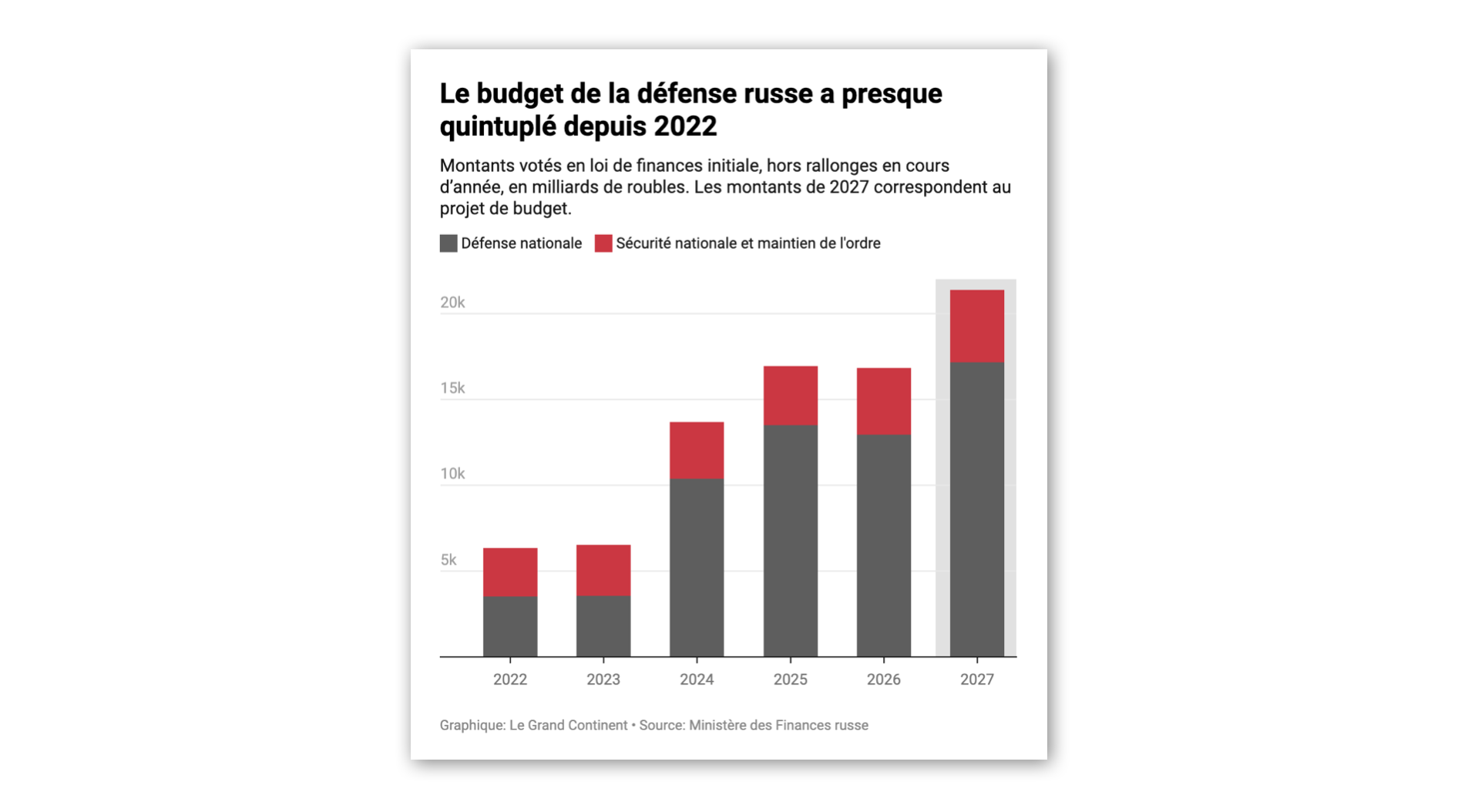
In its budget proposal for 2027, the Russian government plans to devote 35% of its expenditures to national defense, the portion that funds the bulk of the war in Ukraine. Overall, defense spending is expected to reach 17,100 billion roubles (about 190 billion euros), which is roughly three times the size of France’s defence budget for 2027 (63.4 billion euros).
It remains uncertain whether the Kremlin will be able to sustain funding at such a level over time.
– These outlays will be partly financed by debt: the Finance Ministry plans to issue 7,700 billion roubles (85 billion euros) of bonds, up from 5,400 billion (60 billion euros) in last year’s budget.
– Despite a value-added tax increase in January 2026 and the creation of new taxes, these expenditures are expected to be accompanied by a larger deficit than anticipated: 5,500 billion roubles (60 billion euros, 2.2% of GDP) in 2027, versus 3,200 billion (35 billion euros) in the previous year’s budget.
At the same time, Moscow is finding it increasingly difficult to attract buyers for its debt.
– The Finance Ministry had to declare several bond auctions unsuccessful in July and September, due to a lack of bids at acceptable prices.
– In the meantime, new issuances were suspended for several weeks.
To lure buyers, the Russian government has had to offer yields approaching 17%: on October 14, it borrowed at 16.77%, the highest rate since February 2025.
– Demand is increasingly concentrated among large banks, which on September 2 purchased 84% of a 1 trillion-rouble issue, after borrowing nearly an equivalent amount the day before from the Central Bank.
The Ukrainian strategy of mid- and long-range strikes against Russia is intensifying pressure on the Kremlin. On September 1, Putin stated that Ukrainian strikes in the Black Sea and the Sea of Azov against ships and energy infrastructure had caused damages representing “about 1% of Russia’s GDP,” i.e., roughly 23 billion euros.
The strikes have continued and have targeted, among other assets, data centers belonging to Yandex, which underpin the civilian Russian economy (online search, taxis, deliveries, messaging services, cloud computing, etc.).
Some of these data centers house supercomputers among the country’s most powerful, according to TOP500, such as Galouchkine, located at the Vladimir data center.
The company maintains that these supercomputers, which run Yandex’s AI used across the company’s software and applications, were not damaged by the strikes. They were, however, “transferred to new sites,” according to Yandex’s press service.
The fragility of the Russian budget also stems from the inherent unpredictability of war: spending to strengthen anti-drone capabilities, replace equipment, or pay engagement bonuses to fighters will depend on how the front-line balance evolves.