
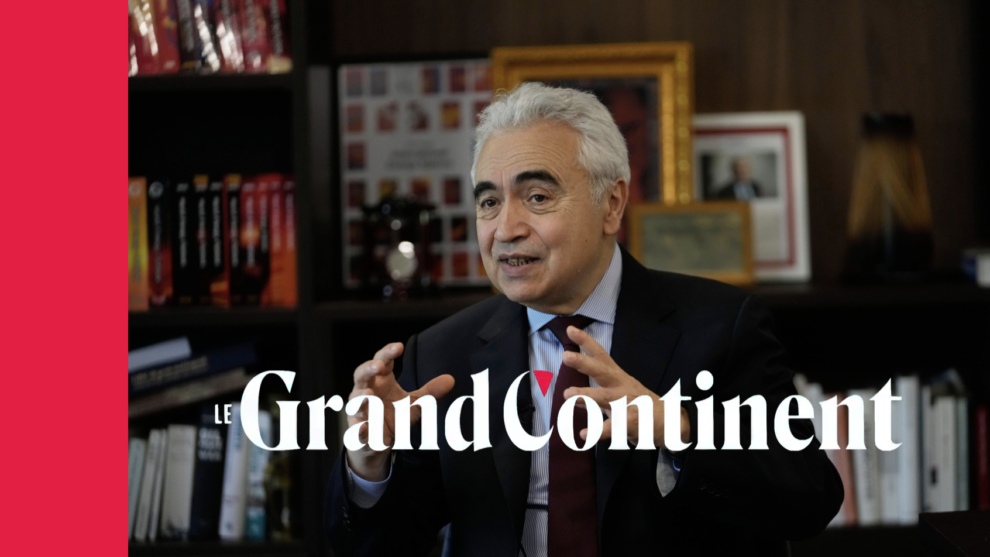
In March, you described the energy shock sparked by the war in the Gulf as the most serious in history, and you warned that a very dark summer was ahead, even for air travel. That did not fully come to pass. Were you right too soon?
I said it was the greatest threat to energy security in history. What has unfolded over the past eight months, along with the consequences we continue to observe, confirms it. I regret it, because it is by no means good news—for our energy security, for economies, or for the lives of millions of people. It is a substantial shock whose impact cannot be measured by the price of crude alone. That would be too narrow a view.
Regarding air travel in particular, the crisis profoundly disrupted the sector and affected passengers. The reasons include the closing of airspace in the Middle East, the rise in kerosene prices, and fuel shortages, notably in certain regions of Asia.
What distinguishes this shock from previous ones?
It is reshaping the dynamics of the global energy market. International oil prices have settled around $117 per barrel. That is crude oil price, but neither you nor I use crude oil directly. We use gasoline, diesel, or liquefied petroleum gas. Yet diesel prices today are twice what they were before the war began.
What are the implications for energy geopolitics?
This shock has prompted many countries, especially in the Middle East, to rethink their energy strategies, partnerships, and trading routes. The situation is straightforward: most of their oil and gas exports used to transit through the Strait of Hormuz. Today, many of them, particularly the larger players like Saudi Arabia and the United Arab Emirates, are rushing to construct or expand oil and gas pipelines to bypass the strait. This is the first time a disruption of such magnitude has occurred so quickly. Even outside the Middle East, countries have revised their trade routes. Canada, a major producer of oil and gas, is shifting away from routes centered on its southern neighbor to look increasingly toward Asia and Europe.
Secondly, the dynamics of global energy trade are changing as well, and this is a first. Normally, if I want to buy LNG and one seller offers it at $3 and another at $4, I take the cheaper option. Now, if I judge the more expensive seller to be far more reliable, I might choose him. It’s a premium on energy security rooted in trust.
Thirdly, and most importantly, this crisis has significantly accelerated the deployment of renewables and electric vehicles. Outside of China, EV sales rose by 60% during the eight months of the war, an unprecedented increase compared with prior years. In many countries, they more than doubled on a year‑over‑year basis. Interest in nuclear power has also risen markedly in many nations. Some are building new reactors. Others that had planned to retire theirs, such as Spain, have reversed course. Nearly 90 gigawatts of nuclear capacity are currently under construction, a level unseen in nearly forty years.
How should we think about energy security today, and how does it align with the climate agenda?
Addressing the crisis in the Middle East and efforts to secure supply are helping to accelerate the transition to clean energy. For the first time, energy‑security objectives and climate‑change goals are converging. It marks a major turning point. Turkey and Australia, the two countries chairing this year’s COP31 and its negotiations, are fully aware of it. They are making it a central theme of the conference to be held next month in Antalya. Under the IEA, one of the main axes will be the role of electrification, a topic to which we devoted a special report in September.
The age of electricity is here.
Fatih Birol
More broadly, it is increasingly clear that events of recent years, especially those of 2022 and 2026, have redrawn the map of the world’s energy. Four years ago, two major supply routes dominated this map: one linking Western Siberia to Europe via Russia, and the other running from Hormuz toward Asia and beyond. Both routes are now cut. New partnerships are forming, while some old ones are being abandoned.
In Europe, climate and security objectives were already converging in 2022 after the invasion of Ukraine. Yet, four years on, Europe still struggles to secure its energy supply. Why?
Here is a striking figure: in Europe, electricity accounts for only 24% of total energy consumption today. In other energy-importing countries, such as China, Japan, or South Korea, this share runs at 33–34%. In fossil-fuel exporting countries, such as the United States, Canada, and Australia, it stands at 23–24%. Europe’s electrification rate is thus comparable to that of hydrocarbon‑exporting nations.
The future of Europe’s energy lies in electrification. Even setting climate concerns aside, if we want a sovereign Europe, we must electrify. We can generate our own electricity from solar, wind, or nuclear energy, thereby reducing our dependence on countries across the globe.
Is this lack of progress due to a faulty analysis?
Diagnosing the problem correctly is important, but so is prescribing the right remedy. Let’s take a past European misstep as an example. In 1973 and 1979, two major oil shocks occurred. Many countries reacted; the nuclear industry emerged in response to these crises. Europeans then understood that relying so heavily on the Middle East was risky. The diagnosis was correct, but the treatment was wrong: they turned heavily toward Russia. I mention this episode because I hope Europe will respond correctly this time to the crisis sparked by Russia’s invasion of Ukraine, as well as the situation with Iran. I am convinced that European sovereignty depends on our ability to electrify our economies. It is a matter of sovereignty, energy, and economic competitiveness. It is ultimately also the condition for achieving climate goals.
It is worth noting that Europe has advanced since the 2022 shock by accelerating the deployment of renewable energy. Thanks to these substantial efforts, European electricity systems were less exposed to gas-supply disruptions this year than they otherwise might have been. But there is still a long way to go.
Are we moving from a fossil‑fuel–centered geopolitical system to a system organized around clean‑technology value chains?
As more and more countries generate their own energy and seek to reduce dependence on others, electrification grows in importance.
Two years ago, I stated that the world was entering the age of electricity. Since the dawn of the modern era, each era has been defined by a particular fuel. There was the coal age with the industrial revolution, then the oil and gas era. Today, as the IEA has announced, the age of electricity is here. Oil and gas exports from regions such as the Middle East and the Americas will remain significant. But in the age of electricity, energy‑importing nations will increasingly take their destiny into their own hands.
Even setting climate concerns aside, if we want a sovereign Europe, we must electrify.
Fatih Birol
That said, one country in particular could stand to gain: China, which has managed to establish itself as a leader in electrification. It is important to consider the implications of a more dominant Chinese role in the coming years.
How can Europe electrify without replacing one dependency with another—this time on China?
In the realm of renewable energy and nuclear power, Europe possesses the know‑how and many European industries can contribute. France is a good example when it comes to nuclear; Denmark and Germany are leaders in wind energy, and the Nordic countries are pivotal players as well. The solar sector relies heavily on China, but there are ways to address this reliance.
The world must remain especially vigilant regarding critical minerals, both in extraction and refining. The challenge specifically lies in refining: today, 75% of refining occurs in China. A single country concentrates 75% of this capacity, while all others together account for only 25%. China’s dominance in this area is overwhelming. It is therefore essential that other countries—Europe, Asia, or elsewhere—diversify their refining capabilities as much as possible.
Having faced numerous energy-security crises, I have drawn a key lesson: diversification is the golden rule of energy security. Diversify as broadly as possible. Do not depend too heavily on a single country or a single trade route. It is naïve to think that an $110 trillion global economy could be paralyzed by the blockage of a 40-kilometer strait.
The IEA remains fully mobilized to meet today’s energy-security challenges, but also to address emerging ones, with the top among them the concentration of supply chains for critical minerals. In recent years, we have greatly expanded our work in this area by establishing a dedicated division. We regularly bring together government representatives and industry players, including for crisis‑management exercises, to better prepare for potential supply disruptions.
China played a key role in cushioning the oil shock.
Indeed, China acted as a major stabilizing force by reducing its oil imports.
For the first time, it asserted its influence on the market as a large energy importer. To put this into perspective, the public oil stocks of the United States, Japan, and the entire European bloc are only slightly higher than those of China. Beijing demonstrated that it could use its stockpile management to influence markets, which did not go unnoticed.
China was not the sole dampener, however. Multilateralism, through the IEA, also played a major part. In early March, our 32 member countries mobilized swiftly to announce an unprecedented release of 400 million barrels of emergency oil reserves. This release, still underway, was pivotal in preventing more severe effects on our economies. And we can do it again if necessary. It represents only about 20% of our reserves, meaning we still have 80% in reserve. If needed, we can release more.
What does this reveal about China’s emerging role in global oil markets?
China’s influence can work in both directions. It can cut back on imports, but if it chooses to step up purchases, prices will respond accordingly.
Vladimir Putin, Xi Jinping, and Donald Trump could meet at a summit in the coming weeks. Could that affect energy markets?
I don’t know what will be discussed or what the outcome will be.
What worries me is that, in this difficult period for natural gas, I hear some European countries and leaders uttering statements I would rather not hear. This winter is going to be challenging for Europe, as gas deliveries from Qatar and the UAE have been interrupted. If winter proves exceptionally cold, prices could rise. Some countries are hinting, in effect, at temporarily reopening the valves of Russian gas. My answer is simple. It was a mistake to become too dependent on Russia. Doing it once was a mistake. Doing it again would no longer be a mistake.
Would a return to Russian hydrocarbon imports spell the end of Europe’s energy transition?
The stakes go beyond the energy transition. It would strike at Europe’s sovereignty and independence. We must take back control of our destiny, and energy plays a central role. We must produce as much electricity domestically as possible.
It was a mistake to become too dependent on Russia. Doing it once was a mistake. Doing it again would not be a mistake.
Fatih Birol
How do you view the United States’ role in the energy transition today?
The current American administration does not share the previous one’s vision. But when it comes to renewables like solar or biofuels, there is strong growth. The United States is also placing bets on nuclear power.
Oil prices have risen in recent weeks. Why did markets delay reacting to the start of the Iran conflict?
People believed—or were led to believe—that it would be quick. In Turkish, there is a saying: “A broken vase cannot be glued.” Everything changed, and realistically I don’t see how next year things could revert to what they were before the war. Everyone will tell you that if the Strait of Hormuz was closed once, it can be closed again. That will alter the world. I expect it will affect, in the near term, the dynamics and trajectory of prices in oil markets.
Do you think the current price is fair, or are markets still underestimating the risk?
The price of a barrel sits at $117, yet diesel prices have doubled. I worry that our attention is fixated exclusively on oil and gas. There is another highly affected area that is talked about far less: fertilizers. In many parts of the world, particularly Africa and Latin America, the sowing season is about to begin. Fertilizers pose a problem, and diesel is essential for tractors and other agricultural machinery. This worries me just as much. For Europeans, $117 may not seem dramatic. But if you tell Africa that prices aren’t high, you’ll hear a different story. At $117, people cannot even afford LPG for cooking.
Where is the most important energy innovation today?
At the IEA, we monitor more than 550 technologies on a daily basis. One of the key questions is maturity: when will these new technologies become widely deployed? If I had to pick the technology that will be broadly available and affordable tomorrow, I would name battery storage.
Battery storage will transform many things. Renewables are growing rapidly, but they suffer from intermittency. Batteries can address that. Their costs are plunging. In my view, it is perhaps the most promising and most important technology for the future.
In Turkish, we have a proverb: “A broken vase cannot be glued.”
Fatih Birol
China already leads in this area, but the good news is that Europe, the United States, South Korea, and Japan are making substantial progress as well. Unlike the refining of critical minerals, this sector is not as concentrated.
Is AI-driven electricity demand being blamed for stressing grids and pushing prices for consumers? Are these claims justified?
Data centers require continuous power, and in my view, artificial intelligence could be the most important technological advancement in human history. The United States and China are in intense competition, and Europe, India, and the Middle East are not far behind. The winner of the AI race will be the one with access to large quantities of cheap electricity. When I look at today’s world, it seems China presently has a lead. Access to affordable electricity is therefore crucial.
In many countries, including the United States and parts of Europe, data centers consume substantial electricity, fueling tensions between local communities and tech companies. People do not want electricity prices to rise because of AI. It is one of the central themes of the U.S. midterm elections, and it is also a concern in many European countries. Governments must therefore encourage tech companies to support the electricity sector more generously.
Do IEA projections view AI as a major driver of future electricity demand?
There are three major trends, and AI and data centers play a significant role in all of them. But there are also electric vehicles. A decade ago, only 5% of cars sold were electric. This year, it is 32%, and within a year we are likely to be talking about electric trucks as well.
The winner of the AI race will be the one with access to large quantities of cheap electricity.
Fatih Birol
However, in fact, the primary driver of global electricity demand today is air conditioning. In some countries, like the United States or Japan, 90% of households are equipped with air conditioning. Yet when I visited Nigeria a few weeks ago, the president told me that only 5% of households had it. The country has 240 million people and is much hotter than the United States or Japan. With rising temperatures due to climate change, one of the first things people do when they can afford it is buy an air conditioner to improve living conditions.
IEA was created in response to the oil shocks of the 1970s, and it has evolved profoundly since. What would it take for it to become the international agency leading the transition to clean energy?
The IEA is already the agency guiding the energy transition: anyone concerned with the topic and seeking a realistic global vision turns to it.
If the age of electricity truly arrives, what would the world look like?
We would see a much more modern, efficient, clean, and fair world. Africa illustrates what is at stake. Today on the continent, four out of five families still cook with wood. This responsibility, largely borne by women, causes respiratory illnesses. Each year, 800,000 people die prematurely as a result. It is, alongside malaria, one of the top two causes of premature mortality on the continent, with women bearing the brunt. This is the greatest injustice in the current energy landscape. Electrification could alter this reality.