
Test The Grand Continent. The ideas and analyses you won’t find anywhere else. But you’ll see them everywhere soon. In your inbox from €8 per month
Between July 30 and July 31, 2026, more than 70,000 people crossed in a few hours the border between Morocco and the Spanish enclave of Ceuta. The thousands who pressed in front of the Tarajal quay were swept up by a rumor amplified by Facebook groups and recommendation algorithms. We had then discussed how Europe must learn to secure its digital border.
What France is experiencing is the same phenomenon, with one difference: the line that gave way no longer runs between two continents, but at the heart of youth who indeed live in two spaces.
The two worlds of the new generation
First, there is the physical world, the one the Republic organizes. It means rising early, having schedules, exams, high school days that can stretch from 8 a.m. to 6 p.m. This world is often worn down. In Saint‑Denis, at Paul‑Éluard High School, students mobilized as early as September 25, recounting ceilings that fall, rats in the canteen, classes in prefab buildings, and teachers absent without replacement. It is a slow and hard world, where you are punished.
And then there is the other: the informational space, where youth spend at least as much time, and where almost nothing holds them back. There you create, there you tell your story, there you meet, and you have the feeling that everything is possible and that you hold the world in the palm of your hand. There you are almost never punished.
Recently, young people also use it to respond to the demands of the first: an assignment written by an artificial intelligence, a quick glance at a conversational assistant during an assessment. One pretends to play by the old rules, while already living elsewhere.
The youth today find themselves exactly halfway between these two worlds, regardless of their neighborhood or origins. One side calls to them, they recognize themselves in the other. The rupture we are living through largely stems from this.
The smartphone confiscated at the gate
High school students have good reasons to be angry. The buildings need renovation, classes are overcrowded, and school rhythms are irrational. Parcoursup is experienced as a funnel whose rules no one understands. Their demands, voiced since September, are legitimate and must be listened to.
But they have also whispered something else, sometimes softly, that must also be heard. Since the start of the school year, the law of August 24, 2026 prohibits them from using their mobile phones at school. Even the executive has ended up speaking of a “weaning.”
It would be hard to argue for phone use in class. You don’t look at your phone during class, any more than in a restaurant or during a family dinner. This is learned, and it is up to schools to teach it. But learning to put it away and having it confiscated at the gate is not at all the same thing. Young people, many of whom are 17 or 18, are deprived, at the moment of crossing the gate, of what gives them an identity in the other world.
We can at least wonder whether this deprivation weighed in the anger of October 17.
This law, moreover, has an instructive history. It was initially intended to ban access to social networks for those under 15. The Constitutional Council struck down this measure on August 14 in the name of freedom of expression. It would likely have been deemed incompatible with the European framework set by the DSA. Only the prohibition of the mobile phone at high school remained. We did not know how to regulate the platforms, so we regulated the students.
On October 17, the border gave way
On October 17, 550,000 people demonstrated.
Then we saw something else.
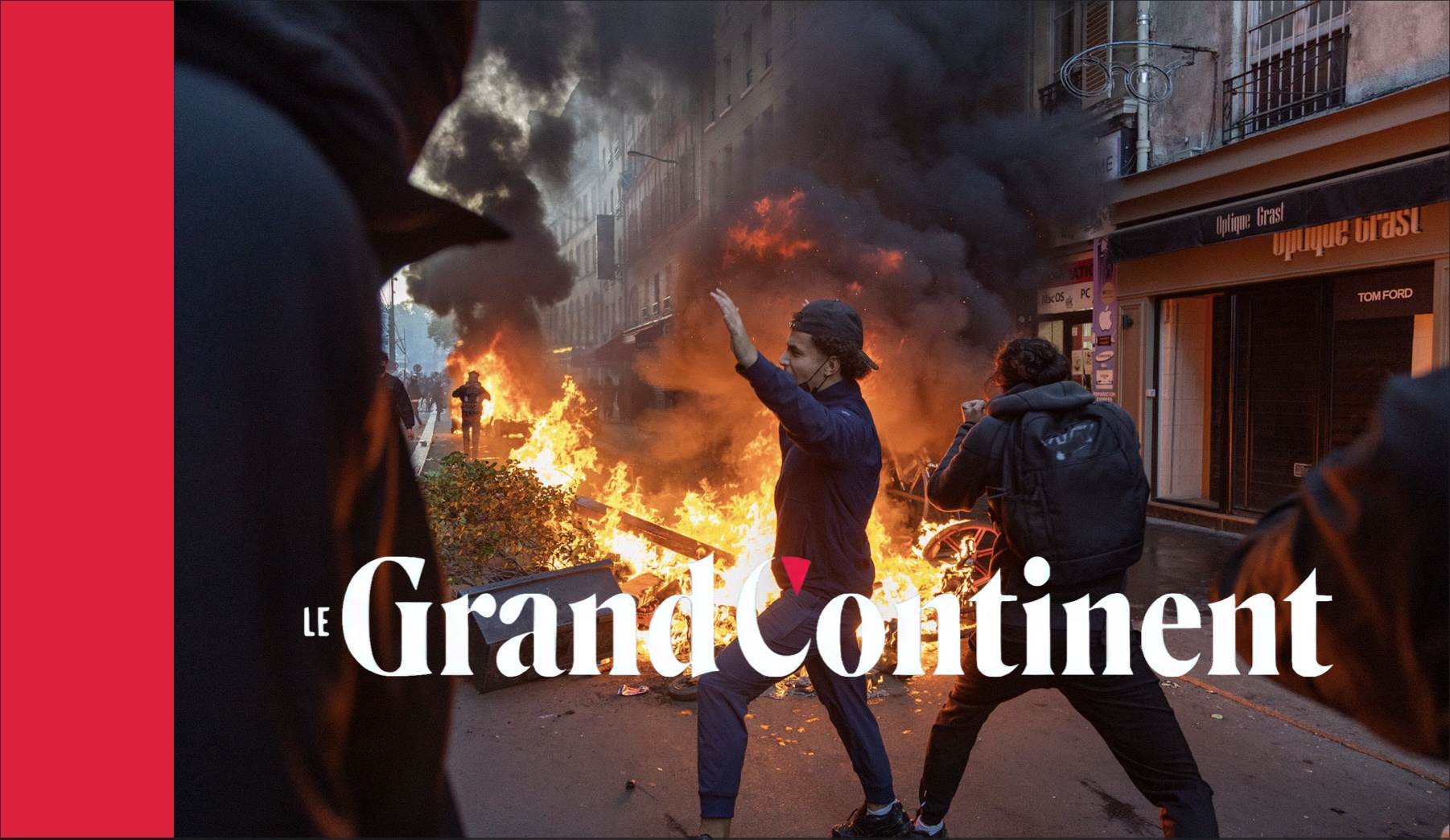
We attacked the Republic and everything it represents. The city hall of Limoges burned. The one in Marseille was stormed and its Marianne toppled. The residence of the Gironde prefect was ransacked. Vendors were attacked: more than 3,000 shops were affected, some emptied within minutes and looted, their owners sometimes trapped inside. People and authorities were also attacked: nearly a thousand police and gendarmes were injured, seven of them seriously.
Those who did this are not all the same. There are vandals and criminals who came to take advantage. There are organized groups seeking confrontation. There are also those who had mobilized for political action. And all around, many young people marching for their future whose movement was stolen from them.
Those who were on the ground recount: they did not see them coming. It was like a flock of sparrows. Suddenly, they sprang from nowhere, hooded, then they attacked. In the same place. In the same minute. As if they knew exactly where the police were. They moved from the digital to the street, then from the street to the digital, taking a kind of highway that no one watches.
The mobilization day itself began with a TikTok video uploaded on September 8. Intelligence services see TikTok as an “accelerator” and rightly point to Telegram as well. Snapchat loops, Signal channels, encrypted messaging, sites showing live the position of the police: in an instant, you know where they are, with whom, and where to meet.
You recognize yourself online. You meet in the street, facing the same target. You break things in the real world as you do in the digital world, without it costing anything. Then you film it and the video of the loot prompts the next ones.
That is the lesson we should have learned after Ceuta: a border is defended today on both sides at the same time.
In the middle of all this, there is a state that does not move. It acts in the physical world, and that’s all; at every crisis, it seems to rediscover the existence of the other.
Yet we had built what links these two worlds: the DSA, the DMA, the Data Act, the Data Governance Act, the AI Act. The idea behind these laws can be summed up in one sentence: what is forbidden on the street must be forbidden online.
We have the tools. The DSA obliges very large platforms, such as TikTok, Snapchat, X, or WhatsApp, to assess the risks they pose to public security and to civic debate, and to reduce them, including by altering their recommendation algorithms. It provides an explicit crisis mechanism, access for researchers to data, and even, as a last resort and under a judge’s supervision, temporary access restrictions. No one is talking here about censorship. It is a matter of accountability.
What is missing, therefore, is not the law. It is the will to apply it. These texts are not applied with the necessary firmness. Because perhaps we wanted to spare Washington—and perhaps not to offend Donald Trump.
Result: many experience this space as a lawless zone. But the Far West has always had its law: the law of the strongest. And those who conducted themselves as its children demonstrated it Saturday in our streets.
Apply rather than invent
So, let us stop reinventing the wheel. Every time European law sits idle, due to a lack of enforcement, states—and France in the lead—make another one. Yesterday, the prohibition of social networks to those under 15 was struck down; today, we consider cutting social networks in entire territories. It is an admission that we do not know how to do it. We summon the platforms to Bercy, while it is for the Commission to investigate them and sanction them.
Paris must clearly tell the European Commission: apply the laws, now, to the events of October 17, you are obliged to.
It is up to us to occupy this informational space. To bring in the law, justice, and the forces of order, as we have always done in the physical world.
This will not resolve everything. School, its walls, Parcoursup, the future of the youth, their fundamental and legitimate questions call for other answers. But none will hold without this one.
We have a generation that no longer knows how to move from one world to the other and a state that has never learned to do so. Uniting the physical world and the informational world is the work and the responsibility of the political class as a whole. The path, the legislations adopted, have opened it. Now we must have the courage to take it.