
Gas prices first affect manufacturers, who use energy in their production processes. In some European countries, the price per megawatt-hour (MWh) of gas can also weigh on household budgets, especially where residential heating still largely relies on gas.
- In France, nearly 40% of homes are still heated with gas, according to ADEME, even though gas accounts for less than a third of the energy households use for heating.
- In the Netherlands, Italy, Hungary and Luxembourg, natural gas accounts for more than half of the energy households consume for heating.
- Gas prices also affect households that heat with electricity, because gas-fired power plants often set the wholesale price of electricity.
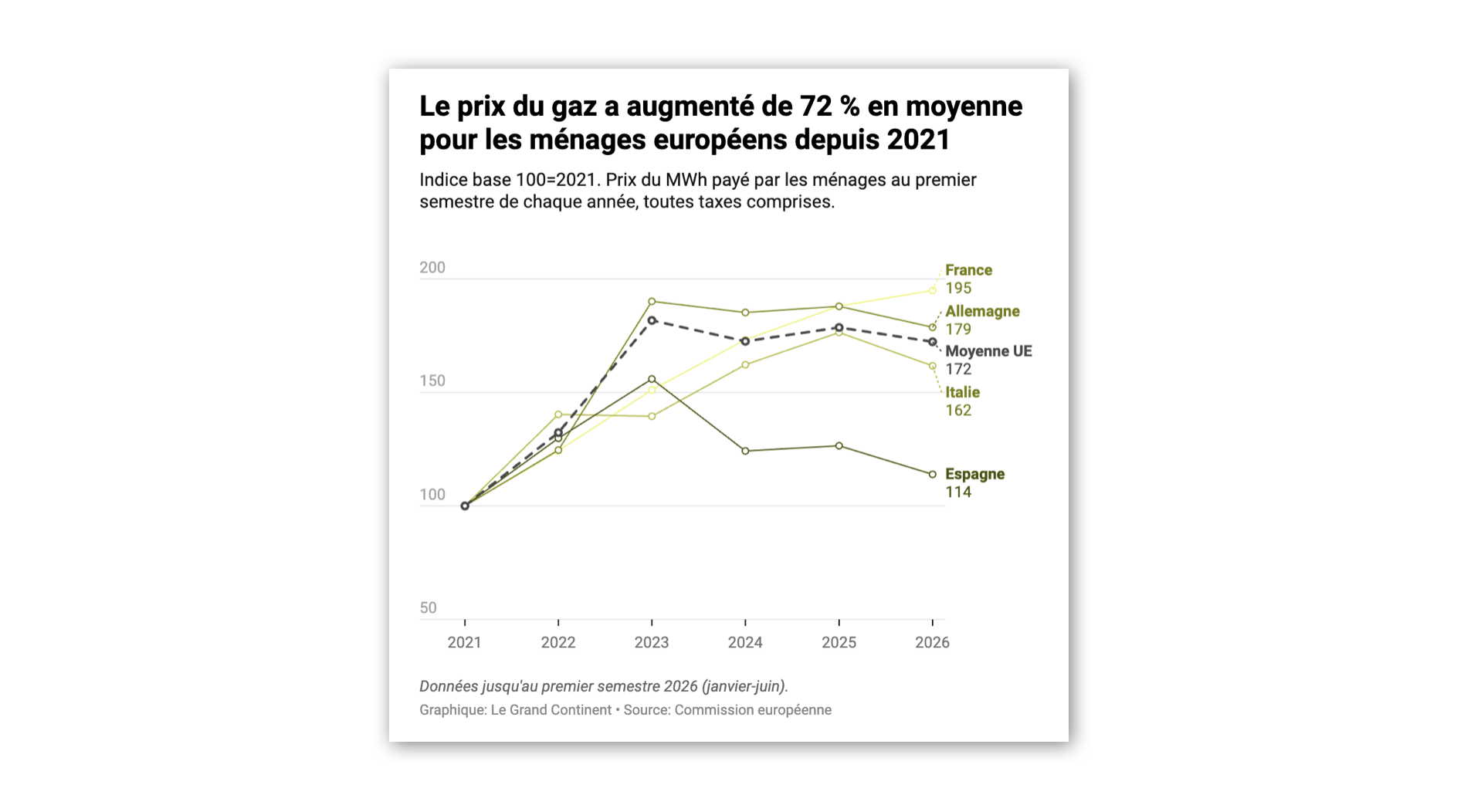
In the EU, the price of gas paid by households has risen by more than 70% between the first half of 2021 and the first half of 2026.
- While the wholesale price of gas per MWh remained below the near-€350 peak reached in 2022, at the height of the energy crisis, it has almost tripled compared with pre-war Iran levels, climbing from €32 at the end of February to €88 on 19 October.
- Part of that rise has already been passed through to households, notably in France, where the CRE-referenced gas price calculated by the energy regulator jumped by 34% between January and October.
- A further increase of 6.6% is announced for 1 November.
The rise in gas prices reflects tensions that emerged on energy markets following the outbreak of the war in Iran, which disrupted about a fifth of global LNG flows, rather than a concrete risk to the security of supply for European buyers.
- However, the low level of European reserves still contributes to keeping prices high, as Europe must compete with Asia to attract LNG cargoes.
Just weeks before the start of the withdrawal season, which traditionally begins in November, European storage was only 74% full as of 17 October. This is the lowest level for this time of year since at least 2011, according to data from Gas Infrastructure Europe.