

For the first time in French, on the occasion of the 80e Anniversary of the end of the War in East Asia, appears an assessment while nuances of the American occupation of the archipelago between 1945 and 1952 and its extensions in the current Japanese society.
An occupation “ copy », But poorly known to the French public
The Second Gulf War launched against Saddam Hussein Iraq in March 2003 by President George W. Bush ended in December 2011 with the departure of the last American occupation forces. Eight years, for an observation of failure as scathing as it is bloody. And yet, we had not praised the merits of this intervention on the model … of the American occupation of Japan ? Since the latter had been a “ success », It would have been possible to do the same in the Middle East: the fall and the disappearance of the Iraqi tyrant, could have-or had to have the same effects. It was nothing. THE “ model Japanese was not transposable and remained unique. Admittedly, the American occupation was not excessive, especially during the first months. But nothing comparable to systematic violence, not to say systemic, which had accompanied the conquest by the Japanese Empire of its “ vital space In East Asia.
However, beyond this irenic vision of a successful foreign occupation, the new opus of the historian Michael Lucken, professor at the National Institute of Oriental Languages and Civilizations (Inalco), is innovative from a triple point of view. First, if Anglo-Saxon and Japanese research on this period in the history of the archipelago between 1945 and 1952 is considerable, this work completes a major gap in French-speaking literature on contemporary Japan. Not that the American occupation was not addressed in the summary works on the history of Japan, or dealing with such aspects of occupation policy – institutional and educational reforms in particular -, but a global analysis was missing: a gap which is undoubtedly explained by the fact that if France is present when signing the Japanese capitulation on September 2, 1945 The archipelago.
Then, Michael Lucken’s work relies on the crossing of Anglo-Saxon and Japanese sources: an essential method to better understand the subtle game of the relationships between occupants and occupied in a historically unprecedented context for the two main protagonists: the Americans had been confronted, for the first time in their history, with the defeat of the old powers of the axis, with the question of multiface Military occupation in foreign land after a total war. Japan had never been occupied militarily, and it had everything to fear the revenge of “ Anglo-Saxon devils “, According to the terminology of military propaganda. Especially since Japan had never been confronted, on its soil, with the presence of so many foreigners – several hundred thousand American soldiers – with whom it had to experiment with obligatory relationships of subordination, cohabitation and collaboration.
Finally, the title even of Michael Lucken’s work sheds light on his remarks at two points of view. First, by placing the focal length on the “ American “And the” occupants The author insists on the role of the actors involved. The occupation is not only analyzed, downstream, by “ guidelines »General and impersonal: it was thought and thought up upstream by specialists who have built, step by step, with their own subjectivity, their representation of Japan and its inevitable realignment. Promethean work if it was, because if Nazism had been considered an odious drift in the history of an attached Germany after all to Western civilization, Japan still remained, in many ways, an enigma, the caricatured symbol of a modernity of facade, out of step with a feudal social substrate: a “ infantile disease Who would have fueled the rise of ultranationalism and militarism.
Michael Lucken clearly shows that the development of these policies has not been improvised after the Japanese defeat, but carefully thought out at least since 1942, within the State Department and theOffice of Strategic Services (Oss) In particular, and that it is often the same men who participated in intelligence and information operations during the war that we find, either as inspiration, or in the handle of occupation policy. These anticipations did not exclude, quite the contrary, strong discussions, on the way in which Japan should be “ straightened ». In other words, the military objective of unconditional surrender has not hampered, but on the contrary stimulated post-war political planning in Japan.
Secondly, the author underlines the decisive role of the United States in the development and execution of the occupation policy: the British, Australian, New Zealand allies who maintained troops in the archipelago were reduced to police, communication and logistics tasks, and the bodies of interallied consultation, such as Far Eastern Commission, were of a very relative weight in the main orientations of the occupation. Ultimately, the only question of importance was that of the room for maneuver of the American proconsul in the archipelago, General Douglas MacArthur, compared to Washington. Michael Lucken shows that unlike current opinion that MacArthur enjoyed very wide autonomy, his action was very framed by Washington.
Make an minds
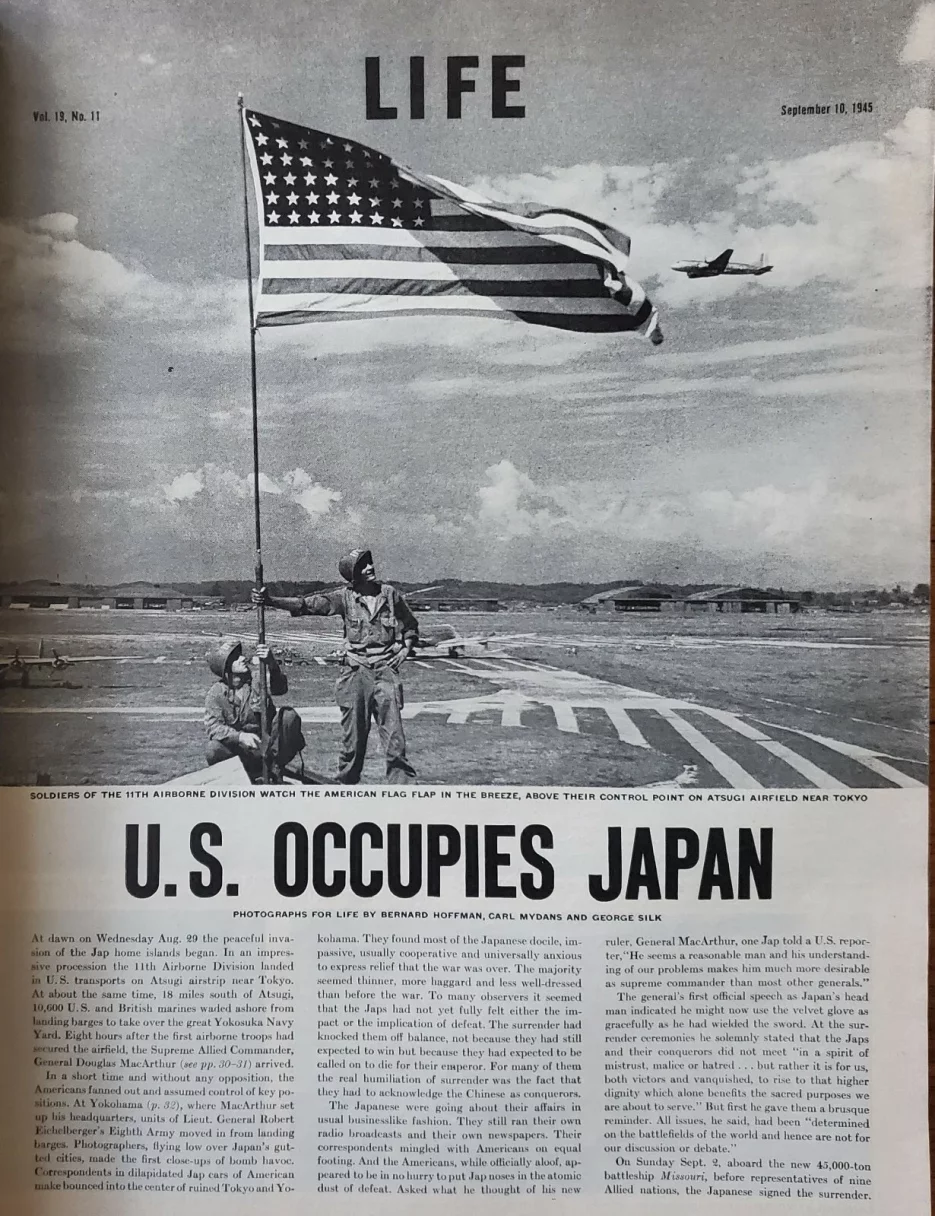
The book rightly stresses that the American occupation has had a messianic dimension. The mission of the American authorities has been, beyond structural reforms, to act on collective mentalities: to ensure, by remodeling of minds, that the new Homo Japonicus No longer succumbs to the sirens of militarism and ultra -nationalism. A strategy that is both authoritarian and pragmatic. Authoritarian, by a heavy censorship implemented paradoxically in the name of freedom, intolerant to any public criticism of occupation policy, and by a “ purge Touching mainly political staff. Pragmatic, by the regime of indirect administration in order to “ wet The Japanese government elites, but capable of adapting, from the years 1948-1949, to the new geopolitical data so that Japan was not the victim of the “ domino theory ».
It is led not only by American policies and military, but also, in its cultural component, by private foundations, such as the Rockefeller Foundation, maintaining close relations with the intelligence services since the war with the intelligence services Americans. As a result, the occupation had a triple effect. It has favored the surprising effects of “ conversion »More or less opportunistic ideological.
The growing openness to Anglo-Saxon thought and culture inaugurated new fields of philosophical reflection and artistic creation. However, it was a source of double frustration in different temporalities: in the short term among American Japanese intellectuals, such as Tsurumi Shunsuke, disappointed by the resolutely conservative turn of collusion between theestablishment Politics and Washington at the turn of the 1950s. In the longer term, its messianic dimension was assimilated to a brainwashing company disputed by the neo-nationalist movement increasingly present in the alleys of power.
The ambiguous legacies of the post-war Japan
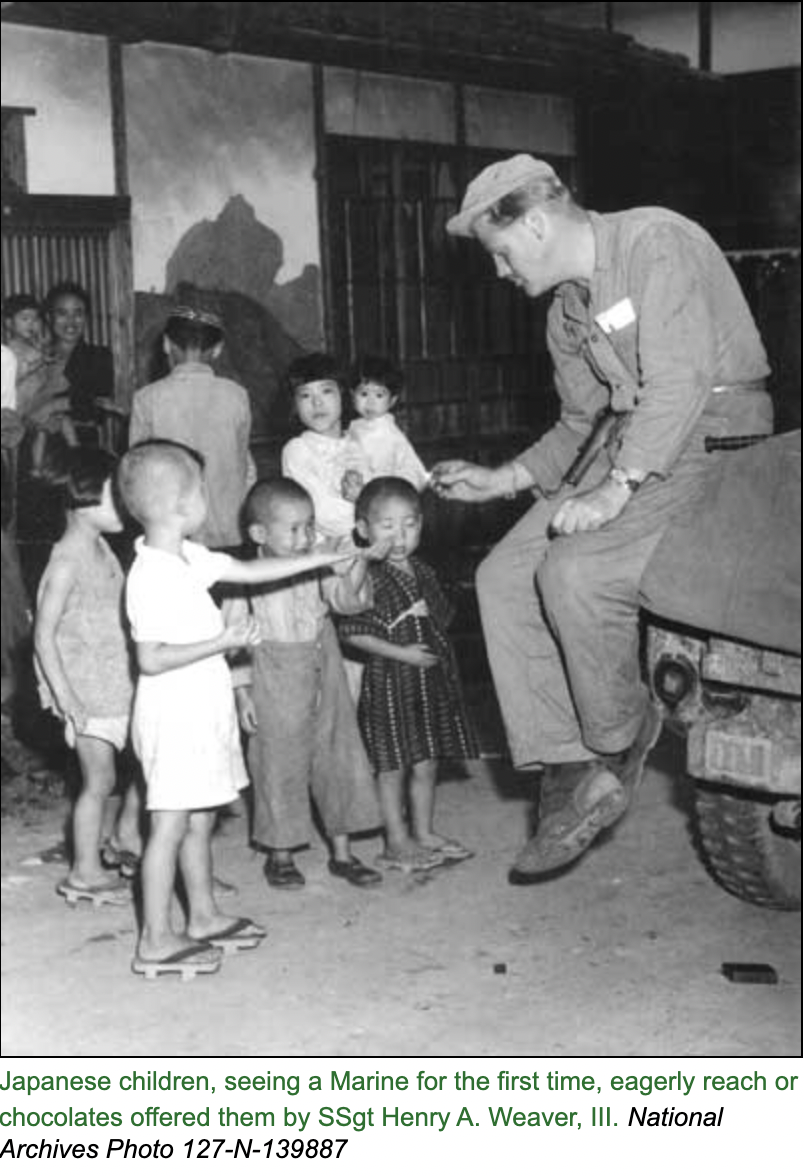
If, unlike Iraq, the American occupation of Japan has hardly encountered resistance, for reasons analyzed by the author holding, according to him, to the resilience of the Japanese political elites (who could but) and the Japanese people “ wounded By defeat, she nevertheless left ambivalent traces in the political trajectory of contemporary Japan. The occupation was the obligatory airlock by which America, an implacable enemy during the war, became an essential ally, although in clogging, with these tens of thousands of American soldiers parking in the archipelago.
Security agreements – at least their first version – negotiated at the end of the occupation only do not only by, which can, a major – but unequal – partnership between Tokyo and Washington. They bridage, as much as the new Constitution of 1946, and for decades, the reconstruction of the military apparatus as well as the autonomous political capacities of Japan, reduced to a peaceful power for lack of having been a power of Peaceful. They finally ensure the subordination of Tokyo with the superior strategic interests of Washington. The pages devoted by the author to the struggle of collectives against the Vietnam War and, more broadly, against the American bases in the archipelago, are symptomatic of this awareness, and the emergence of an autonomous civil society facilitated by the reforms of the occupation, but which Washington proved unable to take the measure.
The bilateral reports remain thus struck by the seal of ambiguity: Japan has not been spared by the surge of soft power American, with its urban landscapes modeled by the swarming of fast food, The quasi-monopoly of English in schools and in public space, and surprising socio-cultural behavior seen from France: the long systematic assimilation of “ whites Having in Japan to Americans, and the propensity of rock and pop groups to use an anglicized Japanese language full of diphthongs. The shadow of Hiroshima and Nagasaki, however, continues to hover over bilateral relations, but that did not prevent the Japanese government from supporting since 1957 that the Japanese Constitution did not prohibit, in principle, the detention of nuclear weapons …
Unlike a reductive interpretation that democracy was imported into the vans of the occupier, the 1946 regime held, because it already existed, under Imperial Japan, – although highly corseted – of democratic and liberal currents. It should also be remembered that the archipelago was, until the mid-1980s, an island of freedom in an ocean of dictatorial or totalitarian regimes, with an incomparably higher standard of living than that of its neighbors, and that it has not known war since 1945 ? Remarkable results which are not all to put in credit for the occupation, but to which the latter is certainly not unrelated.
However, the occupation remains, in many ways, a taboo: it is little mentioned in the Japanese education system, and it remains a thorn in the foot of the conservatives in power and, more recently, populists, quick to denounce the “ excess “Democratization, to put on the back of reforms” above ground Some of the dysfunctions of Japanese society and to cultivate, by a kind of memorial discharge, nostalgia of another age. It would be wrong to consider these tendencies as epiphenomena: the fact that they emanate from segments of educated opinion in the categories of New Japan, whether they are amplified by social networks, main sources of information from Japanese youth, challenges. In Japan, the end of the occupation did not put an end to the post-war period …