
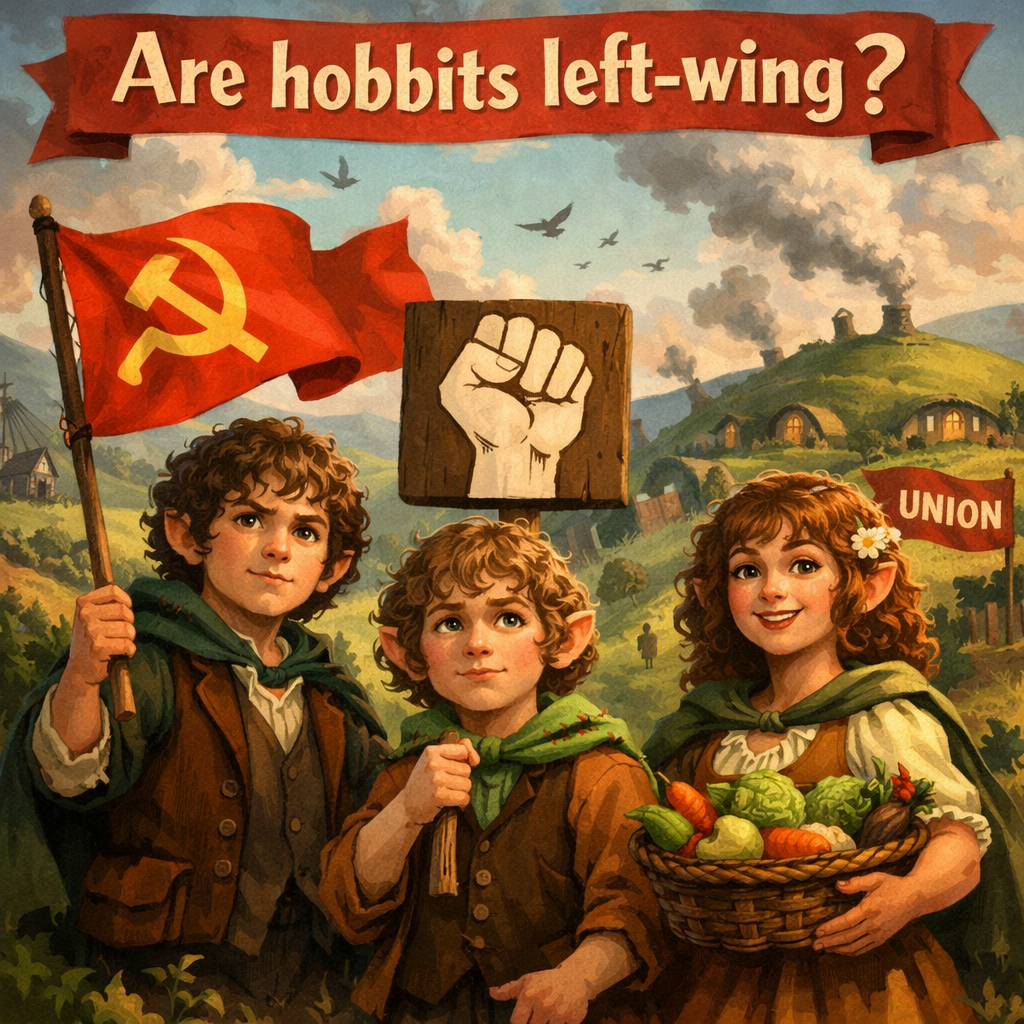
To what extent the work of JRR Tolkien lends itself to political readings ? Between criticism of industrial modernity, ecological concerns and rejection of forms of domination, Middle-earth continues to fuel competing interpretations.
“ My book is not allegorical, nor does it relate to current events. » Despite the assertion of JRR Tolkien about Lord of the Ringsthe work was almost immediately exploited, on the left as well as on the far right. From the 1960s, protest movements, particularly American ones, saw it as an anti-capitalist and ecological ode, while, in the 1970s, hobbit camps were opened created by Italian neofascists – even today, Giorgia Meloni affirms that THE Lord of the Rings is his bedside book.
It is in this context that the short essay by Sébastien Fontenelle, journalist at Blast, is placed, a committed book which aims to denounce the recovery of the work of JRR Tolkien by the European and American extreme right and to demonstrate, on the contrary, that it is a profoundly progressive work, particularly in the field of the environment, despite the assumed conservatism of its author. For Sébastien Fontenelle, THE Lord of the Ringsin particular, constitutes “ an implacable indictment against totalitarianism and against industrialization whose ravages we know today » (p. 16).
The ecological roots of fantasy
Over the course of short, punchy chapters, the author first briefly retraces the life of Tolkien (1892-1973), a necessary reminder, because the ecological dimension of Middle-earth is inextricably linked to the experience of the English professor, who lived as a child in the countryside before being propelled to the industrial city of Birmingham. Sébastien Fontenelle also recalls the foundations of the genre of fantasy by Tolkien in his essay on fairy tales, marked in particular by the desire for a “ recovery » of an intact nature. He then summarizes the Hobbit (1937) and THE Lord of the Rings (1954-1955), which each narrate quests carried out respectively by the hobbits Bilbo and Frodo, and by their companions, at the end of the third age of the world. These two books are showcases of Tolkien’s gigantic but fragmented work (the Silmarillonfor example, which establishes the legend of his universe, was never published during his lifetime ; it was reworked by his son Christopher).
Sébastien Fontenelle then begins to develop several themes aimed at nourishing his argument. Four chapters are devoted in particular to hobbits, whom he considers to be “ quiet heroes », travelers in spite of themselves. Bilbo like Frodo are fans of slowness ; generous in their practice of giving ; altruistic in their relationship with others ; and sober in their daily lives. In short, they would be ecologists before their time and precursors of degrowth. As for the County, their country, it represents rural England, or at least an idealized version, as Tolkien knew it at the end of the XIXe century, according to the writer himself.
The following three chapters evoke, on the one hand, the importance of a key character in terms of fictional ecology, Tom Bombadil. This one, which appears at the right time in the adventures of the hobbits, represents “ the incarnation of original nature, preserved, protected and to which humans and their machines have not yet imposed the outrages of industrial modernity » (p. 68). This appears in particular when her friend states about her that “ The trees and herbs and all things that grow or live in the land belong only to themselves » (The Lord of the Ringsp. 145). On the other hand, Sébastien Fontenelle evokes the Ents of the forest of Fangorn, led by Barbebois, who end up going to war against the perverted magician Sarouman, the latter representing, among other things, the domination of evil and polluting industrialization. The Ents, half-trees, half-living creatures, are in fact considered as “ eco-warriors » before its time (p. 78).
Antifascist Tolkien ?
The next chapter, “ Fascist machines “, returns to Tolkien’s visceral hatred against machines, expressed in particular in his correspondence, even though they are adored by fascist and Nazi writers like Filippo Tomaso Marinetti, author of a Manifesto of Futurism (1909), or Ernst Jünger, for whom nationalism and industrialization converge, particularly in the context of war. However, Sébastien Fontenelle also measures Tolkien’s ambivalence in matters of political opinion: fervent Catholic and “ primary anti-Soviet », he denounces in the same movement American imperialism. In fact, the conservative nature of his position is still the subject of controversy.
Nevertheless, the “ book » of Tolkien would be as much anti-racist as anti-fascist – this is the subject of the last two chapters. Concerning the first dimension, there is again an academic debate on the question: Tolkien has sometimes been accused, on the contrary, of racism – his universe being populated, in particular, by northern white heroes and colorful, southern villains. While it is true that he explicitly denounced Hitler and Nazism in his letters, a certain ambivalence remains, a “ embarrassed » – to use the expression of a great French Tolkien specialist, Isabelle Pantin – which Sébastien Fontenelle nevertheless brushes aside by affirming that the different “ ethnic groups » « coexist without difficulty » and that “ against the evil absolutism which wants to enslave them, it is therefore an interracial solidarity – and in fact internationalist – which prevails and imposes itself » (p. 102).
Regarding the second dimension, the author recalls the recovery of Tolkien by the left in the 1960s and 1970s – which disconcerted the writer – and notes that “ this claim of the Lord of the Rings as a breviary for the contestation of oppressions is much more in line with the reality of what structures Tolkien than the miserable captures that the reactionary right attempts to attempt » (p. 105). This “ reality », this is the anti-totalitarian and ecological content of the work. In conclusion, Sébastien Fontenelle returns to the relevance of considering Tolkien’s work as constituting “ an implacable denunciation of power » (p. 110) and emphasizes that it remains profoundly current in an era marked by “ carbofascism ”, defined as “ conjunction of the deliberate ransacking of our environments and a constant authoritarian stiffening » (p. 112).
An unexpected plea
If Sébastien Fontenelle notes that he is not a Tolkien specialist, his work can nevertheless constitute an introduction for those who do not yet know the work of the founder of Middle-earth, even if it sometimes appears a little rapid (a bibliography would have been welcome). But his remarks above all constitute a political plea denouncing the abusive uses of Tolkien by the extreme right of all stripes. As a committed book, it is sometimes carried away by its subject. On the question of racism, for example, his rather clear-cut demonstration does not highlight Tolkien’s nuances and ambiguities. We can also question the relevance of considering the latter as the precursor of anti-speciesism in view of the rejection of hunting by hobbits – this is perhaps a somewhat short argument.
More generally, certain interpretations lack nuance. To take just two examples, hobbits are not completely ideal creatures. ; according to Tolkien himself, they are homebodies, quite closed-minded and a bit gluttonous. Bilbo, Frodo and his friends are the exception rather than the rule. Or again, if Tom Bombadil actually embodies nature, and even more precisely the English countryside, as Tolkien pointed out, he is ultimately powerless and cannot intervene actively in the War of the Ring.
Ultimately, the politicized rereading of Middle-earth, according to current issues, sometimes leads the author to impose his own commitments – anti-capitalist, anti-fascist and ecological – on Tolkien’s work. That said, Sébastien Fontanelle’s book, which forcefully underlines the dangers of the recovery of an absolutely major work by the extreme right, remains stimulating and invites discussion.