
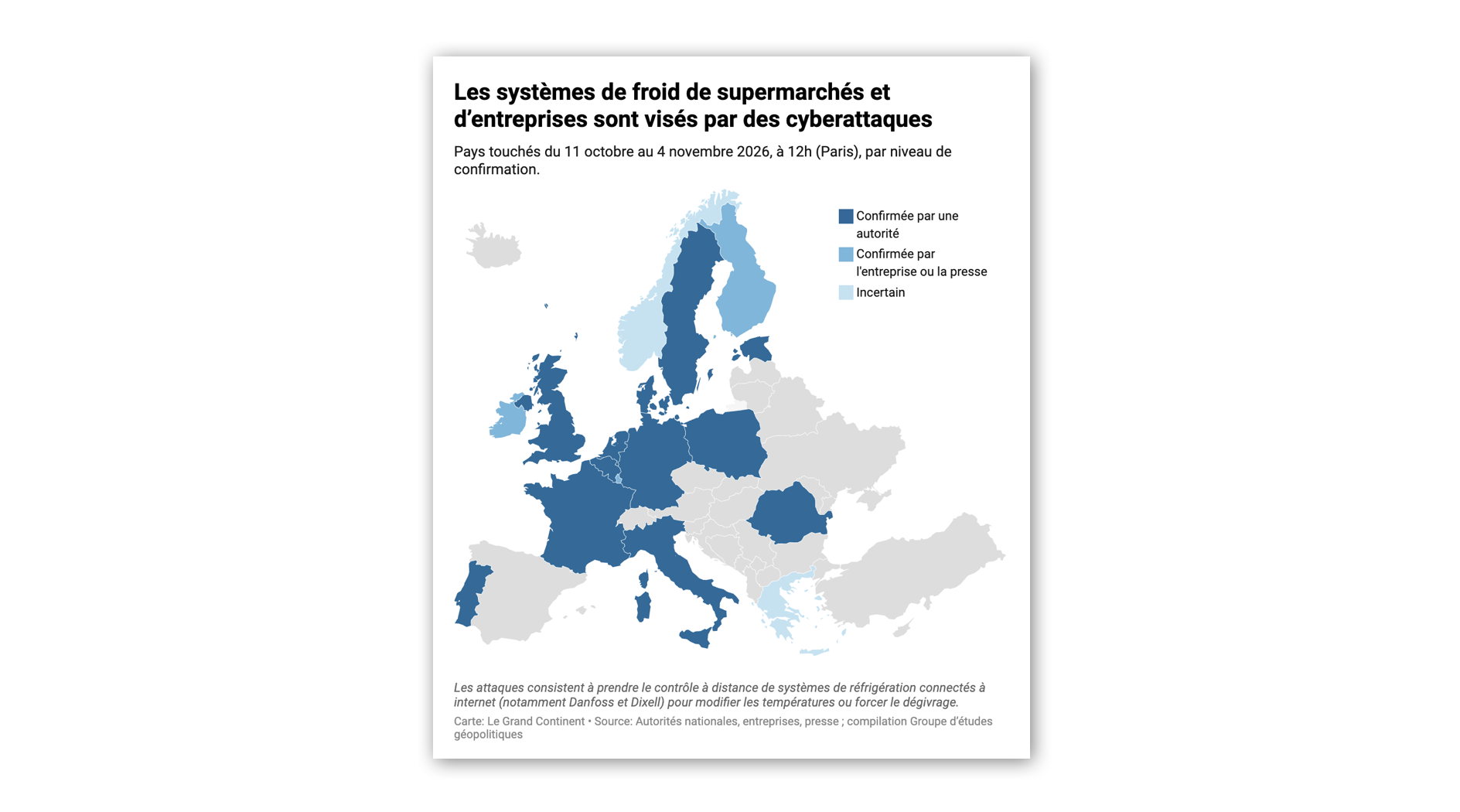
According to an analysis by the journal, at least 15 European countries have been affected by cyberattacks targeting the refrigeration systems of supermarkets and food companies since October 11. These attacks initially affected French supermarkets, causing at least tens of millions of euros in losses, and then spread to other countries in early November.
- Hundreds of French supermarkets were affected overnight on October 11–12, followed by others equipped with Dixell controllers that allow remote regulation of the temperature of refrigerated display cases and cold rooms, during the night of October 12–13.
- A second wave of attacks occurred overnight on November 1–2, affecting 14 countries, including Germany where Rewe and Edeka stores were targeted, and Italy where around twenty stores were affected in Sicily, as well as a catering company in Tuscany.
The scale of these attacks varies considerably from one country to another.
- France stands out from the other European countries hit: around 700 supermarkets were targeted, according to the government.
- With the exception of Belgium, Sweden, Italy, the Netherlands and Ireland, the number of stores and companies affected in the other countries does not exceed a dozen.
- In Greece and Norway, three businesses have claimed to have been hit, though authorities have not confirmed their cases.
The possibility of a Russian operation or action by actors linked to Moscow’s intelligence services should not be ruled out.
- According to the American cybersecurity firm Forescout, most of the roughly twenty attacks claimed since the start of the year against refrigeration systems were claimed by pro-Russian hacktivist groups.1
- Xavier Bellekens, CEO of the Scottish cybersecurity firm Lupovis, says he is “firmly convinced that this activity could be attributed to a malicious actor backed by the Russian state.”2
- According to Lupovis, decoys (also known as “honeypots”) set up by the company were targeted by attackers whose servers had previously been used by Russian groups.
This sequence of attacks is all the more troubling because no ransom was demanded and it could be used to send a message to European governments. On Monday, November 2, cold storage rooms of the French Blood Establishment (EFS) were hit by an attack targeting their refrigeration contractor, with temperature thresholds raised to very high levels.
The EFS maintains that this attack had no health impact.
- Advances in artificial intelligence considerably facilitate cybercrime operations and provide perpetrators with new capabilities to carry out large-scale attacks in a short time.
- CrowdStrike, in a report published in February, estimates that the number of AI-enabled attacks by malicious actors nearly doubled between 2024 and 2025, rising by 89%.
Sources
- Charlotte Hughes-Morgan, Christopher Jungstedt et Jordan Robertson, « Supermarkets Across Europe Report New Suspected Freezer Hack », Bloomberg, 2 novembre 2026.
- Sam Clark et Antoaneta Roussi, « Supermarket Chain Thaw Massacre : Russia suspected in Europe’s fridge attacks », Politico, 3 novembre 2026.
- Luc Chagnon, « Une cyberattaque touche des installations frigorifiques utilisées par l’Etablissement français du sang, « sans impact » sur les échantillons conservés », FranceInfo, 4 novembre 2026.