
Testez the Grand Continent. The ideas and analyses you won’t find anywhere else. But you’ll see them everywhere soon. In your inbox starting at eight euros per month
The Democrats won the midterm elections, surpassing even the polling predictions. Did Americans cast their vote on the economy, or did they reject the MAGA project as a whole?
As the ballots closed, voters were asked to name the issues they considered most decisive, and according to various surveys, the overwhelming answer was “the economy.” The second most frequent response was “democracy.” These two issues are linked: a weakened democracy often leads to a weaker economy. These have been the dominant themes of the past two years, so the result isn’t entirely surprising. There is immense mistrust of the Republican Party on these two questions, particularly toward the president, Donald Trump.
Can Democrats read this as an endorsement of their agenda, or is it merely a punitive vote against Donald Trump?
The fact that a Democratic shift occurred with roughly the same magnitude across many different districts nationwide indicates that this isn’t simply discontent directed at individual candidates in specific states. The broader situation is what matters. It is clear that voters are expressing their disagreement with the policy proposed by the Trump administration. However, it is much harder to identify the precise aspects they are rejecting.
Isn’t there also a rejection of corruption and inequality? Don’t these distort the economic and political playing field?
Yes, without a doubt. In the midterm elections, Elon Musk spent $474 million. That distorts our political life. Each candidate must now wonder, even if only for a moment, not what serves the American people’s interests, but what will please or displease Elon Musk.
Our democracy isn’t designed for such a huge disparity in resources. It’s staggering that a single person can invest $474 million in elections. But, when you do the math, what’s even more astonishing is that he doesn’t invest more. Remember that he has a trillion dollars. He could spend 2,000 times as much. It’s astounding.
Is the vote explained primarily by purchasing power, or by something deeper?
Purchasing power is indeed one of voters’ major concerns. But when people talk about their economic anxieties, it’s partly due to the struggle to make ends meet and partly to the anxiety about their economic future. The share of people who rate the country’s economic situation as poor has never been higher, by a wide margin.
What distinguishes this situation from past economic crises?
We find ourselves in a situation where most of our economic challenges are the product of our own actions. That is unusual. It raises a question: if something grave were to happen, would the right people be in charge to protect us? The anxiety goes beyond concerns about purchasing power and touches a deeper feeling: that we are not breaking through the fog and understanding what the future holds for us. Things we once took for granted are now under threat.
Many of the difficulties people face are real, but they stem directly from policy choices of the administration: nothing justified the tariffs, the exploding budget deficit, harsh and immediate anti-immigration measures, a new Middle East conflict, or a budget that constitutes the largest redistribution of the poor to the rich in a single piece of legislation in American history.
This constitutes a set of economically devastating policies, reflecting a level of incoherence, corruption, and incompetence greater than anything I have known in my life.
Immigration policy is among these decisions. Yet it continues to enjoy broad support among a large portion of the Republican electorate.
Two distinct issues must be distinguished: one concerns immigration as an economic policy and its consequences, the other concerns the discourse around it.
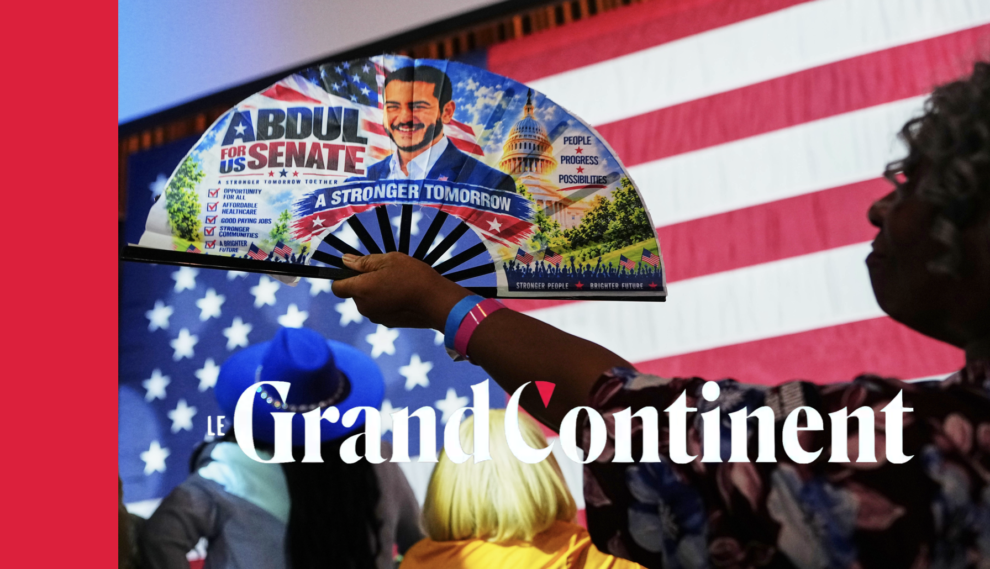
Let me speak from Michigan, where Abdul El-Sayed is about to become the first Muslim senator. We have lived through an experience that I hope no one else will have to endure: every time I turned on my television, I faced a torrent of anti-Islamic hatred. There exists, or existed, a broad consensus among advanced economies and serious nations that hatred based on race, skin color, gender, sexuality, or religion never leads to anything good. It is not only immoral in the strict sense: stoking such hatred creates social divisions that can lead to the massacre of millions of people, as World War II showed us.
That is why we had reached an implicit agreement that this form of hatred was never welcome in the public space, and that anyone who trafficked in it would be excluded. This remains true in many countries. Yet one of the two major political parties in the United States welcomes the most extreme positions with open arms, and we have a president who called El-Sayed a terrorist.
These barriers, which we regarded as bulwarks of decency, have collapsed, and I don’t know how one can put the genie back in the bottle. Repeatedly, the world has become aware of the futility and price of such a way of thinking. It is also true that political leaders have understood how electorally profitable it can be. We had managed to curb this latter tendency by reminding ourselves of how costly it is. That safeguard has jumped the track, and none of us will forget it. That is the first aspect: racism and anti-immigrant hatred.
And economically?
The administration has curtailed all forms of immigration, and that is precisely the problem. The rules in place today simply do not benefit either the United States or immigrants. If you tell a student who wants to enroll at the University of Michigan, “I can guarantee you a visa for the first year, but I cannot guarantee that when you go home for Christmas you’ll be able to return and finish your studies,” will he want to study in Michigan, or in Cambridge, where he would be allowed to complete his studies? The system has always rested on implicit promises: if you behave properly, you’ll be welcome. This applies to students, entrepreneurs, and immigrants in general. If we are a country unable to keep these promises, everyone will take note when they stand at the airport deciding which country to head to. So the United States has become decidedly less welcoming to immigrants.
It is an economic issue for many reasons, but I want to emphasize one in particular. Immigrants are different from others—and I say this as an immigrant myself. We left everything behind to go to the other side of the world in search of opportunities. That goes hand in hand with an entrepreneurial spirit, imagination, and a sense of innovation. We also bring with us the cultures, customs, and ways of thinking and acting from our home countries, which enriches the way this country thinks.
Very serious studies demonstrate the central role immigrants play in research and development. If you look at the major American tech companies, you’ll see that almost each one has a significant immigrant at the core of its story. If Steve Jobs’s Syrian father had felt so unwelcome that he had left for another country, Apple would not have become an American company. Fortunately, that did not happen. But we do not know who will be the mother of the next Steve Jobs. She may be sitting right now in the immigration office, treated with indignity, wondering if there isn’t a better place for her somewhere else.
What concretely can the new Democratic majority do to course-correct?
First, on economic matters, the Constitution explicitly grants Congress the power over tariffs. The president has either stolen it, seized it, or borrowed it. Congress can reclaim it. Tariff measures have proven extremely unpopular; the president wouldn’t have gotten them enacted even with a Republican Congress if he had tried.
It can also be argued that foreign policy power rests with the president, but the power to declare war rests with Congress. The United States went to war without a Congress-resolved declaration. It is time for Congress to decide whether it wants to be at war with Iran.
Would taking back control of tariffs and war be enough to solve the crisis?
No, other questions arise. The current budget deficit is the largest in American history outside of wartime or recession. And the budget must be approved by Congress.
Last time, it was the “One Big Beautiful Bill.” The House and the Senate were Republican. The country club Republicans got what they wanted, and in return, the president got what MAGA Republicans wanted. They struck a deal. We are now in a different world, one that I hope will lead us to a more coherent budget policy.
Reducing the deficit means either higher taxes or cutting spending. Are Democrats ready for these unpopular choices?
The American people deserve an honest discussion about the budget numbers. If a situation cannot last—and I believe our current deficit is unsustainable—it will end. Will it end smoothly or through pain? These are difficult trade-offs. I don’t want to dictate what anyone should think, but deluding oneself is not a solution.
With such slim margins, what levers can Congress pull to boost purchasing power?
Health insurance is one. I am convinced that before tackling one idea, we should imagine a counterproposal to oppose the first. Regarding Obamacare, the Republicans have only attacked and undermined it, so today not only are fewer people covered, but they also pay more. That has an immediate effect on the cost of living: it’s a dimension of the crisis that Congress could address.
Will restoring Obamacare suffice, or is it necessary to rethink the health care system?
Reforming the health system is, to some extent, quite simple. Look at what happens in other countries and see that some have found the right formula; if they haven’t found it, at least they do it with fewer mistakes than we do. I come from a country, Australia, where the health system is far cheaper, more efficient, more humane, more well-regarded, and yields results at least as good. Thus I don’t much care what you call your next health reform package, but if it brings America closer to Australia, it can work: Australians and Americans aren’t that different. From an economic standpoint, the answer is this: yes, there are other models, and yes, they can work. The only difficulty is politics. But that’s the game.
I would add only that, in a domain like health, you need one idea to beat another. If you want to move from the current system to a universal health system, advocate that idea. For my part, I would argue for the Australian model. The only thing that doesn’t work is saying “I don’t like the current system” and then undermining it in a way that raises the cost of care for millions and excludes many because of price, which is precisely what happened in the last two years. Almost any reform would be better than what we are doing now.
With a president who retains his veto power, does Congress truly have the means to act?
The Congress will, of course, have to contend with the president, and the question remains open. The Democratic majority is broad enough to govern coherently, but only if the president signs the bills. So far, the president has shown little inclination toward collaboration, even with a Republican Congress that he largely ignored. So what will he do with a Democratic Congress?
The president maintains control of the executive branch. Won’t the Democrats risk confining themselves to obstruction?
The best path for the Democrats is to learn from one of Trump’s main failures: he did manage to push a lot of things through, but he never succeeded in persuading the American people. Take tariffs as an example. He never really tried to convince us of their merits. He never stood in front of us, face to face, to say, “Here is why I think tariffs are a good idea.” He never took the time to respond to the counterarguments that people raised. He simply said, “I am the man of tariffs; I will do it.” Normally, a president tries to persuade the people of the soundness of his actions. I think one reason the backlash was so severe is that the president took all these measures without ever rallying the American people to his cause.
Take the Iran war, and compare it with the moment President Bush went to war in Iraq: he spent months building his case, bringing us all into his deliberations and discussions. Trump did none of that, and it came back to bite him. So, if I had to offer one piece of advice, it would be this: lead the debates out loud, in public, and rally the public to your cause, because that is ultimately where political support comes from.
Beyond these institutional standoffs, what should be the economic priorities for the next two years?
It is essential to reestablish the United States’ place in the world, which immediately raises the issue of the trade war. The trade war has brought nothing but harm to the United States. It harmed our trading partners and it harmed the future prospects of the United States, because it makes it harder for our country to be a trading partner, a friend, or a trusted ally for a generation. It’s a costly series of missteps, and restoring our standing in the world likely means reconsidering—indeed ending—the trade war.
The same goes for Iran. I am not a specialist in foreign policy, but the one thing I see emerging from the Iran situation are economic hardships and a loss of influence for the United States. Iran suddenly discovered that it could hold the global economy hostage via the Strait of Hormuz. That is enormous leverage that we revealed to them, that we somehow granted them, and it has compromised our security. We must determine what we actually aim to achieve. If the answer is that we refuse to accept defeat because of an old man’s pride at stake, that hurts us and harms the people of the region. Better to wound the old man’s sentiments than to ruin the lives of millions of people.
On technology and AI, the Trump administration chose deregulation in the name of innovation. What should the Democratic program be?
There are two distinct topics: what we used to call the tech giants a mere three years ago, and AI, which could well be the most transformative technology of our lives.
The president alternates between two approaches to AI: either he ignores it, or he promises not to regulate it. Yet when a technology is about to transform careers, communities, safety nets, and the entire economy, simply saying not to regulate it is to miss an opportunity. I sense that the anxiety each of us feels about the future partially explains what we observed at the ballot box.
It’s hard for Democrats to do worse than saying, “I will ignore it and do nothing, and because I do nothing, I will prevent anyone, not only the federal government but also state governments, from acting on this.” That is not up to the moment. Will Democrats mobilize and prove they are up to it? In any case, they will not do worse.
What should they do to live up to the moment?
Every government needs a coherent vision of AI. Watching the world change and remaining with arms folded is not only absurd but likely harmful. I won’t prescribe exactly what that vision should be, but don’t let this technological revolution be regulated by an old man who has never used it. We need a serious and coherent debate about how AI redefines careers, how it changes our social safety nets, what the social contract means in the AI era, the risks involved, how to minimize them, and how to maximize the benefits. This is a debate of enormous importance. If we don’t devote most of our time to discussing it, we are going astray on many fronts.
AI poses a whole slate of difficult questions. It could accomplish extraordinary things that we wouldn’t want to block. For example, if there existed an AI capable of devising a cure for the illness currently afflicting your grandmother, who would prevent that?
But AI will also transform the job market into which our children will enter after graduation, in a way that seems deeply troubling and uncertain. Such transformations could threaten the prosperity of an entire generation. Who wants that?
A large portion of American growth depends on AI. Are we in a bubble?
If I knew it was a bubble, I would have short-sold all the stocks and become the richest man you’ve ever met. Right now there are as many people buying AI stocks as selling them; there are as many who believe in AI’s future as those who think it’s somewhat overvalued.
Does it seem possible to me that AI deserves the valuation it has today? Yes. Do I think it could be overvalued? Yes. Saying more than that is almost impossible. I don’t think anyone truly knows whether we are in a bubble or not.
Should we nonetheless take this risk seriously?
Yes. Whenever you see an extreme concentration of investments, the discovery of a simple fact—for example, that these models aren’t as capable as people thought—could topple an enormous house of cards. If it were just a tiny card house, who would care? But when there is a concentrated source of growth, a crash must be feared, and that is precisely what should worry us.
How should we prepare for this possibility?
We must ensure that the people who invest in AI companies will be the same ones who bear losses in the event of failure. If I bet $100 on the Red Sox and they lose, the government does not come to my rescue. Be clear: if you bet $100 on OpenAI and the stock collapses, the state will not bail you out.
We must also ensure that the rest of the financial system is strong enough so that, in the event of AI-company bankruptcies, the many people who lose their jobs do not drag the rest of the economy down with them. Personally, I hope and believe the system is strong enough.
What we must avoid is the kind of financial contagion we saw during the last financial crisis. The good news is that we weathered that crisis nearly 18 years ago; I hope we have learned some lessons, and that financial engineering, regulatory evolution, and institutions designed to reduce the interconnections that caused the contagion will work.
So yes, we should be worried, but I don’t know if those who should worry actually worry.
What about the security question?
We must seriously worry about the potential security implications of AI: will it bring down major corporations, governments, etc.? We must worry that malicious actors now have access to some of the most powerful tools humanity has ever known. It is therefore essential to ensure these tools are restricted, or that they do not fall into the wrong hands.
Maintaining competition also raises important questions in this domain. If we end up with a world with a single AI supplier, that supplier will suddenly raise prices dramatically, you and I will lose, and it will be that supplier who pockets all the profits.
Should we abandon economic orthodoxy and invent forms of collective compensation, a kind of “AI dividend”?
We need programs that recognize that this AI was trained on our work and that of generations preceding us. That work is currently neither recognized nor compensated. It offers us an opportunity to develop some of the redistribution forms we might need.
Do you have examples?
We must rethink the nature of work. The lower rungs of a career are most likely to be eliminated first: computers can basically do what a recent graduate can do, but they cannot do what a senior associate can do. How can we rebuild and rethink career pathways? This is a businessworld question. The government’s question is how to rebuild a social safety net and an education system fit for this new world. And that’s only the beginning. If we consider that AI could transform the economy as the Industrial Revolution did, we grasp the scale of the task ahead for us all.