
Last week, the Russian Ministry of Labour and Social Protection proposed a draft resolution setting the number of work permits to be granted next year to nationals of visa-required countries at 382,800. This marks the highest level since 2015.
In 2021, before the large-scale invasion of Ukraine began, this figure stood at 102,000 permits.
- This draft resolution, which still needs to be adopted by the government—usually by late November or early December—primarily concerns workers coming from China, India, Vietnam, Turkmenistan, Bangladesh, Sri Lanka, and Turkey.
According to the Russian Ministry of Labour, “the authorization to hire workers from visa-required countries is issued only after confirmation by a regional inter-ministerial commission that the company cannot find employees within the region.”
- They could be assigned to major infrastructure projects, such as the construction of gas complexes in the Amur region, the second phase of the Vostochny Cosmodrome, or the Moscow–Saint Petersburg high-speed line.
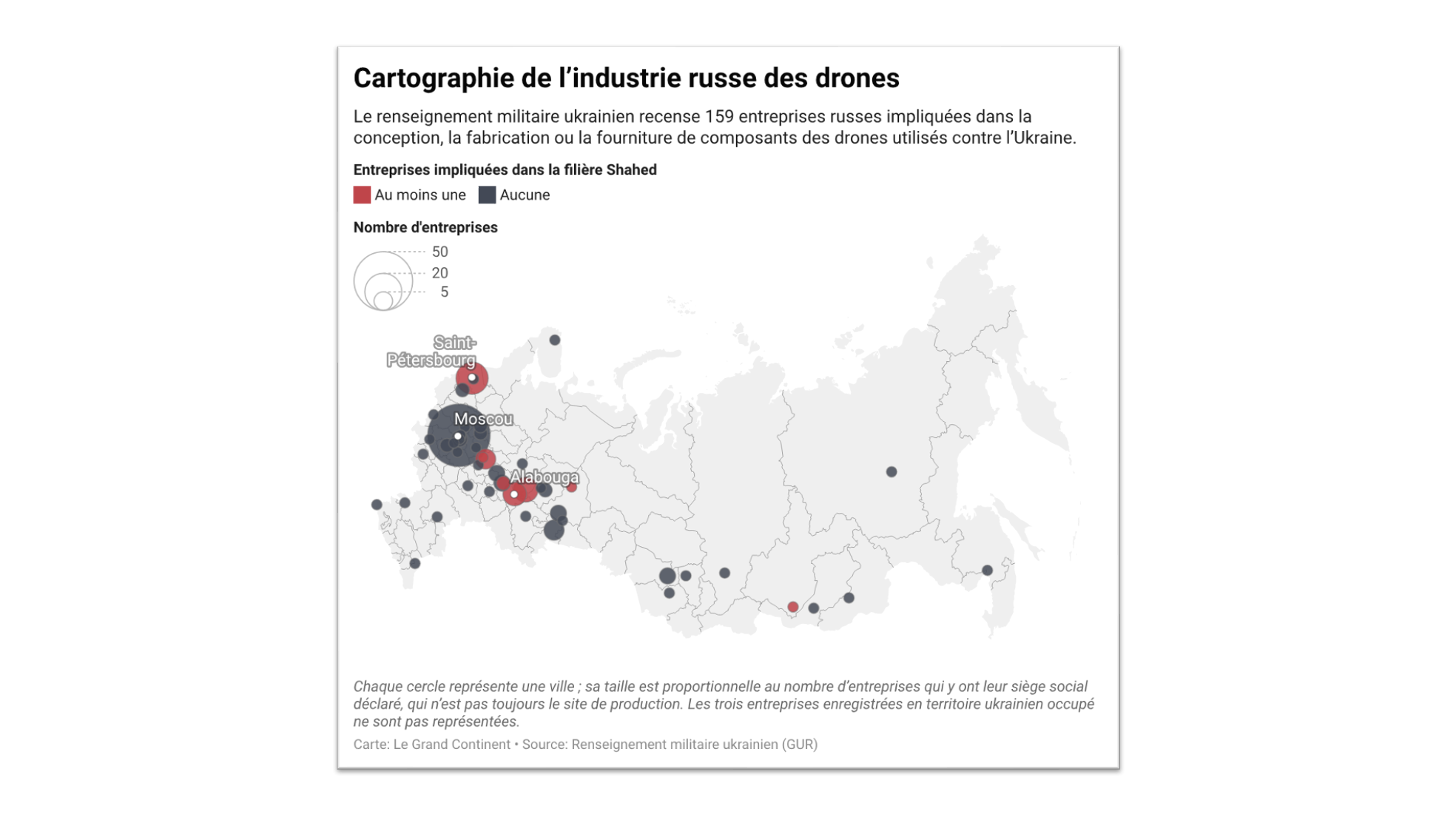
- Some could also be assigned to the Alabuga Special Economic Zone for Industrial Production, created in 2005 in the Republic of Tatarstan, about 900 kilometers east of Moscow.
It is in Alabuga that most of the long-range Shahed attack drones used by the Russian army to strike Ukraine are assembled.
- According to CSIS, foreign workers constitute one of the three main groups of workers at Alabuga, alongside young Russians recruited from the age of 15 by the zone’s polytechnic college, and North Korean workers.
- Under the Alabuga Start program (« Алабуга Старт »), young women aged 16 to 22, mainly from Southern countries, notably Africa, are promised jobs in hospitality and catering by recruiters on social media.
- Once they arrive in Russia, most are assigned to drone production. Their airfare, housing, and Russian language courses are deducted from their salary, and their passports are confiscated.
Russian military losses on the Ukrainian front reached a record high in October. Since 2022, Moscow is said to have lost between 1.4 and 2.1 million people, killed or wounded, including 374,000 to 770,000 deaths, equivalent to 0.6% to 1.2% of the country’s male population according to United Nations estimates.
- These losses weigh heavily on the economy, already facing a shortage of skilled labor.
- If the labor market crisis did not begin in February 2022, the war accelerated a structural deterioration that had already begun, and, according to Alexandra Prokopenko, has frozen its effects for several decades.