
The Republican defeat in the midterm elections, widely attributed to Donald Trump — by Democrats, but also by members of his own party — is seen by several conservative voices as creating an opening to renew the party’s leadership and direction ahead of the 2028 elections, following a decade of nearly absolute GOP dominance under Trump.
This opportunism is especially evident among the most radical fringes of the movement.
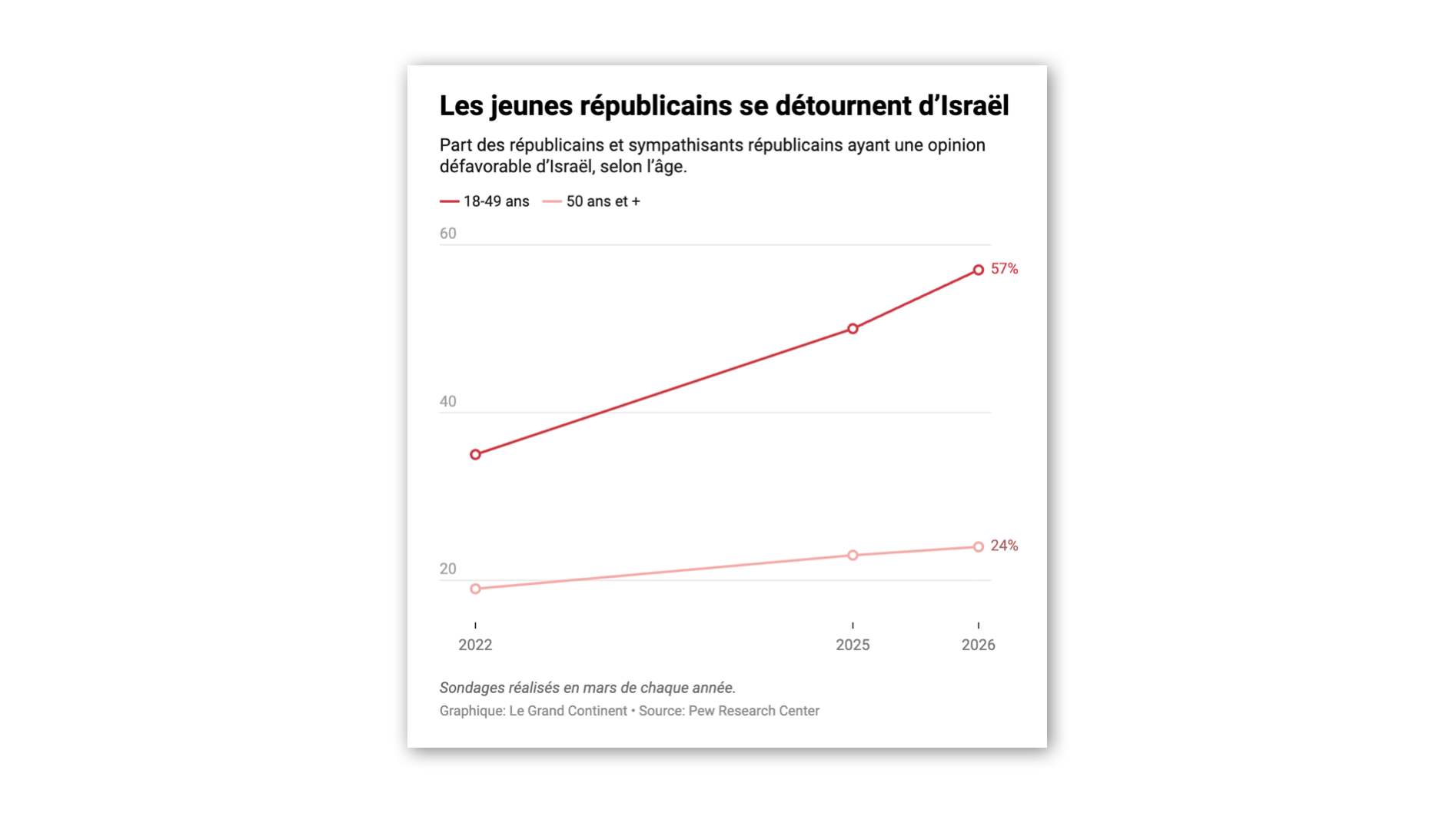
- Blaming the Iran war, responsible for rising pump prices and a portion of the inflation, on the influence Israel would wield over the Trump administration has led to a surge in antisemitic rhetoric.
- Many of those who claim to want to succeed Trumpism thus carry a message largely directed at Israel and its channels in the United States, exemplified by antisemitic influencer Nick Fuentes, who urged voting for the Democrats on November 3.
- The war had also caused a rift between commentator Candace Owens and former Fox News host Tucker Carlson with Trump, or between the influential Daily Wire columnist Matt Walsh, as of March 2. On election night, the latter urged to “move on” and to find a replacement for Trump.
The antisemitic rhetoric is expected to take a central place at the conference “Christ Is King: America After Trump,” which opened yesterday, Thursday, November 12, near Dallas, Texas, for a three-day run. The event is organized by NXR Studios, a media and podcast production platform led by pastor and Christian nationalist Joel Webbon.
- On this occasion, Webbon invited Alex Jones, the conspiracy theorist and founder of InfoWars, to headline.
- He will address the audience alongside other far-right figures, including Buckley Carlson, Tucker Carlson’s brother, and James Fishback, an antisemitic and racist conservative who had run in the Republican primary for Florida governor, won by Byron Donalds.
Webbon, who belongs to the so-called “TheoBros” movement, Christian traditionalist influencers gathered around Doug Wilson, cofounder of the Communion of Reformed Evangelical Churches, read the midterm defeat as a validation of his plan, whose first phase envisioned a Republican Party defeat.
- Webbon’s bet rests on another Republican defeat in 2028: after four years of a Democratic presidency, the American public, fed up with left-leaning policies, would finally embrace Christian nationalism.
- Among the candidates Webbon would like to propel to the presidency in 2032 are James Fishback, who is too young to run in 2028, Nick Fuentes, who, like Webbon, claims to have followers embedded within think tanks and conservative institutions, and even Webbon himself.
Webbon embodies a line that has thus far been minority within the American right. He supports repealing the Nineteenth Amendment, which guarantees the right to vote for women, the expulsion or disenfranchisement of people who cannot claim American ancestry for at least three generations on both sides of their family, and the exclusion of a substantial portion of the African American electorate from voting.
- Webbon is not the only one predicting a radicalization of the Republican electorate. Steve Bannon, the influential adviser from Trump’s first term, also believes that a new nationalist wave could further radicalize the American right.
- It could form more readily around figures who have kept their distance from the Trump administration, something some, like Curtis Yarvin, believe have failed to transform the country in a lasting way.
- In December 2025, Curtis Yarvin wrote: “The administration did not realize, as a whole, that (a) the enthusiasm generated by the prospect of real change was the source of all its political energy, and (b) that energy would fade if the offensive stopped advancing. And, it is difficult to rekindle that Rubicon energy — far harder than lighting it at the start.”