
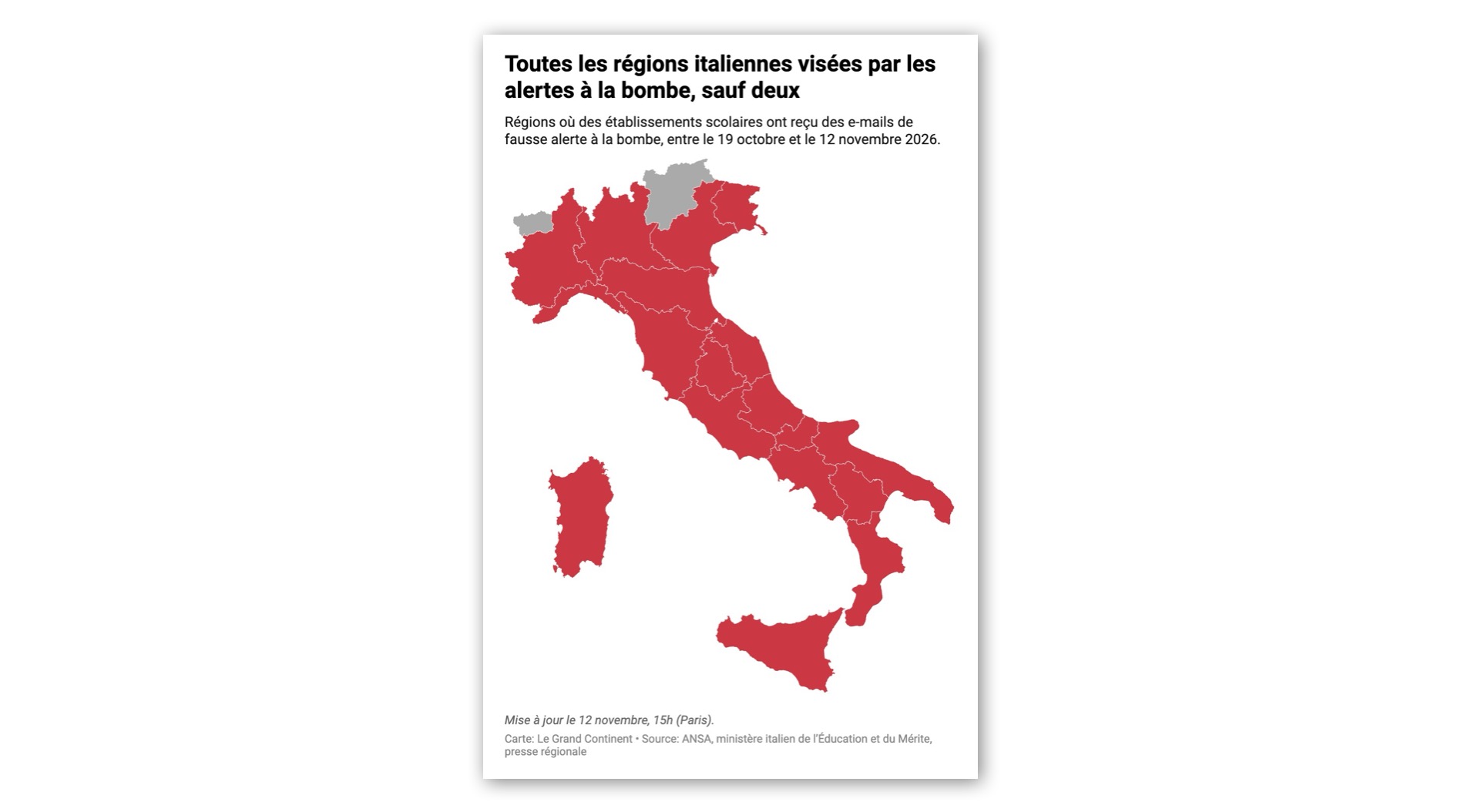
On Thursday, November 12, more than 1,800 public Italian schools were targeted by new false bomb threats. This marks the fourth wave since October 19, when around a hundred schools were affected. More than 270 schools were threatened again on November 2, and then about 6,300 institutions yesterday, Wednesday, November 11.
In total, roughly 84% of Italy’s public schools have been targeted at least once.
- The message, sent from multiple addresses, including one from the Philippine Department of Education and from a teacher, and signed under the name “Mikhaïl Andropov,” states: “Attention […] Inside the device there are numerous metal fragments which, after detonation, will maim the survivors. In order to prevent it from being detected by sniffer dogs, it has been placed in vacuum-sealed bags, which makes its location impossible.”
All Italian regions, with the exception of Trentino-South Tyrol and the Aosta Valley, which use addresses outside the Education Ministry’s systems, were targeted. The scale of the operation could indicate a desire to saturate state services rather than to hit specific institutions.
No explosive device has yet been found, and Giorgia Meloni stated on Wednesday, the 11th, that “there are no elements to suggest a concrete danger.”
- Italy is not the only country affected: on November 11, institutions in Scotland, Northern Ireland and Ireland received similar threats; on October 19, schools in Serbia were also targeted.
- In France, three schools were evacuated after bomb threats on Thursday morning, November 12, though no link to the Italian campaign has been established.
The President of the Council met with opposition leaders at Palazzo Chigi and called for unity, stressing that this meeting did not replace the government’s parliamentary briefing requested by the opposition.
- From November 6, the government had cited the false bomb threats and cyberattacks to justify increased defense spending.
- The Education Minister, Giuseppe Valditara, described the concrete risk as “nearly nonexistent” and deemed it “evident” that there is a “strategy,” in a context where the “hybrid war” is “increasingly the instrument to destabilize nations and economies.”
- The Interior Minister, Matteo Piantedosi, condemned “an obvious attempt to sow insecurity, fuel fear and pressure the institutions,” while calling it “premature to talk of a single direction.”
- Roberto Vannacci, the leader of the far-right formation Futuro Nazionale, refused to attribute the attacks to Russia.
- According to Antonio Tajani, Italy’s foreign minister, the country is targeted because of its “stance on Ukraine.” In recent days Tajani himself has been the target of pro-Russian hackers who released his personal information.