
Pope Leo XIV undertakes, from November 6 to 17, an apostolic visit to Latin America, the seventh and longest since the beginning of his pontificate. In Uruguay (November 6–8), in Argentina (November 9–11) and in Peru (November 11–17), the pope encounters a Latin American world he already knows very well, a world in which he has spent more than half of his life.
- Alone, this twelve‑day journey constitutes a feat, three weeks after his hospitalization for the removal of a cancerous lung nodule, which had led him to cancel certain commitments, such as the presidency of the interreligious gathering of Assisi on October 23.
- With ten metropolitan areas visited, fourteen air trips, and around forty speeches planned, the pope must now demonstrate that he is well and that the slightest sign of fatigue or weakness will be scrutinized differently, barely more than a year after a election in which he appeared young for a pope and in very good health.
- If, from Europe, these three Latin American countries appear to share many characteristics, the questions surrounding the papal visit are no less varied, a reality that this prudent pope, attentive to ground realities, fully recognizes.
- In general, Latin America presents the paradox of a continent that houses one third of the world’s Catholics, yet where Catholicism is in retreat everywhere, facing the dual push of secularization and evangelical Protestantism. The latter particularly attracts the popular classes, despite the Church’s more assertive social discourse, in the wake of its “preferential option for the poor” formulated by the continent’s bishops at Puebla in 1979.
In Uruguay, the challenge of a social voice in the most secularized country in Latin America
A left-leaning stronghold in a continent that is moving to the right, Uruguay is also, and for a long time, the most secularized country in Latin America: while Catholicism remains the largest religious denomination, with 44.8% of its 3.4 million inhabitants in 2018, it is now closely followed by non-believers (44.5%).
- It is also a country officially secular, where churches and state have been separated since the 1918 constitution.
- During the two most recent papal visits, in 1987 and 1988, under John Paul II, the Catholic Church still gathered nearly 70% of the population. Welcomed with respect and deference by the progressive president Yamandú Orsi (a member of the Broad Front coalition), Leo XIV knows that his words must first address social realities to be heard by a population where religious indifference is growing.
- Uruguay, the country with the highest per‑capita GDP in South America, also suffers from stark inequalities, only slightly less pronounced than elsewhere on the continent.
- Thus the pope took care to make a stop in Casavalle, one of the most deprived suburbs, plagued by cocaine trafficking and where homelessness is widespread, in the north of Montevideo, the country’s sprawling capital.
- In his various speeches and homilies, at Montevideo’s Catholic University, at the Marian national sanctuary in Florida, or during prayer vigils at the Centenario Stadium in the capital, which once hosted the first World Cup, Leo XIV recalled the fundamentals of the Church’s social doctrine, placing himself firmly in the wake of the social encyclicals and exhortations of Francis, cited many times.
- He cited as an example his own cancerous nodule detected early as a call to universal access to health care.
- Predictably, he called for the protection of human life from conception to natural death, and denounced, in particular, child malnutrition and the double scourge of suicides and femicides – whose prevalence is particularly high in Uruguay –; he also encouraged the youth to start stable families, not forgetting a word about priestly vocations in a country where, historically low, they have recently seen a modest resurgence.
Fluent in Spanish, Leo XIV spoke more freely than during his audiences in Rome, often deviating from his prepared notes, and he appeared more relaxed than in Rome, in the manner of a John Paul II who did not hesitate to “warm up” the crowds. In return, Uruguay’s Catholic youth gave him a warm welcome, even showing more fervor than expected.
In Argentina, the challenge of a post‑Francis era in a polarized nation
Arriving in Buenos Aires in the afternoon of Sunday, November 8, Leo XIV had to navigate the delicate paradox of visiting the homeland of his predecessor Francis, who himself had never wished to go there, though rumors spoke of a potential late‑2025 trip.
- While various explanations have been offered (a desire not to interfere in the political life of a nation already extremely polarized, a Jesuit spiritual tradition of dedicating oneself fully to a new mission, etc.), none has proven fully satisfactory, fueling a sense of misunderstanding.
- Even more than in Paris, the pope’s apostolic journey to Argentina takes on the tone of a repair for a missed opportunity, a delicate balancing act: the pope pays homage to the Argentine pontiff (a special ceremony was held in the Buenos Aires Cathedral for this purpose) and follows in his footsteps, while not underscoring too ostentatiously his absence during twelve years of his own pontificate – even though in 2013 (World Youth Day in Brazil) and 2015 (Ecuador, Bolivia and Paraguay), Francis had undertaken triumphant tours in several other Latin American countries.
- More than elsewhere, Leo XIV had to emphasize continuity with his predecessor on Argentine soil. His homilies cleverly blended references to Saint Augustine, now customary, with Ignatian spiritual exercises by Saint Ignatius of Loyola, the founder of the Jesuits.
- In Argentina as well, the last papal apostolic journey had been that of John Paul II in 1987, in the context of emerging from dictatorship.
The reception of Leo XIV, in any case, showed that it is futile to try to pit the two popes against each other: in Córdoba, in the heart of the country, a place where Jorge Mario Bergoglio spent the hardest years of his life, his successor already drew a crowd of 650,000 faithful, whom he urged during his homily to be missionaries; then, before a million young people gathered Tuesday evening in Buenos Aires, the pope renewed the call to holiness he had already voiced at the Stade de France for French Catholic youth, urging them to renounce the idols of the time, which led him to denounce the dangers of chasing success and online harassment on social networks, while remaining open to the new evangelization possibilities offered by digital technologies.
- Cleverly, he stressed both the radicality and the accessibility of a vocation to holiness that is meant for everyone, requiring a break with routines and passivity, as he again underscored in a more targeted homily addressed to Argentine clergy, a group marked by significant divisions.
- For his final Mass, at the Marian sanctuary of Our Lady of Luján, proclaimed patroness of Argentina by Pius XI, the pope gathered 2.5 million worshippers (some sources put the figure at up to 3 million), the largest crowd since the start of his pontificate, ahead of masses held in Madrid (1.5 million) and Paris (800,000).
- That enormous figure approaches the largest gatherings from the era of John Paul II, notably his closing Mass at the Manila JMJ in 1995, which drew 5 million faithful, one of the greatest human assemblies in history.
The pope finally came to reinforce a civil society and a Church that are divided.
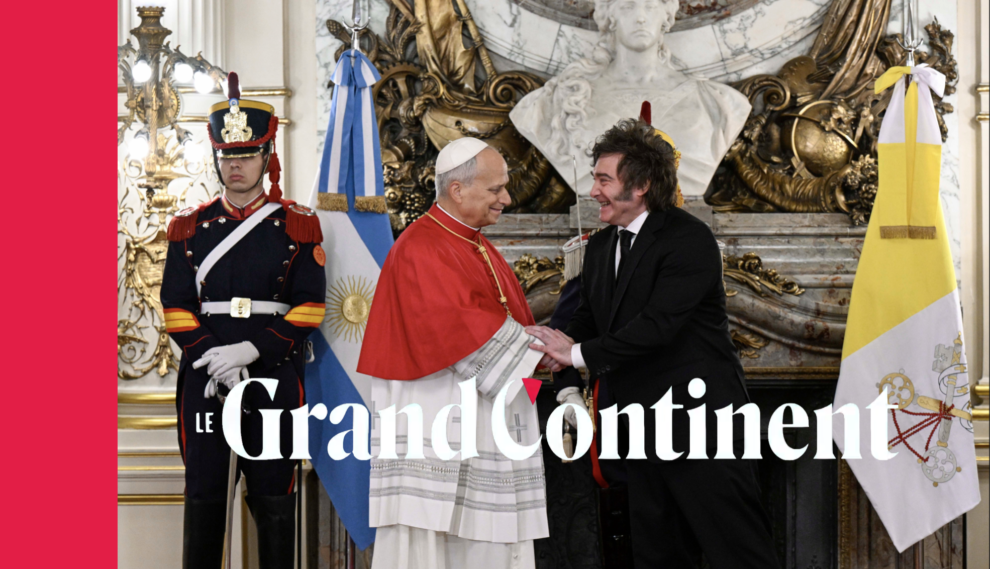
- Regarding the first, where Catholicism long served as one of the cement of national unity, the pope did not come to preach a euphoric reconciliation: on Sunday, November 8, at the Palace of Liberty, in the presence of President Javier Milei — who, perhaps aware of the popularity of his interlocutor, kept a low profile for once — Leo XIV defended a demanding understanding of the Church’s social doctrine, attentive to the dignity of the elderly (while Milei’s government had made clear cuts to pensions), to the education of young people (the same applied to university budgets), and to people with disabilities (whose allowances were also restricted by the same government), even though there were points of convergence in the pro‑life values opposing abortion.
- As Mikäel Corre noted, this relentless demonstration served as a lesson to President Milei, whose religious stance is singular: baptized Catholic, still professed as such in 2024, the Argentinian president is also very close to certain strands of observant Judaism and to New Age spirituality.
But beyond the Argentine nation itself, the local Church appears highly polarized, led by Archbishop Marcelo Colombo of Mendoza, seen as an opponent of Milei (as, in the past, Cardinal Bergoglio, without giving any tokens to the liberal right, was a harsh adversary of the Kirchner couple).
- A recent testimony given during the visit—an interview conducted for the conservative English‑language media Ad Vaticanum—shows that the emeritus Archbishop of La Plata, Héctor Aguer, 83, a notably conservative prelate who opposed Jorge Bergoglio’s resignation in 2018, explicitly asked Leo XIV to repeal Francis’ motu proprio Traditionis custodes (2021), which hinders the celebration of the traditional Latin Mass, and to return to Benedict XVI’s Summorum Pontificum (2007), with more liberal liturgical orientations.
- His sudden death the day after the interview only underscored the poignancy of that plea.
In Peru, the return to the roots of a son who was adopted by the country
It is in the final leg of his journey, in Peru—the longest of the three—where Leo XIV must reconnect with the country that, according to his conversations with Peruvian bishops, “occupies a special place in [his] heart,” and of which he acquired citizenship in 2015 when he became bishop of Chiclayo, in the country’s central region, where he spent about twenty years.
- The first stay of Robert Prevost in Peru dates back to 1984, two years after his ordination as a priest and shortly after obtaining his canonical license in Rome: he was sent there as a missionary priest of the Augustinian order, present in the country since 1533, and served as chancellor of the territorial prelature of Chulucanas, which would become the diocese in the northeast, on the Andean foothills, marked by the importance of its Indigenous population.
- During that first stay he formed connections with Gustavo Gutiérrez, one of the most eminent theologians of liberation theology.
- After a one-year interlude in Chicago (1987–1988), he undertook a second long Peruvian stay for a decade, this time serving the Diocese of Trujillo, the country’s second-largest metropolitan area, as prefect of studies for his order, vicar and then pastor of a poor parish. He also learned the basics of the Quechua language.
- Finally, starting in 2014, after having held higher positions in the United States and in Rome as provincial superior and then superior general of the Augustinians, he carried out a third and final Peruvian stay as interim administrator and then bishop of Chiclayo, later elected vice-president of the Peruvian episcopal conference, until his appointment by Francis to head the Dicastery for Bishops at the Roman Curia in 2023.
- It is not an overstatement to say that Robert Prevost feels as Peruvian as American. And, despite his American passport, none of his Peruvian faithful have ever perceived him as a gringo, since he has consistently worked to implement inculturation—the missionary immersion into local culture—advocated by the Second Vatican Council.
The 14th and 15th of November will see the pope returning to his former Chiclayo diocese, where he will dine with the local clergy on Friday evening. The new bishop of Cusco, Mgr Estreda Herrera, a renowned Augustinian close to the pope and former secretary-general of the Latin American episcopate, is a principal organizer of the Peruvian stage of the voyage.
- Beyond the capital, Lima, where he was welcomed by President Keiko Fujimori (with Prevost having repeatedly spoken out against the authoritarian and violent presidency of her father, Alberto Fujimori), and where he is expected to deliver a long address at the National Grand Theater, then preside over a new prayer vigil, he will also visit Andean communities in Cusco (on the site of the former Inca capital) and in Santa Cruz de Succhabamba, whose high altitude does not seem to trouble him, and he will travel to Pullcapa in the Peruvian Amazon, which will give him the opportunity to address environmental issues as well as respect for Indigenous peoples (following Francis’ exhortation Querida Amazonia). Helicopter trips will be planned for certain stages, though these are discouraged for a recovering pope.
- At the Zana sanctuary, he will pay respects at the tomb of Archbishop Toribio de Mogrovejo (1538–1606), one of the early saints to have lived in the New World, a strong defender of Indigenous rights during Spanish colonization. It is in Peru that Leo XIV’s remarks, shortened after his operation, are expected to allow the greatest room for improvised, a braccio‑style expressions in the spirit of Francis, but perhaps more measured and in keeping with the pope’s cautious temperament.
Only after a final grand Mass upon his return to Lima, Monday morning at the Las Palmas airbase, will Leo XIV, in the afternoon, be able to board a flight back to Rome, where he is expected on Tuesday morning.