
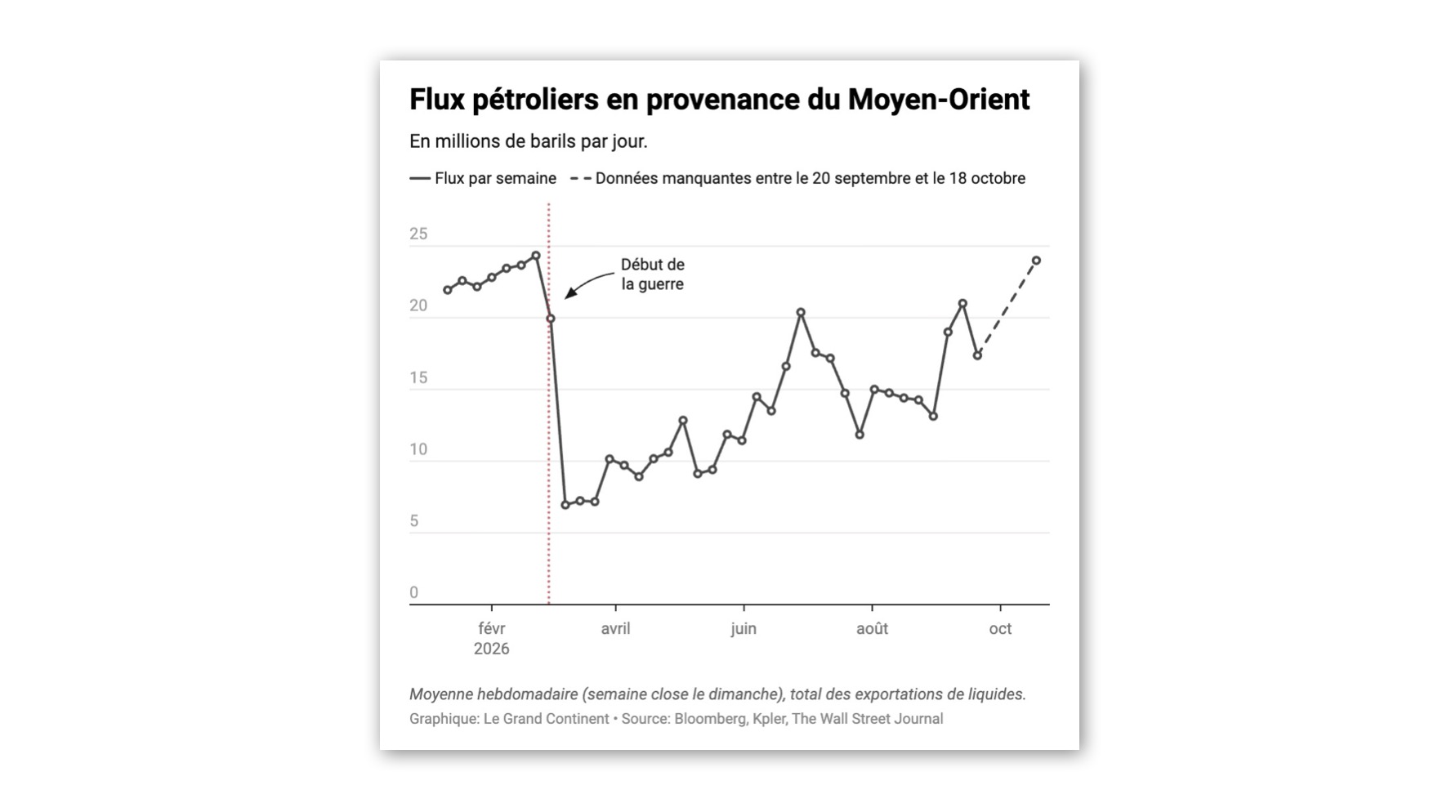
According to data compiled by Kpler, oil flows from the Middle East exceeded their pre-war level last week: on average more than 24 million barrels per day were exported, compared with 23.3 million before the United States and Israel launched the war against Iran1.
- This increase has been evident since the end of summer.
- Analysts attribute this to several factors: the escort of merchant ships offered to shipowners by the U.S. military, the use of shuttle tankers that traverse the strait to transfer their cargoes onto other vessels in the Gulf of Oman, and the bypassing of the Strait of Hormuz via other routes that help move oil out of the region, such as the Saudi East-West pipeline.
Other dynamics at play could also explain the rise in flows.
- According to sources with direct knowledge of the subject, Iran would now export part of its oil via the United Arab Emirates, most of whose ports lie inside the Persian Gulf.
- They would launder the provenance of the barrels, obtaining in return a new lever against Tehran as well as a new security guarantee in the eyes of several Gulf states who view the United States as stepping back.
- After launching a war against Iran, the U.S. military has indeed failed to protect the cities and energy and civilian infrastructure of these countries, calling into question its system of alliances.
The rise in flows, if measurable, has however not led to a drop in the price of a barrel: Brent has flirted with $110 per barrel in recent days, about 70% higher than a year ago.
- The price of Brent reflects the tensions still present in energy markets, notably the surge of Iranian attacks on ships and the risk of a resumption of the active phase of the conflict after the midterm elections.
Nevertheless, the narrowing gap between the price of Dubai crude, the Middle East’s benchmark sold in Asia, and Omani crude, loaded out of the Hormuz Strait, hints at a loosening of the physical market.
- The spread fell to $3.9 per barrel on Monday, October 19, its lowest level since the end of July2.
- At the peak of the crisis, in March, when Tehran had blocked most transit via the Strait of Hormuz, it had surpassed $60.