
Yesterday, Monday, October 19, Trump stated that he was open to hosting a trilateral summit alongside Xi Jinping and Vladimir Putin. It could take place next month on the margins of the Asia-Pacific Economic Cooperation summit, scheduled to be held in Shenzhen, China, on November 18-19.
- The American president added that the meeting might focus less on Ukraine, as Putin had proposed during a call on October 9, and more on “denuclearization.”
- Since at least July, the Kremlin has been seeking to arrange a meeting with Trump to discuss Ukraine, while simultaneously inviting Beijing to participate in the discussions. For Moscow, the goal is to position itself as a major power capable of negotiating on equal terms with the United States and China, at the expense of Europe, even though the war in Ukraine and the real state of its economy are far from allowing it to lay claim to that status.
Putin is thus trying to capitalize on the unprecedented rapprochement achieved in recent months by the Trump administration with Russia to increase pressure on Kyiv and Europe.
- Within weeks, Trump announced a deal with Moscow on diesel, suspended the application of sanctions targeting Russia, and called for Zelensky’s replacement, accusing him of wanting “to cause problems for our farmers and ranchers with diesel.”
- Access of the Ukrainian army to the Starshield service was restricted by order of the White House, and the sharing of intelligence with Kyiv about Russian ballistic missiles was temporarily suspended.
- Yesterday, Monday, October 19, Trump stated that “Russia has behaved well toward Ukraine… It has not done much.” The same day, a Russian drone struck the central park of the city of Nova Vodolaha, in the Kharkiv region, killing six people, including two 11-year-old girls and a 1-year-old.
This rapprochement by Trump with the Kremlin is unpopular with many Republican lawmakers, for whom defending liberal democracy against authoritarian regimes remains the template for what American foreign policy should be. It also runs contrary to the views of the American public and Republican voters, who see Russia as the country most negatively viewed among G20 members.
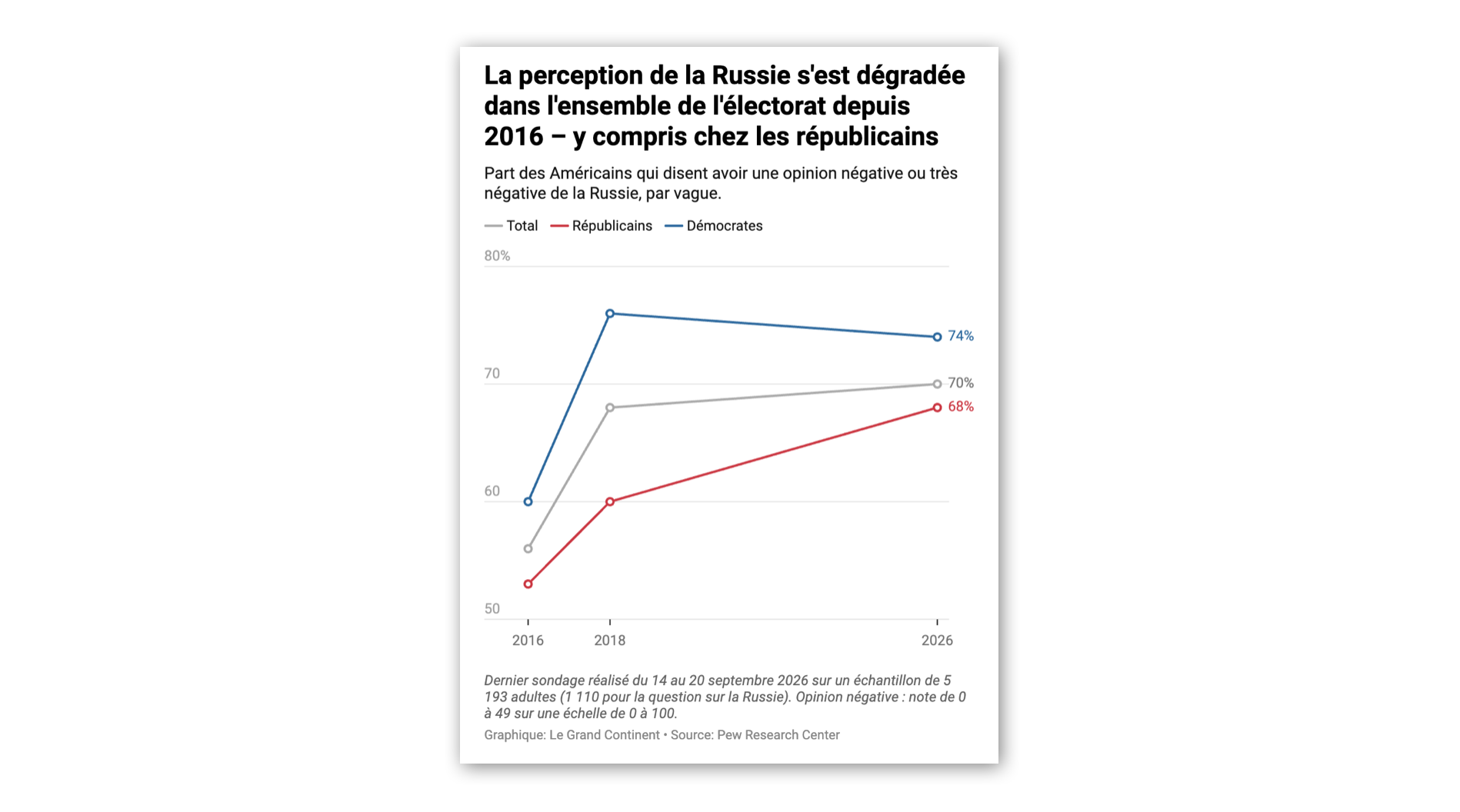
- According to a Pew Research Center poll conducted in September, only 10% of Americans hold a positive view of Russia, a figure that has remained stable since 2018.
Despite the Republican administration’s efforts to “normalize” its ties with Moscow, the Alaska meeting between Trump and Putin in August 2025 and the repeated positions alongside Russia rather than Ukraine have left Republican voters increasingly opposed to Russia.
- More than two-thirds (68%) of the GOP electorate view Russia unfavorably, a figure up 15 points from Trump’s first election in 2016.
- Russia (28%) is thus perceived more negatively than China (29%) and Saudi Arabia (37%), while Canada, a country against which Trump launched a trade war and threatened to annex, ranks among the most positively viewed by his electorate (58%).
The Pew survey reveals the contradictions of Trump’s foreign policy: his statements struggle to move his electorate’s views on Russia in a meaningful way, yet he continues to pursue rapprochement with countries toward which his voters are most hostile, while repeatedly targeting some of the countries perceived most positively (Japan, Canada, the United Kingdom…).