
Spaniards will go to the polls on Sunday, November 29, to elect the Congress of Deputies and a portion of the Senate. According to an exclusive Cluster 17 poll, the leading party among 18- to 24-year-olds is by far the far-right Vox, which collects 37% of voting intentions in this age group—twice as much as in the overall electorate.
- In its latest forecasts, the Commission anticipates Spain’s GDP to grow by 2.6% this year, ahead of Germany (1.3%), Italy (1%), and France (0.4%).
- Since 2022, Spain has experienced sustained growth, placing the country among the EU’s most thriving economies.
- Yet, this growth is largely attributable to immigration, which contributed for about half to GDP growth between 2022 and 2025, and to more than two-thirds of job creation 1.
If macroeconomic indicators point to significant growth, the country’s youth have hardly benefited.
- The rise in the cost of living and housing prices, along with weak wages, has contributed to greater precarity among 18- to 34-year-olds, two-thirds of whom still live with their parents.
- According to a study by the Comisiones Obreras, one of the country’s main trade union confederations, only 31% of this age group can live independently, without financial support from their family 2.
- That is 10 points lower than in 2016 (41%), and the sharpest decline in Europe, where the rate has remained around 50%.
The unemployment rate for those under 30 has fallen markedly in Spain in recent years, dropping from nearly 40% in 2013 to about 16% in the first half of 2026. Yet real household income per capita has risen only modestly (11% from 2004 to 2024, half the European average), and the rise in rents absorbs a large share of young people’s wage gains.
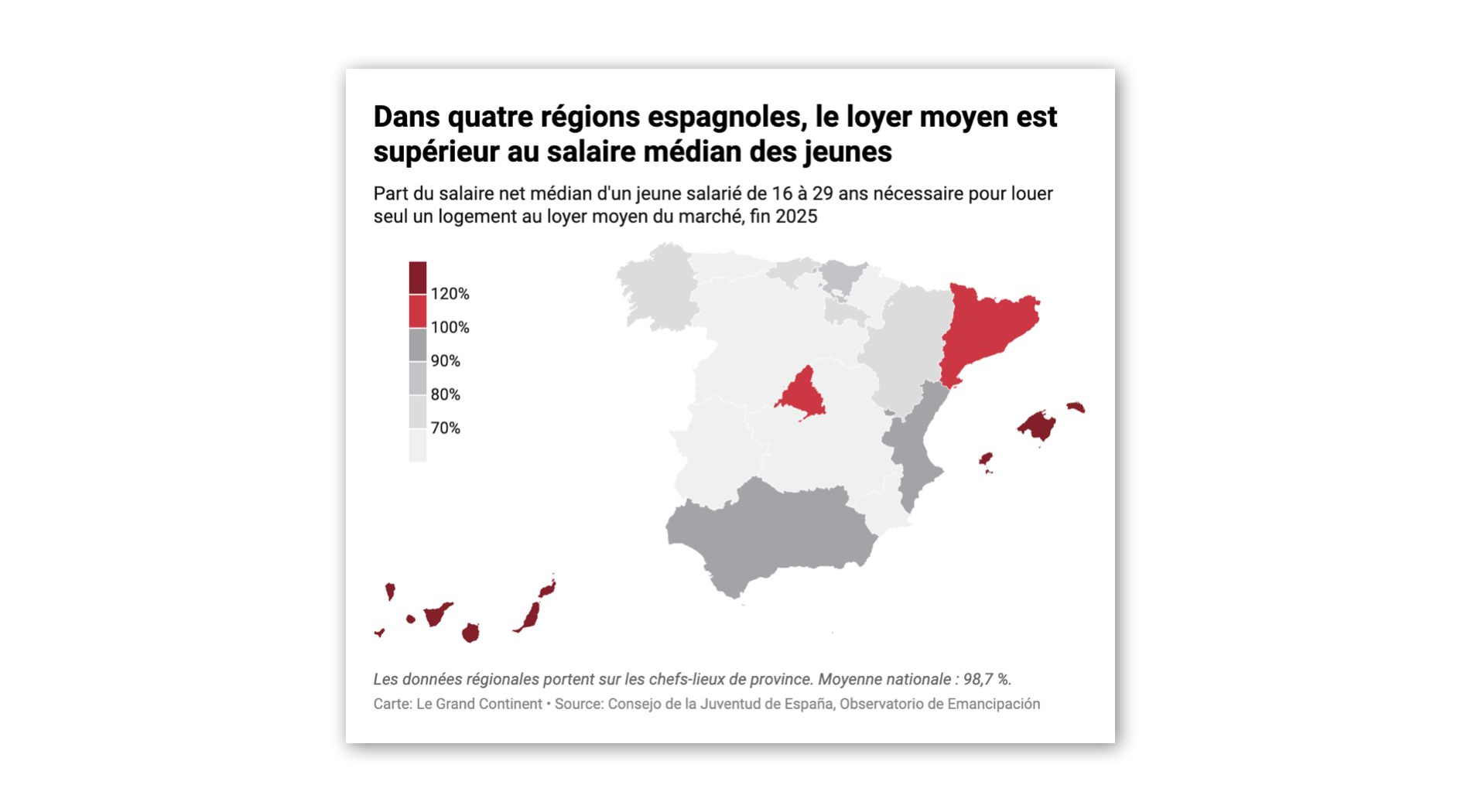
- Thus, the average rent in Spain represents 98.7% of the net median salary of a young worker, and even exceeds the entirety of this salary in the Balearic Islands, the Canary Islands, Catalonia, and the Community of Madrid 3.
- The causes: the construction of new housing collapsed after the 2008 financial crisis and never returned to its pre-crisis level, and tourism reduces rental availability by converting homes into seasonal rentals.