
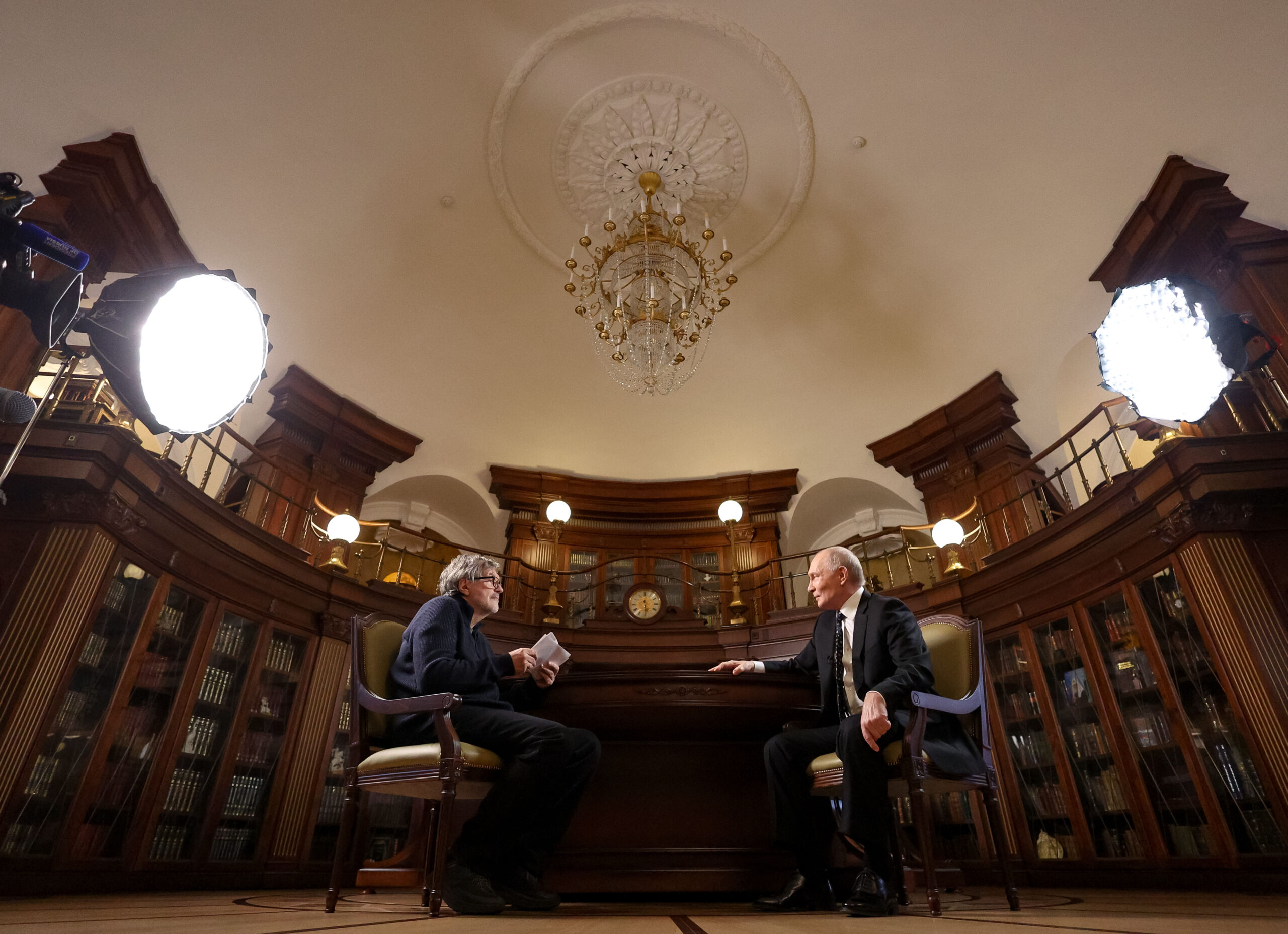
Guillaume Lancereau, Jean-Benoit PoulleThis November 20, the Serbian filmmaker Emir Kusturica engaged in a lengthy conversation with the Russian president on the occasion of the upcoming release of Notre Baptême, conceived to commemorate the 80th anniversary of Patriarch Kirill and broadcast that very evening on the Pervyj kanal channel.
Vladimir Putin naturally made this film, which extols the history of the Orthodox Russian Church, a personal affair. Not even the film’s title avoids referencing the Russian president, whose Kremlin propaganda asserts that he was baptized in Leningrad by the father of the future patriarch—a legend no credible source has ever confirmed.
This intervention once again highlights how the interventions of the Russian president are often mere theatrics, frequently of the most dubious kind. In celebrating the patriarch and signaling their closeness, Vladimir Putin has found little other descriptor for him than the word “interesting,” repeated six times in the text.
In substance, this long interview, conducted in front of a Kusturica spellbound with admiration, primarily strings together the main traditionalist clichés that Vladimir Putin has been rolling out since 2012, ranging from the theme of Moscow as the “Third Rome” to the long-standing conspiracy by foreign powers to dismember Russia.
Some statements are marked by bad faith or a taste for paradox: for instance, attributing the slogan “Divide to rule” to Russia’s enemies, that is to say a state that has been striving since 2014 to divide its neighboring country in order to rule there; and also the assertion that the Russian state does not meddle in the life of the Church—something that would only be true if one still believed that the Church had not been fully absorbed by the state. Indeed, the Moscow Patriarchate was resurrected by Stalin in 1941, in the context of the German invasion of the USSR, in exchange for a complete subordination to the leadership cadres of the Soviet state, subordination that has completely survived its collapse.
Other statements could even be read as signs of a complete detachment from reality, notably when the Russian president boasts of Europeans settling in Russia to find a haven of peace conducive to preserving traditional values, or when he asserts that the Russian state imposes no restrictions on its population’s conduct. As for the invitation to lay down arms and “pass to the good side of history” extended to Ukrainian civilians and soldiers, one would struggle to disentangle delirium from insult.
This sprawling, rambling interview, as disjointed and tangled as statements that may themselves know they are smoke screens, confirms the diagnosis of the 2022 Volos Declaration, by which hundreds of Orthodox theologians accused Russia of practicing ethno-phyletism, a theological designation for the assimilation of a church to a nation solemnly condemned in 1872 by the Constantinopolitan Orthodox Council. All that remains is to ask what can still be ecclesial and Orthodox in an Orthodox Church that daily celebrates the national principle and the principle of aggression.
Vladimir PutinYou know, this is a long story; Russia has existed for more than a thousand years. Over these centuries, many things have been said and written about it: as many superficial remarks as substantial, serious, fundamental judgments. And there have been some amusing facts as well.
There was a field marshal in the eighteenth century, von Münnich, who is said—so the story goes—that Russia should be a country governed directly by God, otherwise one cannot understand how it could exist.
Nearly a century later, in the nineteenth century, Emperor Alexander II, if I’m not mistaken, when asked how to govern such a vast and diverse country as Russia, replied: “Governing Russia is not difficult, it is simply useless.”
Emir KusturicaLet us also recall the German poet Rainer Maria Rilke, who once wrote: “Russia is a country that borders on God.”
Vladimir PutinIf we take the question seriously, then I would answer this way. We begin from the premise that a person is not merely a biological substance, a pile of bones and skin, but that the essential component, the main component, remains the soul, that good which the Lord has granted us, and that the human soul is as eternal and boundless as the universe. And this holds true for us as Russians, and for all those who live in Russia. In this sense, there is a miracle and a mystery. This mystery undeniably exists on Russian soil.
Emir KusturicaI am convinced that we are living today at the heart of a metaphysical period, a moment when Russia has come to represent a good for all humanity. And I am grateful to you, for we will indeed undertake this project: to show the values that operate here, in Russia, and to what extent the Orthodox Church and the Russian civilization work together to preserve them.
Vladimir PutinIndeed.
Emir KusturicaThe Russian Orthodox Church is now present in a large number of countries worldwide, while the Russian state has always been the foundation of the Russian civilization. Could this civilization become a kind of ark, a salvation for all the faithful in Christ?
Vladimir PutinIt can. Yes, it can, certainly.
If I say it with such conviction, it is not only because Russian theological and philosophical thought has carried for centuries the idea that Moscow is the Third Rome and that there will be no Fourth Rome.
What is at stake here? Christianity originated in ancient Rome. After Rome fell, Christianity moved to the eastern portion of the Roman Empire: Byzantium, under Constantine, the very first Christian emperor. Then Byzantium fell as well. But by that time, Christianity had already taken root in Russian soil, in Moscow.
Thus Moscow became the keeper of this faith, of these traditions. In that sense, it truly became the Third Rome, the spiritual guardian of this holy heritage.
But the essential thing lies elsewhere. Beyond this theological or philosophical idea planted in Russia for centuries, what matters is the present time.
Today, for example, even though I know this is not a mass phenomenon, there are cases of citizens from other countries, including European ones, who come to settle here.
When I had the opportunity to discuss with them, they told me that their main motivation, the essential reason for leaving for Russia, was their determination to preserve their values, their family, and their future, to ensure a future for their children who, in their view, should have the right to grow up and be educated within the framework of traditional religious values.
When you ask me whether Russia could become this ark offering salvation to people, I would answer that this concerns Orthodox Christians, and indeed Christians in general, but not only them.
It is well known that four religions traditionally exist in Russia: Buddhism, Judaism, Islam, and Orthodoxy. Representatives of all these orientations, all these faiths, live and prosper together. It must be acknowledged that we share, for the most part, common traditional values, whatever the particularities that some insist on emphasizing within their own religion. If there are always particularisms, the core of shared values remains the same. By creating conditions favorable to the development of these traditional values, Russia offers a kind of ground for all those who wish to live according to these values. From this point of view, Russia can indeed embody this ark you spoke of.
At the same time, we observe the rise in many Western societies of a struggle for the rights of various minorities. But is this really a novelty? Absolutely not: it is merely a repetition of phenomena that have always existed since the world began. The only difference today is that these groups behave in an increasingly aggressive manner and loudly proclaim their rights.
Moreover, we impose no restrictions on anyone. But the idea of the Russian Orthodox Church, and the Patriarch frequently alludes to it, as well as, to be honest, the policy of the Russian state, is to preserve the human being, his spirituality and, above all, if I may be allowed to say, to preserve him biologically, to secure him through state policy, to support the Church’s efforts in this direction, but within the framework of the modern requirements, the demands of today’s civilization, and that is the main orientation of our joint work with the Church. And in this sense, of course, Russia and Orthodoxy can play the role of that ark you mentioned.
Emir KusturicaAnd how does this fit with the realities of today’s Western world, where the role of the Christian Church in society is much more reduced than that of Orthodoxy in Russia?
Vladimir PutinIt seems to me that this stems from the fact that… We have a deep respect for our brothers and sisters in Europe; moreover, we strive to support them when we see that certain branches of Christianity feel offended. But I still think that renouncing certain canons or ecclesiastical rules does not help consolidate the position of these Churches in their societies—in fact, quite the opposite. Probably these liberties taken with established canons and principles seek some form of renewal, to produce a newer, more immediately comprehensible whole, in order to better fit today’s realities. In my view, this leads in reality to a weakening, not a strengthening, of Christian ideas and the influence of the Churches on consciences and societies.
Emir KusturicaOver the last five years, North America has gained a million and a half new Orthodox believers.
Vladimir PutinThat’s exactly what I’m saying. Orthodoxy keeps attracting more people because it has not renounced defending the values I spoke of.
Emir KusturicaAnd how would you define the notion of a “Russian civilization”?
Vladimir PutinThat is a difficult question. Indeed, we often speak of a “Russian civilization,” but I think we do so with a sense of fairness, not in a self-satisfied, presumptuous way—God forbid. We recognize that Russian civilization is one of the great civilizations in history. There have been others: for instance, the Chinese civilization, ancient by thousands of years. In this regard, let us recall history: the Mongols, in their time, fought China and even founded their own Sino-Mongol dynasty. And how did things end? In the end, the Chinese absorbed the Mongols.
Emir KusturicaThere, Orthodoxy played a leading role.
Vladimir PutinYes, and I’m coming to that; you’re absolutely right.
The state and the Chinese people absorbed these supposed “conquerors.” End of story: they simply assimilated.
Take again the example of Indian civilization, an ancient and very interesting civilization. The more I learn about it, the more it fascinates me. Not long ago, in a conversation with Prime Minister Modi, I asked him how many citizens of the country spoke the main language. He replied, “About 600 million.” Of what population? “One and a half billion.” A third of the population speaks the nation’s main language. And the other two thirds? “They speak their own languages.” Isn’t that astonishing?
So, how does Russian civilization distinguish itself from others? You know, I think about it constantly, and here is the conclusion I have reached: Russian civilization has never subdued anyone. It offered the Russian people, the Russian ethnicity, the opportunity to develop, but always while creating the conditions for the development of other peoples and other ethnicities that formed part of the Russian Empire, the great family of the Russian state. It allowed them to develop while safeguarding their spiritual development, their religion, their traditions, and their languages. This is where the essence of the specificity, the singularity of Russian civilization lies.
To return to your first question: where does the mystery lie, what gives Russia its particular characteristics?
Dostoevsky spoke of the Russian man in the clearest terms. He said the Russian man easily interacts with others, willingly lives among them, and knows how to immerse himself in whatever is foreign to him. Overall, the Russian man carries a powerful instinct of the universal, of all that is universal in humanity. It is one of the aspects that distinguishes Russian civilization.
Emir KusturicaAs the head of the Russian state, do you consider the Russian Orthodox Church to be an important component of that civilization, both sacred and spiritual? And what are your relations with Patriarch Kirill?
Vladimir PutinI will first answer your last question. Our relations are excellent, very amicable. I consider the relations between the State and the Church to have been built on a very solid foundation. It is a fairly unique fact: under the Russian Empire, the emperor, the tsar, as head of state, was certainly not the head of the Church in the strict sense, but he was regarded as its guardian and protector.
In other words, this situation had nothing in common with that of England or Great Britain, where the queen heads the Anglican Church. With us, the link was not as direct, but the head of state nonetheless maintained a connection with the Church and played an important role in this regard. There also existed structures such as the Holy Synod, the country’s highest spiritual authority, whose prosecutor general was a representative of the state.
During the Soviet era, the authorities proclaimed the separation of Church and State, but there was in reality a Council for Religious Affairs, whose local bodies directed—or at least tried to direct—the religious life of the country. Besides, I do not know who influenced whom more…
You know, I began my career in the state security apparatus, where there were divisions in charge of internal opposition. Yet, in Soviet times, the Church represented the only legal opposition to the State, the only alternative ideology. Well, that did not stop all the KGB agents I know who worked in that sector from getting baptized. Who influenced whom? Was it the State and the KGB that influenced the Church, or the Church that influenced the State and the KGB agents? At Easter, they brought us all, those who worked in that division, kulich bread, painted eggs, etc. Without this negating any real attempts to influence the spiritual life.
Today, as the Patriarch himself recalls, there is a real separation. The State does not intrude into the Church’s life. In my view, this gives the Church a great advantage, because as long as the Church was part of the apparatus and the state system, part of the criticisms directed at the State for its actions and their consequences always ended up landing on it.
Back then, the Church was considered a cog in the State’s machinery. Why did the Church suffer so many persecutions, with such unimaginable cruelty, in the period after the 1917 Revolution? Because the Church was being repressed as a member of a state that had ceased to exist or was in the process of disappearing.
Today, none of that exists and I think this is a very good thing, and it should be so. It is this arrangement that allows the Church to develop freely according to its own internal laws.
As for the role and place of religion and the Church in the history of the Russian state, it is a phenomenon entirely unique. Spiritual life and the Church undoubtedly play a leading role in the life of any society. But the Church plays a completely specific role in the history of the Russian state. Why? Because before 988, before the Baptism of Rus by Prince Vladimir, there was no unified Russian state, nor a Russian people as a distinct ethnicity. There were about fifteen Slavic groups, if memory serves: the Drevlianians, the Polians, the Krivians, the Viatiches, and others in the Northwest. About fifteen in total, but there was no Russians yet. There was already princely power, a sort of common market, as we would say today, a unified economic life, but also a common language—in this case, Russian, which is a critical fact. But there was not yet a common religion. All were idolaters, and their cults often overlapped, though with some differences, but without a single religion.
The final step, therefore, was the appearance of this single religion. Only after this step could a unified Russian people and a centralized Russian state come into being. In this sense, the Russian Orthodox Church indeed played a unique role in forming the Russian nation, as much as in the institution of the Russian state.
That is also why we have such a special attitude toward the Russian Orthodox Church, which has always stood by its people through the harshest of trials.
It is no accident that, during World War II, after the battles of Stalingrad and Kursk had ended, in 1943, Stalin decided to restore the Patriarchate. Whatever the cruelty of the persecutions suffered by the Orthodox Church and religion in the Soviet Union, and whatever the scale of the extermination of priests, the Church nonetheless rose without hesitation to defend the homeland when the terrible ordeal of the Great Patriotic War presented itself.
Emir KusturicaThe foundations and canons of this Church have remained identical for 1,500 years. Today, the new man, the technological and biological man that is emerging, does not see less the principle of his existence. Perhaps that is why some, in America, want to become Orthodox: precisely because nothing has changed for 1,500 years.
Vladimir PutinYes, I agree with you; that is what I was saying in similar terms just a moment ago. We believe, of course, that progress is necessary and nothing should hinder our movement, our advance and our development. But there still exist things that make a human being what he is, and that contribute to the perpetuation of the human race. It is this whole that constitutes the fundamental values of Orthodoxy.
Emir KusturicaFrom Orthodoxy and humanity?
Vladimir PutinOf course.
Emir KusturicaYou have repeatedly stated that Russians and Ukrainians constitute a single people, driven by their enemies into a fratricidal war. What would you want to say today to the Ukrainians? And why would Russia’s victory serve their interests?
Vladimir PutinThat is a very delicate question, to the point that I am not even sure whether it should be answered. You know the famous Roman formula: “Divide and rule.” What does it mean? It is one of the principles of the ancient Roman Senate; it signified a very simple thing: whenever a large, efficient, growing and influential power looms, it immediately represents a danger to Rome, a threat to divide in order to rule and to submit to its own interests.
That has happened more than once in our country’s history: as soon as Russia became stronger, more powerful, immediately forces arose that sought to divide in order to rule.
It is, in my view, this phenomenon that must be linked to all the invasions of Russian territory in modern history: those of Napoleon, World War I, World War II—our Great Patriotic War—with the German-fascist invaders. In my view, ideological considerations played only a secondary or negligible role. The primary issue concerned order and geopolitical interests, according to the logic of “divide to rule.”
That is also what happened to old Russia when it was fractured as a result of a number of circumstances I will not go into in detail. After the beginning of the consolidation of Russian lands, following the so-called “Tatar yoke,” part of the old Rus’—Kiev and the surrounding area, the current Chernihiv region, the Zhytomyr region—found itself inserted into the Russo-Lithuanian state, then within Poland, the Republic of the Two Nations, where Poles took a predominant role. Naturally, and this is not extraordinary, they pursued a policy of Polonization, assimilation, triggering quickly the first changes in language.
Note that Ukrainians who then lived in these territories and who referred to themselves as Russians behaved quite harshly, to say the least, toward the current Russians, considering them second-class people. And this persisted until the eve of World War I and beyond.
But that is not what I want to talk about. Whether this is good or bad, that is how things happened. Now I regard today’s events as a continuation of the same policy—divide to rule—and of the same will to weaken Russia’s potential, to make it more conciliatory and, ultimately, to subject it, in one way or another, to particular interests.
Everyone must understand this, both within our own population—and I can feel, I can see in the state of our society that we know and understand it—and among the people on the territory of today’s Ukraine. They must understand that all these events and all those feeding them, including in today’s confrontational conditions with Russia, do not serve Ukraine’s interests; they serve the aggressor’s own interests and seek to weaken everyone, to dismember, divide, and submit to their will. If we understand this, we must all, including those living on today’s Ukrainian territory, move toward unification. Not necessarily in the frame of a single state; that is not what it’s about, but toward the broadest possible sense of unity.
Under the Soviet Union, around 1986, when the census was taken, today’s Ukraine had 51 or 52 million inhabitants. It was one of the largest and most industrialized territories in Europe. But what happened after the collapse of the USSR and Ukraine’s independence? It lost everything: its shipbuilding and aerospace sectors, its missiles industry, and even its population, dropping in twenty years from about 51–52 million to 41 million, then to 31 million. Today, there would be perhaps around 20 million left on the entire Ukrainian territory. And this, of course, does not even count deindustrialization: in a word, everything collapsed, even before the responding strikes by Russian forces in recent weeks. No: Ukraine collapsed on its own.
And why this? Because power there was seized not by real Ukrainian patriots, but by nationalists. The difference between patriotism and nationalism, as everyone knows, lies in the fact that patriots love their country, while nationalists hate other peoples—that is the whole difference. And one never goes far by basing oneself solely on hatred of other peoples.
So I would like Ukrainians to hear me. Whatever the events, whatever today’s tragedies, we must think about the future, about our children’s future, and understand that if we want to be strong and ensure the conditions for our development, we must, of course, be together, in the sense that we must unite our efforts to achieve common goals.
As for the Ukrainian military, I do not want to tell them to “Lay down your arms,” because that phrase carries a slightly humiliating tone. It must be acknowledged that they are fighting, and with some persistence. What I would like to say to them is: “Cross over to our side, for it is also yours. Come to the side that is common to us, the good side of history.”
Emir KusturicaI wanted to ask you an unplanned question about Nikolaï Troubetskoï.
Vladimir PutinGo ahead, please.
Emir KusturicaNikolaï Troubetskoï wrote that the speed of the Mongol horses had been the “code” of their victory over Russia. What is most important today in this war, between missile speed and Orthodox spirit? When we think about this war, its end, and victory, is it missile speed or the spiritual strength of the Russian people and the Russian language that constitutes the secret code of this civilization?
Vladimir PutinIn my view, the essential, even decisive criterion today is not missile speed but the speed of thought. Even military experts tell me that while the technical components of modern armament used to have paramount importance yesterday, they are now surpassed by mathematical knowledge, given how rapidly changes in the military-technical domain occur. In these conditions, the winner is the one who thinks best, who reacts more quickly to events and challenges.
As for the spiritual basis, the firmness of the spirit, that goes without saying: no one has questioned it.
Emir KusturicaDo you feel that the citizens of the country pray for you?
Vladimir PutinI do not have the means to know.
However, I sometimes hear about it when I go to church. Priests, other clergymen, mention it from time to time. But I cannot know it personally. What I do know with certainty is that I pray every day for Russia and for our people.
You know, as I have mentioned on another occasion, to my surprise, I have noticed something in myself. When I contemplate the achievements of our scientists, our artists, our athletes, for example, and even ordinary citizens who do something utterly unique with their hands, or simply harvest a fantastic yield, which no one saw in the Soviet Union or in Tsarist Russia, I am filled with a sense of enthusiasm, as if these were not strangers, but people who are beautiful, talented, exceptional and yet close to me, almost like family members. I experience it as a personal success, even a personal victory, and it is one of the most pleasant feelings.
Of course, I am aware of the support our fellow citizens provide. I am grateful for it because, without this support, it would be impossible to work and to achieve any meaningful result, to reach our shared objectives in the name of Russia, for the good of Russia.
Emir KusturicaAs Fyodor Mikhailovich Dostoevsky said, there is at the base of the Russian state a whole symphony of believers that, together, produce the Russian society. Is that a formula that works?
Vladimir PutinOf course. In my view, it works just as in any society, and when it fails and ceases to work, that is the moment when difficulties arise in both society and the state.
The people we see today running around the centers of Europe’s great cities are not, in my view, mere hoodlums: they are a manifestation of deeper problems. I do not want to seem to be endorsing what hurts. After all, such phenomena have occurred in every state’s history, and there have been more serious ones in the past with more severe consequences. Yet all of this reveals internal problems and a rupture of that symphony, of that balance. It is thus understandable that people must react in one way or another, at least those upon whom the health of society rests.
Emir KusturicaOver there, liberal systems’ logic predominated; here, the logic of the community. Here, a symphony that works; there, something far more doubtful.
Vladimir PutinYes, but if we follow your argument, the Soviet Union, too, was born of a certain symphony. Why? Because the socialist idea itself was tremendously popular around the world. It was a very beautiful idea, a cousin to Christianity, with the ideal of common brotherhood, etc. This idea had innumerable supporters across the world after World War I, and that is why, to a certain extent, one can speak of a symphony within Russia.
Certainly, this initial movement later degenerated, with repression, the suffocation of opinions, labor camps and the rest, but the initial phase did produce a symphony of this kind.
That is why, by the way, the immense successes of the Soviet intelligence services: these people worked unreservedly for their ideological homeland, as one of our scholars has written. It was a common idea. And the idea remains the most powerful weapon.
Emir KusturicaChristianity has always been a religion, whereas there has also been, in parallel, how to put it… a progress in social life.
Vladimir PutinCertainly.
Emir KusturicaThat is not as true for other religions.
Vladimir PutinWhy not? I repeat: these values are shared, no one disputes that, but certain specifics born in particular places and times were also a response to the challenges that people faced.
Emir KusturicaI feel that since Justinian, since Byzantium, there is a certain foundation, the one that scholars thereafter wrote about that the Renaissance drew its roots from science, from the laws born in Byzantium, and that the bedrock of Northern Italy was this enigma, this mystery we are discussing.
From all appearances, it seems to be the priest Mikhail, the father of the current patriarch and, in fact, your spiritual father, who baptized you. Such a meeting of destinies cannot be mere coincidence. What do you wish for the primate on the occasion of the celebrations of his eightieth birthday?
Vladimir PutinWe do not see the Patriarch very often, and we do not discuss things very much, but I can affirm that he is, above all, a very interesting man. An intellectual. It is always worthwhile to converse with educated, cultured, and intelligent people.
We are celebrating his eightieth birthday: he was born in 1946 and, if I remember correctly, he became rector of the Saint Petersburg Theological Academy in 1974. 1974 minus 1946 equals 28 years old. It was at that age that he took the post of rector of the academy—I’m not talking about a simple seminary, but an academy, a highly respected theological and philosophical school with very rigorous training. And he, a very young man, held that post for no less than ten years, as far as I recall. No one came to tell him after a year that the post was a bit premature, that it would be better to return in six months or a year: no, he worked there for ten years and did well.
If we must start somewhere, it is with an intellectual, someone with whom it is interesting to converse. When we exchange, these discussions are always very useful and enriching for me.
As for the story you mentioned, yes, I have spoken about it more than once. If you are aware of it, it is because it has already been written somewhere. In this case, it is my mother who told me how I had been baptized: in secret by my father, who was a member of the Communist Party, an atheistic organization. At that time, it was considered improper to maintain any link with the Church; in that milieu, even showing the slightest sympathy for this institution was frowned upon. As my mother later told me, the baptism took place without my father’s knowledge, with the help of the neighbor of the communal apartment where we lived, baba Anna, as I used to call her. It took place not far from us, at the Transfiguration Cathedral. The priest suggested that my mother call her son Mikhail, since the 21st of November was the feast day of that saint and his name was Mikhail himself. So my mother replied, “My father, please forgive me, but we have already named the child after his father: Vladimir.” And the priest answered, “Excellent. That is the name of our saint, the one who baptized all of Rus’. Look up there, there will be your little icon.” Later, I could verify it myself: it is a bas-relief on the wall of the Transfiguration Cathedral. And that is the whole story.
Much later, while speaking with the Patriarch, I asked him how he came to become a man of the Church. He replied that his father was a priest. “Really? And where did he serve?” I asked. “In Leningrad.” And where is that, in Leningrad? “At the Cathedral of the Transfiguration.”
At that moment I became a bit cautious. “And what was your father’s name?” He said, “Mikhail.” And were there other Mikhails serving at that time? And the Patriarch, who could hardly know my mother’s history, assured me that no. “You know, Your Holiness, it would seem that it was your father who baptized me.” Pushed by his astonishment, I then recounted the whole story.
You see, your first question was about Russia, and perhaps a miracle, something sacred that manifests before me. Indeed, it is a remarkable story: the father of the Patriarch baptized a simple infant from a working-class family; later his son, Kirill, left his family to begin an independent life at the age of fifteen…
Emir KusturicaAt fifteen?
Vladimir PutinAt fifteen. He wanted to lead an independent life and became a geologist. He first studied cartography, then became a geologist, a member of a geological prospecting team.
Ultimately, the priest Mikhail’s son became Patriarch of Moscow and All the Rus’, while the little boy from a working-class family whom he baptized grew up to become President of the Russian Federation. If that isn’t a miracle, I don’t know what is.
Emir KusturicaLife as a miracle.
Vladimir PutinBut this is a very real story, there is no invention in it. When I told it to him, his eyes widened in astonishment.
You understand, therefore, that there are very personal, very intimate ties that bind us. But beyond that, I repeat, he is a very interesting man, someone it is always interesting to be around, to meet, to discuss, on any subject indeed.
As for what I would wish for him… You know, the Patriarch has never confined himself within the strict boundaries of the Church; he has never secluded himself within the four walls of a monastery. He has managed to stay close to the people, in contact with them. I sometimes tell him: “Your Holiness, you should perhaps pace yourself a little, not always be going from one place to another.” He is always traveling, in the far North, in the South, elsewhere. One must know how to take care of oneself, to mind one’s health. But he insists on always being as near as possible to the people, just as the Russian Orthodox Church itself has always stood by Russia throughout its history.
I would like to wish the Patriarch to maintain this inexhaustible energy and to continue his service for the benefit of the Russian people and our homeland, for he is, by virtue of his position, one of the main guardians of the homeland. Happy birthday to him!
Emir KusturicaAnd one of the main guardians of the Russian civilization. Thank you very much.
Vladimir PutinThank you.