
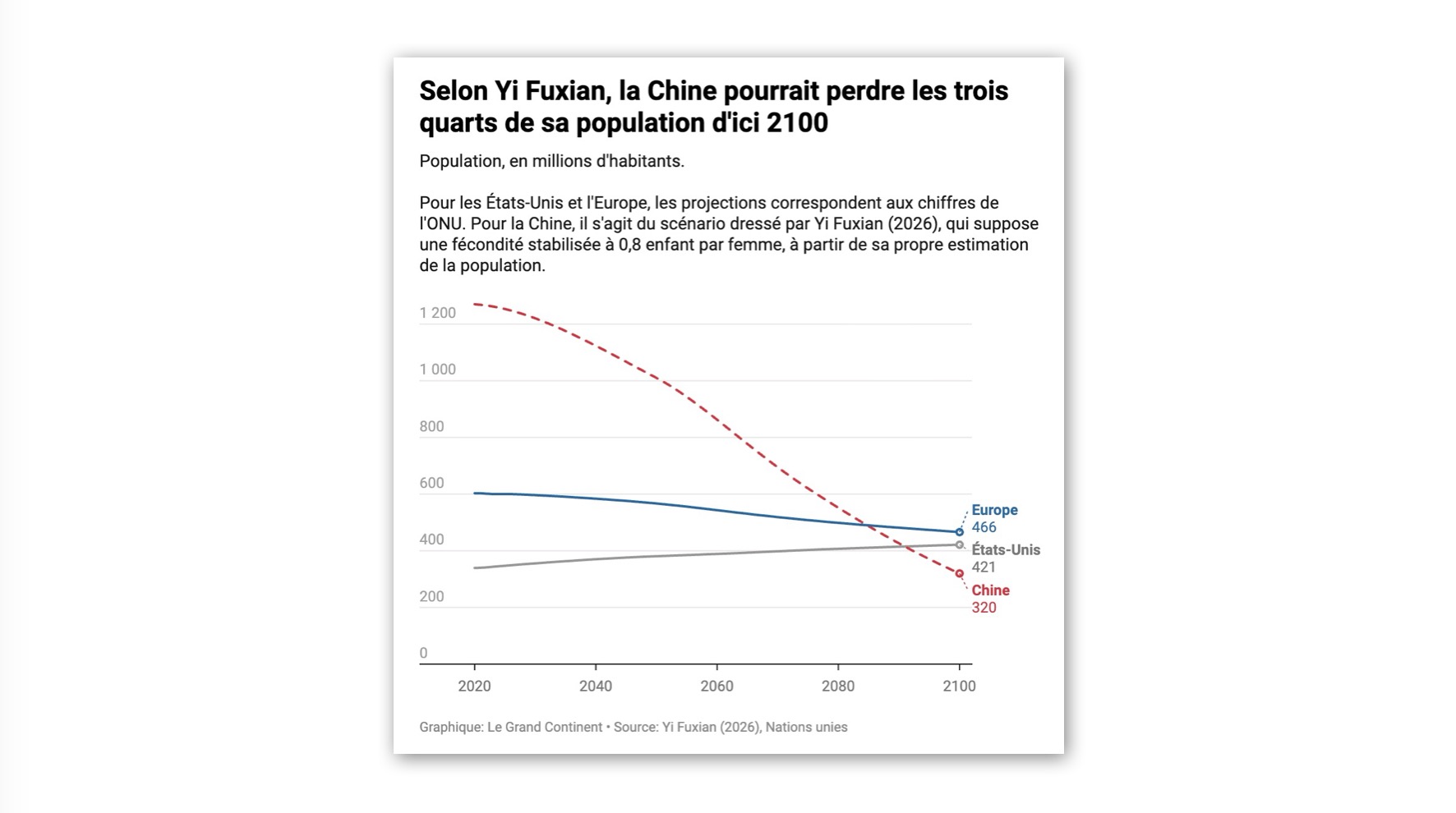
In a recent study, demographer Yi Fuxian, author of the book Big Country With an Empty Nest, a critique of the one-child policy that was banned in China in 2007, argues that the country’s real population in 2020 was around 1.27 billion, and not 1.412 billion as the official census announced.
- This gap of about 140 million people, roughly the size of Russia’s population, could have significant implications for the country’s outlook, notably for its growth model.
- Moreover, China carries a massive debt whose service is expected to account for more than 19% of the central government’s budget this year, seven percentage points higher than in 2014.
Several strands of evidence suggest that official statistics artificially inflate the country’s population, and have done so since the early 1990s.
- Yi notes that the government approved the distribution of about 5.8 million vials per year of the BCG TB vaccine, mandatory for every newborn, between 2018 and 2020.
- Yet, with nearly 14 million births per year on average, according to Beijing, between 9 and 13 million vials would have been necessary: indeed, each vial effectively vaccinates only about 1.1 to 1.6 newborns.
- Likewise, Yi observes that the size of the cohort of children born in 2000 was significantly smaller fifteen years later, dropping from 17.7 million births according to official statistics to 14.2 million college graduates in 2015, even though schooling there is mandatory.
Several actors may have had an interest in inflating demographic statistics: local authorities, in order to obtain larger funding from the central administration, the National Bureau of Statistics (NBS) and the Family Planning Commission, to justify the continuation of the one-child policy, but also the ruling power itself, for whom a downward revision of population figures could have political consequences.
The correction of decades of overstated population data could however lead Beijing to reassess its geopolitical ambitions.
- Yi indeed estimates that if China’s synthetic fertility index stabilizes around 0.8 – versus less than 1 currently according to him –, the country’s population would undergo an unprecedented contraction.
- China would move from 1.4 billion people today, according to official statistics, to 1 billion by 2050 and then 620 million in 2075. By 2100, the country would count only 320 million people.
- It would then be less populous than the United States (about 420 million inhabitants in 2100, according to United Nations projections) and Europe (about 470 million, excluding Russia).