
Directed by Giuliano da Empoli at Gallimard, the new paper volume of Grand Continent L’ennemi qui nous désigne is now available. Click here to discover it — if you would like to receive it and support us, consider subscribing to the magazine
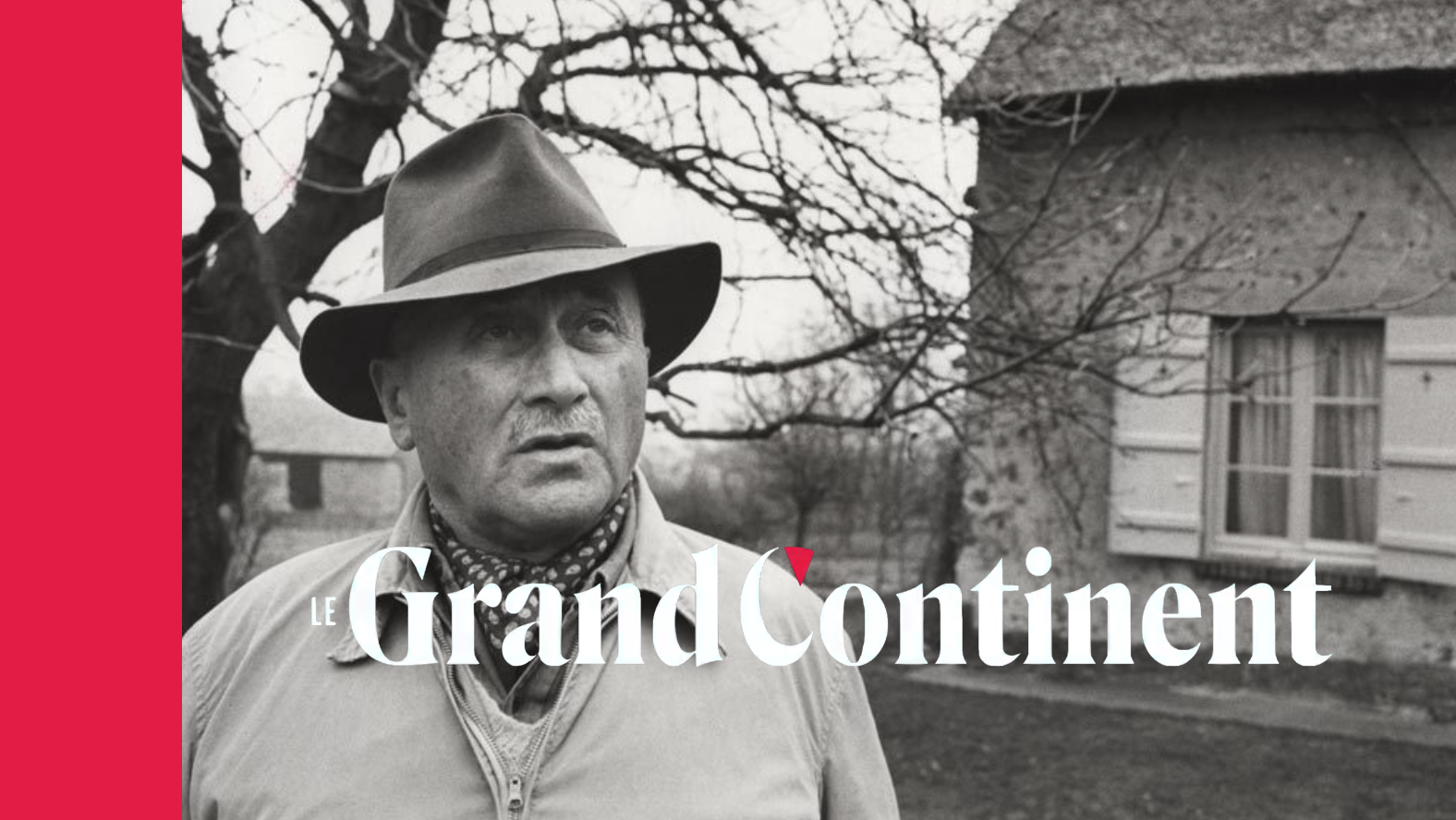
The tragedy of Europe is that it has made Jean Monnet dull. This remarkable figure, who spent decades wandering the world, led incredible adventures, and relentlessly pursued the wild dream of a united Europe, has been transformed into a dusty reference, a taxidermied founding father, good for citation in the most conventional speeches on the state of the Union.
In this text I will first strive to restore to Jean Monnet the madness that was his, by tracing a few episodes of his life.
Then, I will attempt to explore his legacy and what the example of Jean Monnet means for us today.
One of the few positive aspects of the dark period we are living through is that we understand history, that we feel it deep within us.
Previously, we read the chronicles of the first half of the twentieth century and they seemed distant, like something tragic and outdated. We studied them with a certain detachment, as if they did not directly concern us. Today, however, we read the account of these events through the voices of witnesses of that era, and we vibrate with them, because their condition is ours too.
Now, we understand, more than that, we feel what Stefan Zweig meant when he wrote in 1936:
“Rarely has the atmosphere of the world, and our old Europe in particular, been so poisoned by distrust, disunion and fear. Each morning, one grabs the newspaper with feverish anticipation, and with a sigh of relief one puts it down when nothing particularly dangerous has happened. Distrust of neighbors has gradually become a pathological phenomenon among many peoples; everywhere, borders close with fear, day and night European factories work to create, after twenty centuries of magnificent achievements in all fields of culture, the most impressive and most brilliant instruments of destruction.”
.
That morning sigh of relief when, turning on the phone, we discover that nothing particularly dangerous occurred on the world stage during the night—that is something we now know from experience.
But if we must endure, feel in our flesh the darkest face of history, perhaps we can also pay tribute and understand better than ever the men and women who managed to oppose the darkness. All those who, after World War II, laid the foundations for one of the longest periods of peace and prosperity in human history.
The Adventure
Jean Monnet is one of them. And perhaps, among all, the one whose example is the most essential. But for him to inspire us, we must first free him from the pompous layer of rhetoric that has covered him in recent decades.
And for that, perhaps the best way is not to start from the central role he played in building Europe, nor from the nearly incredible achievements that marked his career as statesman and visionary builder, but rather from a few more intimate episodes.
I will pick only three.
The first takes us back to 1906. Jean Monnet is eighteen. Two years earlier, he left Cognac and his studies for an apprenticeship in the City of London; now he has been sent to North America as a representative of the family firm. He first lands in Canada, then travels across the American West. He discovers a world without limits, where Europe already seems distant, almost insignificant.
One day, he arrives at a farm in the middle of nowhere. Seeking to join a settlement of Scandinavian colonists who enjoy cognac, he asks a blacksmith what the means of transport are. Without stopping his work, the man replies that there are none, then, pointing to a horse, simply offers to take him there and bring him back to the same spot. That trust seems perfectly natural to him.
“I was far from Cognac and the lands of written law – Jean Monnet notes in his memoirs – In America I found everywhere this impression that where space is not limited, trust is not measured.” .
Monnet approaches difficulty as he would always: by widening the frame.
Giuliano da Empoli
For nearly eight years, he travels the world in this way—North America, Scandinavia, Russia, Egypt. The almost static stability of European society is joined in his mind by the dynamism of a world in expansion.
The second episode concerns private life, but in its own way it is just as revealing. In July 1934, Jean Monnet leaves Shanghai, where he works as an investment banker and is close to Chiang Kai-shek, to join Moscow. He reunites with Silvia Giannini, whom he had met five years earlier: an instant spark, frustrated by a major obstacle since she is married and divorce is virtually impossible in Europe at that time.
Monnet approaches the difficulty as he will always: by widening the frame.
The only country where divorce is then accessible is the Soviet Union. The two thus arrange to meet there—he arriving from the Far East, she from Switzerland, where she lives with her child. In a matter of days, Silvia becomes a Soviet citizen, obtains the divorce, and they marry without delay before moving on. Monnet would later call this episode “the finest affair of his life.” Their union lasts forty-five years, until Silvia’s death in 1979, and constitutes for him a crucial anchor.
The third episode no longer belongs to the private sphere, but it illuminates, in spectacular fashion, the scale of his influence. In December 1940, Franklin D. Roosevelt delivered a now-famous radio address in which he described the United States as “the arsenal of democracy” . That phrase was Monnet’s.
Having arrived in Washington a few months earlier after the fall of France, he had already established himself as a central interlocutor within the American administration. A State Department note would call him “the mastermind of our defense” .
In the next two years, he plays a decisive role in shaping the Victory Program. Although not a technician himself, he imposes a method: precisely assess military needs, compare them to industrial capacities, and reveal the gap. Monnet tirelessly argues for a logic of abundance—better to have ten thousand tanks too many than one too few. He thus helps persuade the Roosevelt administration to double its production targets.
This process leads to the message Roosevelt delivers to Congress on January 6, 1942, setting industrial objectives of unprecedented scale. Less than a month after entering the war, the United States undertakes the decisive productive effort. Keynes would later say that Monnet “shortened the war by a year” .
Examples like these could be multiplied. But on their own, they suffice to convey the sense of a personality and career that were truly extraordinary. A cosmopolitanism that was wild—and wildly adventurous.
Adventure, according to Giorgio Agamben, is what brings something or someone into existence, what forges an identity, what gives a name: “Adventure is being as it happens” . At the beginning of Chrétien de Troyes’ Tale of the Grail, before he leaves, the hero has no name. It is only at the end that he learns his name is Perceval the Welsh.
Jean Monnet’s life is an adventure. But his work too, his main work, Europe as we know it today, is an adventure.
It is not about proclaiming European unity, but making it necessary, concrete, almost inevitable.
Giuliano da Empoli
We will not recount the entire trajectory here. Yet, three moments—three real adventures—are enough to understand why Jean Monnet came to be regarded as one of the fathers of the European Union.
The first occurs in 1914, at the very start of the Great War. Jean Monnet is twenty-six. He holds no official post, represents only himself, and can only claim field experience from his travels. Rejected from service, he decides to serve in another way. A clear realization occurs: it is absurd that France and Britain, allies against Germany, organize their raw-material supply separately. The intuition is simple; its implementation, highly improbable. And yet, during the Battle of the Marne, Monnet manages to meet the Prime Minister René Viviani and convinces him of the necessity of a close coordination between the two countries. Sent to London, he dedicates himself, until the end of the war, to this task of organization and rationalization, in relative obscurity. This action is nonetheless decisive: it helps give the Allied effort the material coherence without which victory would have been jeopardized.
The second episode takes place in June 1940. The French defeat seems inevitable. Monnet, who refuses the obvious path of surrender, takes on a bold and desperate idea: a immediate and total union between France and the United Kingdom. In a note titled Anglo-French Unity, he proposes the fusion of the two states: a single government, a single parliament, a single army.
Against all odds, he persuades Churchill, his cabinet, and de Gaulle, who is then in London. On June 16, de Gaulle himself dictates the text by telephone to Paul Reynaud. For a few hours, the possibility of shared sovereignty, born out of extreme urgency, appears to be a real option. But, that same evening, Reynaud is replaced by Marshal Pétain, who chooses the path of an armistice. The project vanishes immediately. It remains, however, a striking precedent: the idea that European nations can, when circumstances require, go so far as to unite politically to face their fate.
Finally, the decisive moment. In 1950, Jean Monnet proposes to Robert Schuman to pool the management of coal and steel with Germany. The Paris Treaty of 1951, which establishes the European Coal and Steel Community, gives life to this intuition. For the first time, six states agree to transfer a portion of their sovereignty to a common, independent authority charged with organizing a key sector of their economy. The choice of coal and steel is no accident: these were the very resources that had fed European wars. Placing them under common management makes not only war unthinkable, but physically impossible.
In politics, boredom is a formidable weapon.
Giuliano da Empoli
That is when Jean Monnet enters fully into history. Yet that is also where the great paradox of Jean Monnet and European construction lies: an extraordinary adventure that ends in its opposite: boredom. Not by chance, but by strategy.
At the end of World War II, some believed Europe should be united. They made big declarations, issued calls, organized conferences. Jean Monnet did not join them. When, in 1948, Churchill tried to launch the project of the United States of Europe in The Hague, Monnet did not go. For him, it was not about proclaiming European unity, but about making it necessary, concrete, almost inevitable, by anchoring it in shared material interests.
That, I think, is the true genius of Jean Monnet. European boredom is not the result of chance, but of a precise and enlightened political project. In the immediate postwar period, Monnet understood that union was both indispensable and impossible. Indispensable to prevent the history of fratricidal wars from repeating indefinitely. And impossible because, despite everything, populations did not want it. Moreover, even in the years that followed, adherents to the European Federalist Movement never exceeded 250,000.
That is why Monnet chose another path: that of technical agreements. First on coal and steel, then across an ever-wider range of domains, until he created an intricate network of relationships and shared interests that transformed the European Union into a fait accompli, a technocratic construction with its own inexorable logic.
In politics, boredom is a formidable weapon. If one can render a topic so dull that everyone loses interest, one can do anything one wishes. The American writer David Foster Wallace tells in Infinite Jest how Republicans built in the United States a two-tier society, privileging limitless enrichment for some and widening inequalities through taxation policy. And he writes: “The real reason Americans did not—and do not—fully grasp these conflicts, these transformations and what is at stake, is that all questions of politics and taxation are boring. Massively, dramatically boring…” .
Thus boredom and apathy become a kind of political instrument.
That is how it has been for Europe’s civil service, at least up to Maastricht and, in part, to the present day. We owe them a thank-you: they managed to hide one of the most exhilarating political epic of history behind an endless series of rules about the color of life jackets and the diameter of pizzas.
Facing the Predators
The European Union is perhaps the most beautiful political project of the last century: the first attempt, in history, to build a supranational entity in peacetime, without weapons or threats, on the basis of the free adhesion of peoples. No other political project is more exhilarating; yet over the past seventy years Europe has not been built through grand speeches. It has been constructed by weaving an ever-denser network of rules, which have led to an ever-stronger integration of our continent.
This strategy has met with a success that exceeded even the most optimistic expectations.
The problem today is that violations of the rules have become, more or less everywhere, the quickest way to seize power and the surest way to keep it. “The first thing to do is to kill all the lawyers,” says Shakespeare. Or rather, Dick the Butcher in Henry VI, when he asks what first step to take at the moment of revolt . Today, such is the program of all predatory leaders who want to rid themselves of any restraint on their power: national-populist leaders, unashamed autocrats, the new tech oligarchs.
Facing this situation, Europeans who denounce, who raise their voices loudly calling their enemies ignorant and barbaric, resemble the Persian Emperor who, according to Herodotus, ordered his soldiers to whip the sea to punish it for thwarting his plans.
It is useless to merely denounce the predators who surround us and base their success on breaking the rules. One must understand the power of this model.
In societies like ours, an increasing share of citizens feels, rightly or wrongly, that the system is blocked, that the problems remain the same and that voting for this or that politician changes nothing at all. In such a context, predators burst onto the scene offering a real form of miracle.
In theology, a miracle is the direct intervention of God, bypassing the ordinary rules of earthly existence to produce an extraordinary event; the logic of Trump and the other national-populist leaders is the same. Break the rules—and very often the laws—while claiming to effect change on the problems that concern their voters.
The moment requires Europeans to be able to reinvent themselves, and not only to defend themselves. That is why we again need Jean Monnet. What would he have done, in our place?
Giuliano da Empoli
In response to this kind of offensive, the rhetoric that appeals only to adherence to rules and procedures may seem weak. Not because it is not just. It is clear that without respect for rules and procedures there can be neither democracy nor the rule of law, nor, indeed, the European construction as it has been conceived so far. All those who strive to defend democracy or Europe are therefore right.
But their effort cannot be limited to that. For we risk giving a formal answer to a fundamental challenge. Citizens demand that their problems be solved, not that forms be respected.
Populist leaders focus on the substance, or at least pretend to do so. They promise to solve the real problems people face: crime, immigration, the cost of living. If liberals, progressives, good democrats and pro-Europes retreat solely behind defending forms and institutions deemed ineffective by an increasingly large portion of voters, they are doomed to be swept away.
The moment requires Europeans to be able to reinvent themselves, and not merely to defend themselves.
That is why we again need Jean Monnet. What would he have done, in our place?
It is not a rhetorical question. I believe he would have appreciated it himself, because he was a thoroughly forward-looking being; only the future mattered to him. This is why he did not even want to publish his memoirs (which would have been a terrible loss…). “Could one conceiv“ed memoirs that would evoke the future?” he would have asked his friend, the historian Jean-Baptiste Duroselle .
But, if this is not a rhetorical question, one must avoid answering it with a cliché: “If I could start over, I would begin with culture.” First, because Monnet never said that phrase in that form. And then, it is incorrect: Monnet’s strategy was the right one; had he started with culture, he would never have arrived where he did.
The true lesson of Jean Monnet is more complex. Monnet’s method rests on three main elements. First, a very clear and extraordinarily ambitious vision, which continually guides each of his actions. André Bazin might have said that bad filmmakers have no ideas, good ones have plenty, but the greats have only one. Jean Monnet has one great idea: the union of peoples, and, in particular, the union of European peoples.
Monnet is the most pragmatic man in the world, but what fuels his pragmatism is a noble ideal: the United States of Europe.
The second component of Monnet’s approach lies in a nearly divine ability to find, in every situation, even the direst, the exact leverage point to trigger a virtuous dynamic.
To achieve this, he requires technical expertise, which Monnet cultivated largely through the extraordinary circle of collaborators he surrounded himself with throughout his life. His subordinates adored him. He gave them the exhilarating sense of being at the heart of action and shaping history.
In recent decades, the pro-European has become a figure of caution rather than conquest, which has allowed his adversaries to usurp change while merely proposing a pernicious return to the past
Giuliano da Empoli
Monnet is not a technocrat, but he always begins with a concrete technical lever, one that he knows, if he can trigger it, everything else can follow. In the early fifties, coal and steel clearly were that lever, the spark that set off a chain reaction that has endured to this day.
Third point: Jean Monnet gets his hands dirty. He does not merely cultivate a broad vision and identify the precise technical solution. He mobilizes, with all the force of his energy and his tactical intelligence, drawing on his immense network of relationships around the world to push things forward. And he does not stop until he has achieved it, or at least until he has exhausted every possibility to get there.
The history of the two years between the presentation of the Schuman Plan and the ratification of the treaty establishing the European Coal and Steel Community should be required reading for every public policy student. It yields a Jean Monnet who, as they say in Italy, could make two empty chairs agree, such are his diplomatic talents and his ability to adapt constantly to circumstances to reach his objective. To stay with the metaphor of the great filmmaker, a little like Fellini rewriting the script of his greatest films during production.
It is this incredible combination of vision, technical skill, and execution capacity that makes Jean Monnet an absolutely exceptional figure.
As Alexandre Kojève would have said, the only thinkers who matter historically are those whose ideas have taken shape in institutions. Jean Monnet was one of them. He used to say that he had never held a position that he had not himself created.
If we decided to apply Jean Monnet’s lesson to our era, we should therefore attack these three fronts at the same time: vision, leverage, and execution.
First, from the standpoint of vision, the challenge posed by predators—if we accept to view it positively, which is certainly difficult but necessary if we truly want to fight them rather than pretend—consists, I was saying, in expanding the field of the possible. After all, that is the real appeal of Trump.
“You say that’s impossible? Well, I will prove that it isn’t, to such a degree that I will do it.” Yet it is clear that many of their miracles fail, and it is evident that, from our perspective, Putin, Trump, and the like expand the sphere of the worst possibilities more than anything else.
But it remains true that this expansion of the realm of the possible must be taken seriously. If all the transgressions they commit are possible, surely it is possible for Europeans to be more ambitious as well.
It is up to us to rediscover the epic side of European construction.
Giuliano da Empoli
I do not think it is a coincidence that today, Europeans known for being realistic are increasingly invoking, with determination, a United States of Europe. Reaching this stage in our trajectory, it is clear that we have a choice between turning back or stepping over a threshold, by committing wholeheartedly to the ideal and pragmatic federalism that Mario Draghi has long pointed us toward.
Over the past decades, the pro-European has become a cautious rather than conquering being, which has allowed its opponents to usurp change while merely proposing a pernicious return to the past. The United States of Europe remains, in my view, the only answer commensurate with current challenges, the only revolution that—as Monnet wrote—“wants to enable a new blossoming of our civilization, and a new renaissance.” .
Today, each of us can take the wheel and drive three thousand kilometers to Tallinn without crossing a single border or changing currency. A miracle unthinkable when you consider the history that preceded us. Today, it is up to us to rediscover the epic side of European construction.
Of course, this is a minority position. But in the new information ecosystem, extremes generate energy. We saw this with the far right, which, starting from a small minority base, managed to tilt the balance in its favor. Pro-Europeans must also be able to evolve in this context. That is why we need a minority of activists who sustain the dream of a United States of Europe.
It will take time; we will achieve it little by little, through coalitions of volunteers, as we have done so far, but it is a horizon we must not lose sight of.
The coal and steel of today are digital technology and artificial intelligence; we must find a way to place them at the heart of Europe’s reinvention.
Giuliano da Empoli
Second point. Aim well, find the crucial pivot from which all the others flow. In the early fifties, Monnet begins with coal and steel because they are the nerve of the war. Today, the equivalent is obvious: it is digital technology, and even more so artificial intelligence.
One of the most dangerous and powerful sociopaths in Silicon Valley, Marc Andreessen, published fifteen years ago his manifesto titled “Software Is Eating the World.” His thesis was that, little by little, the progress of digital technology would conquer all spheres of economic activity and human life itself. Fifteen years later, everyone can see that this process is reaching its goal and that software has begun to devour the last bastions of state sovereignty: military action, control of territory, the monopoly on violence.
The coal and steel of today are digital technology and artificial intelligence; the challenge is to place them at the core of Europe’s reinvention. If Monnet were among us, he would probably not seek to compete head-on with the great powers on every front; he would identify a structuring lever and strive to create organized interdependencies there.
We do not have time here to go into details, but the current initiatives and proposals on the table are numerous. Among all of them, we must identify the one that could trigger a new chain reaction, similar to what the Schuman Plan did in the early 1950s.
But once the thread is found, we must pull it. That is the third part of Monnet’s method: execution, setting up the mechanism, the patient construction of political consensus that will make his vision tangible. It is on this front that, compared to Jean Monnet’s era, we face a big elephant in the room.
In Monnet’s time, America was the most powerful promoter and catalyst of European integration. If we now celebrate Europe Day on May 9, the date of the Schuman Plan’s presentation, it is because two days later, on the 11th, Schuman himself was to travel to London for the Allied Foreign Ministers’ meeting, for which Dean Acheson, the American Secretary of State, asked him to present a plan for relations between France and Germany.
Europe Day itself was born out of an American deadline!
Today, not only has that resource disappeared, but our former allies now turn against us, refusing any form of European integration—a trait they share with other geopolitical predators.
There is, however, a new given that Monnet did not have at his disposal: a germinal European public opinion, the very fruit of his strategy that eventually united the continent. Whereas after the war Monnet had to adopt a strategy of near stealth—lacking any popular support and facing exhausted and deeply divided peoples—we now have a base of expectations. Despite its limits and its fragmentation, a European public opinion is emerging, which the Eurobazooka surveys of the Grand Continent confirm in striking fashion. They show growing attachment to the Union across crises we are passing through, almost everywhere, and, even more so, a very strong expectation of action in key areas, starting with defense and technology.
There is therefore a demand for Europe that exceeds the political offering currently available. Where Monnet had to precede opinions, it is now possible, at least in part, to build on them. We need political entrepreneurs capable of capitalizing on them.
Today, we do not have the luxury of waiting for a new Jean Monnet to appear to pull us out of trouble. At the very least, it’s clear that none is on the horizon. Yet, we may perhaps set as our horizon the emergence of a kind of “Monnet collective.”
Europe’s enemies want to live forever, but one wonders why, since they never give the impression of knowing how to enjoy life.
Giuliano da Empli
That is the wish, and the invitation, I would like to offer you: let us, together, become a Jean Monnet collective.
The task may seem daunting. But there is also, in Jean Monnet’s story, something beyond courage, something beyond vision and persistence.
There is a quieter, softer aspect I would like to reference to conclude.
Jean Monnet was also someone who knew how to live. I spoke to you of his great love. I could have described his sense of friendship and his kindness: Chang Kai-shek once said of him that he could have become a great general, if he had not been so gentle with his subordinates. In his memoirs, Paul-Henri Spaak recalls the quality of the dishes served at Jean Monnet’s table . In 1942, in Algiers, where he played a decisive role, Monnet stayed outside the city, in a splendid Roman ruin setting, an aroma of wild thyme, a Mediterranean light, with a profusion of flowers and birds.
Back in France, he settled in the charming thatched-roof house of Houjarray, in the heart of the Rambouillet forest, where he would spend the rest of his life. Today, his archives are kept at the Ferme de Dorigny, in Lausanne, in another delightful place.
That may seem anecdotal, but it is not.
Europe’s enemies are not like that. They do not seek beauty, for they do not know what it is. They spend vast resources to surround themselves with ugliness. Just look at Trump’s real estate choices, the palaces Putin is building for himself, the bunkers of the tech oligarchs. They want to live forever, but one wonders why, since they do not give the slightest impression of knowing how to enjoy life.
Our mission today is to reinvent a European way of life worthy of the challenges of our era. The task may seem modest; it is, however, the most decisive.
Giuliano da Empli
If today Europe has lost some positions, it remains the place everyone wants to live. Even those who hate it. A recent survey of highly educated youths places six European countries among the ten top. The United States, which used to be number one, is no longer among the top ten.
Throughout history, lifestyle has always been the antidote to all totalitarianisms. For the totalitarian impulse—whether religious or technological—to control time, to standardize behavior, to reduce man to a machine, predictable, uniform, transparent. The quality of life is the opposite: freedom, pleasure, whim, and the wasting of time. All that makes the individual unique and which we must be able to protect and foster in the new dimension of digital technology and artificial intelligence.
Our mission today is to reinvent a European art of living worthy of the challenges of our era. The task may seem modest; it is indeed the most decisive.
We will not achieve it without drawing on the noblest qualities of Jean Monnet: his courage, his open-mindedness, his strategic intelligence, and his perseverance. But to succeed we will also need, perhaps above all, his joy, his sense of friendship, and his love of life.