
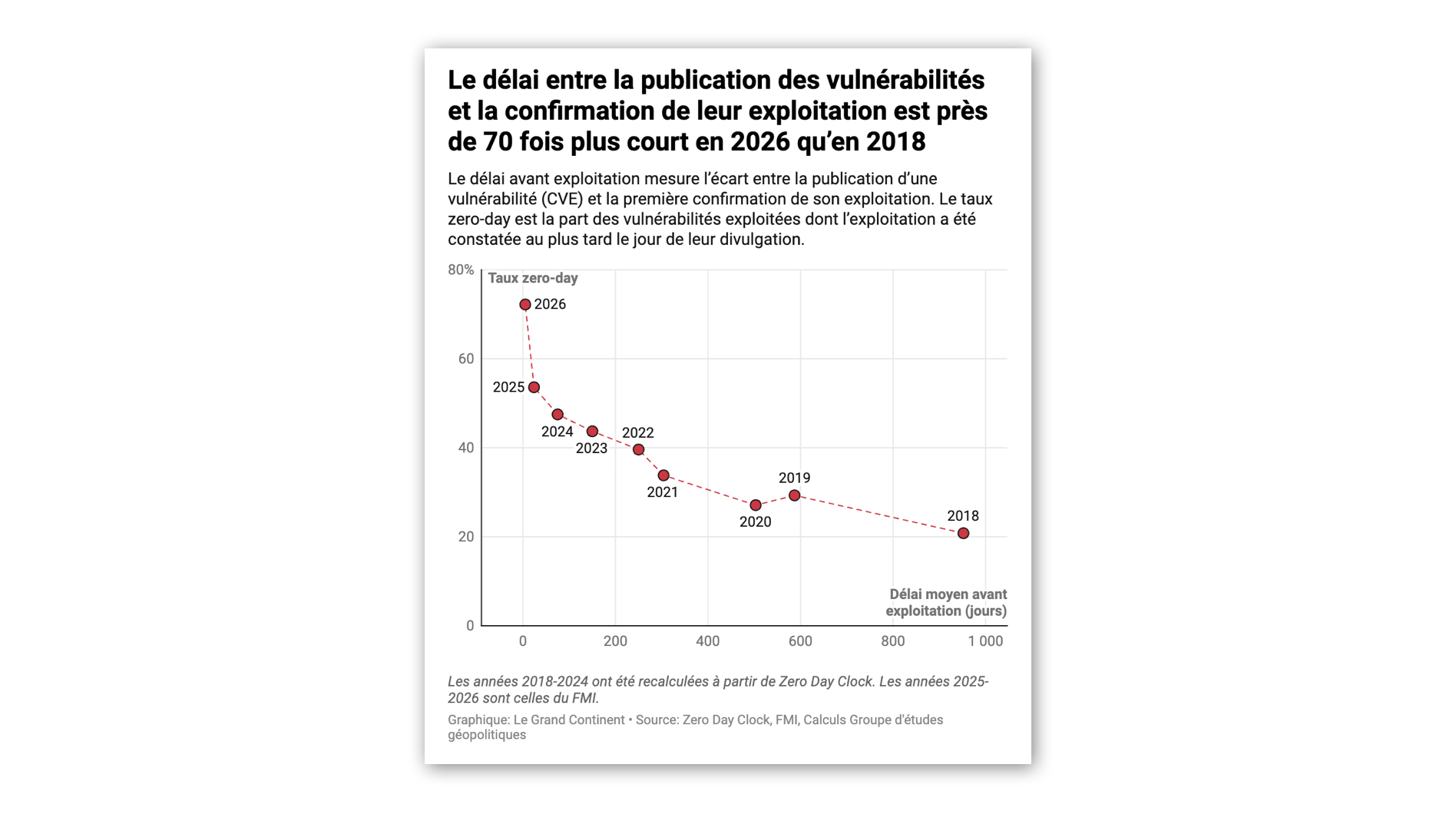
According to the International Monetary Fund, which relies on its latest report published today, Tuesday, October 13, on partial data for 2026, in more than 70% of the cases of vulnerabilities exploited this year, software publishers had barely enough time to fix them before they were exploited by malicious actors.
Last year, this figure stood at just over 50%, according to the IMF.
- The organization attributes the rise in the so-called “zero-day” rate, that is, the share of vulnerabilities exploited no later than the day of their disclosure, in part to advances in artificial intelligence.
- Cutting-edge AI models indeed enable state actors, ransomware groups and malicious insiders to launch more attacks, more rapidly, and on a larger scale.
This threat poses an increasing risk across all levels: to states, financial institutions and large corporations, especially those operating in strategic sectors, but also to individuals. According to Comparitech, more than 2,600 ransomware attacks were claimed worldwide during the third quarter of 2026, i.e., 61% higher than during the same period in 2025.
- CrowdStrike estimates that the number of attacks carried out by malicious actors using AI rose by 89% between 2024 and 2025.
- The cybersecurity company notes that last year, cybercriminals needed only 29 minutes on average to propagate within a compromised network – versus 98 minutes in 2021.
- The fastest propagation observed in 2025, for its part, required only 27 seconds.
AI has had the effect of substantially lowering the threshold of access required to execute cyber offensive actions. The technical skills once necessary for this kind of operation are increasingly delegated to one or more AI agents. The sophistication of the models enables them to operate with few detailed instructions, autonomously hack networks, steal data, and deploy ransomware.
- Artificial intelligence now occupies a central place in the field of cybersecurity, both for its offensive and defensive capabilities.
- In June, the cybersecurity agencies of the Five Eyes member countries estimated that leading AI models should, in the coming months, “exceed the sector’s current expectations, profoundly transforming cyber capabilities—both offensive and defensive.”