
During November, the Russian propaganda channel RT, whose broadcasting activities were suspended in the European Union in March 2022, released two documentaries dealing with social movements, mainly driven by young people, which have proliferated across Europe in recent months.
- In these two productions, available in Russian but also in English for a foreign audience, the channel presents the demands of young people as an opposition to European rearmament and to backing for Ukraine.
- The student protests filmed in the streets of Berlin, Turin or Rome are thus interspersed with interviews with militants and with “experts” denouncing the rearmament policy, which they claim is responsible for a decrease in spending on social aid, health, culture, or the education system.
Several of these interviewees are close to the Kremlin’s positions, such as Stefan Natke, former head of the Berlin section of the German Communist Party (DKP), who has repeatedly traveled to Donbass with the “Antifascist Caravan” and presents the war as a conflict led by Kyiv against civilian populations. In France, RT has approached François Asselineau and Bertrand Scholler, who was convicted in a first-instance ruling in January 2026 for cyberbullying against Brigitte Macron.
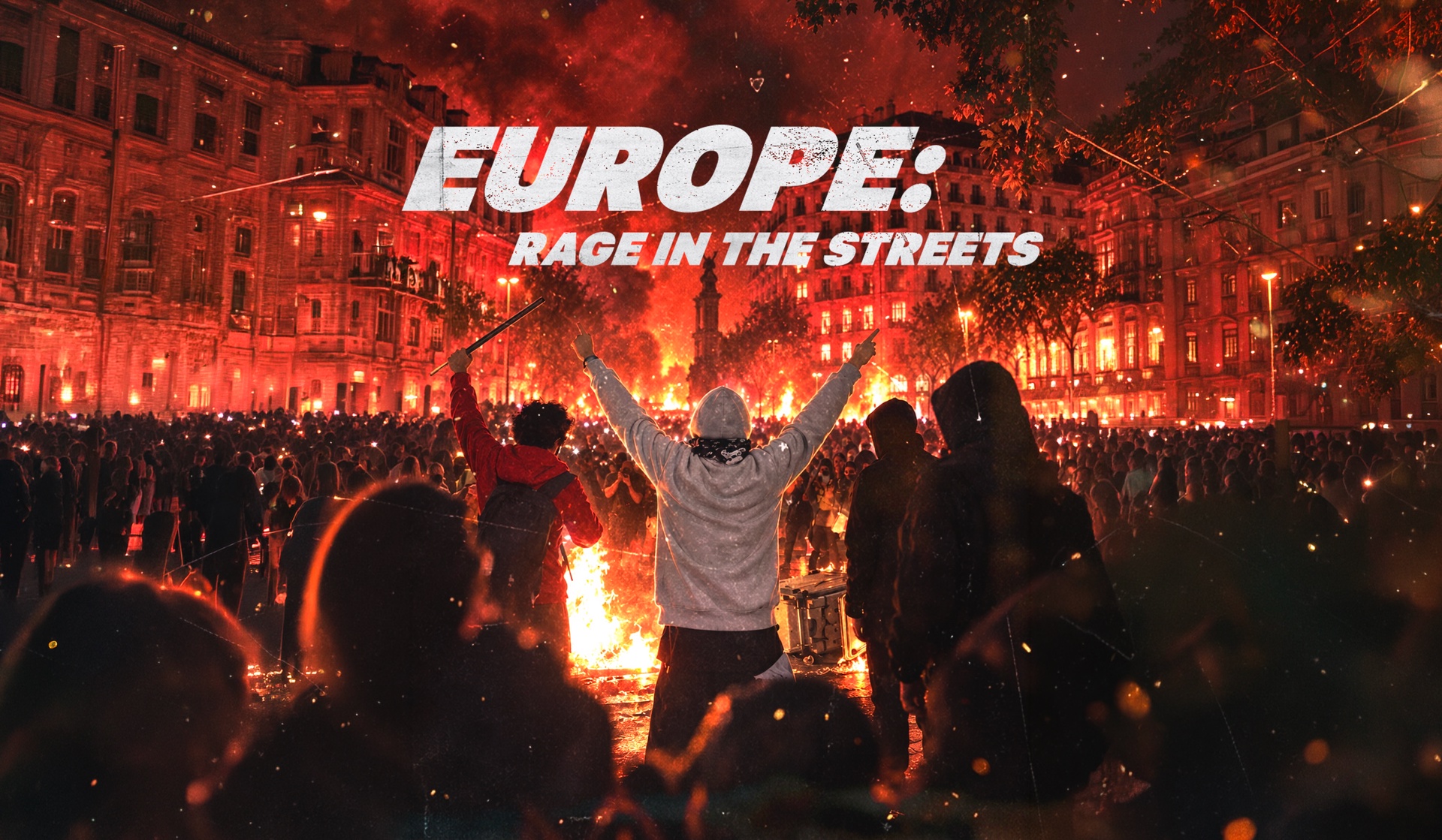
In one of the documentaries, titled “Europe: Rage in the Streets”, Scholler denounces the European Union, which “is accumulating more and more power”. He adds: “and people are becoming aware of it, especially the young.”
- In RT’s narrative, the young people form more of a backdrop intended to project an image of innocence than real actors. Indeed, few students establish an explicit link between European support for Ukraine and the rise in the cost of living, or the poor teaching conditions.
- In Rome, students at Plinio Seniore High School did, however, allow RT journalist Dmitri Khroustaliov, presented as a “correspondent” of the channel, to film inside the occupied establishment and to chat with the students.
- The scene, shared on social networks, was strongly denounced. Deputy Federica Onori, member of the Foreign Affairs Committee of the Chamber, warned of the risk that the students become “unwitting extras of Russian propaganda.” The students’ representatives rejected any pro-Russian stance, while an opposition group within the lycée described any collaboration with the Russian regime as “disgusting”.
While the channel denounces conflicts by showing images of destruction in Iran, Lebanon, Palestine or Syria, Ukrainian cities razed by the Russian army are presented there as victims of the Ukrainian army.
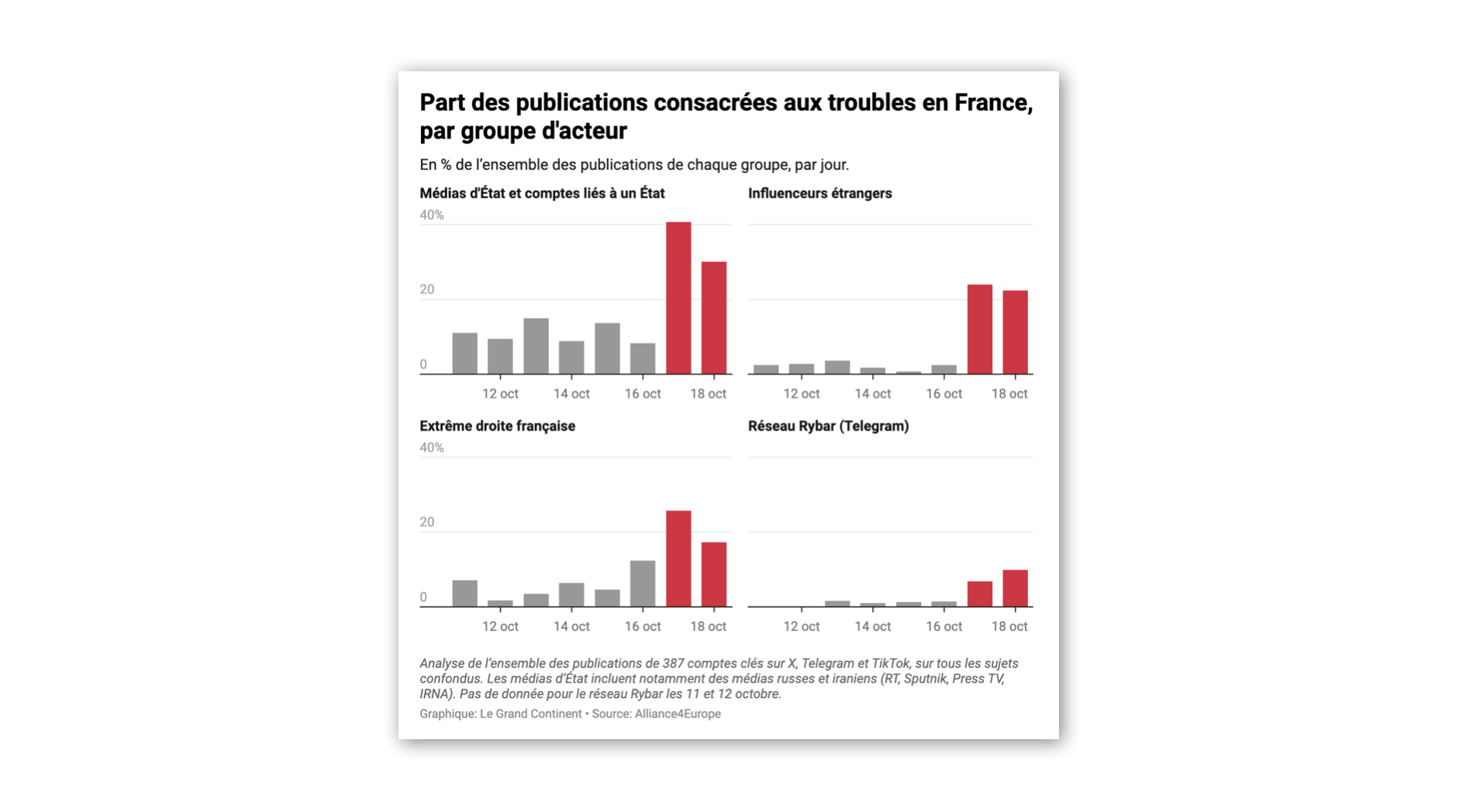
- The footage of the demonstrations, notably those on October 17 and 18 in Paris, and the looting that followed, were exploited by foreign actors, according to a report by the NGO Alliance4Europe, to project the image of the European model collapsing.
- According to Russian propaganda, the population, worn out by the war, which would have caused a rise in energy prices and the cost of living, would massively reject European governments.
In the documentary titled “Confrontation. Europeans Say No”, Natke thus designates the German Minister of Defense, Boris Pistorius, as a “Minister of War”, and accuses him of having stated that Germans should be prepared for a “total war”.
- Pistorius never spoke of a “total war” (the phrase is associated with Joseph Goebbels, the Nazi Germany’s Minister of Propaganda, who invoked “total war” in his speech at the Berlin Sports Palace in February 1943), but of making Germany “fit for war”.
- In Russian propaganda, it is not Russia but Kyiv, supported by the West, that would have triggered the war as early as 2014, and the Russian army would be the rightful heir of the Red Army.
It is difficult to gauge the real reach of these images and narratives in Europe. RT is no longer allowed to broadcast its content in the Union, but on social networks these publications circulate freely and are hard to detect by digital platforms.
- The weakening of public support for aid to Ukraine could, however, signal a certain permeability to the narratives promoted by Russian propaganda.
- According to a survey published on November 24 by the German Körber-Stiftung foundation, 53% of Germans oppose Berlin’s military aid to Ukraine – 14 points higher than in 2025.
- It is among AfD voters that this opposition is most pronounced: 88%. In 2025, it stood at 70% among BSW voters.
To counter Russian information warfare in Europe, Finland announced, on Monday, November 23, the launch of an information-defense specialization for conscripts, to be implemented in February 2027. France, for its part, is battling on social networks through a Quai d’Orsay counter-response account, French Response, launched in September 2025. This account aims to counter misinformation and manipulations aimed at France and, more broadly, Europe.