
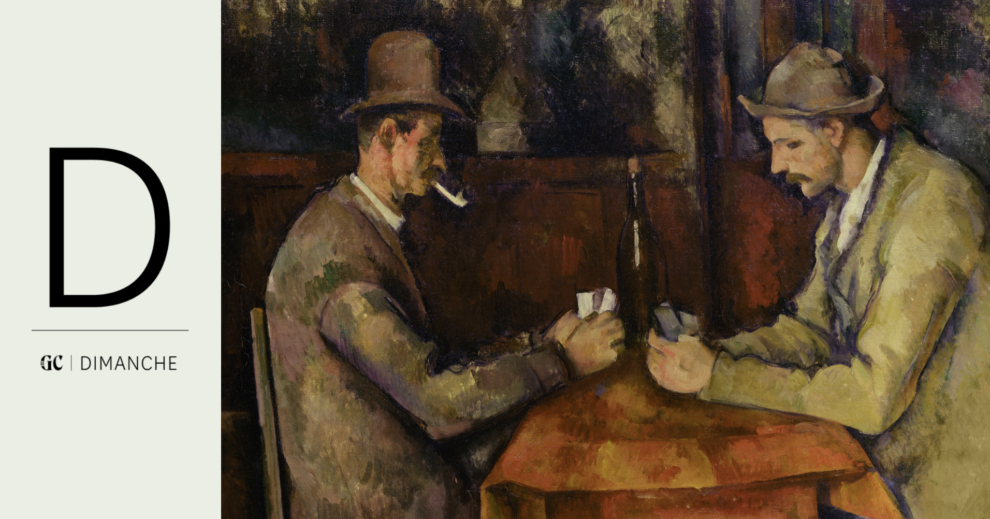
Among the various versions of The Card Players, the one kept in the Orsay Museum was painted by Cézanne between 1893 and 1896. It sits within a distinctive period of the painter’s life, during which he had withdrawn to his native Provence near Aix-en-Provence, while most Impressionists and avant-garde painters were in Paris.
An Artist in Retreat
This life in retreat is not merely geographical: it deepened after several ruptures of friendship, the most well known being with Émile Zola, following the publication of the novel The Work in 1886. Indeed, through the character Claude Lantier, the hero of this fourteenth volume of the Rougon-Macquart series and a half-mad painter who cannot finish his painting, Cézanne would have recognized himself.
Although Cézanne keeps a distance from several artistic and literary movements, he begins to receive a certain form of recognition from a few artists. He sells his canvases and becomes part of the economy of the art world and its circuits increasingly oriented toward commercialization. Far from the image of the Bohemian and impoverished artist, he has inherited a lineage and therefore does not need to work to live. This ease is reflected in his practice and in the subjects he chooses. These illustrate both his solitary path and his desire to paint things that resonate with what he knows and what interests him.
The world he paints is also detached from the industrial, urban, and working-class civilization that so fascinates the Impressionists. Cézanne is not a painter of train stations like Monet, nor of the gesture of labor or of streets like Caillebotte, nor of fêtes in the suburbs of Paris like Renoir. Through this painting titled The Card Players, he adopts a singular approach; he indeed chooses to represent another part of French society at the time: the rural and peasant world.
This world is doubly original. On the one hand, Cézanne does not represent the peasant and rural world one would spontaneously associate with 19th-century France. On the other hand, he captures this world in moments of leisure, which is less often shown.
A Simple Card Game?
Two men are pictured at a table; the one on the left appears older than the other. Their expressions are hard to read, but they seem deeply focused on their game. The specific game being played is unknown. Their elbows rest on a waxed cloth.
Regarding this painting, one can see two generations facing off or, conversely, playing together. They are also two peasants who, after work, enjoy a moment of leisure. There is a whole world off-screen that one can imagine. Perhaps they are in a café, surrounded by noise? Cézanne gives us a suspended moment, very closed in on the players. If one infers what is happening around the scene, one would probably find themselves in a fairly lively room.
Cézanne thus reminds us that card playing is also a time for meeting, retreat, and intellectual activity for peasants whose daily labor mainly calls upon their physical strength. One can also sense a moment of recovery, isolation, or solitude for agricultural workers perhaps under a boss’s orders. More broadly, this game of cards belongs to a whole range of activities of the working classes. These are predominantly masculine: such a scene could not be depicted with women at the end of the 19th century. This painting finally raises the question of what leisure time could have meant in lives so overwhelmingly dominated by work.
Between Continuity and Rupture
This representation of leisure is one of the most interesting aspects of the painting. It sits within a form of continuity that Cézanne explicitly sought and asserted; yet it also signals several signs of modernity—whether the conservative Cézanne wishes it or not.
Indeed, the Aix-en-Provence painter aims to depict what, for him, does not change much, namely the peasant world. By doing so, Cézanne aligns himself with a tradition that also marks his uniqueness. Politically, he is not at the avant-garde. Rather conservative, he thus sets himself apart from Zola, Monet, and others. Through the social world these paintings reveal, his works bear witness.
This continuity also lies in a theme already well known in art history, that of card players. It has often been represented from the angle of the sin of gambling. One might think of the paintings by the Le Nain brothers, for example. Indisputably, Cézanne draws inspiration from them in part here. But his painting also attests to several lines of change.
Towards a Monetarized Peasant World
The peasants of the late 19th century that he represents are not the same as those of the 17th century. These card players are found in a cabaret or in a café, as it was said at the time. The 19th century is indeed the golden age of cafés and cabarets; these places probably represent one of the social institutions that developed most during this period.
Both men are wearing jackets; they are not dressed in their work clothes, nor in their Sunday attire, even if one might think so. Not necessarily made for self-consumption, these outfits could have been bought. They have also had a bottle served to accompany their game, probably wine; and the older man smokes a pipe. We are therefore in peasant economies that are beginning to monetize.
Does this scene take place on a Sunday, traditionally a day of rest following the rhythm of the Catholic Church? Does it unfold in the evening or during winter, when agricultural work is less intense? In any case, we are looking at lives where non-working spaces exist, but also where micro-forms of consumption appear, even if mass consumption remains far off.
Behind the very striking image of a seemingly unchanging peasantry, these elements are a vivid testimony to a world undergoing change, even in the countryside.