
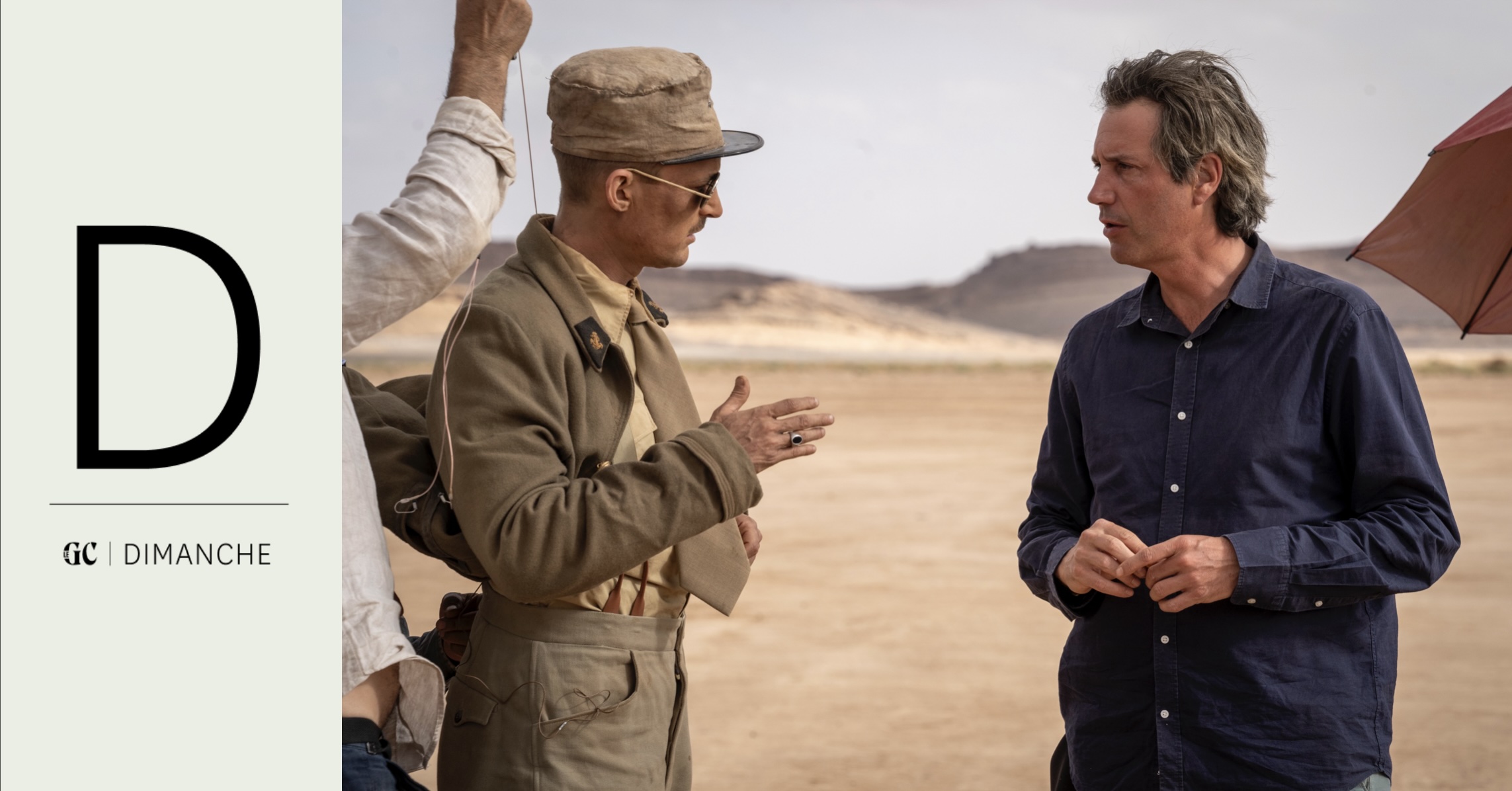
Julian Jackson, you dedicated a year of your life to Antonin Baudry’s film, but how long did it take you to finish your excellent work on de Gaulle?
Julian Jackson — I have no idea. I have lived with De Gaulle for so long that I can’t say exactly when this work began, or when it ended. It haunted me for years.
You are therefore married to de Gaulle?
Julian Jackson — I almost dreamed of de Gaulle: I was having nightmares, dreams… I think I am not the only one in this case. When you ask a historian if he started a project, people often think one has prepared for a long time, then one turns to the archives. But, in reality, it all starts long before.
Antonin Baudry has in a sense put your dreams into images.
Julian Jackson — In an original version, which he removed, there was a passage where de Gaulle had a nightmare about the admiral. I asked him: “How do you know he had this dream?” He replied: “How do you know he didn’t?”
Ultimately, that passage was cut.
How do a filmmaker who must take liberties and a historian who, on the contrary, must ban them work together? concretely, how do you treat June 18, 1940 as a filmmaker and how do you treat it as a historian?
Antonin Baudry — I’m happy to answer that question about June 18 because it’s rather amusing. Until three months ago, June 18 was not in the film.
In the script versions I had written with Bérénice Vila, my co-screenwriter, it was a scene that was absent. However, I had filmed a broadcast that was a blend of several broadcasts, a radio address by de Gaulle mainly based on the June 22 appeal.
Why?
Antonin Baudry — First, because it was more beautiful. The sentences, more poetic. I liked it better. And because it had been much more heard.
I had, moreover, blended in a line that appears in another broadcast, I think from July 13. All of this aimed to propose a coherent moment that could summarize the broadcasts in a single scene. You cannot show all the addresses in a film. You have to find the essence.
What are the possibilities then?
Antonin Baudry — Several options present themselves: take a single address and reproduce it identically, which will please historians, or take liberties and combine them. I nevertheless respected de Gaulle’s words. I did not invent a sentence for this scene because I thought it was important, whereas I invented de Gaulle’s sentences in the rest of the film. In this scene, I took only phrases that had actually been spoken on the BBC during this period.
I thought the film was pretty good as it was.
What happened?
Antonin Baudry — About two months ago, we showed the first part of the film, The Iron Age, in Angers for a test screening. People liked the film, but a substantial portion of them left thinking it ended with the June 18 Appeal, whereas it ends in 1942… I understood they had looked for the June 18 Appeal throughout the film and were relieved to think they saw it at the end. This historical misconception bothered me.
My first reaction was to do nothing. Then I thought that one should not disregard the audience. We make a film so that people derive pleasure from it, watch it, and what they see makes sense to them.
I had wanted to bypass June 18 because it was too well known, too iconic, a bit misleading, but it is in fact a major signifier. From the moment ignoring it disturbed the film’s meaning for my audience, I decided to revisit my position.
I therefore decided to include the June 18 Appeal, but that was complicated.
What was the problem?
Antonin Baudry — I had not recorded this speech. The advantage is that in cinema you can always re-record actors to modify the sound of certain scenes. I still had Simon Abkarian at hand, I had a crew who could record, and a mixing room still open. I had all the necessary elements, and I had already taken the liberty of blending several speeches.
What did you want to put, for instance?
Antonin Baudry — There was a line, which is from another address, that of June 24, 1940, which I wanted to keep. “There must be a sun. There must be a hope. Somewhere, let the flame of the French Resistance shine and burn.”
I did not want to remove it because the last line of the June 18 Appeal, which has exactly the same meaning, is very dry, and not at all emotional. At this point in the film and in history, I thought something that called for emotion was needed, similar to what a man who had to break with everything he had believed might feel. He was raised as a soldier, whose order is to always obey. The weight of this rupture had to be embodied.
How did you manage?
Antonin Baudry — I recorded the opening phrases of the June 18 Appeal and kept the rest.
What I mean: when you do a creative work, you are mainly troubled not by the historical facts, but by their iconization, because people consider certain things important. In this case, at the risk of disappointing some, I do not think June 18 is an important date.
Why?
Antonin Baudry — First, because this speech was heard very little.
Then, because the Resistance and Free France were not born from June 18 as Aphrodite emerges from a shell in Botticelli’s painting: it was a complicated, laborious process, full of conflicts. On June 18, there was nothing yet. Everything that became Free France later resulted from shocks, problems, happenstances, circumstances, and the will shown by several strong personalities.
June 18 has become almost a encapsulation of something much larger. When making a film, it is precisely against this kind of thing that one fights, when aiming to maintain a strong link to the truth.
How did this unfold in this particular case with Julian Jackson?
Antonin Baudry — It’s a concrete, interesting, and rather atypical case: we did not talk about it much between us. It happened in post-production, in the rush at the end, at full speed. I called Simon, asked him to come record something — it happened in an hour, with my sound engineer and my mixer.
So it is not really part of the maturation process. There is a lot of maturation in this work, but also many last-minute decisions, like this one.
But this maturation process, to use your words, is a work of creation and one needs freedom to tell the story. How does that align with the historian’s work?
Antonin Baudry — I did not experience the interaction with Julian as constraining, on the contrary.
I allowed myself the pleasure and space to write, to visualize in my head what I believed, what I wanted to show, knowing that later I would talk about it with Julian. He would read it and be able to give me his perspective, tell me: “That, we don’t know if it happened or not, but it could have happened, that’s no problem”; or conversely: “That’s more unlikely, but ultimately that does not distort the historical meaning of things” — or: “There, you’re twisting things, you’re going too far.”
This interaction, paradoxically, gave me a lot of freedom.
Did you therefore fear being constrained?
Antonin Baudry — No, not at all. Anyway, when you make a film, you have the final say…
Julian Jackson —In the end, Antonin was doing exactly what he wanted. And that is very important.
To come back to this point, I have little to add, except that when I watched the film, I noticed that this scene had been added. I had not found it in the script versions I had read.
And what do you think of June 18?
Julian Jackson — About the importance, or rather the non-importance, of June 18, there is a very beautiful quotation from de Gaulle essentially saying: “They make me laugh with their June 18. One would think everything came from there, while it makes us forget all the battles, conflicts, arguments, memoranda, etc.” He himself was a bit tired of this sacralization of June 18.
For a historian — I am not saying for myself in particular, but for any historian — one could not do what was done with this discourse in the film. But I understood, by observing Antonin’s work, that simplifications and compressions are necessary; otherwise the film becomes incomprehensible, unless you make a multi-part documentary, which would be deadly boring. So one must make choices. If we craft, in a sense, a speech from fragments that actually existed, that is to simplify. I learned a lot from this process.
What is the difference with your profession as a historian?
Julian Jackson — For me, writing a book is also an act of creation, but one is subject to certain rules: references, footnotes, etc. Constraints that cinema (which is also a work of creation) has the luck to avoid.
What happens then when one decides to make a film based on a book?
Julian Jackson — When I was offered to make a film based on my book, my first reaction was quite absurd. I told myself there was no need for my book: all of De Gaulle’s history is on Wikipedia.
When I began working with Antonin, I obviously changed my mind: I saw what he did.
It’s his idea of my book — that is, it’s not necessarily the idea I had of my own book. Sometimes you don’t see yourself what you did: it’s after someone revisits your work that you discover things you did not know you had included.
Are you thinking of something in particular?
Julian Jackson — That aspect that people often talk about, which is entirely present in my book—unbeknownst to me—is de Gaulle’s Don Quixote side. That romantic side is, for me, a very important part of the character. But there are other things that intrigued Antonin less, such as de Gaulle’s rational side, which is less discussed in the film.
On the plane taking him to London, de Gaulle is with two other people, including General Spears. A speech is put in de Gaulle’s mouth that is not entirely invented, because it relies on remarks he made in other interviews. It’s important, because Antonin stages his de Gaulle, with all the romantic side.
That romantic dimension interests you just as much?
Julian Jackson — I am obsessed with the two faces of the character: the realistic and classical de Gaulle, à la Cavour, and the romantic de Gaulle; the Bergsonian de Gaulle, and the thinking de Gaulle. For me, the fascination of de Gaulle is explained by the play between these two dimensions. But in the film, there is probably more of the romantic de Gaulle, which is entirely legitimate — and I did not know to what extent this was already in the book.
That is what is fascinating: you see that someone has done something based on what you yourself did, without necessarily knowing it, and it generates a result you did not know.
To what extent did you not know it?
Julian Jackson — My initial idea was wrong, so I had to abandon it. When I began the biography, my idea was to show that de Gaulle was not alone — to show him as a product of his era, because as a historian I am skeptical of the idea of the lone man. I hate that idea. But for de Gaulle, it did not work for my starting thesis.
However, I was still able to stage people today who are more or less forgotten by the majority of the public — for example René Pleven, who played a very important role in the Fourth Republic and in the early Free France with de Gaulle.
I am therefore very pleased to see that, thanks to the reading he gave of my book, Antonin has placed this era at the center of the film. It is also a very interesting gesture.
After the film’s release, did you discover new things or did spectator reactions surprise you?
Julian Jackson — I find it fascinating that the work, once completed, becomes like a baby that everyone takes ownership of, and in which everyone will ultimately find what they are looking for. I think this applies just as much to the filmmaker as to the historian: from this point of view, it happens that the filmmaker must take a stand — one cannot always stay in nuance.
At times we disagreed. It was always friendly, but sometimes I would say: “I wouldn’t do that,” and Antonin would reply: “I will do it, because dramatically, it is necessary.”
Do you have an example?
Julian Jackson — I’ll give you a case where I was “against” it — that is, I gave my opinion, but it was his film, and he decided.
Remember: it was at the end of the first film, after the Americans had brought to power, in North Africa, Darlan. De Gaulle then thinks that everything is over. In the film, there is a meeting of the National Council in London, where de Gaulle says, in substance: “We did our best, unfortunately it didn’t work,” and alludes to his resignation. We then see a scene where de Gaulle appears in civilian clothes — the only time in the film he is not in uniform, because he is no longer “de Gaulle.” He personally decided to renounce.
Antonin chose to include this scene to be truly striking, to visually convey this moment. Personally, I think de Gaulle had not abandoned. The problem is that with de Gaulle you never really know: when you work on him, he is always two steps ahead of you. He is so complex that when you think you have reached the bottom of the character, it turns out he is always further. However, in this case, I think he was indeed desperate about the situation, but he knew he would eventually prevail. For me, it was therefore not a real moment of abandonment for de Gaulle.
Yet Antonin Baudry did keep the scene…
Julian Jackson —I understand exactly why this scene is there: it is both a completely legitimate interpretation, first because the question of whether he really wanted to leave or not remains open; and second, because it is a striking scene, which seizes the viewer in a very direct way. It is therefore a very concrete example of our disagreements.
Antonin Baudry — We are in the process of re-creating in front of you, live, the discussions we had during shooting [laughter].
At first, we thought to place de Gaulle in civilian clothes at the end of Part II. Then I found the ending better in another way. In any case, I wanted to see him in civilian clothes at some point — it was in the air, so to speak. Secondly, there is the question of whether he was sincere or not. As you say, we don’t really know: it’s one interpretation to say he was, another to say he wasn’t. But one could also think that if it were a form of performance, one could very well act the performance with clothes. And since I had no proof that he never went civilian in that office, I had no major reason to forbid showing him that way.
What does showing him in civilian clothing bring?
Antonin Baudry — It brings symbolism, something we had never seen before in this kind of film, and which is quite strange: even we, the French, have relatively rarely seen de Gaulle in civilian clothes, perhaps only in the news footage of the presidential era. It is unusual.

But it is a decision on which our discussions enlightened me a lot, because they helped me to mature it. There are other cases, conversely, where you would say: “No, I don’t feel that,” and I followed what you said. In this particular case, however, our exchanges made this decision more matured, more assured.
It is a concrete example.
Do you have another one?
Antonin Baudry — I have another example, where there was a very precise historical error. It was at the very beginning of the work: we wanted to show the existence of antisemitism in North Africa, with certain characters, and there was a yellow star worn by one of them. Julian reminded me that the yellow star was not worn in North Africa.” Obviously, I immediately removed it.
This other example is not a question of interpretation this time, but simply a question of historical fidelity.
That is where this double gaze truly allows freedom: to know that there will be this historian’s gaze, who truly knows his subject and who also has access to other historians, allows us to know that we will not go anywhere haphazardly — or at least that we will not do it without knowing. If there is one thing we really want to do, dramatically, because we are convinced that it is what the film should deliver at its core, then we own it — but we never do it without knowing.
You therefore never hesitated to have a historian as a consultant?
Antonin Baudry — I always thought it was absolutely necessary. Moreover, I was really glad that it was Julian — first because his book opened the door to certain aspects of de Gaulle for me. Then, because the spirit of the book was exactly the one that drew me to de Gaulle. And also because Julian is someone who understands things: he is not at all a pedantic historian who fights to impose his discipline.
We are in a different exercise: a fiction film based on historical events, aimed at a priori non-specialist audiences. I have never hidden that I did not want to make a film for specialists in de Gaulle or World War II. I wanted to make a film for my children’s friends, for that generation. That immediately worked and allowed us to work well together.
Julian Jackson, how do you distinguish good and bad choices that depart from historical truth?
Julian Jackson — I think it is very interesting to know what the audience in the room, or the critics, think. I don’t want to criticize another film in particular, but I will nonetheless do so.
I did not like the film The Darkest Hour, about Churchill. There were many things I did not like, even though I found some choices legitimate.
There is notably a scene at the end of the film that surprised a lot: we see Churchill take the London subway. Yet I think Churchill never set foot in the Underground in his life. He is in the subway, surrounded by a Black man, a trans… I exaggerate a bit, but the idea was to show a kind of multicultural world in the subway.
I hated it, because it sounded false, it was hollow. There are things one should not do. You can invent characters, you can invent dialogues, but you must stay true to the character’s reality. That is one example. I did not much like Ridley Scott’s Napoleon film for other reasons either.
I think there are very legitimate questions about what one can do, what one should do, about lines not to cross, etc. But personally, I think that, in this film, we are on the right side — I hope I am not saying this because I was so involved in the film!
I’ll give you another example. I think very few French people know the story of Admiral Muselier, except specialists. Muselier is a very picturesque character, a very ambitious admiral who wanted to get rid of de Gaulle. There were several conflicts between him and de Gaulle, and I think it was important to show them to understand how much de Gaulle was contested in his early days.
He was not alone, but he had opponents within the movement, sometimes supported by the British. There were three major conflicts between Muselier and de Gaulle.
It was necessary to show him. A pedantic historian might say: the first conflict was September 1941, the second in April 1942, etc…— the dates in the film are not exactly right, but that has no interest in itself.
So coming back to the making, because we saw you were quite coordinated, concretely, did you send what you wrote? You were two, by the way — there was also your wife.
Antonin Baudry — Indeed, we wrote the film with my wife Bérénice Vilar. The film is, so to speak, our third child.
Concretely, I would send documents to Julian, who was often in France, and would come to the house. We would discuss at home, then go eat together, then discuss again at home — it happened in a very natural way. We must have done this four or five times, and we also talked by email and phone from time to time. It was very smooth.
Julian Jackson — I would also like to mention a very important aspect for the construction of the first film: the parallel lives of de Gaulle and Fernand Bonnier de la Chapelle.
I do not know if the idea came from either of you, but it is very important because it anchors de Gaulle’s story in the experience of a French resistance fighter — a resistance fighter who also has his Don Quixote side. Moreover, this young man unravels the story at the end, with the assassination of Admiral Darlan.
About Fernand Bonnier de la Chapelle, when did the idea of a dual narrative, one side that of the general, the other that of this young man, emerge?
Antonin Baudry — The idea came from the fact that Bérénice had me listen to a reading, on France Inter, of the letter Bonnier de la Chapelle sent to his father the night before his execution. Hearing that letter, honestly, I broke into tears. We looked at each other, we talked about it, and we decided it had to be in the film. So we explored this narrative thread around Bonnier de la Chapelle, about which there was very little documentation available.
A book appeared in the meantime, which we used, which we read, but sources remain scarce.
That book is very interesting, but it raises a lot of questions, because not much is known about Bonnier de la Chapelle. We know that he killed Darlan, that there was a trial, we know what was said during the trial, we know that he attended Stanislas High School, and that he was educated by his uncle and aunt, who were left-leaning and friends of Léon Blum. What irritates me a lot is hearing history enthusiasts, on the left as on the right, claim that he was royalist — when in fact we know nothing for sure.
He attended Stanislas High School, where there were certainly royalists, and like almost all youths of his time, he had access to Maurrassian books, etc. The person who supplied him with weapons probably belonged to the royalist faction. But there is absolutely no proof that Fernand was royalist, especially since he was raised by a couple who were firmly republican. [Since this encounter, Fernand’s nephew has contacted Bérénice. His aunt, the “little Suzanne” we see in the film, is still alive… and she has seen the film! That deeply moved me. The nephew has sent us two incredible documents, two writings from Fernand’s father. Fernand, he writes, “was never royalist, nor a cagoulard, and in his veins ran only the red blood of true republicans.” He recalls Fernand’s temperament and “his enthusiastic and determined character which did not allow him to understand and above all to admit the dreadful realities of the moment.” His father also adds: “the French voice from London, the only comfort for so many French people, was awaited by him every day with impatience. He listened to de Gaulle’s call and his decision to join him was taken immediately.”]
Why does this character seem so interesting and central in your view of World War II history?
Antonin Baudry — One thing that struck me and greatly influenced us with Bérénice while reading his trial, which was very succinct: the judges could not imagine that a young person of that age could act on his own and with awareness.
They were obsessed with understanding who had manipulated him. Several theories circulated: some thought he had been manipulated by the Italians, because his father was of Italian origin; others, that Churchill had obviously manipulated him — which was not true; others again, that it was de Gaulle — which was not true either; and others finally that he had always been royalist — which is unlikely in my opinion. [Since then, the new documents I have access to fully confirm this.]
I told myself we should give this young man a chance: to consider him as a human being who acted on his own. That is what the film seeks to do: in this film, these are people who exist for themselves.
That is why debates about details, which are most often the work of temple guardians who improvise historians at the last moment, are annoying. They divert the film’s reading from something important: that a 17-year-old boy could act on his own.
I was very moved by this trajectory. I then went to Stanislas High School, and it was moving, because I found documents that had never been opened and consulted by any historian — notably the letters from his uncle to the headmaster, in an attempt to prevent the young man from being expelled. You can feel the uncle’s efforts to excuse Fernand’s bubbling character — it’s moving.
Indeed, he was a troublemaker, he needed to act all the time, there was a constant overflow of energy in him. It was a kind of De Gaulle without the eagle’s eye on history and the future. His uncle spent his time writing to the headmaster to ask for forgiveness, to say that he nonetheless had qualities. I find that quite moving.
What is the narrative use of the character?
Antonin Baudry — What it allowed, then, was to see how someone who lives in Paris — before leaving for Algiers, which occupies roughly the second half of the film — perceives what de Gaulle does.
On this point, honestly, we know nothing: there is no evidence of how Fernand received de Gaulle’s speeches. For me, when you don’t know, that’s a perfect ground for imagination. But always under the historian’s gaze. If Julian had found certain scenes unthinkable, he would have told me and I would have changed my mind and would not have gone in that direction.
[Since then, the documents cited above confirm my intuition, which pleases me.]
When making films, even fiction, as long as they are based on historical facts, it is important to maintain a high degree of sincerity. One must resist adding elements that could make the film better, but are contrary to our understanding of the character.
Sincerity is thus essential. If one is sincere, one can receive and bear criticism. It is, ultimately, a question of integrity.
Julian Jackson, are there scenes in the film that are invented?
Julian Jackson — I read a few articles about the film, including one by a historian who tends to nitpick about something that really existed, but he found it so unlikely that he considered it invented. Even when I saw it on screen, I thought: “That’s odd,” but I knew it had existed!
This is a scene that takes place almost at the beginning of the first film, when the British want de Gaulle to address a British audience. He barely speaks English, perhaps a bit anxious — after all, de Gaulle remains a human being. If you’ve seen the film, he appears on stage with a text he does not dare to pronounce; and he leaves without speaking.
It may seem unlikely, but this scene was actually discovered by one of my PhD students, Charlotte Faucher, who was doing a PhD on the French Institute in London, a very good work on diplomacy of the time. It’s her who found, reported in the press of the time, this anecdote nicknamed “The Silent General”: the general who appears on stage, says nothing, and leaves everyone a bit perplexed.
This scene is therefore not invented: it really happened, even if it seems indeed quite strange!
Aren’t there other examples?
Julian Jackson —Another scene, half invented but not entirely, takes place in July 1942. De Gaulle gives a speech before British MPs and this speech is followed by a Churchill adviser, who says that de Gaulle was remarkable, that his understanding of geostrategic questions, for someone not at the center of decision-making, was remarkable, strong and intelligent.
Antonin said to me that it was a very good scene and asked me: “What is the text of this speech delivered before British MPs?” I told him that he had probably improvised, and that there was no text. So he asked if I could write it! I said, “No I cannot!” So he wrote the speech himself, entirely plausible.
Antonin Baudry — I had a lot of fun writing this de Gaulle speech; I needed, this time, Julian’s validation before shooting it with Simon Abkarian.
There are also invented characters…
Julian Jackson — I love the plumber character, who was supposed to be Welsh, even though I was skeptical at first. Anyway, he is funny. But above all, he is there to illustrate de Gaulle’s solitude.
The plumber visits the Carlton Gardens premises for the first time and the only thing he is interested in is the plumbing, very well done in these buildings. It’s very funny and it says something about loneliness.
Antonin Baudry — I wanted to show with this character that de Gaulle tried to recruit absolutely everyone, even his plumber if he could. And then, Bérénice and I like this character. It’s also the team’s favorite, their darling.
So, specifically, I’d like to return to the choices—you did make choices, for example by focusing on events that are not very well known, like the Saint-Pierre-et-Miquelon operation or Dakar. Who decided?
A film is only about making choices. With Bérénice, fairly early on, we decided not to talk about the year 1941. One could make a film about the year 1941.
If I had to cover the year 1941, I would have had to make three films. I had, however, already written the 1941 script. These are choices that are heart-wrenching, but necessary and made all the time. Two days ago, for Part Two, I cut a scene, a week before the release.
I loved that scene, but the film was better without it. All characters are important, all scenes are important. But one has to make choices to make a film.
If you cut a lot, why keep Saint-Pierre-et-Miquelon? Le Grand Continent has part of the answer, with the publication of the Muselier Doctrine. It is the moment when one relies on a detail, whereas in reality it is the essence: the independence of France from the strongest powers.
The argument is that you could not let Saint-Pierre-et-Miquelon fall, even if, as Pleven says, they are two snowy islands all year round, without much apparent importance. And yet yes, it is important, because it is part of the territory: if you let that go, it means you could potentially let everything go.
I found this interesting, because in mirror, there was an idea I never wanted to put explicitly in de Gaulle’s mouth but that I nonetheless found strong: if de Gaulle is so intolerable with Churchill, so incapable, or at least so unwilling to make the slightest compromise on anything, this comes from a very precise conviction: he is too weak to allow himself compromises.
Showing it through an event like Saint-Pierre-et-Miquelon allowed sending a broader message about the kind of man de Gaulle was, and the situation in which he found himself.
Julian Jackson, does the historian also make choices?
Julian Jackson — Of course. In my book on de Gaulle, for example, there is only one page on Madagascar, and half a page on New Caledonia — one could write much more. A history book does not write itself: it is written by someone who makes choices, not exactly for the same reasons as a filmmaker, but ultimately for reasons close, almost artistic — because a life to tell, is also a form of creation. One chooses where to cast the light, and where, on the contrary, to leave certain aspects in the shade.
You’ve given me a perfect transition for my last question. Antonin Baudry. Do you feel, in your own way, that you are also doing geopolitical work through this film?
Antonin Baudry — No [Laughter].
At the same time, I was glad to highlight mechanisms that seem to illuminate our current era, because, ultimately, they illuminate all eras: the way things are built, both in terms of power relations and in human emotions.
There are things that struck me, which were also surprises for me. You spoke of the idea that someone can see in your work what you yourself did not see — well, that happens to me too, including at different stages of the same film. That is what is amusing about making a film, which is a very long process, with many steps: I find, at a given stage, something I hadn’t seen at the previous stage.
For example — you haven’t yet seen this scene, it is in the second film — I shot the first meeting between Roosevelt and de Gaulle at Anfa, in Morocco, where it really took place. That day, Roosevelt was receiving de Gaulle. Harold Macmillan, Churchill’s special envoy, who had just survived a plane crash and arrived still bandaged, arrived on the scene and saw snipers posted all around. He asked if it was Hitler they were receiving — and no, it was de Gaulle!
De Gaulle was therefore received under the watch of snipers, hidden behind curtains, in an atmosphere of pressure and fear.
I shot this scene in 2024 (before the famous Trump-Zelensky meeting in February 2025), and I rediscovered it when I started editing it in May 2025.
And while editing it, I realized that it bore a strong resemblance — with snipers added and cameras missing — to a scene that has become familiar today: Zelensky in Trump’s office. In one case, Roosevelt treats France as a child, in the other, Zelensky is humiliated before the cameras.
That is obviously not done on my part on purpose, since this scene was shot before the Zelensky interview. But it is interesting to see that there are constants, trends that recur in History.