
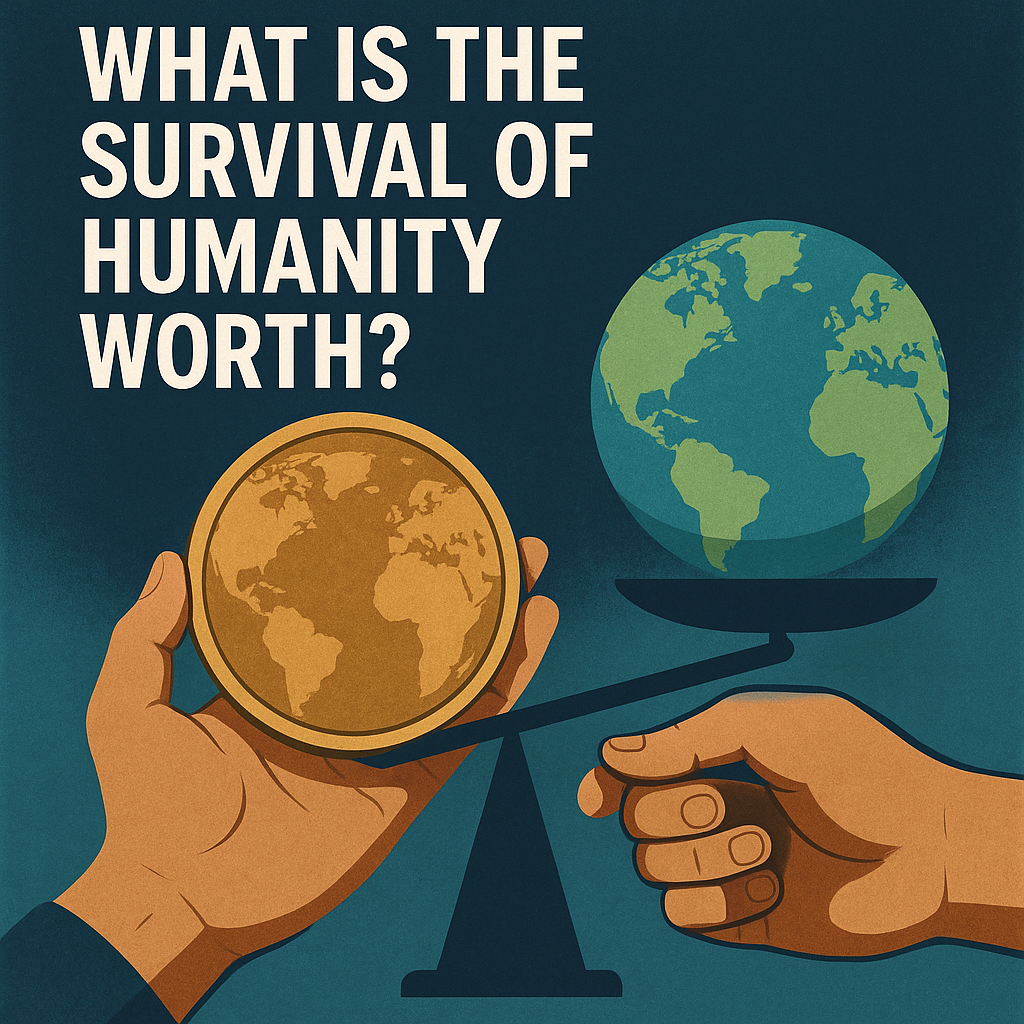
It is difficult to think about the well-being of the generations who will come after us, and yet we have a moral responsibility towards them – all the greater since their existence is now threatened.
What reasons do we have to prevent the extinction of the human species? ? How much value do we place on the existence and well-being of future generations? ? These questions can seem disconcerting, even provocative, as their answers seem obvious at first glance. Indeed, many of us surely think intuitively that we have moral obligations towards future people, whether this involves guaranteeing them a certain standard of living or not harming them (or at least not too much). However, philosophers have shown for several decades that our moral intuitions regarding future generations are not necessarily so obvious or that our most proven ethical principles can lead to surprising results. In a work published for the first time in 2018 and recently translated into French, the American philosopher Samuel Scheffler, professor at New York University (NYU) poses this problem again and provides an unexpected answer.
Beyond what could pass for philosophers’ ratiocinations, the question is crucial from a practical point of view. Since the invention of the atomic bomb, human beings have in fact acquired the technical power to put an end to the history of the species, thus radically raising the question of their responsibility towards future generations. However, it is in another context that the author chooses to prioritize his questioning: that of climate change (p. 24-26). What reasons do we have to reduce our greenhouse gas emissions in order to limit the dangers of global warming? ? Are these all moral reasons or do we also have selfish reasons to address the peril of climate change? ? These questions are indeed essential as, we will return to them, the lack of motivation to act seems to be an obstacle to the implementation of sufficiently ambitious policies to put an end to the intensification of climate change.
Are we really short-termists? ?
The work opens with a critique of what S. Scheffler calls the “ temporal localism “, that is to say the tendency that we would have to worry more about the fate of our contemporaries than the fate of those who are further away from us in time. This form of short-termism of individuals is undoubtedly one of the major causes of climate inaction – even if we should not neglect the short-termism of institutions either. Nevertheless, the philosopher intends to show its paradoxical character. Our actions undoubtedly demonstrate a form of intergenerational myopia when we emit greenhouse gases or destroy biodiversity. However, our moral intuitions would betray a real attachment to the idea that the human adventure can continue after our death. The project of the book thus seems to be to make us aware of our attachments, sometimes unsuspected, to the continuation of the history of the human species and therefore to activate latent motivations to act in favor of policies more favorable to future generations.
Before studying the four types of reasons for caring about future generations put forward by S. Scheffler, it is however appropriate to underline how they differ from other philosophical approaches from which he explicitly intends to distance himself. The author devotes a certain number of pages to the criticism of utilitarian ethics. He does not share the ideal of maximizing aggregate well-being and doubts the motivational force of a principle of beneficence applied to future generations – our sympathy towards distant future people without identity being, according to him, too weak and too little shared. S. Scheffler thus extends the field of moral reflection in relation to utilitarianism, but also to other ethics such as the universalism of human rights: “ Different types of values may have a role to play in our thoughts about future generations, and not all of these values have to take the form of moral obligations. » (p. 37)
Four reasons to protect future generations
The author thus defends four different types of reasons to guarantee the survival of humanity in the future, linked respectively to our interests, to love, to questions of evaluation and to reciprocity. However, it seems to us that, in the economy of argument, these are the “ reasons of interest » which occupy the most important place, taking up the main thesis of a previous work, Death and the Afterlife (“ Death and life after death », 2013, untranslated):
“ Many activities that we find worth doing today would lose much of their meaning and seem of much less value if we thought that human life was on the verge of extinction. » (p. 54)
According to S. Scheffler, our attachment to what we value (a sport, a work of art, a language, etc.) is therefore characterized by what he calls a “ conservative disposition » (p. 121), that is, a desire that what we value be preserved. We would therefore indirectly have a personal interest in humanity surviving in the future so that a certain number of activities still exist. To support this idea, the author proposes a thought experiment: if the entire human species had become sterile, would we not be irremediably distressed and would we not find that all activity would have lost its meaning? ? At least that’s what S. Scheffler thinks.
The author, however, denies that our reasons are purely selfish. We would therefore also have “ reasons of love » to preserve the existence of future generations (p. 76). To these first two types of reasons for preserving the living conditions of future people are added two more. On the one hand, “ evaluation reasons »: in a completely radical way, the very fact that things have a value would become impossible in the absence of human beings for their to agree a value. This problem ties in with classic questions in environmental ethics on the intrinsic value of nature: “ In addition to the disappearance of things of value, the extinction of the human species will lead to the disappearance on Earth of the fact of granting value » (p. 83). On the other hand, “ reasons for reciprocity “: according to the author, we have, despite appearances, a relationship of dependence mutual towards future generations. We would be at the mercy of the opinion they will have of us: will they praise us? ? will they judge us harshly ? will they forget us (p. 85-6) ? It is up to the reader to judge, then, whether the fact that our post-mortem reputation depends on what future generations will think of us constitutes a sufficiently strong and widespread motive to act in their favor.
Are all the reasons to worry about the future good? ?
S. Scheffler’s work thus provides an atypical answer to a question of capital importance. His project of showing us the unsuspected and varied reasons we have to guarantee the future of humanity is undoubtedly timely. However, one might wonder if these different reasons we may have to care about future generations are all good reasons. We can also regret that the work is part of a presentation apocalyptic of climate change which minimizes the problems of injustice.
Throughout the work, S. Scheffler maintains a certain vagueness around the notion of “ reasons » that it mobilizes: is it a question of patterns to act or justifications ? It’s one thing to ask what actually motivates people and another to ask whether those motivations are morally acceptable. His project would have gained clarity by explaining this point. Such a distinction would also have made it possible to address more head-on the question of whether, for our actions to be moral, our motives must also be moral, or whether a moral action can legitimately be performed for quasi-moral motives (the love of one’s own children or grandchildren), or even amoral ones (personal interest, the desire for conformity, fear, etc.). As Dieter Birnbacher noted, this problem is particularly important in the intergenerational context, because the temporal distance from future people – who for us are faceless and voiceless – presumably weakens our motivation in fact to act in their favor more than it reduces the moral consideration that we must give them of law.
In the same vein, one could criticize the work for confining itself to the axiological question of values leaving aside the normative question of principles which would allow us to arbitrate between these values when they come into conflict. However, it is a safe bet that by choosing, for example, a climate policy, we would have to cut back on certain values (a part of our present prosperity, for example) to safeguard others (the fundamental rights of future people, for example). The author is also rather lucid on this point (p. 97).
We could also, as Amia Srinivasan pointed out regarding Death and the Afterlife, find elitist the lifestyles oriented towards the future – lives devoted to the search for a cure for cancer (p. 57), to social and political activism (p. 60) or even to philosophy (p. 63) – which S. Scheffler puts forward to demonstrate that we have an interest in the survival of the human species. Many people lead very different lives – centered, for example, on simple pleasures, play or the contemplation of ephemeral things –, thus depriving them of an interest in the preservation of humanity without their lives seeming morally reprehensible in any way.
Finally, we must put into perspective the relevance of the apocalyptic conception of intergenerational ethics proposed by S. Scheffler by focusing on the reasons to avoid extinction of the human species. While this approach allows us to adequately think about the problem posed by the risk of nuclear holocaust, for example, it tends to obscure many reasons we have to worry about climate change and other environmental problems. By reducing climate change to a question of survival, S. Scheffler distorts the issues and thus (no doubt despite himself) downplays the problem of injustices. It is a fairly common strategy to seek to motivate the most indifferent to act against global warming, but we must not forget that all individuals are not equally vulnerable to climate change nor equally causally and morally responsible for acting to remedy it. More than a question of survival, climate change is above all a question of justice.