
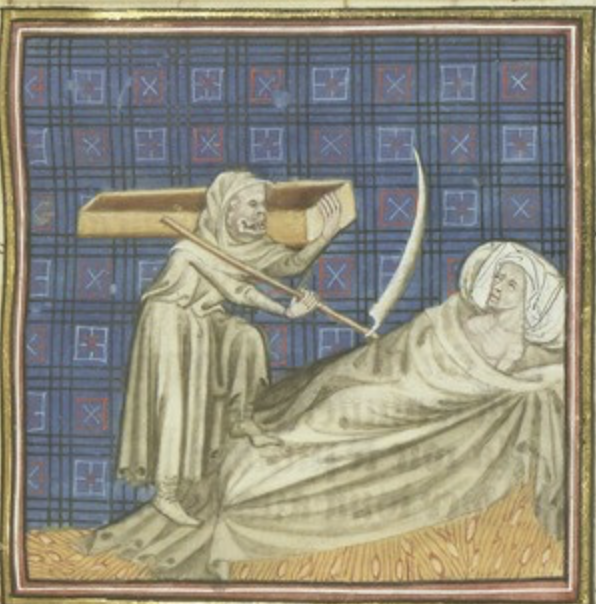
An unparalleled demographic catastrophe, the Black Death disrupted the economic, social and cultural balances of Europe in XIVe century. Long thought of as a major caesura, it now appears to reveal the structures, limits and resistance of medieval societies.
The history of humanity is dotted with brutal confrontations with pathogens capable of spreading across several continents (and therefore causing pandemics), and sometimes even to the whole world. The most recent episode is, obviously, Covid-19, but the most brutal undoubtedly remains the Black Death of XIVe century – or, more precisely, at least as far as Europe and the Mediterranean are concerned, the plague of 1347-1352. This caused, in this region, the death of approximately half of the inhabitants (the precise estimate remains uncertain), or around fifty million victims. The plague left its mark profoundly, not only on the consciousness of survivors, but on Western (and non-Western) culture more generally. Its demographic and economic consequences were just as significant: the effects of the terrible pandemic, amplified and lasting by the recurrence of frequent pestilences, are felt by the lasting shortage of human beings. Paradoxically, in this way, the Black Death was also able to bring about certain positive consequences (which obviously only applies to those who were spared): an increase in resources per capita, an increase in wages and, generally speaking, an improvement in working conditions, as well as a reduction in economic inequalities.
The strange noise of the present
Given its absolute centrality in global history, and even more so in that of Europe, the Black Death has caused a lot of ink to be spilled. From now on, we must also take into account Patrick Boucheron and his impressive essay Black Death. The author, a recognized medievalist, professor at the Collège de France and author of numerous books whose ambition is matched only by their success, is however not a specialist in the study of the plague or other epidemics. Patrick Boucheron’s interest in the plague, as he explains in the introduction to the volume, results from the experience of Covid-19. The author thus experienced, like all of us, the “ strange noise produced by the irruption of the present into things of the past » (p.18), and he sought – like a good academic – to make it intelligible, to himself and to others, through study and teaching.
The book is therefore the result of two years of courses at the Collège de France, during which Patrick Boucheron immersed himself in reading recent historiography on the plague, which clearly surprised him in many respects. This is the whole advantage of the non-specialist: taking a new and curious look at what others take for granted, relating it to one’s own skills, and presenting it effectively in book form to a wider audience, itself largely non-specialist. Let us be clear from the outset: as a high-level, and even very high-level, science popularization exercise, Black Death is a total success. This is a meticulous book, generally very well documented, precise without falling into pedantry. The style is certainly captivating, although sometimes a little too emphatic. However, it would be an exaggeration to say that it reads like a novel, its aim certainly not being to compete with fiction: it is rather a remarkably accessible essay which will not fail to captivate cultivated and curious readers who will not be discouraged by its more than 500 pages.
The story in the genes
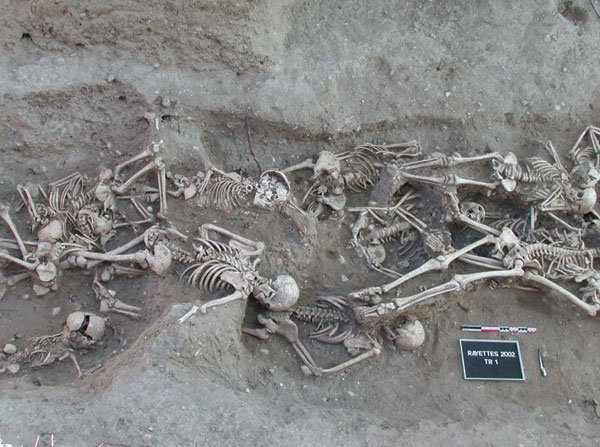
The book opens with the question of the identification of the plague, in the company of the protagonists of the “ bacteriological revolution ” of XIXe century, who took the opportunity of the Hong Kong epidemic in 1894 to try to identify the pathogenic agent causing so much devastation among human societies. The winner of this scientific race was Alexandre Yersin, a Swiss doctor naturalized French and student of Louis Pasteur. The account of these events is accompanied by the analysis of the very nature of the pathogenic agent and its epidemiological and biological characteristics. From the outset, the subject shows how recent research based on traces ofDNA remaining in the skeletons found in the cemeteries of victims of the plague have profoundly transformed our knowledge of its origin and spread. Patrick Boucheron is sensitive to these recent results, which are indeed extremely interesting – even if (as the author expressly acknowledges) they are still far from providing satisfactory answers to all of our questions, particularly those of a strictly epidemiological nature. For example, why did the plague spare Europe and the Mediterranean after the VIIIe century, at the end of a long epidemic cycle started with the so-called Justinian plague of 541-542 ? And why, at XVIIe century, it affected the South much harder than the North of the European continent, participating in the shift of the economic center of gravity of Europe from the Mediterranean to the Baltic ?
The work then addresses aspects on which our knowledge has been considerably enriched in recent years, and which often contrast sharply with what was once almost taken for granted. Not only regarding the geographical origin of the Black Death, which very recent studies place in the Tian Shan region, in Central Asia, in 1338 (a hypothesis which will probably remain subject to discussion for a long time), but also regarding its diffusion in non-European regions, in particular in Asia and sub-Saharan Africa. This is a decisive step to go beyond the long-term, almost exclusive focus on Europe and the Mediterranean.
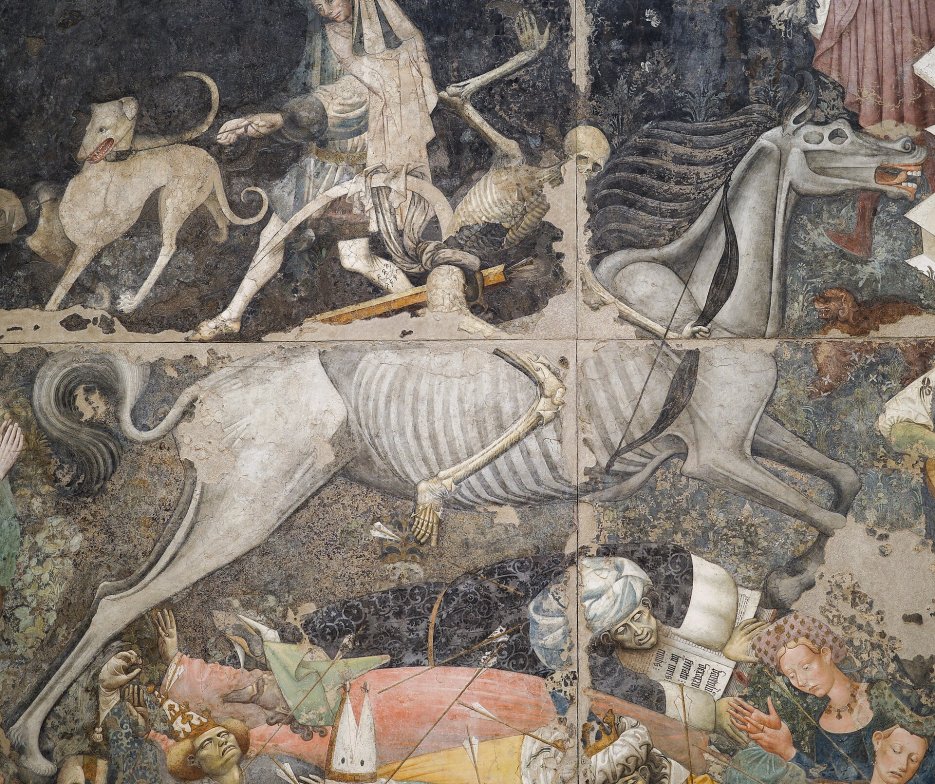
The rest of the discussion, however, turns to Europe to account for the research accumulated by generations of historians of varied specializations and nationalities. In this regard, we can note the remarkable linguistic skills demonstrated by Patrick Boucheron, which allow him to overcome the limits which, too often, characterize ambitious books constructed almost exclusively from research published in English. Also discussed are subjects such as the number of victims of the epidemic, its impact on income and wealth inequalities (which, at least in Europe, are being reduced considerably, an extremely rare event in the history of the West). !), as well as the practices and doctrines developed to stem the spread of contagion. The book concludes with an analysis of the impact of the Black Death on collective psychology, on culture and on forms of artistic expression, then with a brief overview of the last epidemics attested in Europe, before highlighting how the Black Death marked literature and the arts over the centuries.
General table and life lived »
Once again, there is much to appreciate in Black Death. From the point of view of economic history and historical demography – from which this account is based – it is particularly useful to take stock of what we know about the “ life lived » during the terrible pandemic. This, not only in order to provide captivating examples, but to remind us that beyond the general picture which today tends to dominate international historical writing (notably as a result of increasing interaction with hard sciences ), there remains a micro-historical and human dimension – even “ humanist » – at least as important. As this is a book written by a non-specialist, with an obvious concern for accessibility, it would be unfair to note a series of small inaccuracies, or typos, probably inevitable in a book designed from such a large mass of references.
From a scientific point of view, one can discuss the uncritical adoption of the traditional division of the history of the plague into three “ pandemics » successive. According to this, the Black Death would mark the beginning of the second of these pandemics, the end of which should be dated XVIIIe century, while the third “ pandemic » would take off in Yunnan in China during the XIXe century, and would still continue today. This division does not correspond to the strict use of the term “ pandemic » which strictly speaking indicates, as recalled in the introduction, an epidemic capable of spreading across several continents. Also the Black Death of XIVe century was it a pandemic in its own right, distinct from subsequent episodes of resurgence of contagion.
It should also be noted that certain assertions, for example that according to which “ our history books do not organize their story on either side of this caesura (of the Black Death) » (p. 18), are probably true in general, but do not apply to certain particular fields of research – and certainly not to economic history which, in recent decades (and well before Covid) identified in this terrible pandemic a decisive turning point in the history of humanity. Also some researchers find there (rightly or wrongly) the explanation of the success of Western Europe, compared to Eastern Asia. ; others, the starting point of a progressive divergence between the North and the South of Europe, in terms of salary levels or even female participation in the world of work ; still others, a moment of radical rebalancing of the relationship between population and resources – and so on. Finally, if the book devotes great attention to events that occurred in XIXe and at the beginning of XXe century, such as the “ race » mentioned for the identification of the pathogen, the modern period on the other hand remains curiously under-represented, even though it has for several years given rise to some of the most innovative work on the plague – in particular thanks to the availability of more numerous and varied archival funds than for the medieval period.
The historian and the scientist
To conclude, there is one aspect on which Patrick Boucheron seems to have found the right balance: the relationship between historical investigation and the exact sciences. Indeed, while analyzing and reformulating the results from the scientific literature which obviously fascinate him – in particular those based on paleobiological data and phylogenetic research – he avoids the trap which would lead to blindly trusting them. Such an attitude, for those who have followed the convolutions of this literature over the years, would expose one to significant risks, given the tendency of more recent studies to radically modify, if not overturn, everything that has come before – works no less “ scientists » but based on the study of fewer cases, and carried out using less sophisticated laboratory and data analysis techniques. As the author rightly states, “ science will never abolish a historian’s question » (p. 74). At most, it moves and expands it – and makes it ever more interesting.