
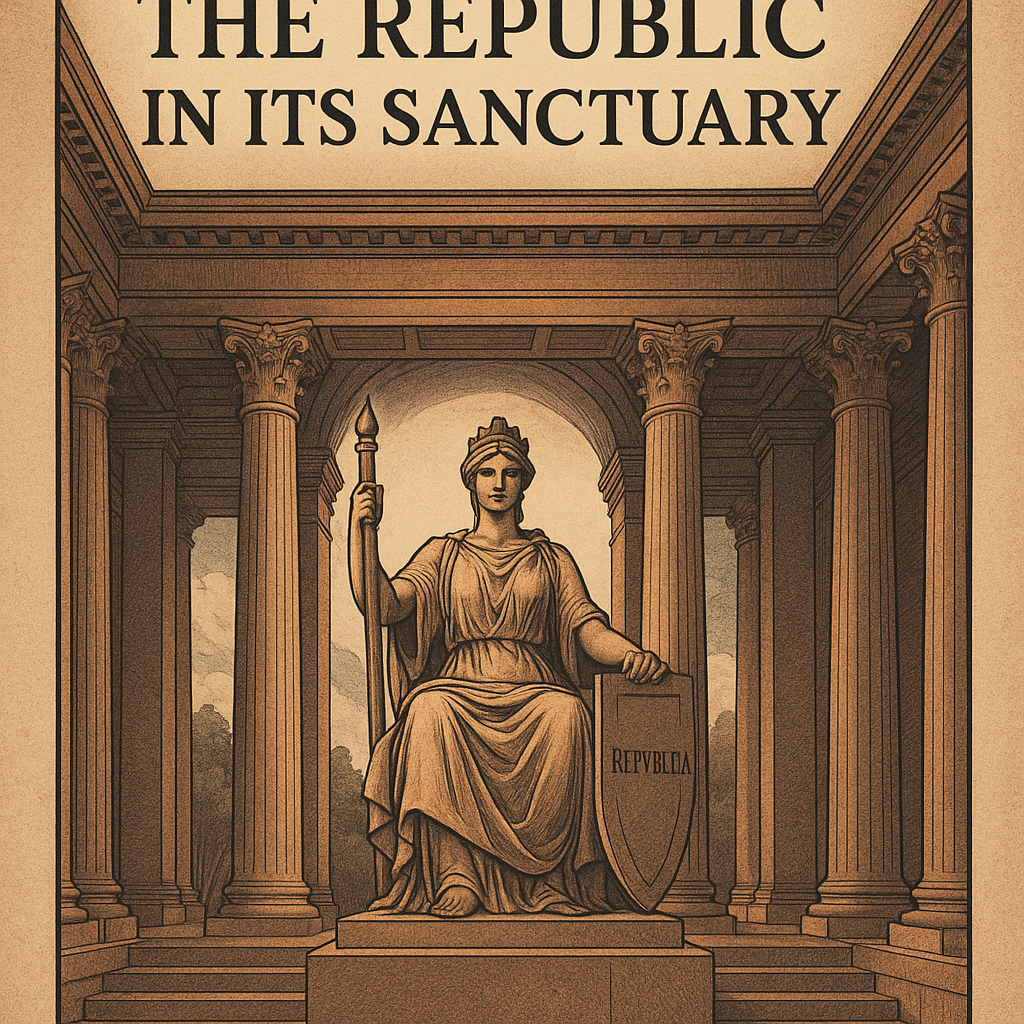
Who does the nation choose to honor, and how ? From revolutionaries to ordinary heroes, two centuries of pantheonizations reveal the political uses of memory, the ideological conflicts and the values that successive powers intended to enshrine.
Even though for the first time since the erection of the Saint-Geneviève Church into a Temple of Great Men (1791), a professional historian, Marc Bloch, returns to the Pantheon, a committee led by history professors is requesting the pantheonization of their colleague assassinated by an Islamist terrorist in 2020, Samuel Paty. To tell the truth, this proposal intends to bring an element of novelty, and to evolve the very conception of what pantheonization is. The promoters of the cause thus underline that bringing Samuel Paty into the Pantheon would promote “ the discreet heroism of everyday life “, a “ new and indispensable figure: that of the ordinary man whose death reveals the decisive importance of his mission “.
This means that the history of the Pantheon is not over and that the place, behind the power of incarnation of the Republic in the long term, must also be located in successive shorter temporalities. This is what theHistory politics of the Pantheon by Michel Biard, historian specializing in the French Revolution. As the author himself explains, the aim is not to create a history of the monument – almost nothing is said about all the issues surrounding the decor and iconography – but to follow the pantheonizations according to the political contexts which give rise to them and the way in which they are, in their times, conceived and discussed. The author is thus also interested, and rightly so, in aborted pantheonizations, in unfinished projects, which could almost lead to another book, in mirror form: from Descartes to Dreyfus via Lafayette or Rouget de Lisle…
From the monarchical flagship to the republican temple
It is the revolutionary rupture which transforms a church, desired by Louis XV like a flagship of the monarchy, a temple to great men. The first thus honored was a political figure, Mirabeau, soon joined by the philosophers of the Enlightenment, Voltaire and Rousseau. But a phenomenon quickly occurs that we will never see again later: the exit from the Pantheon for demerit… Mirabeau, of whom we discover the double game between the Revolution and the King, is in fact depantheonized, just like Marat and Le Peletier de Saint-Fargeau in 1795. The debates lead the Convention to issue a decree thus requiring a period of ten years between the death of the potential hero and his pantheonization.
Napoleon returned the Pantheon to the Church, but the monument remained the burial place of the regime’s notables, ministers, senators and generals. So much so that the First Empire remains the regime which has the most “ pantheonized “, even if many figures from that time are today well forgotten in the national memory (such as the financier Jean Frédéric Perregaux or the soldier Alexandre-Antoine Hureau, Baron de Sénarmont).
After the Empire, for different reasons, the practice went dormant and was only reborn under the IIIe Republic with the pantheonization of Victor Hugo, a major event of the regime (1885), not without controversy on the side of the Church and the anti-Republicans. The Universe written as follows: A decree confiscates the Saint-Geneviève church and gives it to Mr. Victor Hugo ; illegal decree, impious decree “. The Pantheon once again became a republican temple where in 1889 the centenary of the Revolution was celebrated, making room for Lazare Carnot, Marceau and La Tour d’Auvergne, as well as for the deputy Alphonse Baudin who died in his opposition to Louis-Napoléon’s coup d’état.
From the conflict issue to the presidential instrument
The pantheonization of Émile Zola, the author of Nanaand the famous I accuseis undoubtedly the moment of strongest tension, the event arousing virulent opposition from conservatives and anti-Dreyfusards. Inside the building, Dreyfus, who attended the ceremony, was injured by the bullets of a nationalist journalist. The controversies were still strong after the Great War, on the right, when it came to choosing the resting place of the Unknown Soldier, finally buried under the Arc de Triomphe in a ritual ballet with the heart of Gambetta. This is placed in the Pantheon for the anniversary of the Republic, which is celebrating its fiftieth anniversary, in mourning.
Under the IIIe Republic, as under the IVe (who notably pantheonizes figures linked to colonial issues and the emancipation of slaves, Félix Éboué and Victor Schoelcher), it is the legislator, the Parliamentary Assemblies which vote on pantheonization decisions. The premiere of the Ve République changed the process decisively: not without legal discussions at the start, pantheonization became a presidential affair with the entry of Jean Moulin, decided by de Gaulle, but at the initiative of groups of former Resistance fighters.
No pantheonization occurred under the presidencies of Georges Pompidou and Valéry Giscard d’Estaing, the latter entirely focused on a historicity valuing modernity and the future.
Mitterrandian renewal and new questions
The Pantheon does have a history, made up of ruptures. It was François Mitterrand who gave the place an important political function again, particularly for the bicentenary of the French Revolution and by bringing in the first woman – for her merits, and not as a wife –, Marie Curie. Nicolas Sarkozy also makes history an instrument of power, from an equally voluntarist perspective, but undoubtedly too offensive and manipulative. He thus failed in his two major projects of Pantheonization: Aimé Césaire and Albert Camus, the families showing themselves disinclined to serve his designs.
From another point of view, Emmanuel Macron makes extensive use of national tributes and pantheonizations, seeking both to promote consensual values, to be part of the national novel (in particular around the pantheonization of Maurice Genevoix, tutelary figure of all the soldiers of 14-18), and to show audacity by choosing unexpected figures, like Joséphine Baker, or, far from his political action, like the resistance fighters.he communists of the Red Poster around Missak and Mélinée Manouchian. Reading the words of Jean-Noël Jeanneney, reported by Michel Biard, treating as completely secondary the question of the feminization of the Pantheon in 1989, we can clearly see how the issue emerged decisively in the choices of François Hollande and Emmanuel Macron.
A popular Pantheon ?
The Pantheonization process is an interaction where the Presidency is certainly a central, decision-making actor, but surrounded by a whole set of “ pressure groups “. The (political) quality of the committees which launch requests for pantheonization – sometimes over a long period of time – or are formed for this specific purpose plays an important role. We would have liked here the author to bring the matter together a little to understand the decision-making processes over the long term and what makes a committee “ succeeds ”, or not.
Lively debates sometimes took place, both on the day chosen and on the meaning to be given to the act itself: during the pantheonization of Jaurès by the Left Cartel, the communists even organized a counter-demonstration so as not to let, according to The Emancipator of Cher« the Murdered » in company « champions of homelands, religions and morals » (1923). Evolution tends today rather to produce relative unanimity.
If the author takes care to specify the ritual devices and the organization of the pantheonizations, the ceremonies themselves are treated in a fairly descriptive manner. Michel Biard does not make use of the entire anthropological tradition of rituals, including that dealing with political power, which would surely have enriched the understanding of these moments and made it possible to better specify them. Likewise, the media issues of these stagings are somewhat neglected. Despite the breadth of the perspective, the variety of sources used and the precision of the subject, political history is sometimes conceived here in a somewhat narrow sense.
In conclusion, Michel Biard questions the possible evolutions of the process towards pantheonization decisions which would emanate more directly from “ sovereign people », notably through national representation. The final conclusion, which calls for renewing the uses of the pantheon to strengthen democracy and the Republic, affirms that “ The pantheon can still serve the defense of res publica against obscurantism of all kinds “. The proposals around “ ordinary heroes » and Samuel Paty in particular could open here, in this sense, a new chapter.