
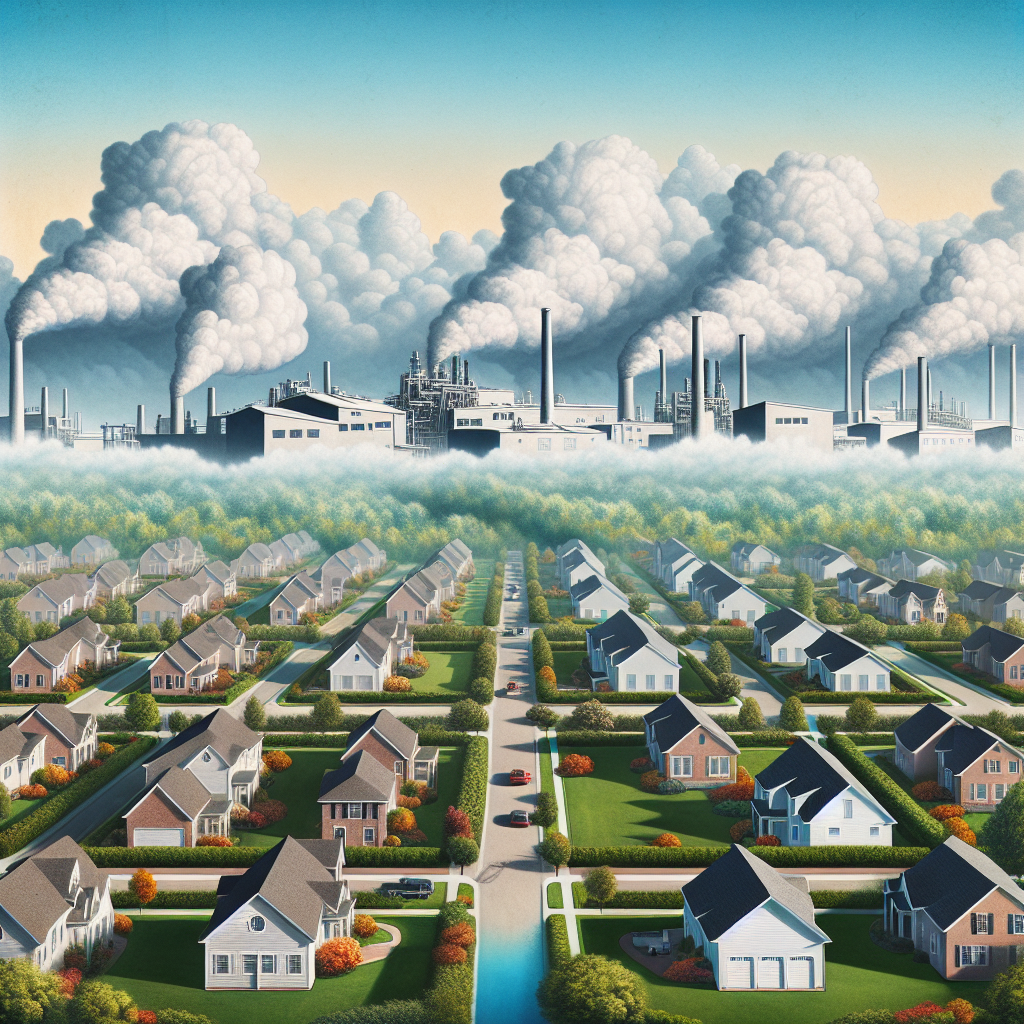
In Perfect CommunitiesEdward Berenson revisits the story of developer William Levitt to better tell the story of a highly popular suburban home, a symbol of modern and standardized post-war construction.
Businessman and real estate developer, William Levitt (1907-1994) was at the origin, in the 1950s, of the development of subdivisions of standardized houses in the United States and then elsewhere in the world, symbols of an extensively studied socio-spatial transformation: periurbanization. In Perfect CommunitiesEdward Berenson, professor of cultural history at New York University, takes us behind the scenes of the suburban property, mainly aimed at the white middle and upper classes.
If Berenson analyzes the economic model of standardization and rationalization of housing developed by Levitt & Sons, he shows above all that the success of this “ peri-urban success » is based on the interrelations between public authorities and private companies. Financial support from the federal government, loan guarantees, infrastructure development and local lobbying have created a particularly favorable institutional framework. The work is not limited to the American context: the export of the model to France and Puerto Rico sheds light on the internationalization of architecture in the 1960s and its differentiated receptions. Evaluating Levitt’s legacy, however, requires understanding its ambivalences: these communities favored the social advancement of certain groups while excluding others. In hollow, Perfect Communities invites us to think about the future of suburban housing in the face of contemporary challenges, particularly environmental ones.
A family business serving the industrialization of housing
Levitt & Sons is first and foremost based on a family dynamic. Abraham Levitt founded the company with his sons Alfku and William (Bill). A division of labor quickly established itself: Bill became the public and commercial face of the firm, while Alfku, a self-taught architect trained under Frank Lloyd Wright, designed the plans and developed “ tiny houses » aimed at the middle and upper classes, with a “ talent for making houses appear worth twice their price » (p. 17).
Built in 1937 on Long Island, the house Rebhuhn illustrates the principles of modern architecture integrated into its environment. The space, centered on the nuclear family and domestic comfort, is characterized by an open plan, a strong relationship to the landscape (large windows, gardens, dining room organized around an oak tree) and a functional interior organization: central kitchen, fluid circulation, built-in furniture, absence of basement and carport rather than garage. This prototype became an architectural laboratory whose principles were reinvested in 1949 in the first houses of Levittown, notably the Ranch Houses.
Despite this initial complementarity, the family balance was disrupted with the success of the 1940s and 1950s. Having become a media figure, a rare situation for an entrepreneur, Bill bought his brother’s shares in 1954 and transformed the company into a listed company in order to raise capital while retaining majority control.
Levitt’s innovation is as much due to this architecture as to the industrialization of production, comparable to the Fordian model: division of labor, standardization of plans and materials, bulk purchases and specialization of workers. The housing, compact but optimized, incorporates modern equipment at prices below the market, promoting rapid production. In Levittown (Long Island), demand far exceeds supply — six thousand buyers for two thousand homes — while the company promotes “ complete communities » equipped with schools, parks, swimming pools and community centers.
This success is inseparable from the role of the State. By guaranteeing up to 90 % of loans, Federal Housing Administration (FHA) reduces banking risk and facilitates access to property for the middle classes. Rather than developing social housing, the federal state, under the influence of private developers and figures like Robert Moses, encourages urban sprawl and the construction of peripheral infrastructure, contributing to the growth of homogeneous white neighborhoods. The apparent free use of the equipment, however, masks costs assumed by residents. via local taxes and charges, revealing the economic constraints of the peri-urban lifestyle.
Segregation and racial violence
Access to the Levittowns was initially restricted to whites. In Levittown (Pennsylvania), African-Americans, who represent approximately 10 % of the regional population, are almost absent. If institutionalized discriminatory practices in housing are often associated with redliningwhich consists of refusing or limiting access to real estate loans for racialized populations in neighborhoods deemed risky, Levitt is inspired by the stability advocated by the FHA for suburban development — advocating “ that properties continue to be occupied by the same social and racial classes » thanks to “ appropriate restrictive covenants » (restrictive covenents) — to exclude black populations from its communities and explicitly target “ refined American families “.
A crisis broke out in 1957 in Levittown (Pennsylvania) when Bill and Daisy Myers, an African-American couple, purchased a resale house. Their arrival triggered hostile demonstrations: stone throwing, burning crosses, insults and threats. THE Levittown Betterment Committee seeks to evict them, notably in the name of fear of a drop in real estate values. Their supporters – civil rights activists, progressive religious leaders – remain in the minority and are regularly intimidated. If the courts condemn certain violence, residential segregation is never called into question. The Myers, however, remained in Levittown for almost four years. Their perseverance, supported by national figures (including Jackie Robinson), becomes a symbol. Their case nevertheless remains exceptional: in 1960, Levittown had fewer than sixty black residents out of tens of thousands of inhabitants.
Despite the illegality of racial covenants (Shelley v. Kraemer, 1948), real estate agents continued to systematically direct black buyers to other areas, in accordance with the property’s code of ethics. National Association of Real Estate Boards. From the 1970s, in Bowie (Maryland), the gradual arrival of middle-class black households led to forms of white flightbut also new tensions, particularly around schools, local power and public resources. The conflicts of the 1990s show that segregation does not disappear but is reconfigured, fueled by accusations of “ reverse discrimination » and by the symbolic competition between racialized middle classes.
Export and adaptation of the Levitt model
Berenson highlights the export outside the United States of Levitt houses, which reveals both its strength and its limits. In France, in a context of post-war housing shortage and official preference for collective housing aimed at maintaining tenant workers and preventing them from becoming “ petty bourgeois », Levitt is a pioneer. He is contacted in particular by mayors of small towns who have available land and would like to develop residential communities. Levitt adapts his approach: brick and stone construction, respect for local style, integration of infrastructure and mixed financing. The projects in Le Mesnil-Saint-Denis and Lésigny met with immediate commercial success and influenced the construction sector, demonstrating the attractiveness of the model of the individual house associated with collective facilities.
In Puerto Rico, Levittown meets the aspirations of Puerto Rican families seeking a U.S. peri-urban lifestyle. The project benefits from the support of the local government and the FHAbut encounters structural limits: inflation, lower quality of construction, difficulties in maintaining infrastructure, degradation, and vulnerability to natural disasters lead to a progressive decline in the population and associated services.
Legacies and criticisms
Berenson recognizes the paradoxical nature of the Levitt legacy. These subdivisions allowed many families to access property in an environment considered pleasant. As a child, Berenson himself lived in a Levitt house and had many good memories there (outdoor games, safe for children, school within walking distance). If the Levitt housing estates are criticized for their dependence on the automobile, their anti-city conformism and their cultural mediocrity, Berenson qualifies the total standardization of lifestyles and populations by relying on sociological surveys such as that of Herbert Gans, which shows that spaces and houses are invested differently by their inhabitants who pursue their own social aspirations.
Based on the 1960 and 1970 censuses as well as interviews conducted in Levittown (Pennsylvania), sociologist David Popenoe underlined in 1977 the persistence of significant social diversity: 68 % of middle and upper classes, 32 % of workers, 15 % of people born abroad, as well as a representative mix of Protestants, Catholics and Jews and varied geographic origins. Despite some concerns linked in particular to drugs and youth, the opinion of residents – including workers – remains generally positive (“ We have everything you need, and it’s close to work and big cities “), the most dissatisfied being mainly large working families with modest incomes. The figure of the alienated housewife, omnipresent in the critiques, is not confirmed: Popenoe only identifies three cases in his sample.
On the other hand, the 1970 census reveals a very low black presence (0 to 1.9 % depending on the neighborhood, compared to 17.5 % in Philadelphia), situation generally unchanged in 2000 (2.4 % black and 2.2 % of Latinos), confirming the institutionalization of residential exclusion. An instrument of social mobility and security for some, Levitt’s individual house, largely reserved for whites, shows how differentiated access to property contributes to reproducing inequalities over several generations. The suburban house therefore becomes a tool of distinction, social control and exclusion, while offering comfort and stability to those who access it.
Perfect Communities also invites us to reflect on the contemporary implications of suburban housing: privatization, individualization and financialization of housing contribute to isolating certain populations and calling into question the collective achievements of the welfare state. In a 2020 issue, The Economist made a virulent criticism of accession to property, calling it “ biggest economic policy mistake » of the Western world and fetish “. Housing markets were not only presented as inefficient, but also profoundly unfair.
Finally, Berenson’s work invites us not to underestimate the social, political and environmental implications of contemporary urban policies. In France, the injunction to limit the artificialization of land, in a context of climate change and increasing land pressure, leads to questioning the model of the new suburban house, which is particularly demanding in terms of space and unsustainable materials. This questioning implies better integrating the issues of accessibility in the face of rising prices, but also rethinking our relationship with natural resources, whether it concerns more sustainable materials, the preservation of living soils, bioregional anchoring, the principles of urban ecology or even the development of solidarity land and new forms of ownership.