
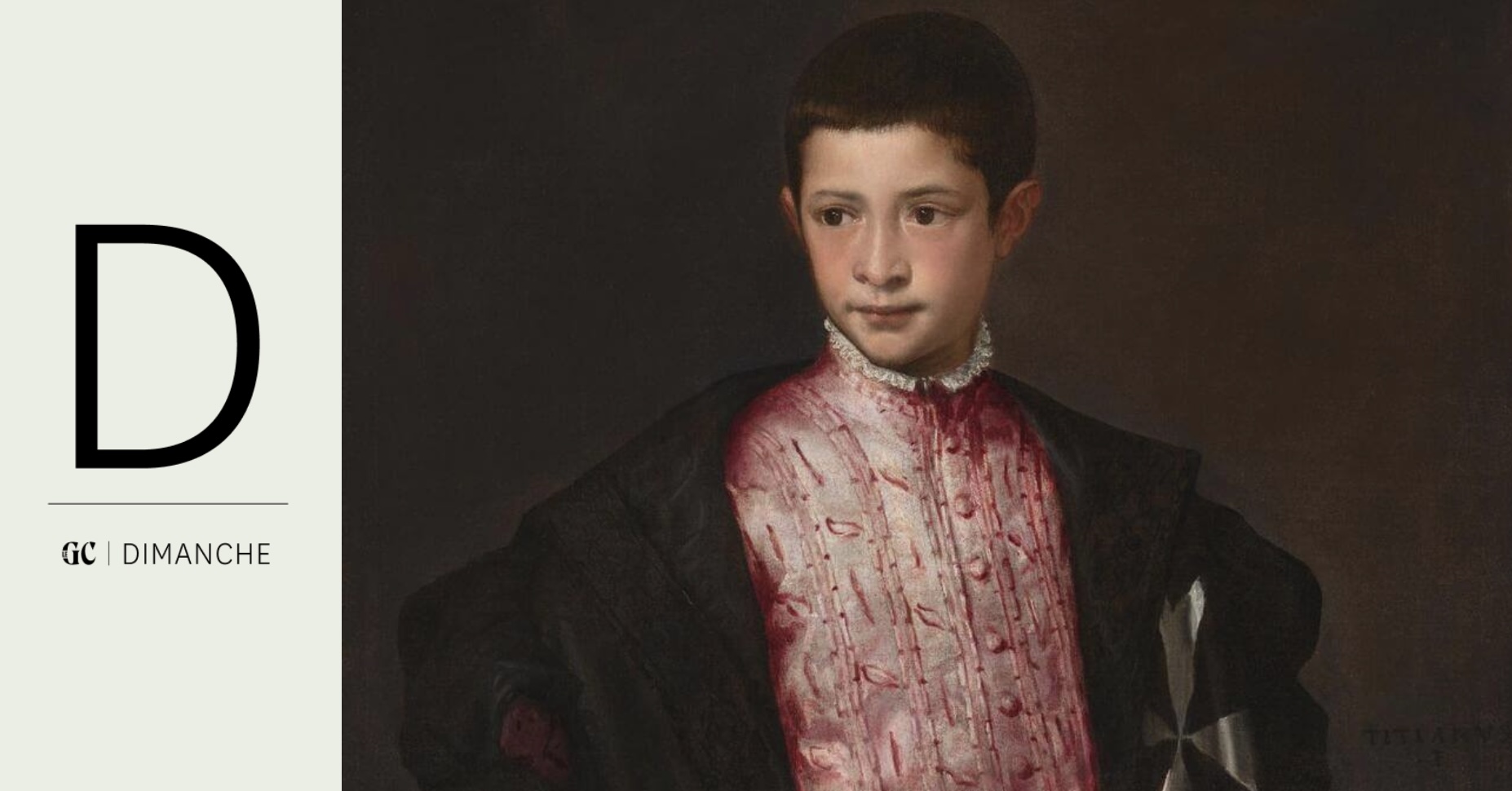
The sitter for this painting is Ranuccio Farnese, grandson of Pope Paul III, seated on the throne of Saint Peter at the time the portrait was made in 1541. Aged eleven, Ranuccio was sent to northeastern Italy to pursue studies at the University of Padua, and to visit the church of San Giovanni di Malta in Venice, of which he had just been named commendatory prior.
Indeed making the most of his stay, Ranuccio poses for the portrait under Titian’s brush. Official painter to the Serenissime since 1516, and one of the most renowned artists in Italy, indeed Europe, Titian had for several years sought to align himself with the wealthy and powerful Farnese family. This is now achieved, provided he produce a work worthy of the family. The painting seems to have pleased Paul III and Ranuccio’s parents greatly, as Titian was invited twice, in 1543 and 1545, to Bologna and Rome, where he painted two more portraits: one of the pope alone, and a second depicting him with two of his grandsons.
The 1540s mark the full maturity of Titian’s career, but also the establishment of a type of state portrait inaugurated in 1533 by the Portrait of Charles V with a Dog, now housed at the Prado in Madrid. The decade’s beginnings are also marked by two paintings: the one we are viewing, and the Portrait of Clarissa Strozzi (1542, Berlin, Gemäldegalerie), today regarded as major contributions to the child portrait in European art history.
The Farnese portrait of Ranuccio illustrates the tension that arises in a young boy’s life when the joys of childhood must end and adult responsibilities—ones one may not want to assume and may not yet be ready for—begin. Newly admitted to the Knights of Malta and the commendatory prior of one of Venice’s most important churches, Ranuccio was also named Archbishop of Naples at the age of 14, then Patriarch of Constantinople and Archbishop of Ravenna at 19. He would finally become Archbishop of Milan in 1564, shortly before dying at the age of 35.
The Cloak Too Large
Clearly, Ranuccio is not yet ready to meet all the social expectations his family places upon him. All the material accoutrements attributed to him are oversized. This is especially true of the black cloak that stands out against the painting’s dark background. A symbol of his new role, it bears the eight-pointed silver cross of the Knights of St. John of Malta embroidered on the left side, a detail that immediately draws the eye thanks to one of Titian’s rare touches of white.
The cloak’s breadth artificially expands the breadth of Ranuccio’s frame and allows him to occupy more space. But the truth must be faced: this cloak is far too large for the boy’s slender shoulders. If painting were not the art of frozen images, one could almost expect him to slip and fall.
The Gloves
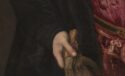
The gloves he holds in his right hand are equally telling. Such an accessory is not trivial in a Renaissance portrait, especially for a young boy from one of Italy’s great families. The gloves, particularly leather ones as they seem here, symbolize wealth. Not wearing them but holding them exposes the bare hand whose color echoes that of the face in the upper portion of the painting and also signals belonging to a social class that does not engage in manual labor. Yet these gloves are again too large for Ranuccio: they protrude beyond the frame of the painting, while his hand is partly hidden by the sleeve of his garment.
The Sword
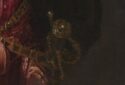
The sword at his side is also a sign of coming-of-age too soon. We see only the elaborately decorated pommel, which also seems far too large for the small hand placed on the same horizontal line. While it was common to gift boys swords at their size to let them play at fighting, this one is no toy. Its weight appears to press on the belt strap, which, by two inclined lines, directs the viewer’s gaze toward the codpiece.
The Codpiece
Originally devised to protect the groin during combat, the codpiece became, in the sixteenth century, a fashion accessory. A kind of small pouch for storing the shirt’s overly long pleats, then any other object to keep on one’s person, it allows a man to expose his intimate parts, and thus his virility, without showing them. Sometimes taking exaggerated dimensions, as Montaigne lamented, it became a common attribute in many male portraits across Europe.
Yet, in Titian’s painting, the only thing that is not too large and seems in proportion to the body is indeed the codpiece. Although emphasized by the lower edge of the frame and placed on the same line as the gloves and the sword’s hilt, it is by no means prominent, or even easily visible, for it is made from the same fabric as the rest of the garment.
A Child’s Body and an Adult Pose
This portrait is thus characterized by an accumulation of elements disproportionate to a body that is only intermittently visible, yet one may call juvenile. Yet Ranuccio’s pose is almost adult. He is restrained and elegant, a true embodiment of the sprezzatura, a concept developed by the philosopher and diplomat Baldassare Castiglione in his Book of the Courtier (1528). His torso turned to the left and his face to the right, in the manner of Leonardo da Vinci from the 1470s onward, breaks with the hieratic and rigid dimension that has sometimes harmed the portrait genre. Ranuccio presents a measured and thoughtful young boy whose demeanor may make his family, and especially his grandfather, proud.
The Face and the Gaze
However, at the apex of the pyramidal composition, set against the painting’s dark background, Ranuccio’s face forms a new expressive counterpoint to this pose and to the attributes of elevated social status. If a beard is a sign of virility in Italian and European portraits, his face is beardless, his cheekbones lightly tinted with a soft shade of red that echoes the brighter hue of his shirt. These few touches in a painting with a rather dark palette can be read as a foreshadowing of adolescence, an age when blood—the mood par excellence—begins to prevail.
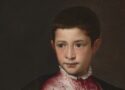
Nevertheless, Titian emphasizes the boy’s gentle innocence and shyness through his gaze, which, directed toward the lower right corner of the painting, avoids any contact with the viewer. This attitude contrasts with many other portraits of adolescents painted in Italy in the same years, where the sitters seem to address, or even challenge, those who look at them.
The Painter’s Choice
This tension between the maturing adult and the still-present child, manifested in every element of the painting, was it the painter’s choice or the patrons’ request? In Venice, artists such as Titian or Veronese are renowned for their fine reading and understanding of childhood characteristics. What makes the Portrait of Ranuccio Farnese unique in European output is the subtle coexistence between demonstrating the heir’s status in one of Italy’s greatest families and an awareness of the boy’s childlike vulnerability. In this, Titian departs from contemporary court portraits of sons of great families, such as those by Bronzino, where childhood or youth seems to always capitulate.