
Discover Le Grand Continent. Ideas and analyses you won’t find anywhere else. But soon you’ll see them everywhere. Delivered to your inbox from 8 euros per month
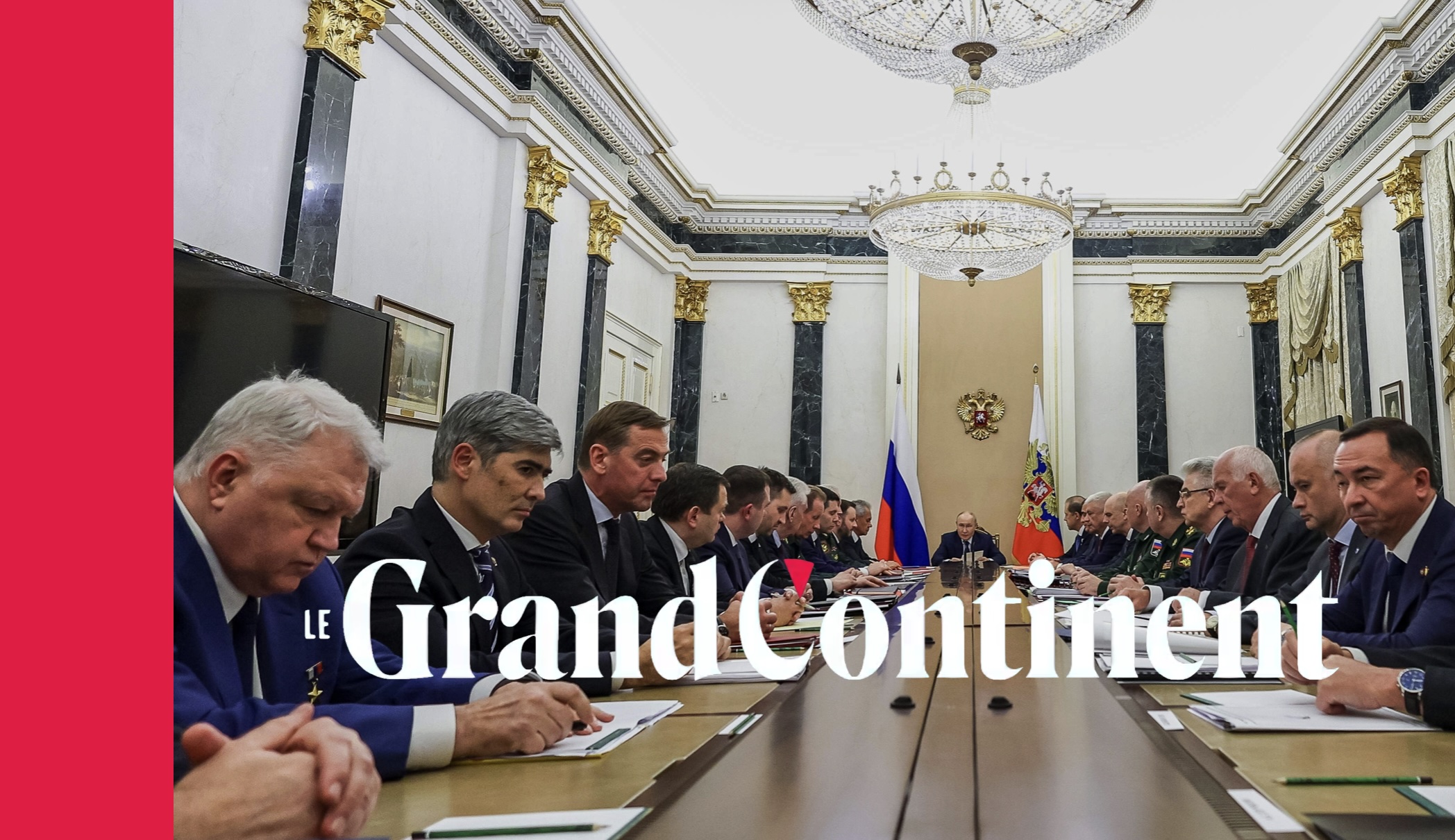
On February 21, 2022, three days before Russia’s large-scale invasion of Ukraine, Vladimir Putin convened an enlarged meeting of the Security Council, broadcast on television. The question at hand was whether to recognize the two eastern Ukrainian separatist republics, Donetsk and Luhansk. Several participants, believing the issue genuinely unsettled, urged caution. Sergei Naryshkin, head of Russia’s foreign intelligence service, backed a proposal to give the West “one last chance” before any recognition. Putin interrupted him. Was he talking about negotiations or recognition? “— I would support… — ‘I would support’ or ‘I support’? — I support… — Then, frankly say it: yes or no?” Visibly unsettled, Naryshkin finally replied “Yes,” and, in his confusion, spoke in favor of annexing the republics to Russia rather than acknowledging their independence. Putin let out a small laugh and cut him off: “Please sit down. Thank you.”
The Russian public as well as the Western public watched this scene and asked the obvious question: why did no one in that room stop the war? Yet the question may be misframed, because the Russian elite had ceased to be an elite long before the war began. To understand why, one must distinguish between two kinds of action capabilities available to those who hold power, which define a genuine elite.
How the Russian elite lost its two powers
The first power is strategic. It is the ability to influence the direction of the state, to shift a decision before it is taken, or to present an argument to which the leader is at least obliged to respond. The second is tactical: the capacity to maneuver within an already drawn course, to delay, to soften, to reinterpret, to shield one’s own, or to secure a concession. The Russian ruling class had lost the first by the time of 2022, and, as the Security Council meeting showed, the war cost them the second as well.
Putin spent his first two terms dismantling every platform from which an elite could express itself politically. The most conspicuous example is the regional governors. In 2004, under the pretence of fighting terrorism and disregarding a Constitutional Court decision, the Kremlin eliminated direct gubernatorial elections. The Federation Council, whose governors had been sidelined shortly before and which was now composed of Kremlin-appointed members, approved the change without a single objection. Within a few years, disagreements between the regions and the central power vanished, because the installed governors ceased to be politicians and became administrators whose remit was limited to the regional economy.
The business world drew the same lesson from a series of inspections conducted by security services and regulatory authorities. Former media magnate Vladimir Gusinsky and oligarch Boris Berezovsky both left the country in the early 2000s. The most high-profile case was the seizure of assets and the ten-year prison sentence of Russia’s wealthiest man, Mikhail Khodorkovsky, owner of the oil company Yukos. The message was so well received that, by the 2010s, it no longer needed to be repeated. Property remained subject to loyalty, and political conflicts gave way to bureaucratic rivalries designed to attract the leader’s attention.
The annexation of Crimea in 2014 constituted a real, large-scale test. Hundreds of officials reorganized budgets, created a ministry for “affairs,” and seized Ukrainian assets without internal friction. Five months after the official annexation, a liberal-leaning deputy prime minister offered a European ambassador a selection of Crimean wines. The diplomat refused; within the administration, the proposal was seen as a trivial joke.
In February 2022, senior Russian economic officials knew perfectly well why this war made no sense: hundreds of billions of dollars in reserves parked in Western countries, a strong technological dependency on imports, and a budget framework founded on integration into global markets. Under Putin’s orders, banks and the largest industrial companies ran stress tests to gauge the economy’s ability to withstand sanctions. The results, which suggested that breaking with the West would cost more than 10% of GDP, were reported to the president. Yet these data were never used as an argument against the war. The space for such a debate had, in effect, closed years earlier.
What the elite managed to preserve until 2022 was an extraordinary capacity to adapt. Deprived of the right to express political opinion, they compensated by mastering an art of preservation: knowing who to call, which position on a board offers protection, when to remain silent and when to pay. Its members stayed in the system either out of fear for themselves, their loved ones and their teams, or due to a lack of alternatives, or because of the grip the state and security services had on their careers. Loyalty here is a rational survival strategy, not an endorsement of Putin’s ambitions or a support for his person.
The war blocked all exits
From the state’s side, by summer 2022, as companies began resisting prioritizing repairs and spare parts for an “special operation” they viewed as someone else’s affair, the Duma passed a law empowering the government to compel any company, regardless of ownership structure, to accept state military orders and reassign its employees without their consent. The bill cleared its three readings and passed both houses in under a week, and Putin signed it seven days after its submission. Firms didn’t even have time to object. “Everything for the front,” privately fumed the head of a state-owned enterprise: “My repair crews are being sent to the Defense Ministry, and then I’m scolded because I don’t meet commercial targets.”
In the real estate sphere, the Prosecutor General’s office intensified lawsuits to reclaim assets for the state, notably lands in Barvikha, the Kremlin’s dacha village near Moscow. Proximity to decision-makers had long served as a talisman against predatory businessmen and security services. That is no longer the case: “Whether you tilt left or right, it changes nothing now,” confided to me a businessman ranked among the Forbes top twenty. “The protection papers no longer protect. Before, it was enough to appoint a Putin ally to the board to be safe. Today, even that won’t save you.” The message, he sums up, is clear: the “old capital” no longer exists.
On the Western side, the exit door has closed. Individual sanctions did not rally the capitalists against the Kremlin; they made them more vulnerable in their own country and more dependent on the regime.
The talent for adaptation did not vanish. The phantom fleet, the niches left vacant by departing Western companies, the thriving trade of intermediaries—all of this stems from initiative, but one that operates within the line imposed, never deviating.
Why have sanctions proven ineffective at influencing the Russian elite?
Sanctions did not place the companies and the Russian elite before the choice of Moscow on one side and London and Lake Como on the other. Essentially, they closed off those two destinations—the West as a whole—and left them with Moscow only. Visa bans, frozen accounts, seized assets, banks refusing operations, fear of seizures: the money returned to Russia.
Today, 97% of the fortunes of the wealthy Russians are concentrated in banks subject to sanctions, and that money effectively fuels the war economy. Indeed, on a bank’s balance sheet, deposits are matched by loans; and loan issuance largely reproduces the two-speed model of the Russian economy. On one side, public markets tied largely to the war receive credit; on the other, everything else stagnates. The sanctioned individuals thus have no way out: their only strategy is to cling to what they own, i.e., to redouble their loyalty.
Without these individual sanctions, the elite would live more comfortably. But sanctions tend to have another, more consequential effect: by naming individuals, they establish their complicity and deprive them of the alibi of being “just businessmen” or mere operators who “press buttons.” It is now possible to identify specific people and the exact roles they play in the military value chain: procurement, financial intermediation, logistics, etc. Yet these sanctions still punish a position rather than a behavior.
And yet none of these mechanisms specify how those targeted should act to have sanctions lifted or eased. In other words, when you are on a list and your daily life is restricted because you sit on the board of a state company, no measure that could improve your situation is offered. You can struggle, transfer money to Ukraine, be prosecuted for it in Russia and end up in prison—for yourself, your relatives, your colleagues—the sanctions will stay in place: no rule provides their removal if you condemn the war and fund Ukraine. Sanctions with no exit constitute a condemnation, not an incentive. To become incentive-compatible, sanctions policy must therefore offer an alternative.
What can Europe do?
First, do not stand idly by waiting for a split within the elite. An elite that has lost both forms of power will not articulate an alternative, for it has structurally forgotten how to proceed. Those who were ready to leave on principle have already done so; those who stayed have accused the dissenters of naivety or disloyalty, further cementing their own attachment to power.
Second, individual sanctions do not constitute leverage over Putin, because the people targeted possess none of their own: “To stage a coup, you must be at the palace. We are not there,” one of them told me. Sanctions merely intensify their dependence on Putin. They can be seen as punishment, but not as pressure.
Third, and this is where Europe comes in, the realistic solution is not a palace revolution. Yet after nearly five years of war, a crushing fatigue has settled in Russian society, among the general population as well as among the elites. Loyalty becomes increasingly hard to sustain. The desire to break free is irresistible; but there is no exit. The equilibrium that such closed systems enjoy, seemingly so stable from within, can only be disrupted from outside. A dialogue, not a negotiation, engaged not with the Kremlin but with those who actually run the state—the economic leaders and business people—could give the Russian ruling class the momentum it needs to regain the autonomy it has lost.
That evening, February 21, 2022, Naryshkin was asked to reclaim his seat. All participants in the meeting understood that they were being told to keep their opinions to themselves and not to take risks. Nearly five years later, nothing within the system can offer him a path to recovery. It is precisely for this reason that the impulse must come from outside.