
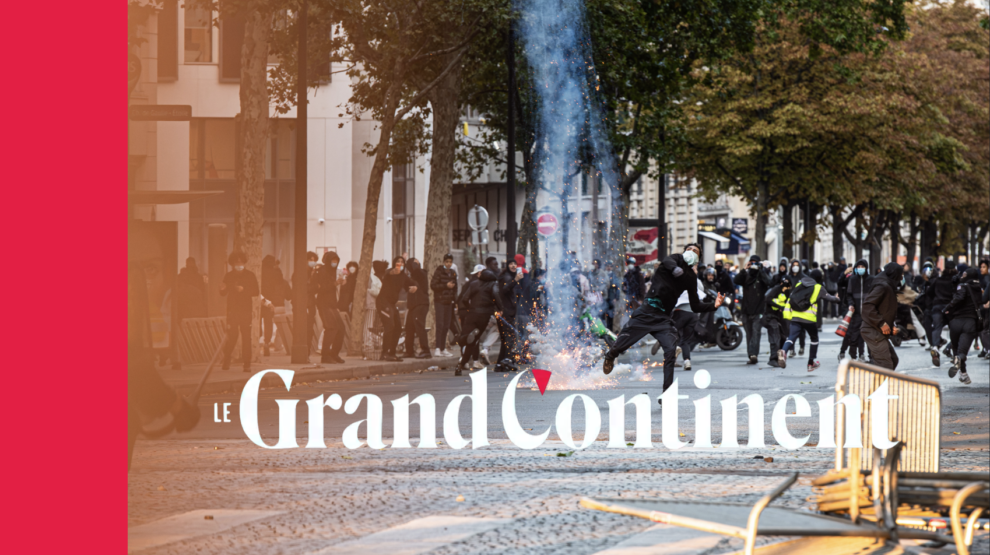
Hundreds of thousands of people demonstrated this weekend in several European countries, including France, Belgium, Italy, Portugal, and Albania.
France accounted for the bulk of participation and the violence.
In France, the Saturday, October 17 protests originated from calls circulated on social networks against rising fuel prices. The Yellow Vests, high school students, and unions subsequently joined in.
- The Interior Ministry reported about 550,000 protesters, including 110,000 in Paris. The CGT, for its part, claims nearly 800,000.
- The protesters’ demands vary by group, ranging from the cost of living to higher wages and pensions, as well as lower fuel prices, the protection of public services, conditions in high schools, overloaded timetables and the shortage of teachers.
- Interior Minister Laurent Nuñez reported more than 2,000 arrests and more than 600 police, gendarmes and firefighters injured, a toll he called provisional.
- About 1,500 shops were damaged, looted and vandalized according to the head of the Federation of Commerce and Distribution. The city hall of Limoges was largely destroyed by a fire, and the city halls of Marseille and Lille were breached and vandalized.
- A large inter-union day of strikes and inter-professional demonstrations is announced for November 5.
In Belgium, the October 17 movement is part of several weeks of protests against university tuition fees and budget cuts in education. Unions also oppose measures considered by the Belgian government, which is struggling to pass its budget bill.
- In Brussels, the march degenerated into riots shortly before 1 p.m.: the headquarters of the Brussels federation of the PS was attacked.
- Around 150 people were arrested, according to Le Soir.
In Italy, thousands took to the streets in Milan, Turin and Bologna and in Rome to denounce low wages and the cost of living. In the south of the country, truck drivers and farmers also protested against the rise in fuel prices.
- According to the ANSA news agency, citing the police, 28 people were arrested nationwide, including 12 minors, and 141 police officers were injured.
In Portugal, the protests follow a police operation carried out earlier in the week to evacuate a protest camp against the housing crisis in Porto. According to organizers, the operation left about 40 people injured.
- The protests have turned into a nationwide campaign against unaffordable rents, low wages and the rise in prices of food and fuel.
In Albania, protests continue to denounce corruption, the lack of jobs and the lack of resources in the education system. These demonstrations follow months of peaceful protests during the summer against a luxury tourism project backed by Jared Kushner, Donald Trump’s son-in-law.
These movements, though distinct, share several common traits, including the difficulties related to the rising cost of living. High school students and university students are also at the heart of the mobilizations in France, Belgium and Albania.
- Moreover, in the background, there is the energy shock that drives inflation higher and stems notably from the war the United States has waged against Iran since February 28, a conflict over which European countries have very little leverage.
- These demands also come in a particularly fragile fiscal context, where the budget margins of European governments to respond are very limited.