
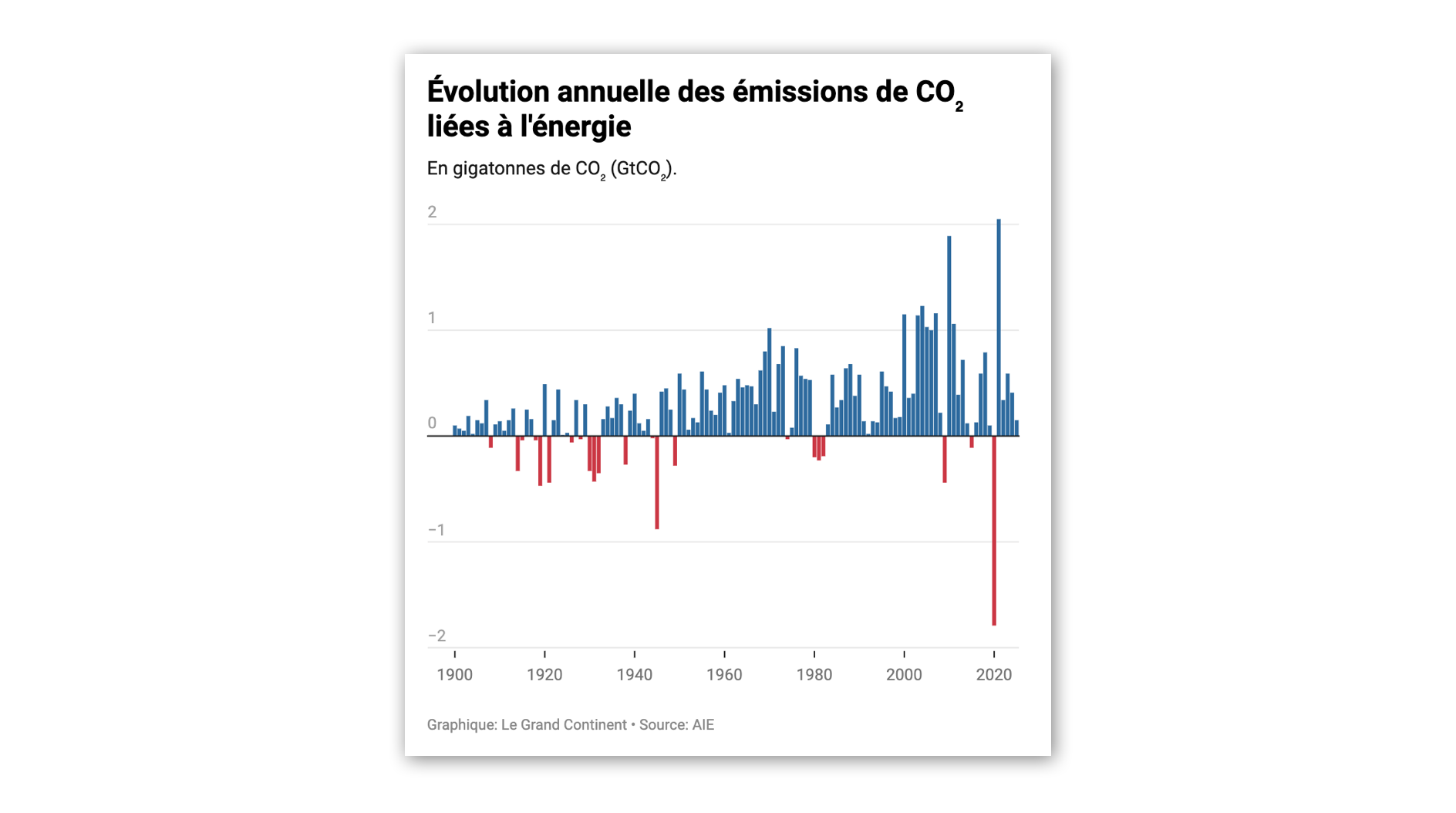
According to an analysis by Carbon Brief, and based on the latest forecasts from the International Energy Agency, global CO2 emissions are expected to dip by roughly 0.5% this year compared with 2025 levels, as the spike in oil and gas prices sparked by the closure of the Strait of Hormuz has cooled global demand.
- The volume of emissions tied to oil consumption is projected to fall the most (around 270 million tonnes of CO2), followed by gas (about 40 million tonnes)1.
- Emissions linked to coal are expected to rise by roughly 190 million tonnes this year. However, most of this increase in coal use is not tied to the Middle East situation.
Thus, this would be the first year since the coronavirus pandemic in 2020 in which CO2 emissions from fossil fuels have declined.
- Part of the decline is attributed to demand destruction—especially for oil and gas—driven by price increases that followed the outbreak of the war and the disruption of flows through the Strait of Hormuz.
- According to a Morgan Stanley note dated September 15, oil demand is expected to fall by 2.4 million barrels per day in 2026, a projection close to the IEA’s estimate (-2.5 million bpd, i.e., a 2.4% drop)2.
As Pierre Charbonnier noted in 2022 at the outset of Russia’s invasion of Ukraine, the pressures of conflicts and rising prices may push fossil-fuel dependence into a strategic objective for countries that rely on imports for their energy needs.
- Because hydrocarbon production is concentrated in a small number of countries—primarily the United States, the Gulf states, and Russia—75% of the world’s population lives in countries that depend on fossil-fuel imports.
- In 2023, 62 countries worldwide imported nearly all of their oil, and 89 countries imported at least 80% (99% for Spain and Japan, 96% for Germany, and 87% for India).