
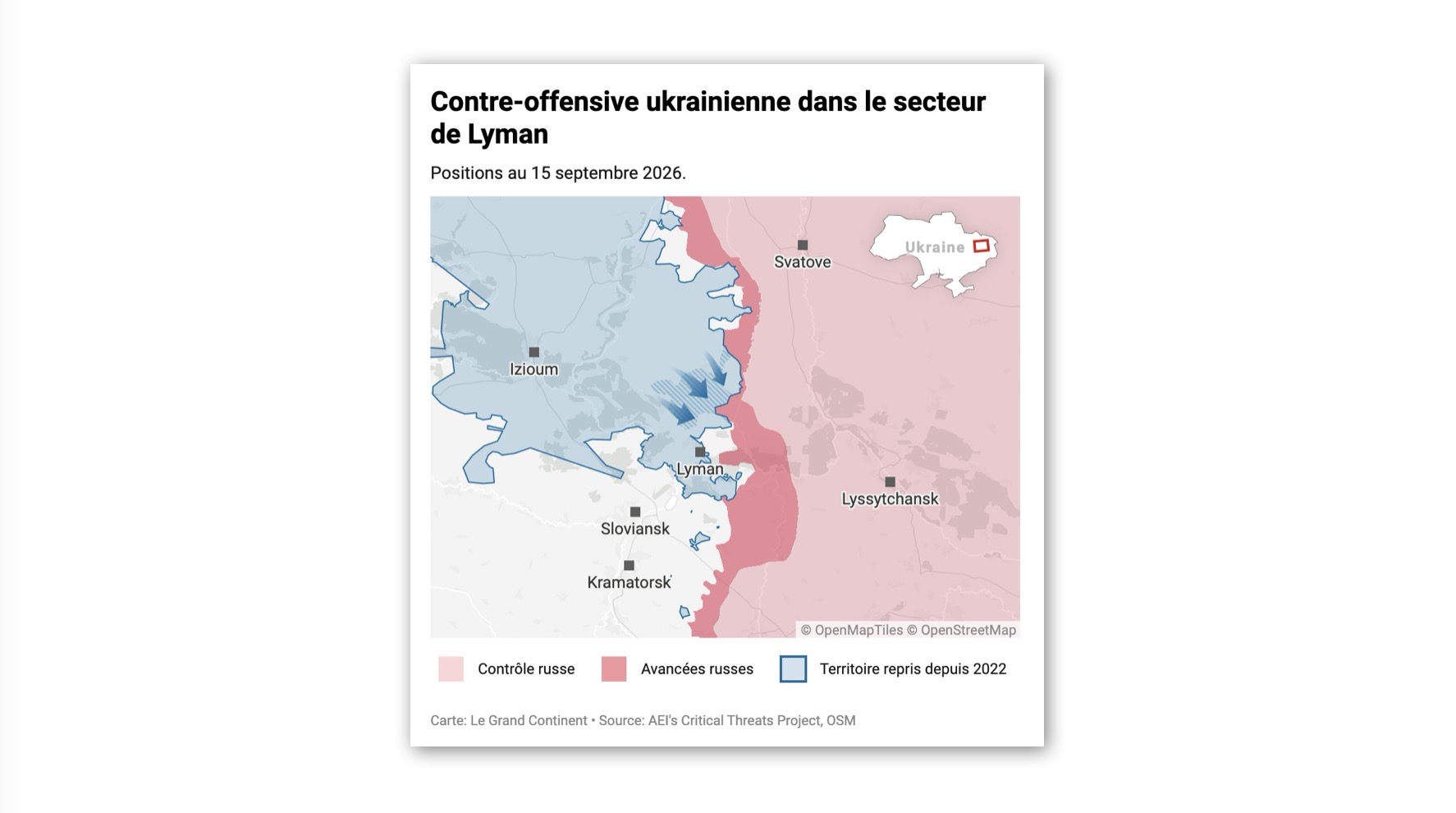
Yesterday, Tuesday, September 15, the commander of the Ukrainian 3rd Army Corps, Andriy Biletsky, confirmed rumors of an ongoing counteroffensive in the northern Donetsk Oblast. Biletsky announced that Ukrainian forces had liberated about 85 square kilometers of territory around Lyman, and had forced the Russian army to reroute its fuel supplies toward Russia’s Voronezh Oblast, roughly a hundred kilometers away.
This marks the first time Kyiv has meaningfully pushed back the Russian army in this sector of the front in nearly four years.
- Lyman, a town in northern Donetsk Oblast with a prewar population of about 20,000, had been liberated in October 2022 by Ukrainian forces after five months of Russian occupation.
- The situation, however, had deteriorated since then: in November 2025, Deep State reported Russian infiltrations into the town from the southeast.
- The group noted then that “the constant pressure exerted by Russian forces and their numerical superiority can at any moment change the situation.”
The operation, named “Vivaldi,” is surrounded by an operational silence similar to that which characterized the counteroffensive conducted in the first half of the year in the south of the country, which had led to the liberation of 745 square kilometers of territory in the Dnipropetrovsk, Donetsk and Zaporizhzhia regions.
- This “media blackout” serves as much security reasons as it does to avoid prompting the Russian command to allocate more resources to push back the Ukrainian advances.
- The four years of war have indeed shown that the gap between Moscow’s perception and the reality of the balance of power on the front tended to create favorable conditions for Kyiv.
Because Russian military leaders have been unwilling to communicate failures or lack of success on the front to the political leadership, the Russian army could have allowed the situation to deteriorate for months without timely reaction.
- According to analyst Clément Molin, the Ukrainian counterattack in the Lyman sector was launched as early as the end of May.
- Biletsky claims that the liberation of 85 square kilometers would constitute only the first phase of a longer operation, which leaves open the possibility that the liberated territory could be larger by the end of it.
- At the end of August, Molin stated that about 200 square kilometers of terrain under Russian control “have been lost.” According to the ISW, Ukrainian forces would probably have already achieved advances beyond those announced by Biletsky.
If these gains remain smaller than those achieved in the south of the country between January and August, Kyiv’s regaining of the initiative in this sector of the front could significantly delay the Russian advance in the Donetsk region.
- According to sources close to the Kremlin, Putin would like to have captured the entire oblast within the next six months.
- In late August, Volodymyr Zelensky had stated that the Russian president had set as the deadline December 31, 2026.
- Since 2022, Putin has set 15 deadlines for the army to capture Donetsk Oblast — but none have managed to be met.