
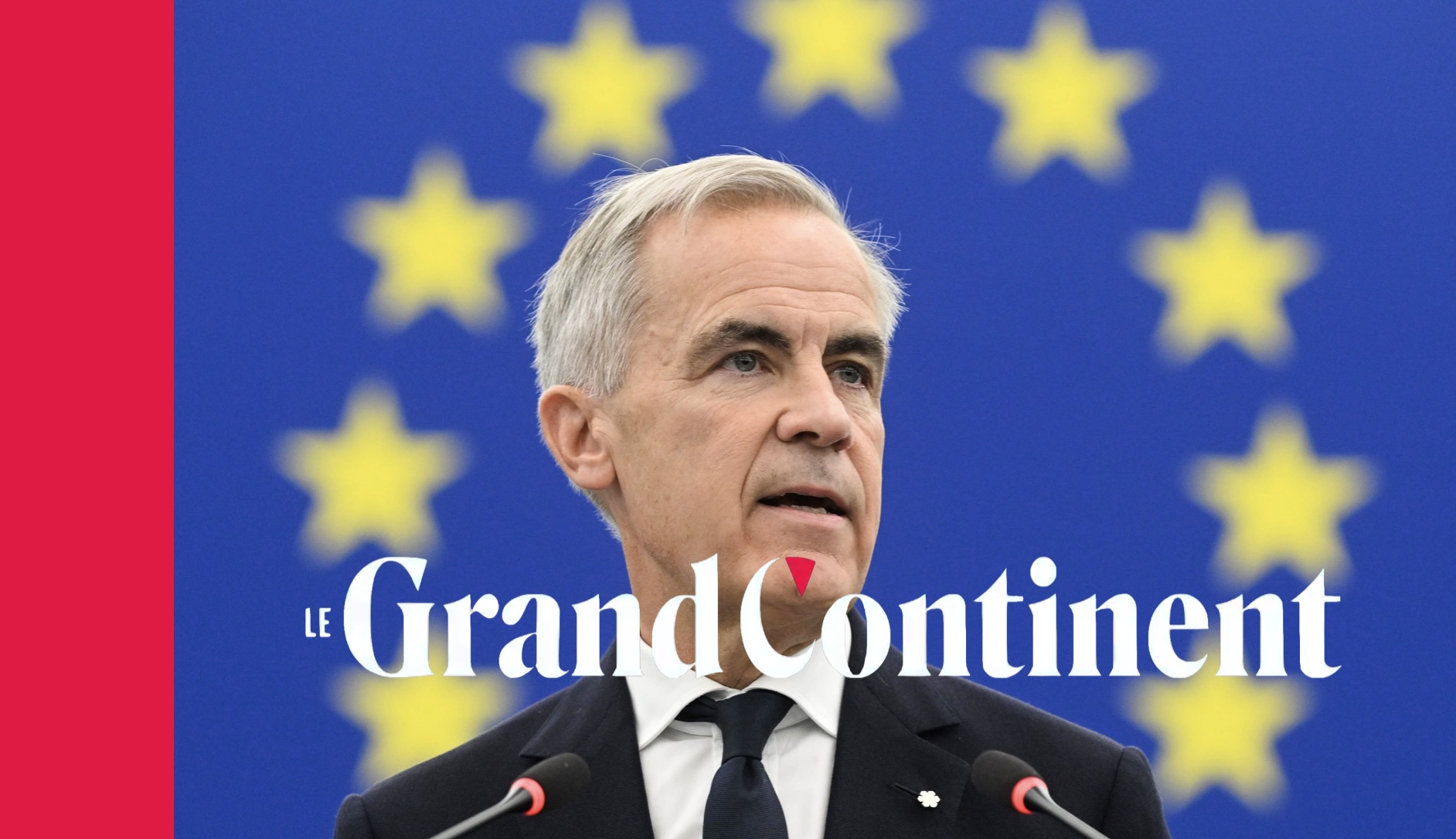
Today, September 17, Canadian Prime Minister Mark Carney addressed the European Parliament in Strasbourg, a day after Ursula von der Leyen’s annual State of the Union speech, in which she proposed that Canada become the European Union’s first associated member, suggesting a transformation of the free trade agreement into an “alliance for the future.”
Carney opened his remarks far from the arena of trade policy, on a forested ridge above Weimar. There he recounts Goethe’s oak and quotes a line from Faust, “Only he who must conquer freedom each day deserves freedom,” which will serve as the through-line of his address.
That detour through Goethe is perhaps not incidental and resonates with another transatlantic vision, the one voiced by Marco Rubio at the Munich Security Conference. For the secretary of state, the West and the bond between the two shores rest on Christian faith. He described a relationship shaped by centuries of “shared history, Christian faith, culture, heritage, language, and ancestry,” insisting that America would “always be a child of Europe.” Carney does not lean on faith or lineage. He adopts a term Goethe had borrowed from chemists: Wahlverwandtschaft, or elective affinity. Canada and Europe, he says, are bound by an affinity that is elective, chosen, and renewed. Where Rubio speaks of an inheritance received, Carney speaks of a belonging chosen.
The speech picks up the thread he had already laid out in Davos in January: economic integration and supply chains have become weapons now, with tariffs as levers of pressure. In the face of this new reality, Carney notes: “An isolated tree will fall. A forest, not.”
He replies to the European Commission President’s proposal by laying out a new transatlantic partnership in which each side fills the other’s gaps: “We all have significant gaps in these strategic capacities, and we each must rely on nations or individual companies to close them.”
According to him, Europe offers “a market power. Leading-edge research. A cutting-edge manufacturing base. It also provides the capacity and the will to set standards that the world frequently adopts. A defence industrial base that is rebuilding at a steady pace.” Canada, for its part, provides energy and one of the world’s largest reserves of critical minerals.
This, in Carney’s words, is an “alliance strong enough to prevent anyone from dictating our choices.” He is quick to clarify what he does not propose: “the creation of a third bloc aimed at becoming a great rival power.”
Carney’s remarks advocate a strategy of pooling, a concept Anu Bradford describes in a policy piece as forging partnerships with like-minded countries to amplify the collective influence of all participants. As Bradford notes, “These countries also possess key technologies that can be shared to reduce their individual vulnerabilities, whether it is energy access, microchips, open-source models, or research and public procurement. Such collaboration would allow them to pool resources and benefit from economies of scale and complementary capabilities, while offering stronger resistance to coercive strategies from Beijing and Washington.”
Madame President Metsola,
Madame President von der Leyen,
Honorable Members of the European Parliament,
Distinguished colleagues,
I thank you for granting me the privilege of speaking before you at the outset of this pivotal session.
Today I will discuss how our response to the current geopolitical rupture should incorporate a new dimension.
But first, I would like to recall a much older element.
Something that predates the relations between the European Union and Canada.
For the depth of our ties is not measured in trade alone, nor written into our treaties.
Our bonds are deeply planted in the soil.
In the heart of Germany, above Weimar, rises a wooded crest known as the Ettersberg.
For decades, Goethe walked there, reflected there, wrote there.
One oak on that crest came to bear his name, a living monument to the highest ideals of European culture.
As the twentieth century darkened, that same oak found itself imprisoned behind the barbed wire of Buchenwald, a silent witness to humanity’s deepest moral failure.
Goethe understood that ideals must be defended; values do not defend themselves. At the end of Faust, the old man’s final vision is of a free people on a free land.
Only he who must conquer freedom each day deserves freedom.
Day by day. Not only in 1945, nor in 1956, nor in 1989. Day by day, including today.
Freedom was won through the heroism of European resistance during the war. It was nurtured by the founders of the European Coal and Steel Community in the postwar era. It was fostered by the creation of the European Community. It was safeguarded by the establishment of the European Union. And it grew through its enlargement after the fall of the Berlin Wall.
The values embodied by Goethe’s oak endured, partly because the ideals born under its shade crossed the Atlantic.
In 1917, amid the devastation on the Vimy Ridge, a Canadian lieutenant named Leslie Miller gathered a handful of acorns from this European landscape. He carried them home to Milliken, Ontario, where they were planted and grew into a majestic forest.
A century later, a profound renewal cycle reached its end: grafts from those Canadian oaks were repatriated to France and replanted on the same Vimy Ridge where they had originated.
That is the very essence of the Canada–European Union partnership: seeds, values, ideas, commerce, people, and progress crossing the Atlantic in both directions for centuries.
We are not fair-weather allies. We do not seek zero-sum deals. Our commitment to the rule of law and our steadfast defense of human dignity, of individual liberty, and of democracy share the same deep roots, the same unwavering dedication.
We share common values, for which we have always fought and which we must continue to defend with vigilance.
We believe a strong economy is not an end in itself but a means to a just society. We are steadfast stewards of our natural heritage. We believe prosperity grows when it is shared. These values—that is how we choose to live.
In Goethe’s terms, it is a sharing by choice, not mere coincidence.
In his writings, Goethe borrowed a term from the chemists of his day: Wahlverwandtschaft, the elective affinity among different elements that join together because of their inherent attraction.
Canada and Europe are not bound by geography, even though, as our Danish friends know, we share a 3,000-kilometer Arctic border. We are linked by an elective, chosen, and renewed affinity, and it grows stronger precisely because it is chosen.
Today, our societies are buffeted by new storms: climate upheaval, erosion of democratic norms, and the weaponization of trade.
The multilateral institutions we once relied upon have grown weaker. Sovereignty and openness are hard to reconcile. Economic integration is used as a weapon, and tariffs as leverage. Financial mechanisms are deployed for coercion. Supply chains reveal their fragilities.
Technology is changing the character of war, the structure of economies, and the ability of states to govern.
Technology platforms aspire to sovereignty. They seek to set terms of access, regulate and even circumvent. They want to control our data, spread misinformation, and steal the childhood of our children.
This combination is a devastating storm. An isolated tree would fall. A forest, no.
For beneath the forest floor, the roots of one oak intertwine with those of its neighbors, exchanging nutrients, uniting their strength to form a resilient, self-sustaining ecosystem.
Together, Canada and the European Union can anchor our foundations to defend our values while providing a protective canopy under which our citizens can thrive.
Sovereignty is a matter of our ability to live as we choose. It is about the freedoms we must fight for every day.
Because sovereignty requires resilience—the capacity to endure shocks.
Today, sovereignty extends beyond merely feeding ourselves, fueling ourselves, and defending ourselves. It now demands secure access to AI, to semiconductors, to critical minerals, to payment systems, to clean-energy technologies, to vaccines, and to space communications.
We all face significant gaps in these strategic capacities, and we must each rely on nations or individual firms to fill them. That creates vulnerabilities, especially when so-called “global” firms reveal themselves as national in a crisis.
Bridging these gaps cannot be done alone, but it can be achieved collectively.
Canada and Europe are each strong. Europe and Canada are stronger together.
The institutions we inherit are organized by geography. The strategic capabilities we require are organized by function. We can form alliances by function, if we show boldness and determination.
We should not be daunted by the scale of the task. Just as domination is the arrogance of hegemony, perfection is the enemy of good. The economic stakes are clear: the influence of powerful players in a relationship of exploitation dissolves long before complete independence is achieved. For diversity confers an advantage.
The objective is not autarky. It is collective resilience.
This mutual advantage lies at the heart of the case for a closer Canada–Europe partnership.
Europe brings so much: market power, leading-edge research, a world-class manufacturing base, the ability and willingness to set standards that the world frequently adopts, and a defence industrial base rebuilt at a steady pace.
Canada brings large-scale energy across the spectrum needed for the transition. We possess one of the world’s largest reserves of critical minerals. We have strong capabilities in space, AI, and quantum computing. We boast one of the strongest banking systems and some of the most sophisticated retirement capital. We benefit from unique Arctic geography and privileged access to Atlantic and Pacific networks.
Where our strengths differ, they complement one another; where they overlap, they generate economies of scale.
We must deliberately, systematically, and quickly leverage our respective strengths.
We have already begun, and I thank this Parliament for CETA, one of the world’s most successful trade agreements. I also thank President von der Leyen and President Costa for the Strategic Partnership Agreement we concluded last June. We are expanding and deepening it. We have also started to leverage Canada’s role as the first non-European member of SAFE.
Yet we must acknowledge that the ecosystem we have built does not fully match the pace and violence of climate change. It is not evolving quickly enough to keep up with these disruptions.
Yesterday, President von der Leyen spoke of moving from CETA to an “Alliance for the Future,” opening the door for Canada to join as the EU’s first associated member. Canada welcomes this ambition: polls show a broad mandate among Canadians in favor of strengthening ties with Europe.
An alliance for the future is a unique and constructive approach that we will define together, drawing on our shared strengths and guided by our common values.
Let me take this opportunity to spell out clearly what Canada proposes.
Canada and Europe should safeguard their strategic autonomy through deep cooperation across all strategic capabilities, including critical minerals, defence industrial capacity, artificial intelligence and computing, energy security, space, and payments.
We should progress toward frictionless digital trade for non‑agricultural goods and a broad range of services.
We should strengthen ties between our peoples, enabling our youth to work, study, and live wherever they choose, on either side of the Atlantic.
Canada’s accession to the Erasmus+ program would give our students—yours and ours—more opportunities to study at some of the world’s best universities, broaden their horizons, and forge durable links that will sustain our alliance in the years ahead.
Canada’s participation in the next generation of the Horizon program would allow us to pool our resources, collaborate on cutting-edge technologies, and leverage our world‑class research institutes and universities.
Yesterday, President von der Leyen announced the creation of a “new European Critical Raw Materials Society” to secure and stockpile “materials needed for electric vehicles, microchips and batteries, clean technologies, and defense.” I would note that Canada hosts more than 34 critical minerals and ranks among the top producers of the ten minerals most essential to the energy transition. Our alliance can help meet Europe’s reliable supply needs, while enabling Canada to advance state-of-the-art processing capabilities and, together, complete value chains in the energy transition and in defense.
Canada can provide LNG and hydrogen at scale to bolster Europe’s energy security, including by developing and leveraging new port infrastructure in the High North and on the East Coast. And Canada, in turn, can benefit from your leadership in many clean-energy technologies.
We can pool new sovereign computing capabilities and establish more secure high‑speed connections between Europe and Asia thanks to our shared geography.
Canada and Europe can join forces to develop AI security protocols, harmonize standards, and increase transparency, while pursuing applications that help our governments and our businesses serve citizens better.
This is the most ambitious proposal in the speech, and the most cautiously framed: a union of two financial systems renowned for their stability—Canadian banks weathered the 2008 crisis without a public bailout—and a response to dependence on American payments networks (Visa, Mastercard).
Canada and Europe should consider exploring an integrated market for financial services to broaden choices and reduce costs for our citizens, to improve access to capital for our companies while preserving our financial resilience, one of the strongest in the world.
These are just a few opportunities, but the essence is that the opportunities created by an Alliance for the Future stem from our shared values, compatible systems, and complementary strengths.
Deepening and widening our relations will strengthen our sovereignty, improve financial accessibility, expand opportunities, and enhance the security of our citizens, while preserving our ability to live as we choose.
I want to be clear about what I am not proposing: I am not proposing the creation of a third bloc to become a rival great power—even if such a bloc might claim better intentions.
We are not seeking power to dominate others. Rather, we seek resilience so that no one can control our open markets, erode our sovereignty, threaten our territorial integrity, or undermine our freedoms, our democracies, and the rule of law.
These motives, these core principles, combined with latent hard power, enable us to contribute to the creation of a fair, stable, and prosperous new world order.
An alliance between Canada and the European Union would serve as a model for other democracies.
An alliance defined not by what we oppose, but by what we defend: liberty, solidarity, prosperity, and sustainability. An alliance that strengthens resilience by what it allows us to do for our citizens, and what our citizens can do for themselves.
An alliance strong enough that no one can dictate our choices. An alliance open enough for others to join. An alliance firmly anchored in principles so that our strength reinforces international law rather than seeking to supplant it.
And to conclude, it is often said that Canada became a nation at Vimy Ridge.
Indeed, thousands of Canadians who did not return sacrificed their lives for a cause far greater than themselves.
One of those who returned home paused to pick a few acorns.
Today, the same oaks of Vimy grow in Canada as in France, living proof that what we cultivate together can survive even the darkest winter to rise again.
Let us deepen these roots, broaden this canopy, and grow a transatlantic forest under which our citizens can flourish as free people on a free land.
Day after day.
Thank you.