
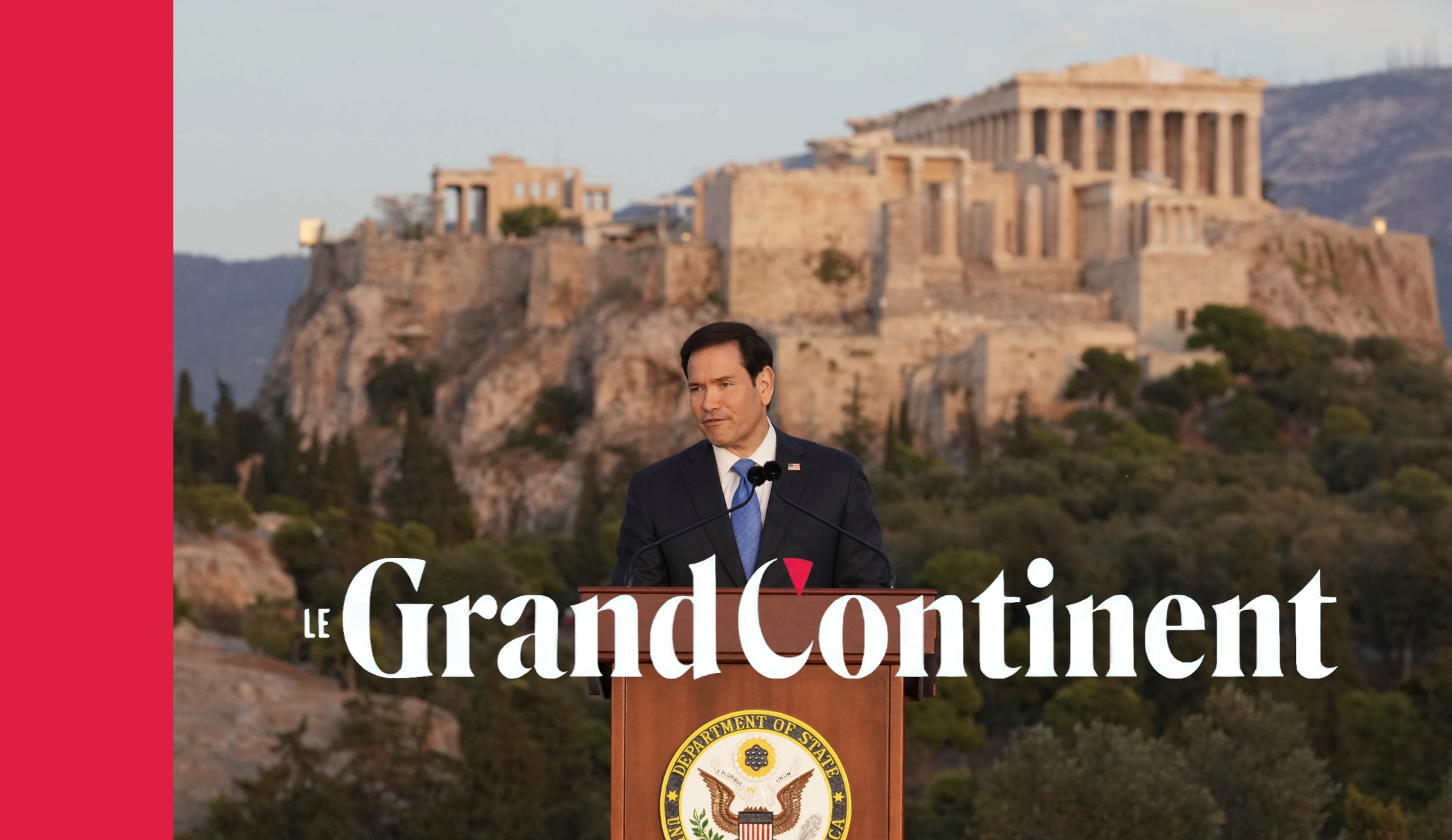
The westernist doctrine of the new Trumpism may well have found its founding text. The speech delivered this Wednesday, October 7, by Marco Rubio on the Pnyx echoes the one delivered by the American secretary of state at the Munich conference, and marks a new turning point in the contest with J. D. Vance over the definition of the post-Trump era.
In February 2025 in Munich, the vice president inaugurated this format with a speech on regime change of unprecedented harshness in the transatlantic relationship. He accused Europe of betraying its own principles and suggested to the future chancellor Frédéric Merz, seated just a few meters away, a collaboration with the far-right in Germany previously unthinkable. As with his Munich speech, Rubio introduces a different tone—more conciliatory—in this political reversal by claiming intellectual leadership of the movement.
In February, the secretary of state cast collapse as a “choice” and urged Europe to reject the “controlled decline of the West.” In Athens, he anchors this call in a mythic Antiquity where Greek civilization becomes a mirror, for to know it is to know ourselves.
Léonidas, Achilles, Alexander and Cortés thus fit into a converging lineage, since “the qualities that led Alexander to conquer the known world reappeared in Caesar, then in Charlemagne, and in Cortés.” It is an conquering West “born in Athens, formed by Rome, baptized in Christianity” of which Washington now seeks to be the custodian and the arbitrator. The alternative is stated without nuance. The West must choose between “the unabashed pursuit of national power” and a future of “atrophy, servitude and decline.”
The political frame has not changed since the United States’ National Security Strategy of December 2025 explicitly made “civilizational fading” the premise for regime change and a strategy of recolonization.
The Greek setting that gives this speech its iconic and historical dimension must be read within this frame. In the background, the Acropolis, bathed in twilight, undergirds the secretary of state’s civilizational argument. It presents itself as a metaphor for the West’s decline — this Abendland (“land of the setting sun”) that the Trump administration intends to lift up.
This gesture has many Straussian echoes. Like Leo Strauss, Rubio turns to the Ancients for a remedy to a crisis of modernity. But while Strauss saw Athens and Jerusalem as an irreducible, fertile tension, the secretary of state merges them into a single genealogy and views American history as a definitive synthesis. The neoconservatives educated by the Straussian school drew from the Ancients a universal natural right they intended to export with democracy. Rubio takes from that only a reactionary misappropriation that minimizes the democratic heritage in favor of aristocratic excellence, believed to enable the United States to preserve its status as a power by producing a new elite liberated from democratic constraints.
Finally, recall the political backdrop of this speech. At the end of September, the Wall Street Journal reported remarks given in March in Athens by the American ambassador, Kimberly Guilfoyle. Recalling the fall of the Romanian government of Ilie Bolojan, she would have assured Greek minister Stavros Papastavrou that Washington could do the same in any country. He would have replied that no power could replace a government chosen by Greek voters. Her lawyer disputes this version, but the episode has prompted the Democrat Gregory Meeks to open an investigation on October 1 into the ambassador, a former partner of Donald Trump Jr.
From Romania to Germany, the Kremlin and the White House back the same far-right forces. The Athens speech sketches the doctrine of this convergence: a global North that defines Western civilization by power and recolonization.
The question remains, posed by the Die Zeit journalist Jörg Lau: “Why do Europeans allow opponents of the Union to use their heritage as a prop for their propaganda?”
Less than a month before the U.S. midterm elections and on the eve of a campaign year in which Greece, Spain, Italy, Poland and France will elect their leaders in a context of intense interference, this question is far from superficial.
There are great ruins all over the world. They are often places where history seems exhausted: remnants of distant cultures that have long faded from living memory.
But the Acropolis is different.
For thousands of years, the civilization that built what stands behind me has captivated the Western imagination. Generations of our statesmen, our artists, and our philosophers have turned to it with awe and with a respectful fear.
Time tends to dull the senses. Great victories as well as catastrophic defeats seem to reduce to a footnote in a textbook, a fact our students learn and then forget. But the Greeks of antiquity exert a nearly mystical hold on our memory. They call us back, again and again.
In 480 BC, Xerxes’ armies reached this city and set fire to its sanctuaries. Most Athenians had already evacuated by boat to a neighboring island. But a handful refused to leave their home. They barricaded themselves in the rocky stronghold of the Acropolis to deliver one last, extraordinary fight. They rolled huge stones from the cliffs onto the invading Persians and held off, for days, the greatest empire of the era. They were eventually overwhelmed. The Persians plundered the temples, burned the sanctuaries, and razed the Acropolis. Yet upon their return, the Athenians gathered the debris of the old Acropolis and buried it on the hill where it had stood. A few decades later, under Pericles, they erected the Parthenon.
For twenty-five centuries, the Parthenon has stood. Empires have risen and fallen in its shadow. And the descendants of the men who built it, the sons of Athens and Rome, carried their civilization to the farthest corners of the Earth.
Two and a half centuries after the founding of the American Republic, on the other side of the world, I stand here today as the secretary of state of this Republic and as the great-great-grandson of settlers who came from Spain to the New World. I come to bear witness to a debt that no passing time or distance can ever extinguish.
The history of America, the history of my country, bears the marks of Antiquity everywhere. Greece is literally carved into the architecture of our government: in the vast columns, in the domes and the monuments of our capital. The city where our Constitution was born, Philadelphia, itself bears a Greek name.
The men who founded my country were deeply drawn to the heritage we inherited from yours. They knew history remarkably well and possessed a keen sense of the unique place they occupied in it. Yet no other era of the past captivated their attention and imagination as much as Antiquity. Many are surprised to learn that the author most cited in the Federalist Papers is not a Enlightenment philosopher or political theorist. No, it is Plutarch, the Greek biographer of the great figures of Greece and Rome.
There has been much written and spoken about the influence of ancient Greece on the ideas of the American founders, and indeed on all Western philosophers and statesmen who preceded them. Most of us know the broad strokes of history. Athens gave us democracy. Plato and Aristotle gave us Western philosophy. Our ideas of law, virtue, citizenship and republican government were formed in the Greek city-states. Even a large portion of our political vocabulary, such as democracy, tyranny, and the word “politics” itself, was born here.
All of this is true. But what we owe to this place, as Americans and as Westerners, goes far deeper. These institutions and ideas were outward expressions of traits more fundamental, visible in the ancient Greeks, traits that cannot be reduced to any system or any political theory.
It is here, in Athens, that for the first time all the essential features that would define the West were fully realized: a fierce individuality and relentless ambition; the audacity of exploration and invention; the thirst for discovery, for adventure, for risk and for glory. An insatiable curiosity about the world and the principles that govern it, a hunger to know the mysteries of nature and to grasp the secrets of the cosmos. An impatience with the very idea of impossibility, which collides with every border and limit and seeks to plumb the depths of the unknown.
These were not merely formulas or precepts of a particular philosophical school. They were the character of a people, expressed in their traditions, their stories, their imagination; in the qualities they demanded of their citizens; in what they lived for, fought for, and died for.
Knowing them is knowing ourselves.
What blossomed here, in this place, is the Western world’s desire to uncover everything that ignorance, darkness, and distance had concealed from the human mind. The Greeks did not merely shape history; they gave us history itself. Much of what we know about many ancient civilizations comes almost entirely from the accounts of Greek explorers and historians. They did not merely relate the history of their own people: they went far afield to observe and document the sagas of peoples and cultures beyond their own borders.
Where others looked inward, the Greeks were the first to turn outward, to pursue the thrill and glory of seeing all that was strange and new. It is this trait that would push the West to create and build what others could not, and that set us apart from so many other cultures and civilizations where stability and subsistence were the highest aims of life.
But we inherit not only the Greek ambition to explore the unknown; we inherit from them the conviction that the unknown can be known. The certainty that the world can be mapped, measured, conquered, and understood. And that there exists a rational order to the cosmos, governed by fundamental laws that man can observe and the mind can come to understand.
This was the foundation of the Western spirit: our mathematics, our science, our medicine. Our philosophy, our ethics and our religion. It laid the groundwork for the flourishing of Christian theology, of Augustine, of Thomas Aquinas, and of the whole tradition of natural law.
It gave rise to a civilization marked not only by a common culture but by a shared anthropology: a common vision of humanity and its place in the universe. Its descendants would share not only the notion of a natural order but a distinctive understanding of virtue; of destiny and fate; of truth, good and beauty; of a code that tells how men should live; of standards and ideals toward which to strive.
For the ancient Greeks, the quest for excellence was the very principle of human existence. They organized all civic life around contest, ambition, and rivalry: in philosophy and poetry, in sculpture and theatre, in athletics and the art of governance. The classical Greek city was an arena where great men tested themselves and proved their worth, sharpening their potential in a perpetual struggle: to be the best, the strongest, the most beautiful, always striving to draw a little closer to perfection.
I know that to modern ears, the lifestyle I’ve just described may seem strange, even cruel. The ideal of many ideologies today has become, frankly, a world of perfect security, without risk or failure, without the glory of victory nor the shame of defeat. Too often today, we build downward. We fashion our norms so that no one loses; we care more about the comfort of the weakest than about the potential of the best. We kidnap what is most exceptional among us for the benefit of the average, the ordinary, the mediocre.
Those who built the Parthenon aimed upward. They believed that the highest and noblest aim of life was to outshine others, to strive to be the best in all things. The ancient Greek cities were filled with intense passions and rivalries, factions and conflicts. But from this constant struggle to distinguish themselves arose the great flowering of art, philosophy, and political and intellectual energy that would transform a cluster of Mediterranean city-states into the cradle of the world’s greatest civilization.
Thumos, as the ancient Greeks called it—the fire of passion, the strength, the courage, the pride—is the heart of a great civilization.
And without it? Without it, nations lose the will to fight, the will to surpass themselves, the will to survive.
Today, too large a portion of the West has forgotten this quality. Over time, we, the Westerners, have grown ashamed of what made us exceptional. We were embarrassed that our achievements set us apart from the rest of the world. Our prosperity has somehow become a source of guilt. We no longer believed we deserved or earned our greatness.
The word “nationalism” has become a dirty word. So we toppled our monuments; we condemned our own history.
And in too many places, we taught our children to be ashamed of the countries they would inherit. In doing so, we opened our borders, offshored our industry and let our militaries wither and degrade.
And year after year, we seemed to offshore more sovereignty still, transferring our decisions to global bureaucracies beyond our reach.
But others have been more than willing to fill the void we left, the void created by our weakness. And as Western confidence waned, its rivals and adversaries grew more aggressive, amassing their own wealth and power in our stead.
Today, we stand at a crossroads. For the next decade and the choices we make will write the history of the century to come. The path we select will determine whether the West retains its leadership in the world or resigns itself to a future of atrophy, servitude, and decline. Either we act now, or we will lose the very ability to act.
Under the presidency of Donald Trump, the United States has chosen. We choose the unabashed pursuit of national power: to reclaim control of critical supply chains, to reindustrialize our economy, to rebuild our defense, to strive to master the technologies and industries of the future.
We choose to push into new frontiers: in advanced manufacturing and in superintelligence; in drones, weapons and warfare; in semiconductors, minerals, cyber and all other realms of human potential. To unleash our energy, rebuild our factories, send our astronauts back to the Moon, and usher in a new era of space exploration.
Despite their noble ideals, the ancient Greeks were not naive. They understood that nations have interests. They knew that the art of governance requires prudence and diplomacy, but also the ability to resort to force when prudence and diplomacy fail. They knew that power requires not only the means to defend oneself, but also the credibility of being willing to use it.
It is this classical conception of politics and the art of governance that the Trump administration aims to reclaim, not only for our country but for the entire civilization.
We believe Europe can emerge from its long slumber and rekindle the fire that was lit here millennia ago.
There are already signs.
Across the continent, we are witnessing what we hope are the early signs of a generational shift: defense spending surging, a multitude of new partnerships and programs, a rise in manufacturing and production, building on the defense commitments undertaken last year in The Hague.
Greece sits at the heart of this shift. The people of this nation have again proven themselves indispensable friends to Europe and to the United States, across all issues—from energy to migration to defense, where Greece has been a model ally.
And we sincerely hope that all of Europe will follow your example.
If passions have occasionally strained the bonds between the United States and Europe, we must not allow them to break. Together, we must strengthen an alliance capable of confronting the threats of our time.
And we can. For we do not believe that the transatlantic friendship is a zero-sum game.
Far from it: our vision is of an alliance whose strength exceeds the sum of its parts. It is a vision we witnessed last month, in an unprecedented agreement among the United States, Denmark and Greenland, an agreement that will reshape the Arctic and bolster the security of NATO as a whole. The three partners emerged as winners from this accord. All of Europe, NATO and the United States came out safer, stronger and better protected.
We want to win together. We must win together.
It has become fashionable to think that a well-ordered foreign policy means putting the global community before one’s own people. Again, I believe we have much to learn from the men of ancient Greece. They understood that there is nothing selfish or wrong in loyalty to one’s nation, or in fighting to defend its interests first.
They ardently believed in the ideal of the great man: the exceptional individual who achieves immortality through his own deeds. But they believed that glory and fame were earned by fighting, by sacrificing, and by accomplishing great things for a cause larger than oneself. The recurring hero of the ancient Greek world was the man willing to pay any price for a cause worthy of his loyalty.
We see him in Socrates, who refused to abandon the pursuit of truth even at the cost of his life. We see him in the legendary resistance of the 300 Spartans, surrounded and vastly outnumbered by the immense Persian armies, who refused to save themselves and chose to fight to the last man rather than abandon their post or duty. And we see him in the epic myth of Achilles, who is offered to return home to a long, peaceful life, but who chooses to stay in Troy and perish in pursuit of eternal glory.
These are the qualities that would shape the West’s moral imagination. From the Christian martyr who refused to betray his faith to the patriot who laid down his life for his country; from Saint Thomas More to the Battle of the Alamo, to the immortal final words of the United States Declaration of Independence: “We mutually pledge to each other our lives, our fortunes, and our sacred honor.”
It is from the Greeks that the West inherited its sense of duty: unwavering loyalty to one’s code, one’s cause, one’s country. Our heroes, the heroes of the West, are those who choose to remain faithful to their duty precisely when it is hardest and most painful: the man bound by his word, the soldier who does not abandon his post, the captain, the proverbial captain, who sinks with his ship.
It has nothing to do with what we still see today, for instance among fanatics like the radical Iranian mullahs, whose death cult glorifies kamikaze children as national heroes and treats martyrdom as an end in itself.
Our heroes may be ready to die for their cause, but our heroes do not worship death. It is precisely because we prize life that we recognize the heroism of those who choose to sacrifice themselves rather than betray their principles. We take for granted the Western conception of these things—the heroism, the honor, the duty. We assume they are somehow universal, shared by all peoples, all ages and all places. They are not. They are the product of a singular character, one that was born here and shaped the entire history of the civilization that followed. A civilization we must now fight to defend with the same passion as our ancestors.
To the men who built the Parthenon followed the architects of European Christendom, who raised the cathedrals of Milan, Cologne, and Florence. The Greek sculptors’ pursuit of the perfection of form found new expression in Michelangelo. The Greeks’ quest to understand the structure of the universe was picked up by Copernicus, then Galileo, then Kepler, and Newton.
It was the thirst for new knowledge that gave birth to Magellan’s first voyage around the world, to Columbus’ discovery of the Americas, and ultimately to Apollo 11’s journey to the Moon. And the qualities that led Alexander to conquer the known world reappeared in Caesar, then Charlemagne, and Cortés.
And in America, that same tradition reemerged. A land open and wild became the theater of a great rebirth of Western imagination and ambition.
The Greek aspiration for new horizons became the American frontier spirit. The civilization of Athens and Rome transformed a young coastal republic into a continental empire.
The greatest Americans of each generation have carried the defining traits of their ancestors: born in Athens, shaped by Rome, baptized in Christianity, tempered in the crucible of medieval Europe, endowed with the English genius for liberty, and carried across the Atlantic to be reborn on the shores of a new world.
Together, we must now rediscover this spirit. We stand at a turning point, not only in the history of my nation but in the history of our civilization as a whole.
The threats we face today are as real as those that faced us on the stage of Antiquity.
National interests have not vanished before international institutions. War has not disappeared just because we prefer peace. Other states have continued to arm themselves, to seek influence, to dispute territories, technologies, resources, markets, energy and power.
And today, war has returned. The great-power rivalry is back. Vulnerability, aggression, terrorism—an entire universe of new threats and new attacks is back.
This passage illustrates well the geopolitical rupture championed by the second Trump administration, and clearly laid out in the National Security Strategy, the principal drafter of which seems to have been Michael Anton. This mercantilist and imperialist logic breaks both with the isolationism on which Trump campaigned in 2016 and with neoconservative interventionism. This logic of a return to empires fits within a framework of confrontation with China, as Arnaud Orain described in Le Monde confisqué (Flammarion, 2025).
We must therefore rebuild our institutions and our alliances to confront these threats together. Their aim is not to abolish the sovereignty of the nations that comprise them, but to defend it. And nations do not need to renounce their own identity in order to recognize their shared interests.
We have built a model of this with our partners here in Greece: in our defense partnerships, in energy and technology, in our shared ambition to defend Europe’s borders against the threats of mass migration.
Our friendship goes back to the earliest years of my country. When Greece rose up in 1821 to reclaim its independence after centuries of Ottoman rule, Americans recognized something familiar in that struggle. Three years later, the great American statesman Daniel Webster addressed Congress with a famous speech that helped carry the cause of the Greek revolution to the representatives of the young American Republic.
He began by drawing their attention to all that surrounded them. Here is what he said in that speech: “This form of government that is free, this popular assembly… This practice of free debate and public discussion, this clash of minds… Even the very building in which we are gathered, those well-proportioned columns, that ornate architecture, all of it reminds us that Greece existed, and that we are, like the rest of humanity, deeply indebted to it.”
Those words are as true today as they were when he uttered them. And all of us, not only Americans but Europeans and friends across the West, must relearn the lessons our ancestors drew from this place and its history.
The history of Greece does not merely offer us a glimpse of our institutions in their earliest forms. The history of Greece shows us a picture of ourselves.
It shows that we are the heirs of great heroes, and that we should be intensely proud of our origins. We should marvel at what our ancestors forged on this land. The history of our civilization is the grandest story humanity has ever known.
And it began here, with the first men and women of the West. From them, we can recover the virtues, the courage, and the strength to face the dangers of our time.
Thank you.