
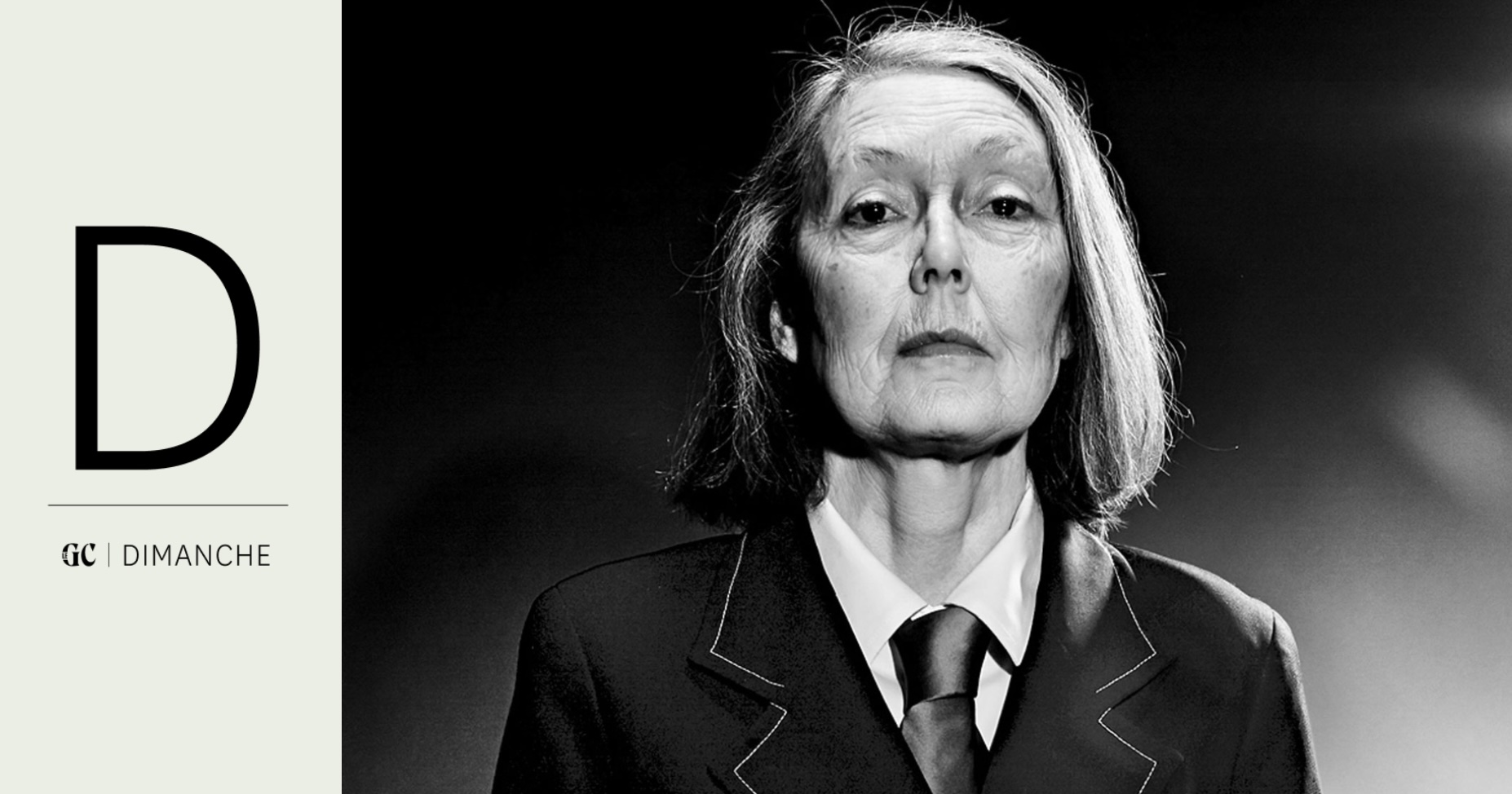
Anne Carson had long been anticipated as a Nobel Prize in Literature recipient. Her work, rooted in poetry and essays, indeed nourishes a substantial portion of contemporary poetic reflection. After Louise Glück in 2020, it was also, for the Nobel committee, important to emphasize the influence of Anglo-Saxon poetry on world poetry as a whole. The only classic figure of this great current to have received the Nobel Prize was indeed T. S. Eliot (1948); the other major figures had largely slipped from notice. The recent tilt to respect parity (one year a man, one year a woman) also seems to be becoming a tradition of the Nobel committee.
Like many contemporary poets, Anne Carson works at the borders of genres. Poetry, the essay, the fragment, the play—these are ultimately everything that is not a novel, and thus – at least economically, i.e., in terms of sales – on the margins. It is there that a literature of creation exists, demanding and sometimes difficult for readers accustomed to the forms that have now become canonical in major French literary prize lists: the family novel and/or the self-narrative. The Nobel Prize has this peculiarity, sought by Alfred Nobel when the prize was founded, of highlighting poetry. We can be grateful to the committee for continuing this heritage, while glancing at so-called “postmodern” novels (Krasznahorkai last year) and opening up to the margins of literature (the song with Bob Dylan, the literature of the self with Annie Ernaux, the journalistic narrative with Svetlana Alexievich, for example).
Thus, a book such as Glass, Irony and God is obviously a book of poetry, but it ends with a short essay, The Genre of Sounds. Autobiography of Red is a novel in verse, where ellipses, fragments, images and shifts in rhythm abound. This hybridity is particularly important for understanding Carson: she is at once a poet, an essayist, a translator of ancient Greek, and a specialist in classical literature. This fact leads to the other striking element of her poetics, namely the hybridization between Antiquity and the contemporary world.
The myth (Greek or biblical) is not separated from the contemporary in Anne Carson: the characters seem to continue living in our modernity. This sometimes creates effects of juxtaposition (contemporary characters alongside the mythical figure) and sometimes elements of continuity tied to the memory of the heroes. A significant example is undoubtedly the first section of the part “Television Man” in Glass, Irony and God, devoted to the figure of Hector, and opening with the formidable line: “Television is merciless, like Lenin.” Hector is propelled into our reality (or rather into the unreality of the show) without time since Troy having seemed to pass. “Hector was destined to be Prince of Troy, not a man of television,” is said at the start, after which we follow Hector during a shoot in Death Valley, while the narrator recalls his glorious deeds of old. Hector seems to play a blockbuster hero, perhaps indeed he is Hector, Prince of Troy…
“Hector was destined to be Prince of Troy,
hence his success.
The bad people look good on television, they are so
visibly split souls
and we all love this pathetic state.
Join Hector
on the eve of the shoot in Death Valley.
He lies
on the motel bed, clad in his armor, and watches himself, with his red lips up there.
The ceiling is reflected in a divine fire.
Your law has possessed
my guts, he murmurs. His lipstick smiles at him upside down.
Through the window he sees an horizon of small brown mountains put end to end.
They make a whistling sound. O Prince of Troy!
With butter and honey
you will feed yourself, so that you know how to ward off evil
and choose the good.
Television is inherently cynical. It speaks to the eye, but the mind has no eyes.”
The antique appropriation is even more visible in Antigonick or Norma Jeane Baker of Troy . These two works naturally lead us to one of the major thematic faces of her oeuvre: a feminist rereading of the ancient myths. Here too, Anne Carson places herself within a tradition now well established, though on the margins of dominant literatures: just as H. D. reappropriated the Helen myth, as Louise Glück reappropriated the Persephone myth, Anne Carson reappropriates Antigone, Sappho, Helen, or other figures, among others to effect a reversal of vision. In “Television Man,” Hector thus appears partly as an example of virility somewhat ridiculous, or at least critically distanced, while Sappho, a few pages later, gives rise to a magnificent poem about talent.
The shift in perspective is indeed, probably, one of the major means and aims of contemporary poetics and of all forms of creative writing. Anachronism, hybridity, ellipsis, fragmentation, syntactic ruptures: all of this helps to defy the levers of prejudice, cliché, the expected, not to claim that every tradition is dead, but rather to revitalize it. The Greek heroes are dead, long live the Greek heroes. A literature that is perceived as “difficult” only because any new perception is difficult. If you open one of her books and you find it complex, that’s a good sign: you should keep going.