
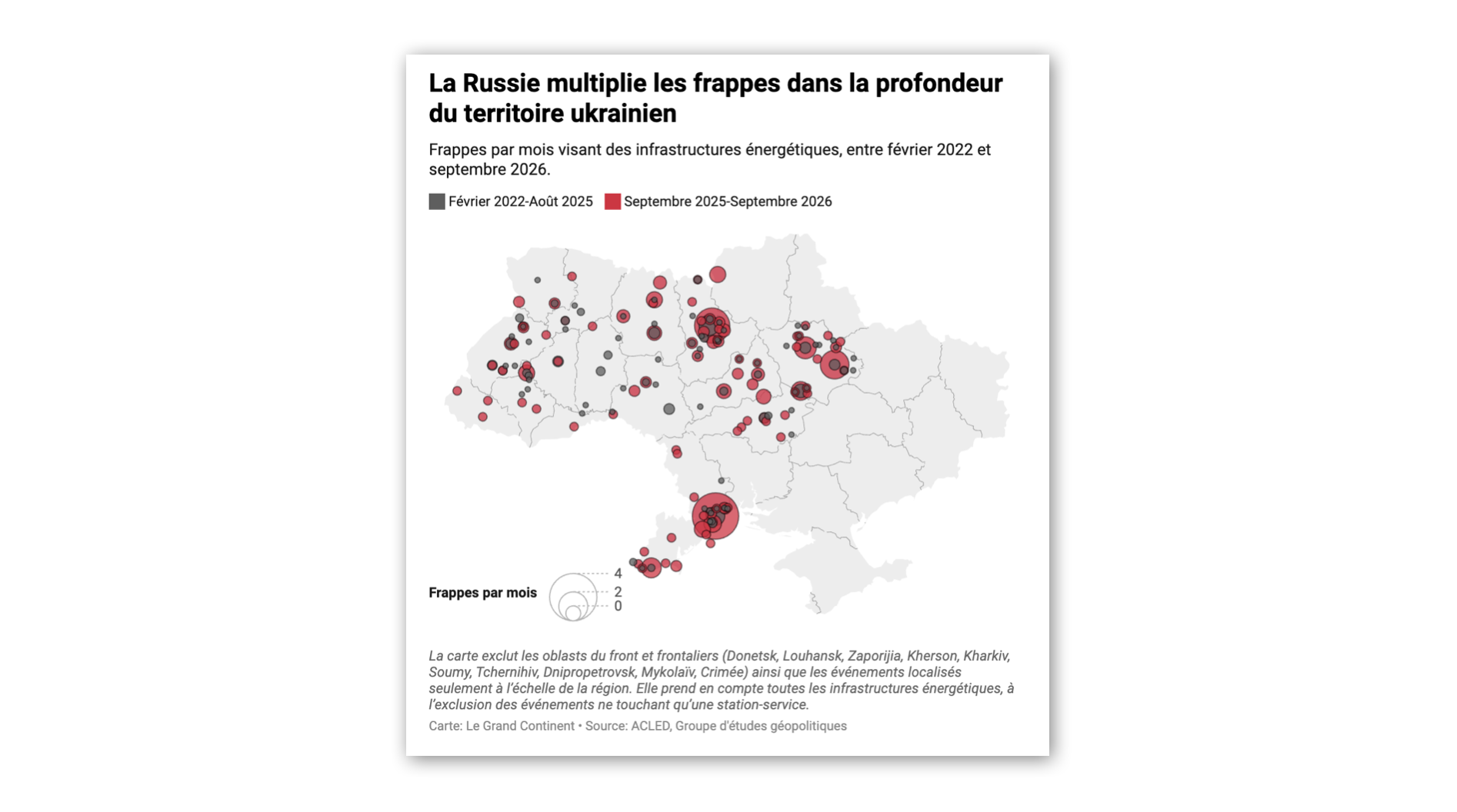
According to an analysis of data collected by the Armed Conflict Location & Event Data Project (ACLED), Russian strikes hitting Ukrainian energy infrastructure—gas stations, power lines, power plants, substations, fuel depots—have quadrupled between September 2024 and September 2026.
Last month, 160 attacks were recorded, compared with 129 in 2025 and 21 in 2022 over the same period.
- The Russian campaign against Ukrainian energy infrastructure became systemic as early as the autumn of 2022, but has significantly intensified since then.
- The strategy is to deliberately target civilian facilities (heating, lighting, charging capabilities for devices…) in order to pressure public opinion and undermine Ukrainians’ confidence in their government.
- These attacks are becoming more frequent as winter approaches, particularly against natural gas production and storage sites, which households rely on for heating.
Russia benefits from the improvement of its attack drones, including the Geran-5, a jet-powered model that, according to Ukrainian military intelligence, can reach targets up to 1,000 kilometers away, to inflict damage deep inside Ukrainian territory.
- In recent years, the Russian army had mainly relied on expensive cruise missiles to strike electrical substations.
- These strikes can now be carried out with drones whose unit cost is estimated at tens of thousands of euros.
- The increasing rate of strikes on distant infrastructure also reflects the degradation of Ukrainian air defenses and the Kremlin’s decision to intensify the strikes, according to researcher Dara Massicot.
Since the 2010s, Russian military thinking has contemplated systematically attacking the opponent’s “military-economic potential,” notably its electrical plants and the vital infrastructure of its cities. According to a RAND study, drawing on writings by Russian military strategists, these strikes aim to “throw the enemy’s economy into disarray,” rapidly degrade living standards, and “spread chaos through a domino-like cascade of secondary damage factors.”
- A Russian document intercepted by Kyiv outlines a plan to strike civil infrastructure, and estimates that by hitting 12 substations, Russia could cut 90% of electricity supply to Kyiv, Kharkiv, and Odesa.
- The plan, dated August 2026, designates electricity production and distribution, water supply, sanitation, and heating as the four “priority targets” of the Russian strike campaign.
- For the 60 key targets it lists, the document calculates the number and type of weapons required for their destruction (drones, missiles, glide bombs…), installation by installation.
This kind of document is not new: according to Oleksandr Khartchenko, director of the Energy Research Center, similar documents have circulated since at least 2023. They would be used to justify to industry the volumes of weapons to be produced and then to develop the destruction plan, which sets the operation dates and the distribution of strikes.