
Debates in the National Assembly on the 2027 budget bill begin today, Tuesday, October 13. These discussions will be crucial for the economic outlook, only a few months ahead of the 2027 presidential election.
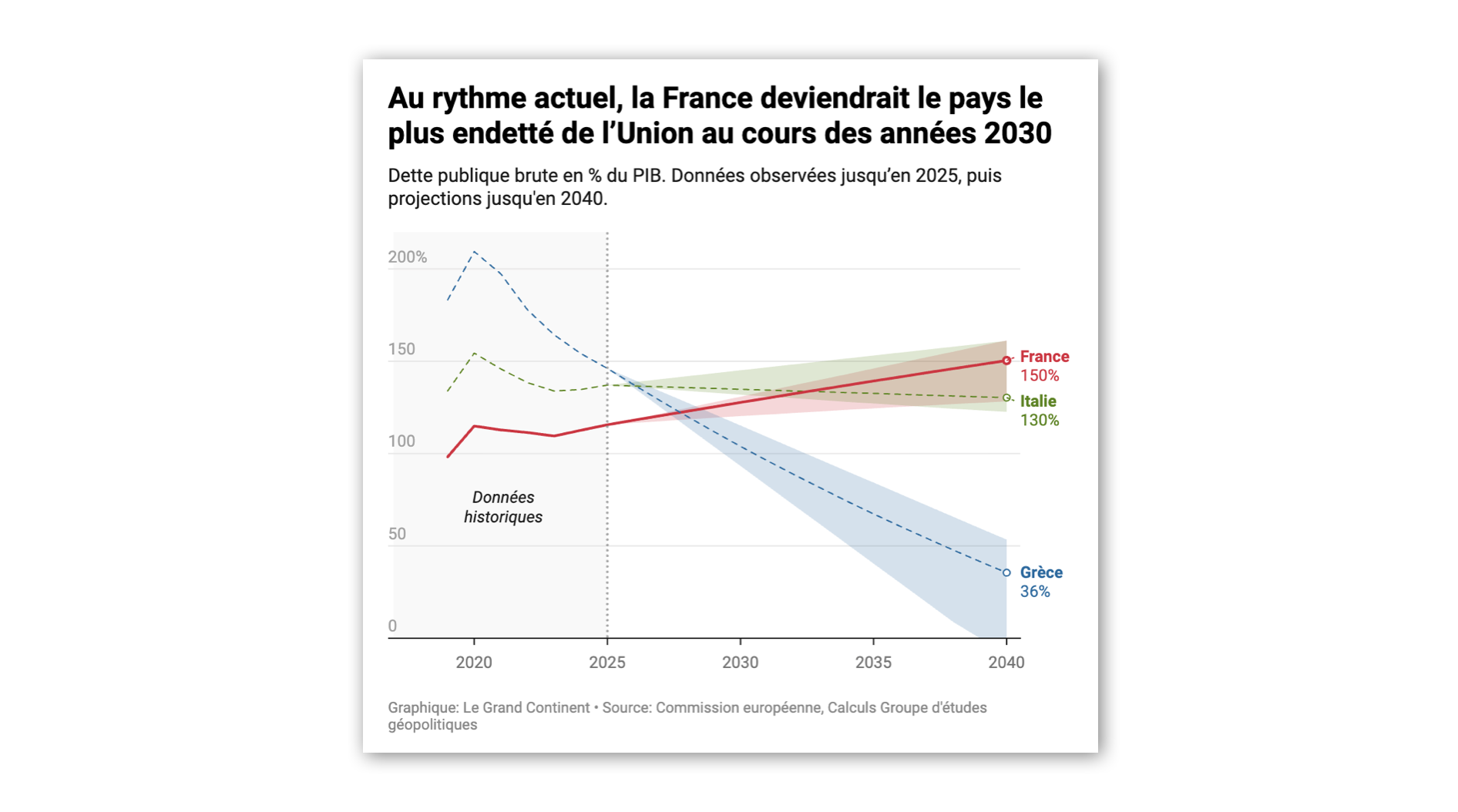
- France is currently the third most indebted EU member state relative to its GDP.
- In the first quarter of 2026, debt stood at 118% of GDP, 21 percentage points lower than Italy, and 26 points lower than Greece.
- Following its current trajectory, France could, however, become the most indebted member state in the coming decade, according to the calculations of the journal.
These projections reflect the budgetary situation of countries at a given moment in time. The model, which is built on six trajectory scenarios, uses in its central version the assumption that the conditions observed in recent years (the primary budget balance excluding interest, the average interest rate paid on the debt, and nominal GDP growth) remain unchanged. It therefore does not take into account forthcoming budget measures, any shifts in the conjuncture, or the progressive rise in the average interest rate paid on the debt.
- According to these scenarios, France would surpass Greece as early as 2028 or 2029, and Italy between 2033 and 2040, thus potentially becoming the most indebted country in the EU within seven years.
- In Central and Eastern Europe, several countries also show a clear upward trajectory: Poland could see its debt-to-GDP ratio double by 2050 (rising from 60% to 123%), Romania would reach 113% of its GDP (against 59% in 2025), and Slovakia would see its debt jump to 98% (37 percentage points higher than in 2025).
- German debt could rise by 16 percentage points by 2050, reaching nearly 80% – versus about 64% in 2025.
At the end of September, Shahin Vallée warned that France had entered a “historic danger” zone for its debt.
- The OAT-Bund spread, i.e., the gap between the rate at which France borrows for 10 years on the markets and that of Germany, reached 140 basis points in early October – a rise of more than 60% in a year.
- Although it remains distant, the spread is thus approaching its historical peak reached in November 2011, at the height of the euro area sovereign debt crisis, when it had exceeded 200 basis points.
The American Nobel laureate in economics Paul Krugman, however, cautions against overinterpretation: despite their sharp rise, the CDS prices on French debt, i.e., insurance against a default, remain well below their levels seen in Southern Europe during the euro crisis, and the implied probability of a French default in the next five years stands at only 1.2% .