
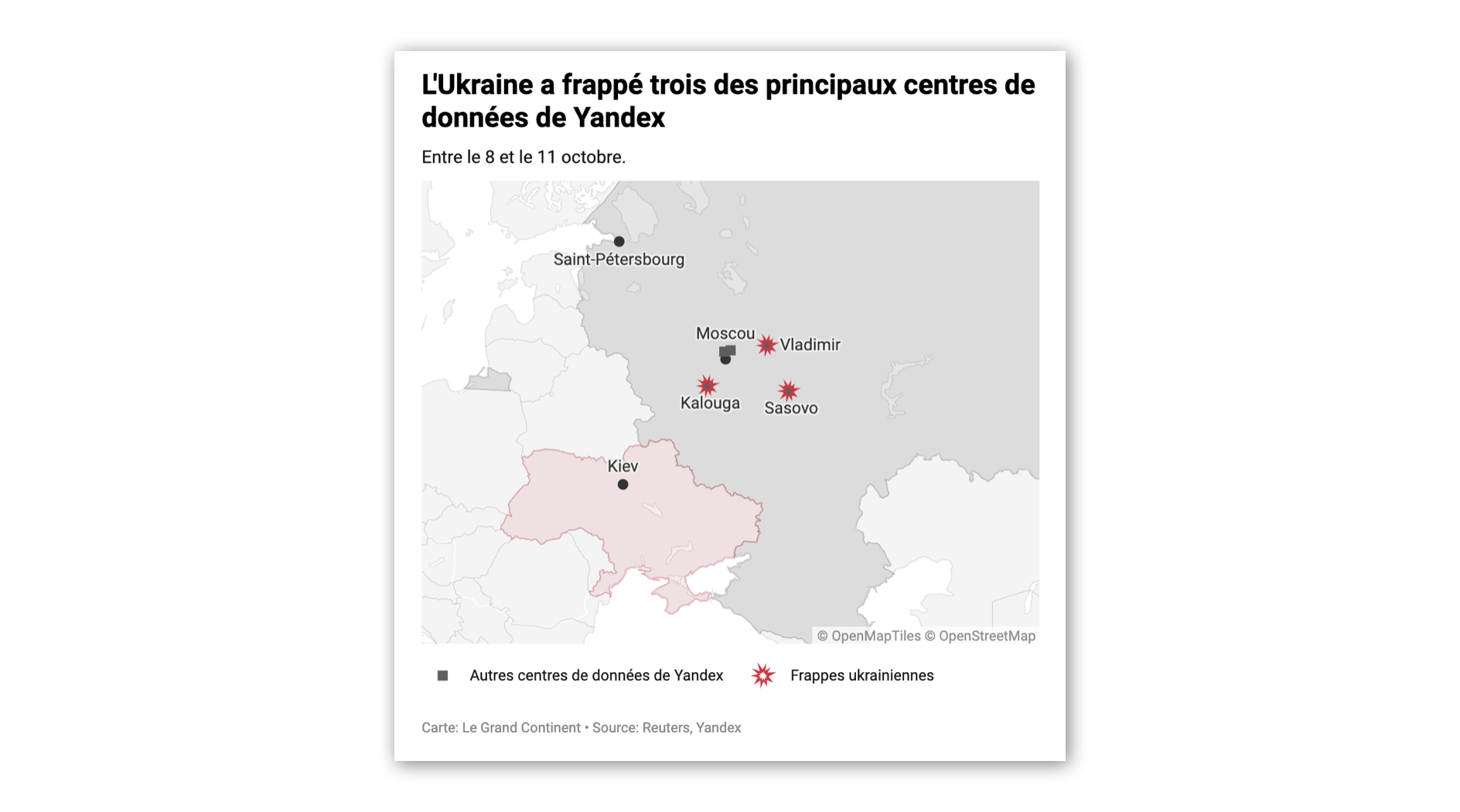
Between Thursday, October 8 and Sunday, October 11, three of Yandex’s major data centers were hit by Ukrainian drones, causing partial or total shutdowns of their operations.
In the hours that followed, Cloudflare data showed a substantial drop in traffic generated by Russian bots.
- Some observers, including Czech Member of the European Parliament Tomáš Zdechovský, suggested a link between this drop in traffic and an alleged reduction in the support provided by bots on social networks to several far-right forces, including the AfD in Germany and the MAGA movement in the United States.
As things stand, Cloudflare data do not allow establishing a connection between the offlineing of these “bots” — which are largely indexing robots (“crawlers”) used by Yandex to crawl pages and reference them — and the number of posts or interactions with pro-extremist content.
- According to Kevin Limonier, a specialist in the Russian-speaking cyberspace, one can nevertheless suppose “that certain components of the pipelines that constitute most social media bots today have ceased to function, rather than the bots as a whole. It could be an LLM hosted in Yandex Cloud that suddenly becomes unavailable, an orchestrator like n8n that is meant to automate actions and is no longer online… ”
Cloudflare’s data clearly indicate a drop in the volume of automated requests following the strikes on the data centers. However, these data do not specifically concern activity on social networks, but rather on all sites protected by Cloudflare, which these robots visit notably to index them.
The Ukrainian strikes on the data centers could however have an impact on Russian digital interference activities.
- Two of the three affected data centers host supercomputers among the country’s most powerful, such as Galouchkine, housed in the Vladimir center, which ranks among the 150 most powerful in the world, according to TOP500.
- The disruption of the YandexGPT API, the language model hosted in Yandex’s cloud, could deprive trolling farms of tools to generate, translate and disseminate online disinformation.
- It is not unusual for Russian actors, whether state actors or linked to the state, to use public AI tools for interference operations, as Anthropic showed in a September report listing cases of Claude used for malicious and criminal purposes.
Given the absence of data, it is nonetheless difficult to assess the long-term impact of these strikes on actors operating at a broader scale, such as Russian military intelligence. That intelligence would fund self-hosted AI models, independent of commercial providers, to support some of its interference operations.
- Yandex, which says it cannot confirm whether Sasovo’s equipment will be restored, estimates that replacing the destroyed hardware could take several months, or even several years.
- Because of sanctions and the global shortage of memory and components, Russian companies struggle to obtain in large quantities the hardware required for major data centers (RAM, processors, etc.).
- According to Data Center Map, Russia has 14 times fewer data centers than EU member states, and 25 times fewer than the United States.