
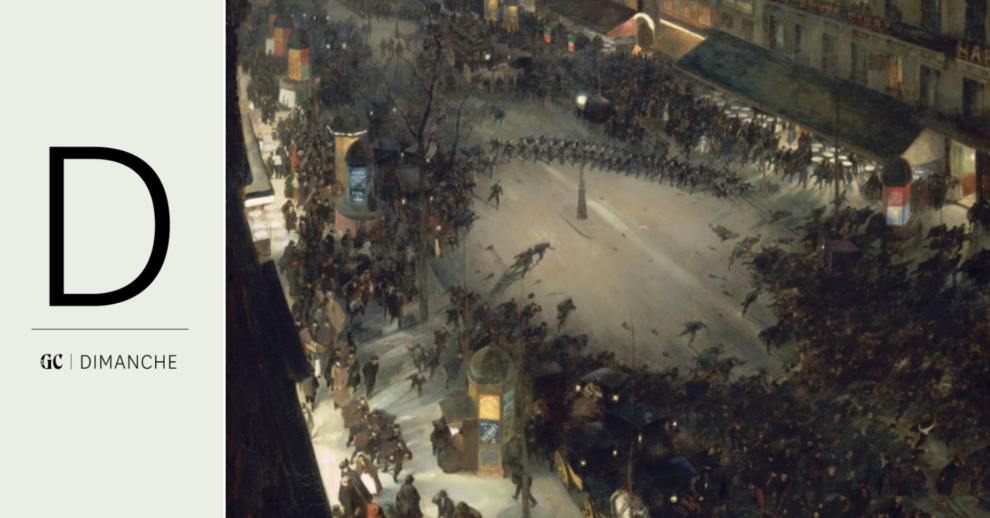
The Charge, by André Devambez, is a painting that was displayed at the Salon of the Société des artistes français in 1902. The first thing that catches the eye is its very particular point of view. We know precisely where it was painted from: from a Haussmannian building located at the corner of Boulevard Montmartre and Rue Vivienne, where Devambez resided, evidently from a balcony on the 5th or 6th floor.
It depicts a police charge against protesters. It is immediately clear that this is a night scene, with streetlights lit. It would appear to be the early part of the night. At the time, gas lighting was not entirely new, but it remained a feature of large cities.
The scene clearly takes place at the beginning of winter or the end of autumn, i.e., in the same season as the one we are currently experiencing. What allows us to say this is that the tree on the left side of the painting has no leaves. We know that the winter of 1902 was particularly cold, but it is not so cold on that day, since many protesters are dressed in suits. There are also people on café terraces.
One might be surprised that the demonstration takes place in the evening, but this was in fact quite common at the end of the 19th and the beginning of the 20th century, because people demonstrated after work. Demonstrations typically began around 6 or 7 p.m., and not during the day, except in the case of very large demonstrations. This one is not a large one.
If one moves closer to the painting, one sees that it is structured around Boulevard Montmartre, with a large open space around a street lamp that occupies the center of the composition and draws the eye with its light, which traces a circle. This circle is closed at the top by the police and at the bottom by the protesters. Their faces, depicted as lighter dots, indicate that they are fleeing. Everything suggests that the attack has not quite begun and that there has been no scuffle or trap, since the police lie behind the protesters.
The painting is deliberately deceptive. When viewed quickly, one gets the impression of considerable violence, especially from the police. One sees the protesters running and the gray semicircle of the police behind them. Most scholars who have studied this painting have stressed that the crowd was a major concern of the era. Gustave Le Bon had published his Psychology of the Crowd in 1895, in which he describes the crowd as a being distinct from each individual who composes it, a being particularly sensitive, capable of both the worst and the best, of violence as well as generosity.
The violence alluded to is reinforced by a number of details, notably by the fact that on the right, near the light line that cuts across the painting, one can glimpse a small white blotch that could be a handkerchief or a newspaper, but most likely something that was quickly abandoned. Just beside it, one sees someone who has just fallen. This person lies stretched out on the pavement. And if one looks a little further to the right, one can see a man stumbling on the sidewalk. There may thus be injuries.
That’s not what you think.
However, and this is where the painting is deceptive, if one looks more closely, one realizes that it is not a large demonstration. On one hand, there are relatively few people and the gathering is fairly calm, as onlookers on the sidewalks stand quite upright and do not seem frightened at all. In the foreground on the left, one even sees silhouettes buying newspapers at a kiosk that remains open; the café terraces are likewise open. People have risen from the café tables to witness the police charge, but again stand upright, chat, and form groups. One can also draw attention to the carriage horses. The initial impression of great movement is therefore contradicted by this mode of calm.
On the other hand, the police are on foot, whereas bicycle brigades had just been created by the prefect Lépine and we were witnessing the first bicycle charges of the era. Yet here, a relatively small police force stands in two ranks only.
This painting can also mislead us when we look at it today. Our habits regarding demonstrations might lead us to think of the movement depicted as some form of revolt, perhaps leaning to the left, and being repelled by police representing power and order in their conservative or reactionary sense. We cannot know with certainty who is protesting in this case, but we do know that there were a number of protests at the start of the 20th century, between 1900 and 1902 in particular, in defense of confessional schools, or anarchists, or nationalist anti-Dreyfusards. The image we might have today, with our current references, is thus probably not what the painting actually represents.
The reception
The reception of the painting is rather surprising. In 1902, at the Salon, it was perceived as belonging to the comic genre. One can cite a relatively little-known document: the account by Maurice Hamel, in which he writes that Devambez was perfectly entitled to make us laugh by having the boulevard swept at night by a line of city sergeants deployed in a triangle, driving away bewildered protesters, startling the cab horses, and causing the crowd on the café terraces to bustle. The scene, viewed from a sixth-floor perspective in a plongeant view, takes on an unexpected and striking comedic quality.
At that time, the painting was regarded in a very official manner as comic. It would later take on a very different career. Prefect Jean Chiappe, who took office in 1927, asked that it be displayed in his office. It was well known that visitors would see the painting shown there, now celebrated for the prowess of the police forces rather than as a comic work. It was not acquired by the State until 1979.