
With Patrick Modiano, Michel Houellebecq, Jean Echenoz and Annie Ernaux, Jean-Philippe Toussaint stands as one of the greatest contemporary writers in the French language. A number of scenes he imagined and wrote have become classics of literature. The honey-colored dress conceived by the stylist Marie (Nue, published in 2013 by Minuit, as are all of his books) and which is followed by a swarm of bees, the horse that vomits in the hold of a cargo plane (La Vérité sur Marie, 2009), the hero of the Emotions (2020) whose father has just died and who embraces his ex-wife who came to attend the funeral, thus rediscovering shards of the intimacy they once shared—these suspended moments form reservoirs of images, beauty, and emotions toward which Toussaint’s readers often return. Urgency and Patience (2012), a text that does not dwell on inspiration—of which he does not believe— but on literary creation, its elaboration, its rhythms and its stages, propelled this diptych, “urgency and patience,” into the vocabulary of those who write, whether amateurs or professionals. In Toussaint’s new novel, The Haunting, the image that lingers after finishing the book is a sex scene between the narrator and a woman, Yolanda Paul, who wears her right arm in a sling and a plaster around her wrist. She is the central woman in the novel, in the manner in which every James Bond installments possesses its own Bond Girl. When the narrator and Yolanda Paul lie together, the plaster soars above the narrator’s head: “She seemed, with this plaster, to be more naked than naked. I had never seen a woman so naked. It was fragility itself, flesh and crystal.”
I meet the writer in Villers-Cotterêts. Since 2023, this town of 10,000 inhabitants has housed the International City of the French Language installed in the Château de François I, admirably renovated. Toussaint is there “in residence.” Villers-Cotterêts lies in the Aisne, one of the departments most affected by illiteracy, in a region itself among the most affected by this scourge, Hauts-de-France. Thirteen percent of the Aisne population is illiterate compared to 11% for Hauts-de-France and 7% for the whole of France. Paul Rondin, the director of the institution, welcomes me and explains that the public institution’s bookstore is the only bookstore in Villers-Cotterêts, which nonetheless has three public middle schools and a high school. It is also the only bookstore in the Aisne within a 30-kilometer radius. For twelve years, from 2014 to 2026, the RN party led the town hall. In the municipal elections of 2026, it was defeated by a mayor from a center-divers list. A few days before my arrival, on a Saturday morning, Paul Rondin opened the château’s park to the residents of Cotterêts. Several books of the literary autumn were displayed and put up for sale: “And then Jean-Philippe Toussaint arrived in the park and visitors were astonished and delighted.”
He is here to run two translation workshops. The first focuses on Dante’s Inferno, which Toussaint had begun translating in 2012: “I thought I would stop, but I ended up drafting a first version that I revised with Dante specialists. The other workshop concerns translating The Chessboard. The book has appeared in four languages, but five more translations are in progress. I work with translators in Chinese, Japanese, Greek, Czech — a couple of hours every morning. It is extremely interesting.” The early novels by Toussaint were translated in China and Japan and he sold more than 100,000 copies there. For several years he hasn’t been translated in these countries, for reasons he does not understand and which have not been given to him. Translating The Haunting into Chinese may prove delicate since the book recounts, among other things, a Chinese espionage story at the European Parliament.
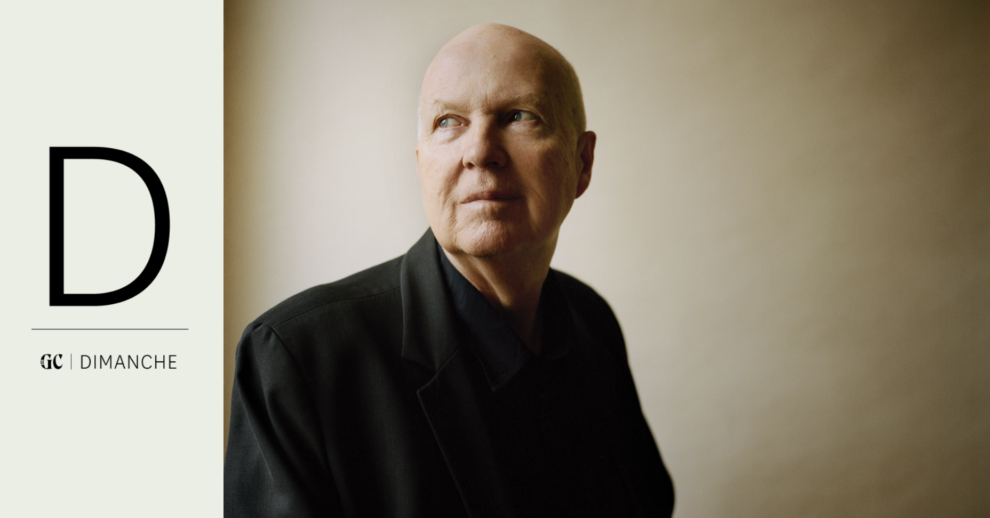
We are under the castle’s roof, on the second floor. Only residents have access to this part. It is bright; the light wood parquet is new, so worn-out older ones have given way; the castle was in ruins when Emmanuel Macron undertook its renovation. The residents sleep in a hotel because there are no apartments in the City. There is, however, a kitchen. It is three in the afternoon, there are still teas and coffees in thermos, and on a plate, brioche. Jean-Philippe Toussaint offers me some before we retreat to a bare, pleasant room, ideal for working. He is all in black, in jeans and a shirt; the light comes from his blue eyes, his pale complexion, and his bald head. He listens carefully to the questions I ask, smiling and patient. He has time ahead of him.
Which question to begin with when addressing a writer who so meticulously tends to the first and last words of his books? The Haunting opens with “— What kind of man is your father?” To that simple question posed by a family friend to the narrator whose father has just died, he adds others: “What can one answer to that? How, in a few sentences, to summarize a life? How, in a few words, to define a man’s personality, and especially that of one’s father?” The novel paints the portrait of this fictional father, a character nourished by the writer’s own father’s biography. USB Key (La Clé USB, 2019) and The Emotions share the same protagonist as The Haunting and unfold in Brussels, more precisely around the European Parliament. We do not stroll through Brussels, but there are frequent references to “the avenue Molière,” which I don’t know, yet whose name conjures something broad and shaded, elegant, residential, quiet, and conducive to high-stakes dealings. Toussaint and his publisher gave the trilogy the name “the Brussels cycle.” The European capital is Toussaint’s birthplace (he was born there in 1957). Before that there had been the “cycle of Marie,” a quartet of love novels.
“Love Says It All Without Saying It”
The hero of the Brussels adventures is named Jean Detrez, a name that can be heard as “distress.” Melancholy always surfaces in Toussaint’s work, yet he catches it immediately, with the same motion. How does he dose his irony, and keep it in check so deftly? In the manner of Nabokov, whom he admires, he walks a tightrope: “You’re right, it’s a matter of balancing. A long time ago I wrote a very serious book called The Reticence (1991). I kept laughing while writing it and then I removed all the funny bits, and unfortunately the reader could not enjoy them. I have this taste for making people laugh; it’s even an aesthetic criterion. But the only book where laughter was a conscious objective is The Television (1997). I must hide my game. I must surprise the reader without disrupting their attention. Another thing I thought about when listening to your question is that you must always believe in what you do. I never mock what is said.” The humor also hides in the proper names of The Haunting. Some recall the world of Tintin: “The Tintin reference does not charm me, even if the allusion to the ‘ligne claire’ is relevant. Names like John Stravropoulos, Gabin Trinh-Duc, I can see that they might remind you of Tintin. But I think there is something more grave, more intimate and sometimes more autobiographical. There is no second degree in my work, nor that Echenozian tendency to flirt with genre. I admire what Jean Echenoz does, but that is not what I am seeking.”

The deceased father of the hero was a senior official at the European Commission. His strong character and authority recall those of the real father depicted in The Chessboard. Died in 2013, Yvon Toussaint was a journalist and ran the Belgian daily Le Soir. How is it, then, that while everything in The Haunting signals Jean Detrez’s love for his father, the word “affection” is what the narrator uses to describe what binds him to his father, rather than the word “love”?
“Good question, I don’t have an answer. But you’re right: everything says love without saying it. And perhaps in that moment, when the narrator stands before a stranger, a friend of his parents who asks him to listen to the father’s voice, the word ‘love’ wouldn’t suit. There is a modesty, and the term ‘affection’ participates in that modesty. It is better if everything is said without anything formalized. At my father’s death, something opened up. I even discovered Brussels. It is, certainly, my city, but I discovered the European Quarter, a fifteen-minute walk from my home.” The use of the word “affection” also signals that filial love remains ambiguous.
Why John le Carré?
The Haunting is partly a thriller. Jean Detrez stumbles upon a USB key, reads its contents and discovers that European Parliament officials have set up a network of international corruption in service to China. Brussels is filled with spies; Toussaint has read that it is the city with the most spies, along with Washington. In March 2025, Le Soir revealed that police had conducted searches at Huawei lobbyists for corruption, forgery and use of forged documents, money laundering, and an organized crime group active since 2021.

A dozen or so European Parliament members were suspected of receiving gifts from the Chinese telecom giant Huawei: “The case interested me, obviously, but it is not my entire purpose; I am not conducting a thorough investigation, I am not denouncing anyone. In the novel all this forms part of a kind of cloud of plausibility.” His interest in espionage novels is tied to his father: “He greatly admired John le Carré. When I was approaching my father’s territory, I asked myself: ‘What is this John le Carré about?’ I read one and did not like it. And I told my mother: ‘No, John le Carré isn’t my thing.’ Then I read a second, a third, then a fourth and fifth, with a son’s cordiality. All of this to say that, in a sense, I wrote books to please my father.”
His attachment to Europe, Toussaint adds, is a legacy: “When you are Belgian and of my generation, the European ideal is obvious and natural. The cultured Belgians of my age are all pro-European, which isn’t necessarily the case in France, given the weight of the nation. In Germany there is the Länder… Unless one is truly populist or far-right, Belgium immediately understood the importance of Europe. Everyone else eventually understood, but they don’t say so. They enjoy Europe’s advantages while speaking ill of it. I cast the father of the narrator as a great European humanist. My father was a great European humanist, and I stand in that tradition. I harbor not the slightest reservation about Europe. Even if I agree that it isn’t perfect—yet—I remain a big fan.”
Rue Saint-Guillaume, at Modiano’s
The novel also unfolds in Asia and in Paris. Jean Detrez spies on someone from a dimly lit apartment on Rue Saint-Guillaume, in the 7th arrondissement, a setting that evokes Modiano’s Haussmannian interiors in which a lamp, and only one, glows and is glimpsed from the street by the narrator: “That reference delights me; I adore and greatly admire Modiano. I used to advance even further into his territory in The Chessboard: I mention a friend from my adolescence, and the 1970s resurface. There, it’s entirely De si braves garçons (Gallimard, 1982), where a boy imagines his father as a spy. The pinball machines, Saint-Lazare station, the boarding-house trunk—I’ve lived through that in the 1970s too.” Jean-Philippe Toussaint regularly rereads Modiano, just as he rereads Proust: “I keep him company all the time; he’s a comrade. ‘Comrade’ is a term Robbe-Grillet used: my comrade Flaubert, my comrade so-and-so. It denotes a regular acquaintance.” Reading time, for him, is in the afternoon and evening: “In the morning, I read only myself. I wake up and reread myself.”
The choice of the title The Haunting followed a rule. The last word of The USB Key is “emotion,” and the last word of The Emotions is “haunting.” Toussaint had chosen the title during the writing of the book, thinking that if he found something better, he would change it: “Throughout the writing, I asked myself: What is this haunting? It should be defined.” I drafted a fairly beautiful sentence to define it and, upon rereading, I removed it. I thought it more interesting not to say anything and that each reader, the right reader, would decide for themselves which haunting it is. In fact, the title would be almost: The Haunting? followed by a question mark: is it linked to Stavropoulos? To Yolanda Paul’s duplicity? To the father’s death, or to the narrator’s fear of having his computer stolen “bare-butt naked”? It is more interesting not to say it; the lack is richer.”
The Frontiers of Literature
In The Emotions there was more unease and even anxiety. Jean Detrez buried his father and divorced for the second time, or for the second time—no one is immune to a bad encounter and a third failure. Diane, his second wife, kept their shared apartment and Detrez quietly retrieved his belongings as Diane was away. He was no longer at home while still being a little at home. Toussaint, without stating it, created the impression we all feel in a separation, or in the death of a parent from whom we vacate the apartment: “The unease in The Emotions stems from the sense of being a son. There was something more psychoanalytic, more serious and gravely than in The Haunting, which is more playful. Even if there are moments when there is cause for worry, I wasn’t personally anxious while writing it; I could see that the novelistic element dominated all of it. The Emotions is more autobiographical. I tried to say something deep about my father and perhaps about myself, about this anxiety that accompanies me. Psychoanalysis really worked!”
Jean-Philippe Toussaint tells me he has never undergone analysis. In The Urgency and the Patience, he uses the expression “oceanic feeling,” which Romain Rolland used when addressing Freud: “My mother was a great reader of Freud. When we were little, my sister and I, she explained all our missed acts. Before even reading Freud, I knew all that very well. I have always found it rich to employ Freud’s broad intuitions without naming them.” The New Roman did not like psychoanalysis. Edited by Jérôme Lindon (The Bathroom, published in 1985, is Toussaint’s first novel), the author has adhered to this refusal of psychology in his early books: “But from the Marie cycle onward, I allowed myself nothing else. I was pleased that there was some of that in the relationships between my characters. Freud’s insights, like Proust’s, bring a great deal to literature. They are small touches of subtlety that I don’t see why I would deprive myself of.” He regularly rereads the volumes of In Search of Lost Time. Recently, it was the last section of Time Regained, “the very last scene, on creation, which is the most extraordinary part of In Search of Lost Time.”
These books about the father are magnificent; but what about his mother? “Let me answer by telling you an anecdote. I was in Buenos Aires in May and I was discussing The Chessboard with a journalist. I told him that I had heard a lot about my father when I published that book, while I speak more about my mother. He replied: ‘It’s like football—the difference between possession of the ball and scoring a goal. Your mother had possession of the ball and your father scored the goal.’ I said that did not surprise me about my father. He would have been glad to hear that. That’s one element of an answer. Of course I think a great deal about my mother and a book about her, but she died in 2023, my father in 2013, so he was ahead of her. I will devote time to my mother. The new novel took autobiography to the foreground, claiming that it wasn’t literature. How can a writer who is mainly concerned with form yield to the temptation of autobiography? One must find conceptual touchstones. It is precisely the conceptual questions that interest me, because writing, broadly speaking, is easy. Having a conceptual reflection on literature is much rarer. It must be flexible, intelligent, barely perceptible. That is very tricky. In most books, either the form is heavy-handed, or it does not exist. This conceptual search nonetheless stems from how the Nouveau Roman perceived literature, which seems to me the right path. There is a reflection on literature in every sentence.”
There was no reason to fear this interview. I did fear it, however, because of a passage in L’Échiquier (2023) about a high-school girl he calls Hélène (“The name has been altered—or perhaps not; I don’t know.”) This passage caused talk. Like other readers, I find that Toussaint lacks indulgence toward this young Hélène and that the two pages dedicated to her are harsh. The pupil had sent him a letter in 2005, at a moment when he was, he writes, “tweaked by the trigger, reacting at the slightest provocation.” This charming expression, of course, saves Toussaint. But still. Hélène had read Fuir, selected for the Goncourt des Lycéens, and then she wrote to the author. She didn’t understand the novel; in her view, it didn’t tell a story and didn’t convey a “message.” Toussaint, irritated, replied “with care” and reproduced his answer in L’Échiquier: “I could have greeted your letter with a shrug and a wry smile. But I will answer you, because your letter seems to me a clear example of a widespread misunderstanding of what literature is.” Literature does not have, he writes, a vocation to tell stories or to deliver a message. He adds: “In truth, the sources of your legitimacy escape me. It’s because you are in top ‘literary’ class that you judge me—and condemn me—with such aplomb. It’s as if your ‘scientific’ first-year classmates judged quantum physicists and wrote to complain that their work is incomprehensible. Comprehensible to whom?” I ask Jean-Philippe Toussaint about this affair: “It’s been raised too much for my taste. If I had known all this, perhaps I would have removed that passage. It wasn’t a stake of my book. I didn’t care about that thing, but I put it there to redeem literature. I did an interview in Brussels in a bookstore and the person who questioned me about it a half-hour there. In Switzerland, at another meeting, I had to explain myself, some defended me, while I had no wish to be defended, nor to be attacked. There was no crusade intention on my part, and I regret the militant tone of that passage. But I stand by what I said.”
We part around five o’clock in the evening. Jean-Philippe Toussaint tells me about the trains that connect Paris to Clermont-Ferrand. One of his friends was caught for several hours recently on that line. The cars are old and the journey long. The little he tells me about it sounds like a scene from a novel.