
Do you know three Chinese provinces? To understand Xi’s China, you have to step outside Beijing and Shanghai. Our new series goes to meet the spaces where another figure of the future is being formed. To receive this series which has already taken us from Sichuan to Zhejiang via Guangxi, subscribe to Grand Continent. In your email inbox from eight euros per month
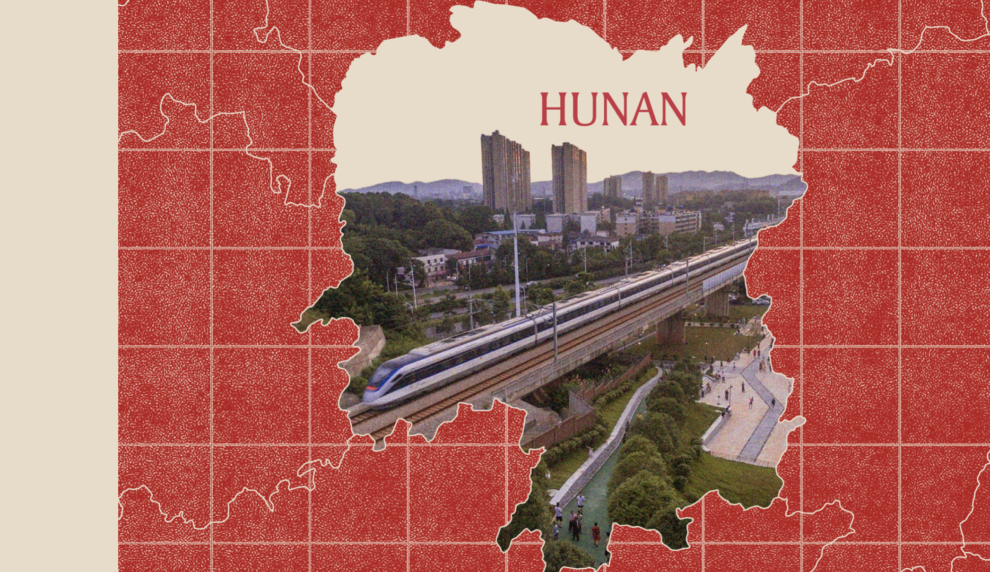
In Zhuzhou, a typical industrial city in Hunan Province, central China, a railway viaduct cuts through the heart of the city. It is often said that it was “brought here by trains.” Employed across the region, this phrase has gradually become a badge of local pride.
From “156 Projects” to Market Reform
There was a time when the railway company handled everything. The administrations and factories did not merely provide jobs, but also ran schools, clinics, and residential complexes for the families of their workers. Everything radically changed shortly after 1993 with the shift to a market economy.
Primary schools once reserved for railway workers’ children are now open to all. In the southern suburb, on the site designated by code “331,” a middle school has replaced the armaments factory built under the nationalist regime. During the Cold War, Factory 331 (today China Aero-Engine Corporation Southern Industrial Co., Ltd.) was part of the “156 Projects”—key industrial and mining schemes imported from the Soviet Union and Eastern Europe during the First Five-Year Plan (1953-1957). They covered, among other sectors, coal, electricity, machinery, and non-ferrous metals. In 1960, when the Soviet Union withdrew its aid, 133 of them had been completed and put into operation. It was one of the largest foreign aid programs of the socialist bloc.
The Soviet Union had sent 14 experts to Zhuzhou, along with plans and machinery. It also left behind red-brick buildings with a recognizable style. On August 16, 1954, the first Chinese aircraft engine was built at Factory 331. Two months later, Mao Zedong personally signed a letter of congratulations, and his text, carved in stone, still recalls this episode today.
Following this model, Zhuzhou also built Factory 601 (a cemented carbide plant), a power plant, and a coal-washing plant. The aid program provided technologies, funding, and expert guidance. It also allowed many Chinese technicians to train in the Soviet Union. But Sino-Soviet relations deteriorated. In July 1960, aid abruptly ended. Moscow recalled all 1,390 experts then in China, who left with their technical documents .
In 1964, as the United States’ war in Vietnam intensified, Mao Zedong, concerned about national security, launched the “Third Front” construction. The plan aimed to mobilize the nation’s resources to relocate key coastal industrial and military sites inland. These regions were poorly served, but factories could shelter there in the mountains and caves. Hunan was part of this plan.
This national campaign to equip the country with an autonomous industrial base reached its peak between 1965 and 1966. According to official statistics, western Hunan built 71 large- and medium-scale projects during this period, with investments totaling 4.5 billion yuan, i.e., more than 70% of the province’s equipment expenditures at the time. These projects were not economically profitable. Nevertheless, they laid the foundations for Hunan’s later rise as a major industrial province.
But with the start of the Cultural Revolution in 1966, the Third Front project faced setbacks and repeated disruptions. Many projects were wholly or partially halted. The Third Front fostered a generation of “children of the industrial complexes,” raised amid intense pollution. It produced families that were particularly dependent on the state system. When state-owned enterprises were restructured and the country turned to market reforms in the late 1990s, these families were left behind. Many workers, reassigned or laid off while still young, left to seek their fortunes as migrant workers in the south, in Shenzhen or Guangzhou.
Even today, some envy those who moved to the South, telling themselves, “If only I had taken the plunge back then, my life would not have deteriorated so much.” But few there have truly made a fortune.
Geography and Industry of Hunan
The railways, the red-brick houses, the nearby unemployment… To tell the story of Hunan, one must place these images in their historical context.
By the end of 2025, Hunan counted 64.92 million permanent residents, roughly as many as France. In 2025, its GDP stood at about 5,530 billion yuan (nearly 700 billion euros). This placed it tenth in China and made it a major economic power in the central region. Yet the province is very populous: its GDP per capita in 2025 was about 84,600 yuan (around 11,000 euros). This figure was below the national average (around 12,900 euros) and represented less than two-thirds of that of coastal provinces like Jiangsu and Zhejiang .
Hunan lies south of the middle reach of the Yangtze. It hosts Lake Dongting, China’s second-largest freshwater lake. Around the lake the terrain is flat and crisscrossed by rivers. Its subtropical monsoon climate brings both rain and heat. These conditions make the Dongting basin an ideal ground for rice cultivation and freshwater fish farming. Hence the Dongting Lake basin is nicknamed China’s “Land of Fish and Rice.” The province’s deep agricultural roots give society a stable base. Today, agriculture accounts for only about 9% of the economy, while industry accounts for around 29% of provincial GDP and supports about 41% of its growth. Industry also provides 42.7% of tax revenues .
The geography of Hunan has also shaped a distinctive culinary culture. One of its main traits is a love of spices, especially chili peppers. It is said to ward off moisture from the body, a valuable asset in such a heavy, humid climate. At a time when preserving food was difficult, the Hunan people developed smoking, salting, and marinating techniques. This love of spices even found its way into the province’s political character. Mao Zedong once quipped—widely quoted—“No chili, no revolution.”
This was only half a joke. Pragmatism, boldness, and tenacity (“baman”) have indeed become hallmarks of Hunanese identity. The province’s modern history has seen the birth of major political and military figures: the leaders of the Hunan Army at the end of the Qing dynasty, Zeng Guofan and Zuo Zongtang; the figures of the 1911 Revolution, Huang Xing and Song Jiaoren; and several marshals from Hunan who count among the founding generals of the People’s Republic.
In his work Provincial Patriots: The Hunanese and Modern China, Stephen R. Platt asserts that this is no accident. He argues that the Hunanese rediscovered, in the thought of Wang Fuzhi, a pragmatic and worldly philosophy, as well as a sense of national consciousness. The victory of the Hunan Army over the Taiping Rebellion also helped weave a broad network of regional ties that supplied the talents needed to organize the 1911 Revolution.
After the departure of the Soviets, Hunan relied on the industrial base inherited from the Third Front. It gradually built construction machinery into a key industrial chain to develop. From 2000 onward, China built roads, bridges, and buildings on an unprecedented scale. Riding this wave, demand for excavators and cranes exploded. The Changsha-based groups Sany and Zoomlion thus became leading providers of basic industrial equipment. Local media often use the term “Hunan Army” in reference to Zeng Guofan’s army to designate the province’s industrial flagship, their construction machinery symbolizing troops.
In 2017, Changsha became the first city to implement the “Chain Leader System” (链长制). In this governance model, a government official acts as the “chain chief” and helps coordinate land, capital, and policies. A leading enterprise takes on the role of “chain master,” and handles innovation and market expansion. The scheme has partly improved the local supply rate, but it has also led to abuses, such as excessive administrative intervention. In September 2020, Xi Jinping visited Hunan and defined the strategy of the “Three High Plateaus and the Four New Missions.” Building a “nationally important high-end manufacturing plateau” thus became a provincial priority .
Behind the Entertainment Capital, Inequalities Deepen
Hunan is also nicknamed the “Entertainment Capital,” of which Changsha, its capital, is the showcase.
It was on Hunan’s satellite television channel (the Hunan Broadcasting System) that Changsha began to emerge as a hub of viral culture. In the early 1990s, the channel was still only a provincial channel. It relied on advertising for agriculture and livestock. Its annual revenue was less than 60 million yuan (about 7 to 8 million euros). The inhabitants humorously nicknamed it the “Fertilizers and Animal Feed Channel.” But in 1993, Wei Wenbin, the channel’s new director, launched reforms. According to him, entertainment was what China most lacked at the time.
1993 was also the eve of the restructuring of state-owned enterprises. The wave of reforms that would close the factories in industrial cities opened, at the same time, the floodgates of the channel’s advertising revenue.
The channel then surged into entertainment. Happy Camp, a weekend variety show, was launched in July 1997. It accompanied the childhood of several generations of Chinese and forged a collective memory. In 1998, the historical drama My Fair Princess, produced by Hunan Economics Channel, drew an average audience share of 45%, with peaks above 58%, a record for the channel. A quarter of a century later, the series, adapted from a novel by Taiwanese author Qiong Yao, is still rebroadcast every summer and remains at the top of the ratings.
In 2004, Hunan TV launched a program titled Super Girl, a talent contest for the broader public, whose format resembled Star Academy. The second season, in 2005, achieved unprecedented success, with more than 150,000 people registered across five regional selections. For the first time, hundreds of millions of viewers tasted the thrill of choosing the winner themselves.
It is on this television undergrowth that Changsha became a factory of trends. Many people trained within Hunan’s audiovisual and media system later contributed to the creation of new mainstream public brands in the province. These brands place importance on media and cultural creation, understand young people, and know how to create buzz. Take, for example, the local Cha Yan Yue Se tea brand, which gained popularity a few years ago. At first, it focused its outlets in Changsha and became known on platforms such as Douyin (the Chinese TikTok), riding a wave of “scarcity marketing.” Since 2022, the brand has gradually expanded to cities such as Wuhan, Nanjing, Chongqing, and Shenzhen. Its poetic name and traditional-style shops seem to meet young people’s desire for cultural identity.
Strolling today through Changsha, one often sees long queues in front of many brands and stores. Besides bubble tea, Hunan’s nighttime specialties include fried and peppered stinky tofu (臭豆腐), and kouwei xia (口味虾), spicy crawfish.
This consumption frenzy is partly due to the relatively moderate cost of living. In 2016, while housing prices were skyrocketing nationwide, Changsha imposed resale restrictions and land-price regulations to prevent real estate speculation. According to the 2020 study by the E-House Research Institute on the price-to-income ratio in 50 Chinese cities, Changsha’s ratio was only 6.2. This placed it last among the 50 cities: in other words, a family could buy an apartment with a little more than six years of income. In the same year, Shenzhen’s ratio reached 35.2.
This growth is highly uneven across the province. Thus, in 2023, Changsha’s GDP per capita represented 1.82 times the provincial average. This multiple placed it at the top among all Chinese provincial capitals, even though it had fallen from the previous year (1.86). In 2025, Changsha continued to account for 28.5% of the provincial GDP, and this enormous internal imbalance could widen further in the coming years.
Turning Abroad: A Growth Lever
The Chinese real estate sector faced a brutal decline after the pandemic, and infrastructure investments stagnated. The province’s industrial machinery sector must reinvent itself, and its growth is now playing out internationally.
Since 2019, the China-Africa Economic and Trade Fair has settled in Changsha, where it has been held four times. In 2020, the Hunan Pilot Free Trade Zone opened its doors, with Africa as a top priority for cooperation. In 2025, for example, Sany Heavy Industry—one of China’s largest construction equipment manufacturers—reached international sales of 55.86 billion yuan (about 7 billion euros), or 64% of its total. Revenue generated in Africa reached 8.31 billion yuan (about 1 billion euros), up 55.29% from the previous year.
The construction equipment from Hunan is also widely used in infrastructure projects in Belt and Road Initiative countries. From a tram line in Ethiopia to copper mines in Zambia, to Algerian highways, machines from Hunan’s factories are found almost everywhere. Their presence also fuels debates in some countries about working conditions and debt.
The city that trains “brought here” now sees its residents and its machines depart. In the 1950s, Zhuzhou welcomed fourteen Soviet experts; today it exports its construction machinery, the roles having reversed. What this passage will leave in Africa remains unknown. In 1960, no one knew that the red-brick buildings left by the Soviets would still mark the city sixty years later.