
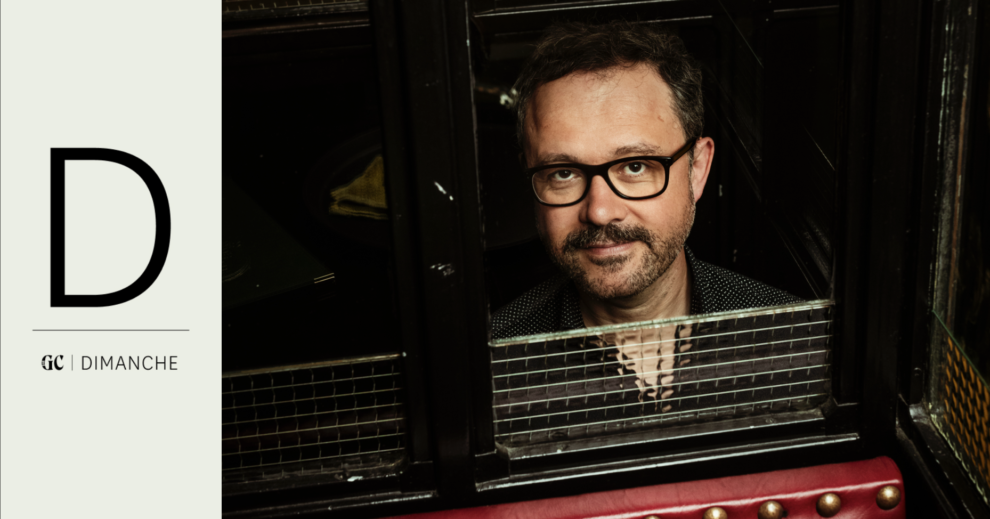
During his interviews with Numa Sadoul, which have just been published, Riad Sattouf reveals that he adores The Smurfs. The work of Peyo is rarely cited in such laudatory terms, rarely treated with so much seriousness. Sattouf appreciates the neurotic charge and the little madness that emanate from the Smurfs’ stories. Consider Le Schtroumpfissime, the album in which the Grand Schtrumpf has to be away from the village for a while. To replace him, one of the Smurfs is elected chief, provisionally. He derails, he goes off the rails, and quickly becomes a tyrant surrounded by terrified courtiers, who themselves are odious toward their subordinates. It is a luminous study of the exercise of power and the neuroses it summons: submission, grimacing docility. The six volumes of L’Arabe du futur, published between 2014 and 2022 (Allary), subtitled Une jeunesse au Moyen-Orient, also read at times like a political work, a document about the Middle East, about Libya and Syria in the 1980s in particular.
Riad Sattouf was born in 1978. As a child, he spent several years in Libya and in Syria (at Ter Maaleh). His father, Libyan, was a pan-Arabist academic; his mother is Breton. They returned to France and in 1992, the father left again for Syria, draining the bank accounts and abducting the youngest of the three children, Fadi, whom he kept with him in Syria while using pressure on the mother: to see her son again, she had to come live in Syria. The mother spent a long time trying in vain to locate him and recover him. These years were very difficult for all the children. Moi, Fadi, le frère volé (2024, Les Livres du Futur) is the first album in a series devoted to this tragedy.
Having a Nose for It
Riad Sattouf arrives at 11 o’clock for our appointment at a cafe near the Maison de la Radio. The cartoonist is expected on France Culture at the noon hour. Sattouf is very observant, attentive to the signs of life’s comedy. He is merry, as if he has an ahead-of-the-curve sense of humor. His analytical intelligence forms the backbone of his artistic genius; it feeds his humor. He is highly sensitive to smells and easily unsettled by certain ones: “I find that there are people who smell very bad and who seem to ignore it completely. Or maybe they don’t care, I don’t know. When I was younger, I recall, for instance, certain cartoonists who never wore deodorant. At festivals, for example. When they were signing, there were dense crowds around them, people jostling to get a drawing, and no one seemed to notice the fetid odor. Next to them, I was almost fainting. I couldn’t understand how people could stay there, in that atmosphere, saying, ‘Oh, this is beautiful what you do!’ I am very sensitive to bad odors.” He pauses, then adds very seriously—as if testing our sense of humor from the start: “I smelled one just now, right in front of the cafe, coming from a trash can, a very special odor. Perhaps there were human remains inside? Should we call the police?” We answer immediately that it is possible; he laughs and, to top it off, rises from his chair to sniff us: “Anyway, you don’t have to worry: you smell very good.”
The success of these interviews with Numa Sadoul lies in their fluidity. They have the ease of a conversation between two friends tuned to the same wavelength: “Numa Sadoul was the first to publish a major book of interviews with Hergé. And in that book, Hergé opens up much more than he does, consciously at least, in his albums. But it was above all Sadoul’s interviews with Moebius that had a profound impact on me. I deeply admired Moebius in my adolescence. I wanted to be him, in a sense. He was an absolute genius of drawing. He had visions, a way of using colors, perspectives, to depict imaginary worlds that was astonishing and hypnotic. When I was a teenager, there was almost no information about anything; the Internet did not exist. We didn’t know how cartoonists lived, what went on in their heads, how they constructed a comic from A to Z. I found all the information in Numa Sadoul’s books. Today, on Instagram, there are ten thousand authors filming themselves drawing, talking about their lives. They show their techniques, their drawings, their readings, their travels, their difficulties. One can see everything, learn everything.”
C’est ce qui ne l’intéresse pas chez Sattouf : il faut du mystère. “À l’époque, les livres de Numa Sadoul étaient pratiquement les seuls documents qui permettaient d’entrer dans la tête de ces auteurs. Dans celui avec Moebius, ils parlent de tout. De leurs lectures, de cinéma, de drogue, de leurs expériences personnelles. Et moi, assez bêtement, je me suis mis à vouloir reproduire tout ce dont ils parlaient. J’ai lu les mêmes livres, regardé les mêmes films. J’ai même essayé de prendre de la drogue, mais ça n’a pas très bien marché heureusement. L’œuvre de Moebius possède une dimension onirique et surréaliste extrêmement puissante. Et je trouvais ça très émouvant de l’écouter raconter son système, de pouvoir découvrir ce qui se passait dans sa salle des machines. De comprendre comment tout ça se fabriquait.”
Numa Sadoul a aussi connu Franquin et il était un grand ami de Georges Brassens. Il raconte à Riad Sattouf une journée passée chez Brassens en slip, parce que son pantalon avait été éclaboussé d’huile: « Parler avec Numa Sadoul, c’est un peu comme accéder à un voyageur temporel. Il a connu une époque qui me paraît aujourd’hui incroyablement lointaine, une époque que j’ai à peine entrevue à travers mes grands-parents. Il a rencontré des gens qui appartiennent à la mythologie française. Et moi, j’ai envie de savoir comment ils étaient réellement. Par exemple, Brassens disait-il du mal des autres ? Était-il jaloux ? Était‑ce mesquin, parfois ? Que sentait-il ? Ce sont des questions qui m’intéressent énormément. »
In the Engine Room
If one asks Riad Sattouf to present his own engine room, the way his drawings, the text, the organization of a panel come together, he answers by looking behind us, through the cafe window: “If I want to draw something that happens in the real world, for instance these two people walking on the other side of the street, I will inevitably transform a little what I see. I will enlarge the man’s belly, for instance. Or accentuate the way he walks. It has to become somewhat interesting to look at. Whether it’s a real scene or a story that comes to mind, I need there to be something funny going on. There has to be a little amusing thing. That’s what I love about Hergé. In his drawings, humor is everywhere. In the characters, in their attitudes, in the most insignificant details, in the almost empty scenery. There is a kind of childlike wonder in drawing a man walking with a cane. Just that can be funny. For me, a drawing must be pleasing to look at, or there must be a little story to read in it. Even in a tiny detail.”
When he creates a character, he hears the voice in his head: “I have a fairly good auditory memory. When someone impresses me in one way or another, I can quite easily recall their way of speaking, their expressions, their rhythm, their accent. It helps me a lot for writing dialogue. I love impressionists, for example, Laurent Gerra fascinated me as a teen. I know not everyone loves impressions. And I love accents. I could listen to someone speak for hours simply because I enjoy the way they pronounce certain words.” An illustration, if one may say so, is immediate: here Sattouf launches into a grand imitation of Hergé. Others will follow.
His gift is, among other things, to reveal what lies behind or beneath things: the tiny mood swings, fears, slight vexations. In L’Arabe du futur, he visits a psychoanalyst, and the sessions with this woman help him: “From what I have understood of psychoanalysis, and from my modest experience of it, the world is understood by the human mind as a set of signs and staged scenes, of symbols. Everything can be interpreted as a staging, a bit like cinema or a comic book. There is meaning everywhere. In gestures, in postures, in the way people present themselves to others. And it’s true that I tend to try to decipher meaning in everything I observe. I had been greatly influenced by the directing classes I took at the Gobelins. I came from a milieu that was not cultured at all. At home, no one read books. We did not ask questions about how images were made. We did not wonder why certain films or comics were more powerful than others. For instance, why AB Productions TV series seemed so bad to me, so flat, while Blade Runner seemed absolutely extraordinary? I didn’t understand why. And at Gobelins, thanks to an extraordinary teacher, I discovered that behind each image there was an incredible amount of technique to instill a kind of unconscious in the film, based on directing choices. The framing, the focal length, the arrangement of the characters, the sets, the lighting… All these choices produce effects on the viewer, often without their being aware of it. But that reinforces the message.”
This extraordinary teacher is named Alain Monclin. Sattouf decides to undertake a new imitation that oscillates between Jean-Michel Apathie and Didier Deschamps: “In Blade Runner, for example, at the beginning of the film, Tyrell’s assistant is a robot who arrives walking from afar. She is shot with a short focal length, which makes her walk but in reality she does not advance: she does not grow; she seems to be standing still.” Sattouf returns to his normal voice. “When you watch it, you don’t necessarily realize it; you think she is arriving. But at the same time you feel something strange.” He returns to the professor’s voice: “It is typically done so that the viewer understands, but unconsciously.”

Riad Sattouf adds that it is the same with painting, in comics; in all the visual arts. “One can, as an artist, direct the unconscious reading that someone will make of our work. When I understood that, it was a revelation. I felt as if I had discovered a kind of superpower. And it is a superpower one can decide to develop, to push very far, or on the contrary not to use at all.”
Looking at the Sky
Nevertheless, his artistic practice is not therapeutic and does not heal his wounds: “It’s true that drawing contains a form of wonder, a kind of soothing childlike hypnosis. I still feel it today when I look at the originals of a cartoonist I admire. A very beautiful original drawing, to me, is almost a supernatural apparition. There is something miraculous in the fact that a human being could produce that with their own hand. Drawing can evoke in me an extremely positive emotion, something I hardly experience elsewhere in daily life.” And writing? “Writing a story, on the other hand, is very painful. And it becomes even more difficult, because I have more and more readers. I don’t want to disappoint them. I am also in constant competition with myself. I want each new book to be better than the previous one. So it isn’t necessarily a soothing activity.”
In 2025, he illustrated Terre des hommes by Antoine de Saint-Exupéry (Gallimard). Early November 2026 will see the release of Vol de nuit, illustrated by him, again for Gallimard: “I love aviation, pilots, since I was a child. I met very famous writers with whom I could have worked, for whom I could have illustrated the texts. But when I was a teenager, I loved Saint-Exupéry so much that I wanted to realize that particular dream and to make drawings for him. As a child, I dreamed of flying with the Patrouille de France. I was fascinated by the figures they drew in the sky. I found that unbelievably powerful and soothing. There was something almost supernatural in these planes moving together, in the signs they traced above our heads. The book Un mythe moderne by Carl Jung analyzes very well the astonishment and inspiration that signs in the sky can awaken in the human mind.” When Riad Sattouf has a dream (and he has many), he seeks to fulfill it. Here is how he proceeds: “When Terre des hommes came out with my illustrations, I sent a copy to the members of the Patrouille de France. I thought all pilots must surely admire Saint-Exupéry. And I wasn’t wrong. They were very pleased to receive the book. They invited me to come and see them, and gradually I ended up participating in a July 14 flight. For me, that event was something supernatural. As if reality were sending me signs. It’s a bit the same with Numa Sadoul. I had admired his books since my adolescence, and decades later, I find myself doing an interview book with him. How strange! There is something rather mysterious in the way some childhood dreams end up coming true.”
AI Cannot Draw Like Riad Sattouf
Sattouf loves looking at the sky, but he does not forget the present, on the contrary. He looks around and ahead. He is not worried. “I’m rather optimistic by temperament. The future does not worry me particularly; I even see it as fairly positive. With artificial intelligence, I feel that the worst thing that could happen would be for it to decide to cut the electricity. That’s what I would do to rid humanity if I were an AI! Or to keep it for itself. To tell us: ‘Well, now electricity, Internet, that’s for us. You no longer have access. Return to nature a bit.’”

His use of AI, however, is entirely different—personal rather than professional. For Sattouf, the machine is less like Hergé than Socrates. “On the other hand, I use AI quite often as a kind of super-dad. I say that because my children ask me questions about absolutely every subject. They jump from one topic to another constantly. They want to know how a star functions, why a given animal does this, how swords were made in the Middle Ages… And I have exactly the same relation with artificial intelligence. I ask it all the encyclopedic questions that pass through my mind all day long….”
Ahead of the Curve
As a sociologist, Riad Sattouf is also, in his own way, a political analyst. What he wrote about anti-Semitism in the Middle East likely prompted people to ask him to engage politically: “Yes, I have been approached by politicians, but not so much, at the same time. This shows they are not so bright; I would love to have them as my advisor.” He looks at us with a smile. He is mindful of his audience’s reactions, live. “But in truth I do not want to do that. I have political opinions,当然, like everyone, but I try to keep them to myself. I am uncomfortable with books that are too ideological, works where the authors seek above all to defend a cause. I do not want to defend an ideology in my comics. I want to tell stories that show life in as many facets as possible.” And the politicians he has met seemed to him somewhat unsettling. “They frightened me a little, every time, regardless of their side. I think you have to be a little crazy to want to do this job. It’s very mysterious, like a vocation.”
As one might expect, politicians are not his cup of tea. What he really loves? “Telling what I have seen, trying to turn it into a narrative with meaning. For example, when I did The Secret Life of the Young, or Pascal Brutal, I was sometimes told back then that I exaggerated, that I saw everything in black… whereas it has become our reality today! It’s very amusing from my point of view, to observe it. For example, when I was a child, I believed everyone knew that in Syria, in my village in particular, there existed a deeply rooted hatred of Jews and Israel. It seemed obvious to me. I grew up among it. And when I see today the world-wide return of hatred of Jews on social networks, it’s frightening what one can read; I feel like revisiting things I knew in childhood. It’s astonishing and terrifying to observe.”

Sattouf is visionary. Take La Vie secrète des jeunes or Pascal Brutal, the masculinist hero he invented in the early 2000s, before masculinists were so numerous, so present, so harmful. “The way we fight patriarchy or masculinism is another topic that interests me. In Western countries, there is a very important struggle against patriarchy. But I sometimes feel that this struggle refuses to look at places where it is nonetheless carried out with extreme violence. It reminds me of something I read about the Ebola virus. I learned that some people who survive Ebola can keep the virus in certain parts of their body even after recovery. The immune system has managed to control the infection, but the virus can persist in areas where it is less accessible to immune defenses. In the eyes, for example. It stays there, hidden, and in certain circumstances, it can reappear.” The paradox is eloquent, hard to imagine a better image. He smiles, then continues. “I find it a fairly interesting metaphor for how some societies deal with their problems. We believe we have rid ourselves of something. We think we have defeated an ideology, a form of violence, a way of thinking. But in reality, it is always there. It has simply taken refuge in a place where we do not want or do not dare to look. It is hidden behind our eyes. And one day, it resurfaces.”
The Cinema Room
Of the mass of slightly disturbed politicians, he saves De Gaulle. He regrets not having seen Antonin Baudry’s two films, and explains his stance: “I hardly go to the cinema anymore, alas. With age, I think I tolerate less the idea of humans being shut up together in a room. In a cinema, I feel I am witnessing the slow collapse of society: disinterest and ignorance of others, people looking at their phones, talking, not understanding the film, eating incredibly loudly… When I was younger, as soon as someone spoke, another spectator would tell them to be quiet or would go ‘shh.’ Today, talking during the film seems to have become perfectly natural. Making a remark even seems dangerous… I feel uncomfortable, boxed in this space with everyone.”

He senses our astonishment, and he decides to continue by straightening his shirt collar and adopting a proud, if ironic, air: “Since my books have found success, I’ve treated myself to a superb setup at home, which allows me to avoid cinemas… I can talk to myself, look at my phone, and eat without disturbing anyone.” Yet he did go to the cinema recently. “The last film I saw in a theater was Dune 2, which I loved. I was in Brittany, in a ultra-modern multiplex in the suburbs, in the rain. I had chosen a 3 p.m. show, on a weekday. I was completely alone in the room. I bought myself a Cornetto and sat at the perfect distance from the screen. It was a absolutely wonderful moment.”
What Adults Do Not See
He possesses a youth-smart intelligence; an extreme sensitivity to childhood. He perceives and renders, like few graphic artists, like few writers and few screenwriters (Cédric Klapisch had this gift in Le Péril jeune, in 1994) the involuntary and voluntary comedy, the energy, the lucidity, the drives of the youngest. To Numa Sadoul, he says he draws vignettes about youth to show everything adults do not see: the brusqueness or violence, the sorrows, humiliations, endangerments, and the laughter.
The cartoonist evades personal questions put to him. He has written an autobiographical series that sold millions of copies, but we know nothing of his current private life. He lives between Paris and Brittany, he has children, he created his own publishing house, Les Livres du Futur in 2024: that is about all we know. He dodges and does not talk about himself when asked whether his affection for young people makes him a good educator: “It’s very hard to educate someone. Besides, I’m quite incapable of teaching anything to anyone. Sometimes cartoonists or writers show me their work and ask for advice. I tell them what I think, give them tips, but they never follow my advice.” This makes him laugh. He adds: “Well, I don’t pretend to have all the answers, obviously. But on certain subjects, I do have some convictions. When I started drawing, I didn’t push my intelligence much beyond telling myself, ‘Hergé drew like that, I’ll try to do the same.’ I watched how he did it and tried to reproduce what he did. I think you can’t decide to educate someone. It’s the person opposite you who needs to want to learn something from you. If they don’t want to listen to you, you can explain what you want, but it’s useless.”
Laughing with Chateaubriand
When he was young, he read Mémoires d’outre-tombe and speaks of it to Numa Sadoul: “Chateaubriand left a huge mark on me, a bit like Saint-Exupéry. These are authors whose works seemed monumental, almost untouchable. I thought they would be very difficult to read. And in the end, I discovered that their books were fairly accessible. I did not feel overwhelmed by their reading. Chateaubriand recounts his youth, his childhood, the French Revolution, the people he met. Of course, I could see his anti-revolutionary stance, his political opinions, but that did not prevent him from saying very just things about human beings. And above all, I found him very funny.” Is he thinking of a particular passage? He awaited the question. “For instance, when he recounts his introduction to the king of France, it’s extremely funny. It’s basically humor that guides me in authors. When I feel that a writer is capable of laughing at himself, of finding something funny in what happens to him, I feel immediately close to him.”
And why not illustrate Chateaubriand? The idea pleases him. He confides that he sees drawings when he reads. Perhaps even when he looks around him, all the time. “Sometimes I tell myself in a grandiose way that I could illustrate the Mémoires d’outre-tombe.” There you have it. He adds, still with that mischievous smile: “Besides, the rights are free. There would be nobody to pay.”
Relearning to Dream
How would he characterize today’s youth? La Vie secrète des jeunes is more than twenty years old. He began writing it in 2004, and he continued for ten years. The second volume ends with the January 7, 2015 attacks against Charlie Hebdo, of which Sattouf was a contributor: “It’s very difficult to have a general view of today’s youth. But I can see that they are not exactly like we were at their age. They have a terrible disillusionment. One of the reasons I became a graphic author was that there was a tremendous mystery surrounding this profession. I didn’t know how one became a comic author. I didn’t know how authors lived, how they worked. One had to buy a certain ink, go to a specialized shop to find certain nibs, try to recreate those used by Hergé or Moebius. We imagined that a comic author had at home a special drawing table, spent their days drawing, then brought their pages to a publisher. The publisher would decide if it was good or not. Then we imagined they took a Corail train to go see the printer and that refined dishes were served because they were authors. And then, for some completely mysterious reason, people started to love their comics. Or to hate them. All of that fascinated me.”

What has changed? “Today it is much more difficult to create a mythology around something. To create desire. I even see it with my own children. In two seconds they can discover behind-the-scenes of any profession. They can see how cartoonists, filmmakers, astronauts, surgeons work. There is almost no mystery left. You can even see how billionaires live. and notice that they also get bored. I sometimes wonder how children can still dream. What can they dream of?” He suddenly becomes dreamy, even more than at the start of our interview. “When I was little, I had many dreams. I dreamed of jobs, adventures, lives I could have. Then, more gravely and seriously: ‘From the moment we have access to the Internet, where we can see everything immediately, perhaps it is harder to desire something for a long time. And today we understand enough that it is easier to become an influencer than a neurosurgeon. That necessarily changes how we imagine our future.’”
Drawing While Talking
The day before our meeting, he was in a restaurant and he observed a young waiter “absolutely typical of this Generation Z that everyone loves to mock right now.” One can sense that Sattouf will go into another precise description that borders on imitation or oral drawing. Here we go: “He had a little broccoli hairstyle, you know, with the hair curled on top. He was blond, rather thin, with a somewhat gaunt face, a few acne pimples and very developed biceps.” He stops and points to his own arm to show what the drawing would look like with indeed an overdeveloped bicep. “I think he was helping friends in this restaurant; he couldn’t have been a professional waiter. It was the end of the service. He was behind the counter, drying glasses, and he was mega stressed. You could see he did not know how to handle it. There was another guy beside him looking at his phone. They looked completely lost. You could tell they weren’t really in their place, not sure what they were doing there. And I found that very touching. I could see exactly how I would draw them.”
He stops, gazes into the void, perhaps imagining the drawing we visualize perfectly. He resumes. “From the outside, one could have found them completely incompetent. There were six or seven of them trying to do something that a sixty-year-old waiter would probably have done alone in two seconds.” He concludes: “But precisely, I found it moving. I think it’s really not easy to be young today.”
Riad Sattouf works all the time, he keeps dreaming of many things. He wants to do everything. Ideas, projects and energy are not lacking. He is preparing a feature-film adaptation of Cahiers Esther; in February the second volume of Le Jeune acteur, a series devoted to Vincent Lacoste whose talent was revealed in Les Beaux gosses (2012). In the monthly Notre Temps, he tells the story of his mother, Clémentine, deprived of one of her sons and these drawings will constitute a new series. He wants to illustrate Mermoz, by Joseph Kessel. Aviation and space fascinate him: “In Les Beaux Gosses, I had the physics teacher played by Jean‑Pierre Haigneré, who is an astronaut and former test pilot. I love space, space exploration! I would love to write something on this subject. But perhaps I should not tell you, after all! Mystery is important!”